Why Your Child’s Goodbye Protest Is a Sign of Healthy Attachment
What Your Child Is Actually Experiencing
When your child walks through the door of a quality childcare environment, they enter a world deliberately and thoughtfully designed for exactly the moment they are in. Every element — the lighting, the spatial arrangement, the presence of familiar objects and photographs, the rhythm of the morning — exists to meet your child precisely where they are.
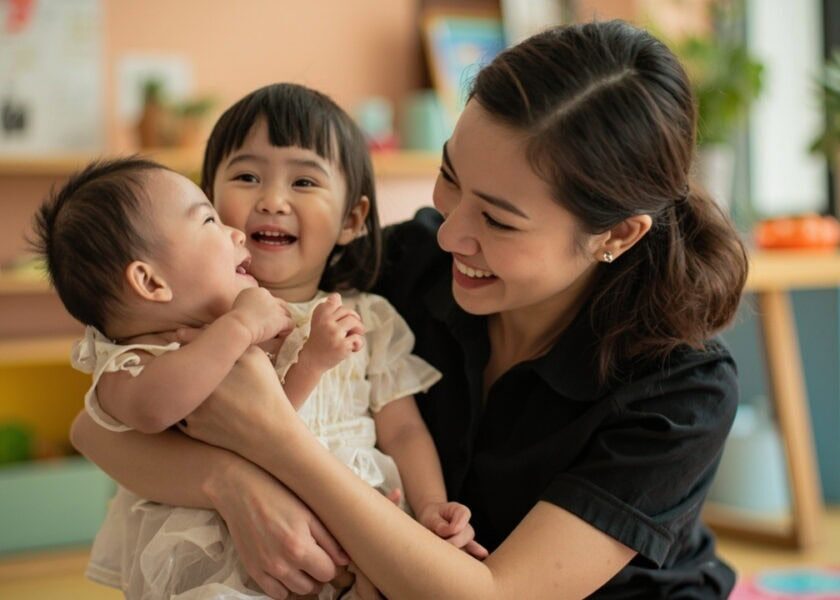
A trained caregiver does not simply welcome your child into a room. They read the child’s body before the child even speaks. They notice the tension in the shoulders, the way a small hand grips a parent’s leg a moment too long, the shift in breathing when the parent moves toward the door.
These are not signs of failure. They are data. And a caregiver who understands early childhood development knows exactly what to do with that data.
The Neuroscience Behind the Goodbye
Here is something that may reframe the way you think about those first moments entirely.
When your child protests at separation — when they cry, when they reach back toward you, when they resist the transition — they are not telling you that something is wrong. They are telling you that something is right. They are telling you that the bond between you is so strong, so securely formed, that they have the developmental capacity to experience the genuine, felt reality of your temporary absence.
This is, paradoxically, evidence of healthy attachment. A child who cannot register your leaving is a child whose early emotional development has been compromised. Your child’s protest is not a flaw in the system. It is a feature of it. It is the sound of a child who has been loved well enough to feel the weight of separation.
The Critical Distinction: Protest vs. Distress
The difference between protest and distress is one of the most important distinctions a parent can understand. It is the difference that separates quality care from care that merely manages behaviour.
When a child is in genuine distress — when the distress is sustained, escalating, and shows no signs of self-regulation — that is meaningful information. It tells a trained caregiver that the child’s nervous system has been pushed past its current capacity, and it requires a specific, skilled response.
But when a child protests and is then gently, consistently held within a supportive environment — when a caregiver responds not with distraction or dismissal but with genuine attunement — something remarkable happens. The child’s nervous system learns that absence does not mean abandonment. That the world can hold them even when their primary attachment figure is not in the room. That they are safe, and that safety is not dependent on a single person but on a reliable, responsive system of care.
This is not sentiment. This is developmental science, and it is happening in those first five minutes after you leave.
What Trained Caregivers Actually Do
So what does a trained caregiver do in those first moments? They do not rush the goodbye. They do not usher the parent out quickly in the name of efficiency, because efficiency in separation is the enemy of security.
They give the child time to process what is happening. They get down to the child’s eye level — not looming, not towering, but meeting them where they are physically and emotionally. They speak in a calm, unhurried voice. They may mirror the child’s emotions, naming what the child is likely feeling:
“I can see you feel worried. Your mummy will come back. I am here with you now.”
This is the practice of responsive caregiving, and it is the foundation on which your child’s internal working model of safety is being built. Every interaction in these early moments is teaching your child something about how the world works. A quality caregiver is teaching your child that they are seen, that their feelings matter, and that the adults around them are trustworthy.
The Invisible Minutes
Your child’s brain is processing a massive amount of new sensory information — faces they have not seen before, sounds, smells, the particular quality of light in an unfamiliar room. Simultaneously, their emotional system is navigating the very real experience of separation from the most important person in their world.
This is why the sensory and emotional landscape of quality childcare is not an afterthought. It is the work itself. The warm colours, the low shelves, the accessible materials, the small group ratios — these are not aesthetic choices. They are developmental ones. They are the architecture of safety for a child in the most vulnerable moments of their day.
What Quality Childcare Actually Looks Like
For Singapore parents evaluating their options, it helps to know what to look for. Quality infant care is not defined by flashy facilities or impressive marketing — it is defined by the small, consistent moments that happen every single day.
- Low caregiver-to-child ratios allow for genuine attention. When one caregiver is responsible for three or fewer infants, each child can be truly seen and responded to.
- Caregivers who slow down rather than rush through transitions. They give children time to process, to be held, to settle.
- Environments designed for the child — low shelves, warm lighting, familiar objects, spaces that feel safe rather than institutional.
- Communication that flows both ways — not just updates from the centre, but genuine dialogue about what parents observe at home and what caregivers observe during the day.
- Transparency about what happens in those first moments. Quality providers want parents to know. They are proud of how they hold children through transition.
What we are describing here is not a transaction. It is the beginning of a developmental relationship that, when done well, shapes your child’s capacity for emotional regulation, for trust, for resilience, for the ability to form healthy attachments throughout their entire life. The first moments after you leave are not filler. They are foundational.
Addressing Your Real Concerns
Every parent who walks through our door carries questions. Here are some of the ones we hear most often.
“What if my child never settles?”
Most children do settle — and the way they settle tells you something important about the care they are receiving. A child who is genuinely distressed for extended periods needs a different response than a child who protests briefly and then engages. Quality caregivers are trained to recognise the difference and to adjust their approach accordingly. If your child is not settling over time, that is a conversation worth having with your provider — not to blame, but to understand and adjust.
“How do I know what’s really happening when I’m not there?”
You ask. You observe. You look for patterns. And you choose a provider who welcomes your questions rather than deflecting them. At EduNanny, we believe that the parent who asks the most questions is not the most difficult parent — they are the most engaged one. We want that engagement. It makes us better at what we do.
“Is it too early to leave my child?”
Every family situation is different, and every child’s readiness is different. What research consistently shows is that quality care — care that is responsive, consistent, and attuned — can be beneficial for children across a wide range of ages, including infants. The key word is quality. The question is not whether to use childcare, but whether the childcare you are considering meets the standards your child deserves.
“What if I just don’t feel ready?”
That feeling is valid. And it may be your instinct telling you that you need more time, or that you need more information, or that you need to find a different arrangement. Trust that instinct. But also know that some anxiety is normal — even when you have found the right place. The goal is not zero worry. The goal is informed trust, where your worry is based on understanding rather than uncertainty.
EduNanny Singapore: Built on Understanding
As a parent, understanding what happens after you leave changes the shape of your worry. You move from wondering whether your child is okay to understanding why they are displaying certain behaviours, and what those behaviours actually mean. You begin to see your child’s protest not as evidence of your failure or the setting’s inadequacy, but as a normal, healthy response to a significant life transition.
This shift — from anxious uncertainty to informed understanding — is profound. It changes the conversation you have with yourself on the drive to work. It changes the way you process the update you receive later that morning. It changes the quality of the trust you have in the people caring for your child, because trust that is built on understanding is far more resilient than trust that is simply hoped for.
Over time, as you receive insight from your child’s caregivers about these moments — as they share what they observed, how your child settled, what helped and what did not — you will notice something else happening. Your own relationship with your child deepens. Because you begin to understand your child not just as the person you know intimately in the evening and on weekends, but as the person they are in your absence. You learn who they are in new contexts. You learn what calms them, what challenges them, what they are capable of when you are not there to lean on.
Our Approach and Standards
EduNanny, under the banner of BUTLER, is part of the ECDA Childminding Pilot, which means our programme is built on a foundation of recognised standards and genuine accountability. We offer both home-based and community or centre-based pathways, because families in Singapore have different needs, different living situations, and different rhythms, and quality care must be flexible enough to meet them.
Our infant ratios are carefully maintained — up to one to three — because we believe that the depth of attention a child receives in these early months is not a luxury but a necessity. Our fee structures are designed to be accessible within the pilot framework, and we actively support families in leveraging CDA and Baby Bonus schemes, because we believe that quality care should not be the exclusive domain of those with significant financial resources.
When you choose EduNanny, you are choosing a programme where communication is not an occasional update but an ongoing commitment. We use measures including transparent reporting and CCTV where deployed, not because we do not trust our caregivers, but because we believe that transparency is the soil in which genuine partnership grows. We want you to know what happens in those first moments after you leave. We want to share with you what we saw, how your child met the day, what they discovered, what they struggled with, and how they were held through it all.
We also believe that modern parenting should be supported by modern tools. Our Thomas AI Chatbot is available to answer your questions, provide guidance, and offer support between visits — because the questions do not only arise during office hours, and a parent navigating the early days of childcare should not have to wait for reassurance. Thomas is not a replacement for human connection. It is an extension of our commitment to being present for the families we serve, whenever and however you need us.
A Final Word on the Threshold
So the next time you stand at that door and your child looks back at you, know this.
What is happening in that moment is not something to fear or to rush through. It is a threshold, and thresholds matter.
Your child is walking into an environment designed to hold them. They are being met by caregivers trained to read them, to respond to them, to teach their nervous system that the world is a safe and predictable place.
And you — by making the choice to walk through that door with them, to stay present for those first moments, to trust the process even when it is hard — are doing something extraordinary. You are teaching your child that transitions are survivable, that love persists across distance, and that the people who care for them are worthy of trust.
We are honoured to walk that threshold with you. At EduNanny Singapore, we see both sides of that door — the parent who leaves and the child who stays. We understand the weight of both. And we are here, every day, to make sure that what happens on the other side of the goodbye is worthy of the trust you have placed in us.
If you are a parent in Singapore exploring infant care or childminding options, we invite you to start a conversation with us. Not because we have all the answers — but because we believe in asking the right questions together. Come and see our environment. Meet our caregivers. Ask us about our ratios, our training, our approach to those first moments, and everything else that matters to you.
This is the work that shapes a generation. And we do not take that lightly.
Ready to explore quality infant care in Singapore? Connect with EduNanny Singapore today and discover what thoughtful, responsive childcare can look like for your family.