Why Your Child’s First Teacher Is Not in Primary 1
The Quiet Anxiety Every Singapore Parent Feels Before Primary 1
There is a moment, somewhere between your child’s third birthday and the morning you walk them to their first Primary 1 classroom, when the weight of the question finally arrives. It rarely announces itself. It comes as a stray thought at bedtime, a comment from another parent at the playground, a flyer handed to you at the mall.
And the thought is this: Are we doing enough?
Are the choices you are making right now — the caregiver you trust, the environment you have placed them in, the way they spend their days while you are at work — are all of these things actually preparing your child for what is coming?
You are not alone in this thought. It lives in the quiet corners of every parent’s mind in Singapore. You look at your four-year-old, laughing at a butterfly, refusing to share a toy, needing help buttoning their shirt, and you try to imagine them sitting in a classroom, navigating a new teacher, managing a full day of structure.
This article is here to sit with that question alongside you. Not to add to your worry, but to do something far more useful: to help you see clearly what school readiness actually means, where it comes from, and why the decisions you make in these early years matter far more than the anxiety you are feeling right now suggests.
What Real School Readiness Actually Looks Like
Most parents in Singapore think about school readiness the way they think about packing for a trip — as something you do in the final weeks, a checklist of things to acquire and practice before departure.
And so they find themselves, in the months before P1, scrambling to enrol their child in readiness classes, drilling them on alphabets and numbers, worrying about whether they can write their name or hold a pencil correctly. These things have their place. But they are the suitcases in the trunk. They are not the engine.
What every experienced teacher, every developmental psychologist, every caregiver who has watched children grow for decades will confirm is this: school readiness is not a curriculum. It is not a set of academic skills. It is a state of being.
It is the difference between a child who walks into Primary 1 and thinks, finally, a new adventure, and a child who walks in already feeling behind, already anxious, already performing for approval rather than learning for joy.
The children who feel ready — who are genuinely ready — are the ones who have spent their early years in environments that understood something profound: that learning begins with trust. A child cannot explore, cannot take intellectual risks, cannot sit with the discomfort of not knowing something unless they feel safe. Not just physically safe, though that matters enormously, but emotionally safe.
The real readiness is built in the first thousand days of care, relationship, and play — not in the final months before school begins.
- School readiness is not a curriculum. It is not alphabets, numbers, or the ability to write their name. It is a state of being.
- Quality care builds what schools cannot teach. Executive function, emotional regulation, the capacity to focus, to delay, to trust adults who are not their parents.
- Your child does not need academic acceleration. They need to feel that the world is interesting, that people are trustworthy, and that they themselves are capable.
- The window is real but it is still open. Every morning drop-off, every evening homecoming, every moment of connection is still writing your child’s story of readiness.
What Quality Care Builds in the First Thousand Days
Not academic acceleration. Not the premature push toward reading and writing that some centres promise and that leaves children exhausted and wary before they have even begun.
What quality care builds is something far more foundational and far more valuable: it builds executive function. It builds emotional regulation. It builds the capacity to focus, to delay, to adapt, to relate to adults who are not their parents as people worthy of trust.
These are the invisible skills that schools do not teach but schools absolutely depend upon.
Walk into any Primary 1 classroom on the first day of school and watch. The children who settle most quickly are not the ones who arrived knowing the most. They are the ones who arrived knowing how to learn — how to listen, how to wait, how to try, how to recover when something is hard.
The Skills That Matter Most in Primary 1
- Self-regulation: The ability to manage impulses, sit still when needed, and calm themselves when upset
- Attention span: Sustaining focus on a single activity for a meaningful period
- Social confidence: Comfort approaching other children, sharing, taking turns, resolving conflicts
- Curiosity: A genuine desire to explore new things rather than fear getting them wrong
- Trust in adults: Confidence that teachers, like caregivers, are people who will help them
How the Brain Changes with Quality Care
A child who has spent their infant and toddler years in a setting where caregivers are present, attentive, and responsive — where they are spoken to, sung to, read to, played with in ways that follow the child’s lead — that child has a different brain than a child who has spent those same years in an environment where needs are met but curiosity is not engaged.
Not different in any stigmatizing way. Different in the way that matters for school:
- More capable of sustained attention
- More flexible in the face of challenge
- More fluent in language
- More socially attuned
These differences compound year after year. By Primary 1, they are not small. They are the difference between a child who finds school stimulating and a child who finds it overwhelming.
The Singapore Paradox: Why Earlier Is Not Always Better
Singapore is a place that takes education seriously. It is one of the things we do well, and it is one of the things that creates enormous pressure. There is a cultural momentum here, a shared assumption that earlier is better, that more is more, that the child who starts reading at four will inevitably outperform the child who starts at five.
And this assumption is not entirely wrong — structured early exposure does matter. But it matters in the way that a good foundation matters for a building. You cannot skip it. But you also cannot substitute it for the walls, the beams, the architecture that makes a building actually function as a home.
The children who are most advantaged in Primary 1 and beyond are not the ones who were drilled on academics before they were ready. They are the ones whose early years were filled with what developmental scientists call serve-and-return interactions — the back-and-forth between caregiver and child where the child’s interest leads and the caregiver responds with warmth, with language, with more to think about.
These are the moments that build neural pathways. These are the moments that create the architecture of a mind that is ready to learn.
The Caregiver-Child Relationship: Your Child’s First Model of School
Here is something that is rarely said plainly: the relationship your child has with their caregiver is their first model of every teacher-student relationship that follows.
When a child trusts their caregiver, when they feel safe enough to be vulnerable, to ask for help, to try something and fail — they are building the emotional architecture that will allow them to trust their Primary 1 teacher in exactly the same way.
A child who has never learned to trust a non-parent adult will walk into school carrying unnecessary weight. A child who has learned, in their earliest years, that adults can be relied upon, that asking for help is safe, that school is a place where people know them — that child has already won half the battle.
This is why the quality of your child’s care relationship in the first five years is not a logistical decision. It is an educational one.
What Quality Childminding Actually Looks Like
So what should you look for? Not the glossy brochures or the impressive-sounding curricula. Look for these signs instead.
Your Child Comes Home Happy
Not just entertained, not just fed and clean, but genuinely happy — the kind of happy that comes from being genuinely seen and valued by the adults in their world.
The Caregiver Knows Your Child as an Individual
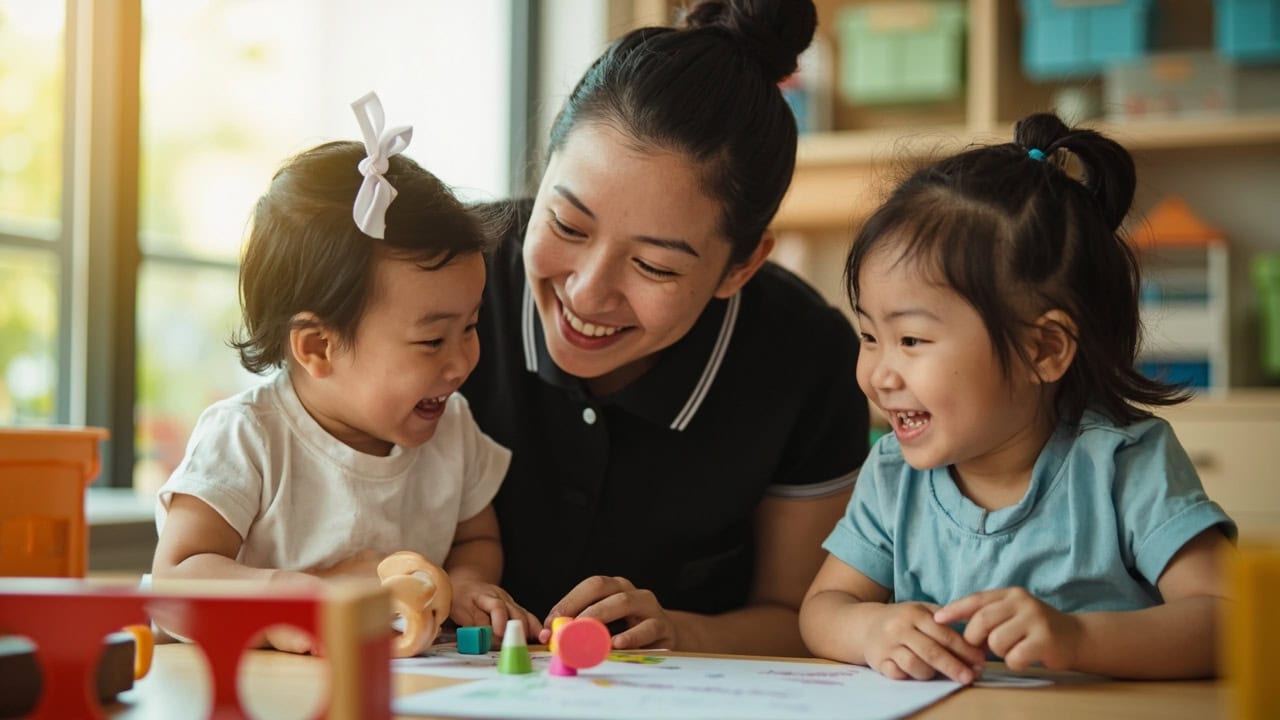
Does she notice things — the way your daughter holds her crayon, the rhyme your son cannot stop singing, the way he struggles when there are too many children making noise? Quality care is not uniform. It is personalised. It is the caregiver who knows your child well enough to adapt, to modulate, to create an environment that fits.
There Is Time for Unstructured Play
Does your child have time and space to play freely? Unstructured play — the kind where children choose their own activities, solve their own social problems, create their own worlds — is not idle time. It is the workshop where executive function is built. The children who are most ready for school are the ones who have learned to direct their own attention, to persist with a task, to negotiate with peers. These skills are not taught. They are practiced, in the generous margins of a day that is not over-scheduled.
Your Child Is Being Prepared for Learning, Not for School
The first is a performance. The second is a transformation. The child who is being prepared for school has been taught to sit still, to raise their hand, to colour inside the lines. These are useful skills. But the child who has been prepared for learning has been given something far more enduring: a love of discovery, a sense of their own competence, an understanding that effort leads to growth, and a trust in the adults around them that makes them believe school is a place worth going.
Academic Preparation vs. Learning Readiness
| Academic Preparation | Learning Readiness |
|---|---|
| Can recite alphabets and numbers | Curious about what words and numbers mean |
| Can sit still for 30 minutes | Understands why sitting still sometimes matters |
| Knows how to raise their hand | Feels safe enough to ask questions out loud |
| Can write their name | Wants to write stories and share ideas |
| Knows colours, shapes, and facts | Is excited to discover new things |
Both matter. But only one creates a child who thrives beyond the first term.
Addressing the Concerns Singapore Parents Actually Have
“Am I a bad parent for using childcare instead of staying home?”
You are not. The research on early childhood development is clear: what matters is not whether your child is in your care or someone else’s. What matters is the quality of the care they receive. A child in a warm, responsive, consistent caregiving environment will thrive. A child in a neglectful or inattentive home will struggle. The variable is quality, not location.
“How do I know if my child’s current arrangement is good enough?”
Ask yourself: Does my child want to go? Not because of toys or other children, but because they feel safe and known there? Does the caregiver speak about my child with specificity and warmth? Does my child seem tired but fulfilled at the end of the day, rather than simply tired? If the answers feel uncertain, that is information. It is not a failure. It is data.
“Is it too late to change arrangements?”
The brain remains remarkably plastic throughout the early years. The habits and relationship patterns your child is forming right now are not impossible to adjust later, but they become harder to shift with each passing year. This is not a cause for panic. It is a cause for clarity. If something is not working, the best time to change is now.
“What if I cannot afford premium childcare?”
Quality care should not be reserved for families with significant financial resources. Singapore offers CDA and Baby Bonus funding for eligible families, and many childcare models — including home-based options — are designed to be accessible within these frameworks. Cost and quality are not always correlated. What matters most is the presence of warm, consistent, responsive relationships.
Questions to Ask When Evaluating Care
- Does my child come home happy? Not just physically healthy. Emotionally thriving. Visible joy.
- Does the caregiver know my child? Not just their schedule and their allergies. Their temperament, their fears, their joys, the particular way their mind works.
- Does my child have space to play? Unstructured, child-led play is not a gap in the curriculum. It is the curriculum.
Red Flags to Watch For
- Caregivers who cannot speak specifically about your child
- An environment that feels rushed or over-scheduled
- A curriculum that prioritises visible outputs over invisible processes like curiosity, persistence, and social confidence
- High staff turnover — consistency is not a nice-to-have, it is a prerequisite
- Dismissal of parental concerns or questions
Green Flags That Signal Quality
- Caregivers who share observations about your child’s development without prompting
- An environment that looks messy, creative, and child-centred
- Staff who have been there for years, not months
- Open communication about how the day went, not just what was eaten
- A clear philosophy that prioritises your child’s wellbeing over parental convenience
Why EduNanny Was Built Around the Caregiver-Child Relationship
Many Singapore families face a genuine challenge. Two working parents, long commutes, the need for reliable, trustworthy care that does not feel like a compromise. The existing options can feel like a spectrum between clinical and convenient — a large centre where your child is one of many, or a home-based arrangement where you hope for the best.
EduNanny by BUTLER was built around a conviction that is both simple and, we believe, transformative: the caregiver-child relationship is the most powerful learning environment that exists.
Our home-based and community-based pathways are designed to offer something that larger settings often cannot: small ratios, consistent caregivers, an environment that feels like an extension of home rather than a departure from it.
When you place your child with EduNanny, you are placing them with caregivers who are trained, supported, and committed to the philosophy that every interaction is a learning opportunity. Not a lesson. Not a worksheet. A conversation, a shared discovery, a moment of connection that builds the foundation for everything that follows.
Our infant ratios — up to one to three, depending on the arrangement — mean that your child’s caregiver is not dividing her attention among six, eight, or ten tiny people all at once. She can listen. She can respond. She can notice when your child is tired, or frustrated, or on the verge of a breakthrough in language or motor development, and she can act on that noticing in real time.
This is not a luxury. This is the mechanism by which early learning happens.
We are part of the ECDA Childminder Pilot, and we have built our model around exactly this belief: that the infant and toddler years are not merely a waiting period before real education begins. They are real education. They are the education that everything else rests upon.
Your Child’s First Teacher
Here is a truth worth holding onto: your child’s first teacher was not the one they will meet in Primary 1.
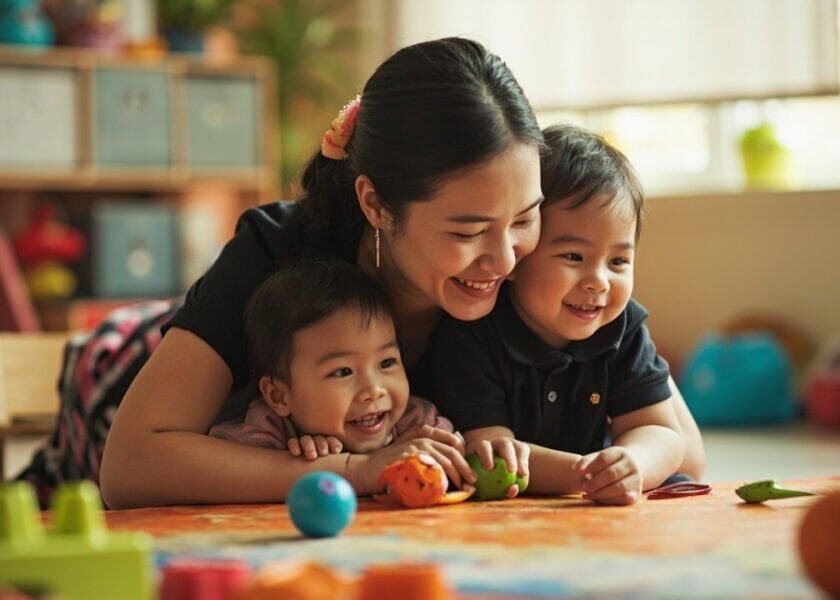
It was the caregiver who held them when they cried. Who mirrored their emotions with calm. Who expanded their language with patient repetition. Who gave them the gift of feeling safe enough to explore.
Every interaction in those early years was a lesson. The question is not whether your child learned. It is what they learned — and whether what they learned was that the world is interesting, that people are trustworthy, and that they themselves are capable.
A confident learner in Primary 1 is not an accident. It is a consequence. Not a product of luck but of love and intention and consistent, quality care.
The anxiety you feel is not a weakness. It is evidence that you care deeply about getting this right. Let that care guide you toward the decisions that last — toward relationships, not just programmes, toward readiness, not just performance, toward the long view that sees your child not as a student to be produced but as a learner to be formed.
The first thousand days of your child’s life are not behind you yet. They are still being written, in every morning drop-off, every evening homecoming, every moment of connection that tells your child: you are known, you are loved, and you are ready for whatever comes next.
That is what school readiness looks like when it is real. That is what we are here to build.
Every child who walks through a school gate for the first time deserves to believe they are ready. That belief is built in the first five years — and it can still be built, one caring interaction at a time.
If you are searching for care that understands it is not a pause between home and school, but a critical chapter of development in its own right, we would welcome the conversation. Whether you are just beginning your search or looking to make a change, we are here to answer your questions honestly, transparently, and without pressure.
Reach out to learn more about our home-based and community-based childminding pathways, our fee structures, and how we support families in accessing available subsidies.
Learn more about the EduNanny approach and why we believe the caregiver-child relationship is the foundation of everything that follows.