Why Your Children’s Sibling Bond Deserves Intentional Care
Why Siblings Need More Than Proximity
When children grow up alongside each other, it is easy to assume that sibling bonds develop naturally. They share a home, a lineage, a daily life. Surely, the argument goes, proximity is enough. They will figure it out. They are family.
But proximity is not the same as holding. Co-presence is not the same as care. And the difference matters enormously for how sibling relationships unfold.
What developmental science and relational wisdom have taught us is this: siblings who are merely raised in the same household often develop what researchers call parallel lives. They coexist. They tolerate each other. They may even love each other in a vague, obligatory way. But they do not necessarily know how to be in relationship with each other.
They have not learned to navigate conflict. They have not learned to repair rupture. They have not learned to celebrate each other’s wins or hold space for each other’s pain. These are skills. And skills require scaffolding.
In Singapore, where many families live in HDB flats with limited space, where both parents often work full-time, and where the demands of modern parenting leave little room for intentional relationship-building between siblings, the gap between co-presence and genuine connection can widen significantly.
The Rivalry You Cannot Quite Solve
Rivalry between siblings is natural. It is not the problem. The problem arises when rivalry is the only register your children have for relating to each other—when every interaction is filtered through scarcity, comparison, and the fear of getting less.
As a parent, you cannot easily solve this. Not because your love is insufficient, but because the demands of parenting two or more children simultaneously create an impossible attentional burden. When one child is melting down and another needs help with a task, you are managing, not holding. When you are dividing your energy across multiple needs at once, you are responding, not scaffolding.
There is no blame in this. It is simply the nature of being a parent to more than one child. But it is precisely why an external holding system—an intentional, trained, professionally attentive environment—can offer what individual parental attention alone cannot.
How Quality Childcare Holds Sibling Bonds
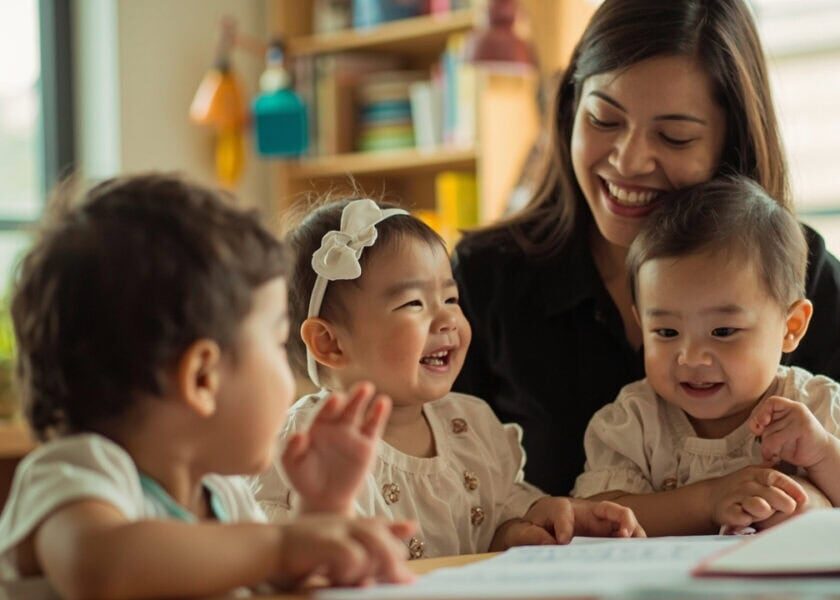
Now consider what happens in a quality childcare environment. Siblings are not just placed in the same room. They are held within a relational system that is intentionally designed to support their development—individually and together.
A trained caregiver observes how siblings interact. She notices when one child consistently defers, when another consistently dominates, when there are moments of genuine connection that need to be gently supported, when there are friction points that require careful intervention. She does not just supervise. She holds.
This is the crucial distinction. Children can be co-present in a room without anyone truly holding the dynamic between them. But when a caregiver understands sibling relationships as a developing system—when she has the training, the attention, and the intentionality to notice and respond to what is happening between two children—something different becomes possible.
The sibling bond has room to deepen. Rivalry has room to transform into partnership. And each child has room to be known not just as an individual, but as part of a whole.
Co-Regulation: The Foundation of Sibling Connection
What does this look like in practice? It starts with something called co-regulation—the ability to calm yourself not through willpower alone, but through connection with another regulated person.
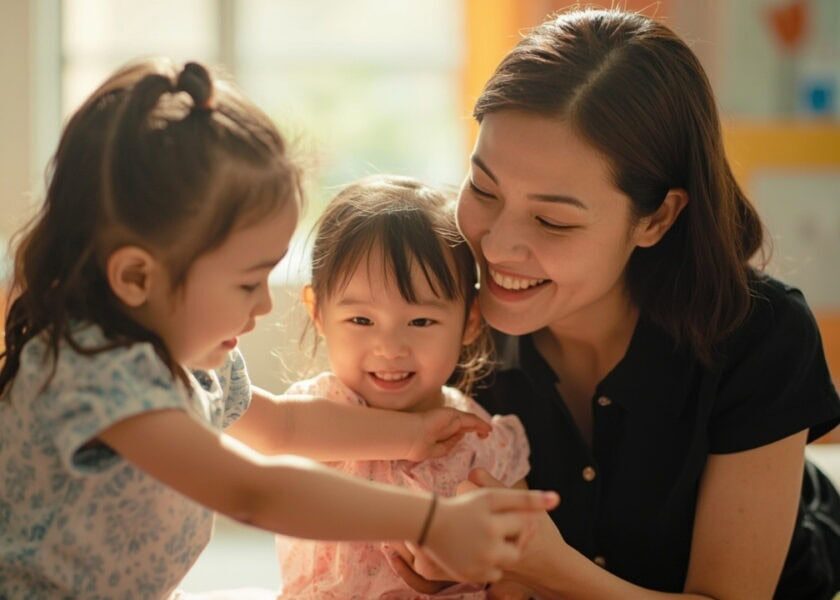
When a caregiver models emotional attunement throughout the day—when she names what a child is feeling, reflects it back, and helps the child find words for their experience—she is building something that siblings then draw upon with each other. The child who has been co-regulated by an attentive adult can offer that same regulation to a sibling who is struggling.
“You seem sad because your block tower fell. Do you want help rebuilding?”
This exchange is not spontaneous. It is cultivated. It is taught by caregivers who narrate feelings, model calm in the face of conflict, and step in at just the right moment to help two children find language for what is happening between them.
What Parents Notice When Siblings Return as Partners
Children who have been held well together in care develop something remarkable: a shared emotional vocabulary. They have words for what they are feeling. They have been heard, named, and mirrored by attentive caregivers, and they have begun to offer the same to each other.
In Singapore homes where Mandarin, Malay, Tamil, or English are spoken—or where multiple languages weave together in daily life—this shared vocabulary becomes a bridge. It is the language of their bond, learned in care and carried home.
Siblings who have been supported in quality care do not avoid disagreement—disagreement is healthy, even necessary, for any relationship to deepen. But they have tools. They can negotiate rather than fight. They can take turns without it feeling like loss. They can express frustration without it becoming rupture.
“I’m not done with this toy yet. Can you play with this one while you wait?”
The other accepts. They have learned this from watching their caregivers hold them, and from being held together in ways that make space for both their individual needs and their shared bond.
Why Professional Caregivers Can Hold What Parents Cannot
The reason siblings can develop these capacities in quality childcare rather than simply co-existing is that trained caregivers do something parents rarely can: they hold sibling dynamics with a kind of equanimity that is simply impossible when you are also the parent.
When you are caring for your own children, your own history, your own emotional triggers, your own fears about fairness and favoritism are always present. You love your children fiercely, but you cannot be neutral about them. You cannot observe their relationship with perfect clarity because you are too deeply embedded in it.
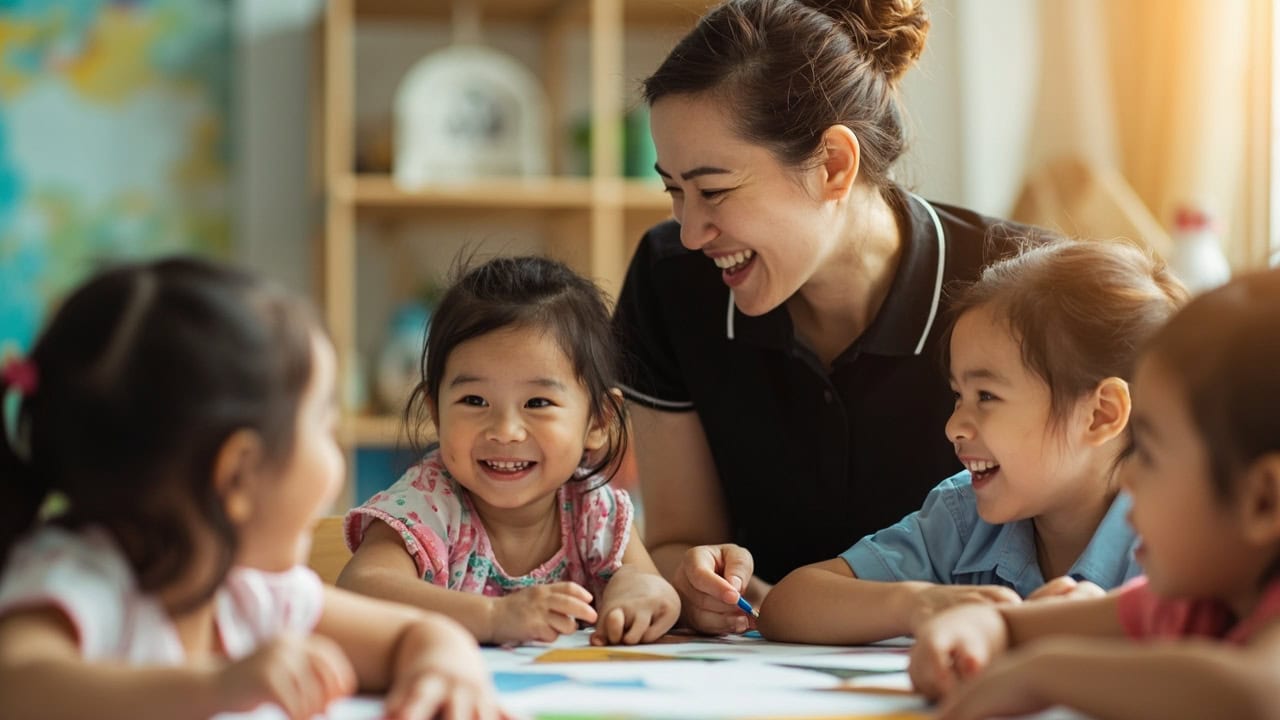
A skilled caregiver, by contrast, can hold the sibling system with professional attentiveness. She can see where one child is struggling and intervene before frustration builds into resentment. She can amplify moments of connection, drawing the children’s attention to what went well, what felt good, what worked. She can help siblings learn to read each other, to anticipate each other’s needs, to experience the pleasure of being known by someone who shares their world.
The Invisible Work of Attunement
What parents often don’t see is the invisible work that happens in quality childcare. The caregiver who notices that the older child is beginning to exclude the younger and gently redirects. The caregiver who spots a moment of tenderness between siblings and makes sure to narrate it aloud: “I saw how you shared that with your brother. That was kind.” The caregiver who helps two children negotiate a conflict before it escalates, modeling the language they will eventually use on their own.
This is holding. And it is only possible when someone has the attention, the training, and the emotional space to provide it.
What to Look For in Childcare for Siblings
For families in Singapore, specific factors shape the sibling childcare decision. Space is limited. Both parents often work. Extended family may not be nearby. The cost of living means that many households require dual incomes.
In this context, the question is not whether you will need support—it is how to find support that genuinely serves your children’s relationship, not just their supervision.
If you are beginning to think about childcare for your siblings, here are some questions worth asking:
- How does this environment observe sibling dynamics? Do caregivers notice what is happening between your children, not just what is happening with each child individually?
- How are conflicts handled? Is there a framework for helping siblings navigate disagreement, or are children simply expected to work it out?
- What is the caregiver-to-child ratio? Can each child truly be seen? Can each sibling pair receive the attention their relationship needs?
- How do caregivers support emotional vocabulary? Do they narrate feelings, model regulation, and help children find language for their experience?
- How will you know what is happening? Is there transparency? Regular communication? A way for you to understand your children’s days?
EduNanny’s Approach: Holding Siblings as Individuals and as a Pair
This is what EduNanny Singapore offers. Not just supervision. Not just care. Holding.
EduNanny by BUTLER operates within the ECDA Childminding Pilot, which means our approach is grounded in recognized standards and our caregivers are trained with intention. We understand that siblings are not two children who happen to share a home—they are a relational system that requires the same intentional support we give to individual children.
How We Hold Siblings Differently
Our caregivers are trained to observe sibling dynamics with the same attention they give to individual development. They notice patterns. They support connection. They intervene thoughtfully when friction arises, helping children build the skills they need to navigate their relationship.
We offer home-based care for families who want the warmth and familiarity of their own environment—a particularly meaningful option for siblings who may feel unsettled in unfamiliar settings. We also offer centre-based pathways for families who find that structure serves them well.
Our ratios are designed to ensure that each child is truly seen. For infants, we maintain ratios of up to one caregiver to three children, which means every child receives the attentiveness they need, and every sibling pair receives the holding their relationship requires.
Accessible to Singapore Families
We know that affordability matters. That is why our pilot fee structures are designed to be accessible, and why we make it straightforward to use CDA funds and Baby Bonus payments for childcare arrangements.
We know that trust is everything. That is why we maintain open communication with every family we serve, implement measures that give parents visibility into their children’s days, and build our relationships on honesty about what we do and what we cannot do.
We are not a black box. We are a partner.
Addressing the Concerns You’re Carrying
You may have questions. Perhaps you feel guilty even considering childcare for your children—worried that it means you are failing them. Perhaps you are concerned about how your children will adjust, or whether a caregiver can truly understand your family’s unique dynamics. Perhaps you are simply uncertain whether quality childcare is worth the investment.
These concerns are valid. And we want to address them honestly.
“Isn’t this just about guilt? Am I failing my children by needing help?”
No. The sibling bond requires more than love to flourish. It requires holding. And sometimes, holding means bringing in support that has the training, the attention, and the professional capacity to give your children’s relationship what you, in the midst of everything else, may not always be able to give.
Seeking quality care for your children is not a failure. It is a recognition of what siblings actually need to thrive together.
“How do I know my children will be held as individuals, not just as ‘the siblings’?”
Quality care holds each child as an individual and as part of a pair. Your older child needs space to be known for who they are—independent of their role as “the big brother” or “the big sister.” Your younger child needs to be seen for their own personality, their own needs, their own emerging self. At the same time, their relationship as siblings needs its own scaffolding, its own intentional support.
This is what we provide: individual attunement and relational holding, in balance.
“What if my children resist? What if they don’t adjust well?”
Adjustment takes time, and every child is different. A quality childcare arrangement includes support for this transition—for you and for your children. We work with families to ensure that the shift is gradual, warm, and responsive to each child’s pace.
Your Instinct Is Right
Beyond the details and the structures, beyond the logistics and the frameworks, here is what is truly at stake:
The sibling relationship is one of the longest relationships your children will ever have. It will outlast their childhood. It will outlast their teenage years, their young adulthood, their first jobs and first homes and first families of their own.
The sibling bond is the one relationship in most people’s lives that has no beginning and no end—no wedding, no divorce, no friendship that requires maintenance. It simply is. It is there at the beginning, when you bring your children home and place them in each other’s arms for the first time. And it will be there at the end, long after you are gone, when they are the only ones who share your history.
When you choose quality childcare for your siblings—when you choose an environment that holds them as individuals and as a pair, that scaffolds their bond with intention and care, that offers them the co-regulation support and shared emotional vocabulary they cannot develop through passive proximity alone—you are making an investment in that future relationship.
You are building infrastructure for their partnership. You are saying, through your choices rather than your words: This matters. You matter to each other. And I am going to do everything I can to help you build that.
You came into this article carrying questions. Perhaps you are already navigating the tension of divided attention, watching your children struggle to share you, wondering if there is a better way. Perhaps you are expecting a second child and already dreading the logistics, the guilt, the impossible arithmetic of love across two.
Here is what we want you to know: your instinct to worry about fairness, about attention, about whether each of your children is being seen—this instinct is not a weakness. It is evidence that you understand what is at stake. It is evidence that you care about your children’s relationship, not just their individual wellbeing, but the bond between them that will shape so much of their lives.
That care is exactly why the sibling bond can flourish. Because you are paying attention. Because you are willing to consider what your children actually need, even when it requires something more than you alone can provide.
EduNanny Singapore is here to provide that something more. Not as a replacement for your love, but as a complement to it. Holding your children together, so that they may hold each other for the rest of their lives.
If you are ready to explore what quality childminding can offer your siblings, we invite you to learn more about our approach. We welcome the conversation, and we are here to answer your questions with honesty and care.
At EduNanny Singapore, we believe every sibling bond deserves the chance to flourish. Learn about our team and our approach to childminding, or reach out to speak with us about your family’s needs.