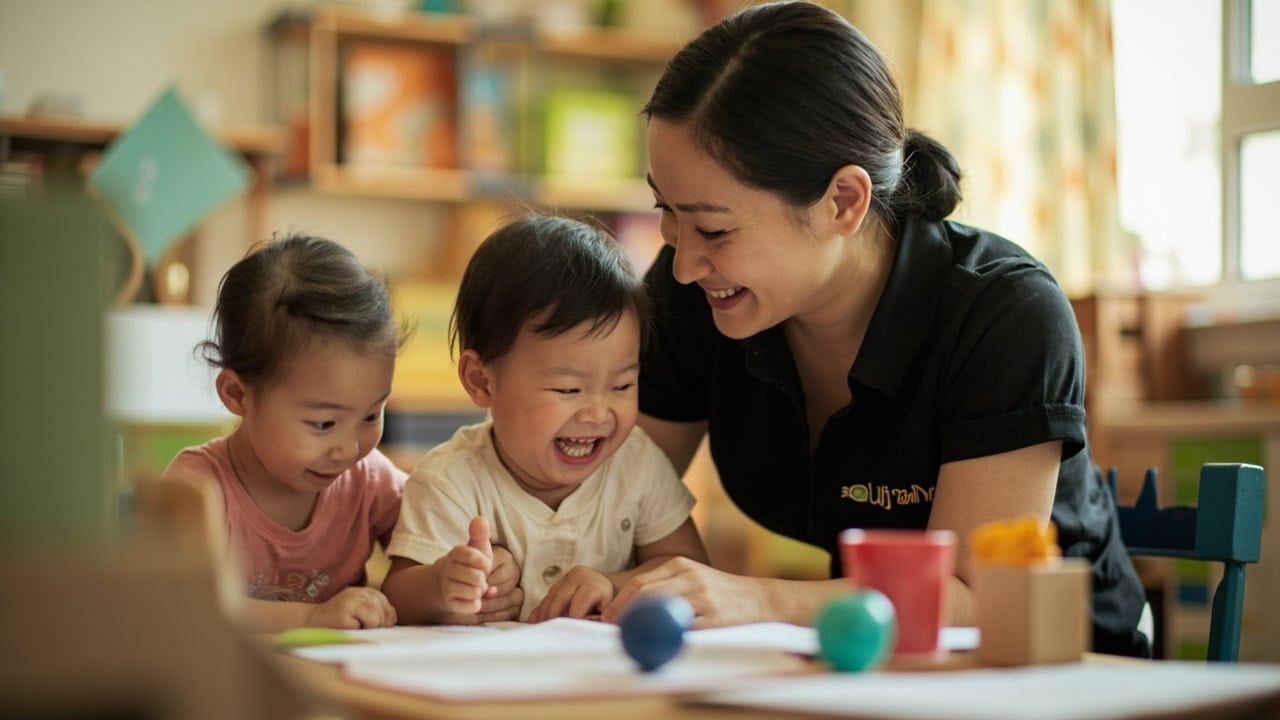
Why Your Childcare Provider Should Feel Like Your Partner in Parenting
What Partnership Really Means
When we speak about childcare, we tend to frame it in the language of transactions. We choose a provider. We evaluate quality. We compare curricula, ratios, and facilities. We make a decision, sign an agreement, and expect that our responsibilities have been fulfilled.
There is nothing wrong with this framework. It is sensible and responsible — the way we navigate so many decisions as parents in a world that asks us to be informed consumers.
But this framework, while necessary, is incomplete.
The people who spend their days caring for our youngest children — the ones who notice the way your toddler’s brow furrows before a tantrum, who learn the precise sound that means your baby needs to be held differently, who see your child in the hours when you cannot be there — they already know this. They have been living inside this tension every single day.
The Architecture of Early Development
The caregivers who have stayed in this work for years — who bring to it not just skill but vocation — will tell you that the children who thrive are not simply those in the highest quality facilities or the most elaborate programmes. They are the children who are held in a web of consistent, attuned attention, from their parents and from their caregivers, working together as a single ecosystem of care.
In those critical early years, children are building the architecture of everything that comes after: neural pathways, stress response systems, the capacity for relationships, the willingness to explore, the foundation of trust upon which all other trust will be built. And the single most important variable in the quality of that architecture is not the toys or the curriculum. It is the presence of stable, responsive, emotionally available relationships.
When a caregiver and a parent are truly partnered — when they share not just information about the child’s day but a genuine understanding of who that child is, what that child needs, how that child moves through the world — something extraordinary becomes possible. The child has not one anchor but two. The child senses, even before they have words for it, that the adults in their life are connected, that they communicate, that they care about the same things.
This consistency of relational presence is not a luxury. For children in those critical early years, it is the soil in which everything else grows.
What Caregivers See (And What Parents Can Learn)
A seasoned caregiver will tell you that every child communicates far more than they are given credit for. The way a toddler arranges toys before playing with them speaks to a need for order that may also show up at home in ways you have not yet connected. The specific songs that calm a particular child. The particular way a caregiver must hold a baby to ease their reflux. The foods a child will eat only if they are cut in a certain shape.
These are not trivial details. They are the texture of your child’s individuality — the particular fingerprint of their needs and preferences that only becomes visible through sustained, attentive observation.
The Rhythms That Matter
Caregivers notice when a child’s play becomes repetitive in a way that suggests they are processing something — a transition, a household stress, a new word that has captured their imagination. They notice when a child who typically runs to greet them at drop-off instead clings, and they begin to wonder not as a clinician would but as someone who loves a child would wonder: What is this child carrying today?
What parents can learn from this kind of noticing is not a technique to replicate at home. It is a posture — a way of slowing down and truly looking.
When you pick up your child in the evening and ask how their day was, you are asking a question that deserves more than the shrug or the silence you might receive. Ask instead: What did you play this morning? Who did you play with? What made you laugh? These questions open a door into the world they have been living while you have been away, and the answers — if you listen with attention — will tell you more than any daily report can capture.
This is what the best caregivers wish parents understood: that they are not just watching your child. They are learning your child. And if you give them the chance, they can become one of the most valuable allies you have in understanding who your child is becoming.
Questions Worth Asking
Consider asking your caregiver:
- What is my child really like in the mornings before I arrive?
- What makes them laugh during the day?
- What are they working on right now — a skill, a concept, a way of being in relationship?
- What have you noticed about how they handle frustration? Transition? Separation?
- Are there moments when they seem uncertain or overwhelmed? What has helped?
These questions signal something important. They signal that you see your caregiver as a person who knows your child, who has valuable knowledge about your child, whose perspective you value.
Building Bidirectional Trust
Parents are vulnerable. They are entrusting the most precious thing in their lives to someone they may have known for only a few hours before the first day of care. It is entirely natural and entirely reasonable that parents hold their caregivers to high standards, ask questions, and maintain appropriate oversight.
But what happens when the posture of evaluation becomes the entire relationship? When parents approach caregivers solely as employees to be managed, the dynamic shifts in ways that are subtle but real.
The Cost of Feeling Watched
Caregivers who feel watched rather than trusted, who sense that their expertise is not welcomed, who are given instructions without context or feedback without warmth — they do not leave. Many of them stay because they love the children. But something in them withdraws.
The discretionary care. The going-above-and-beyond. The moments of genuine attunement that require a caregiver to feel safe and valued. These begin to diminish.
What caregivers need is not blind trust. No responsible caregiver would ask for that, and no thoughtful parent should give it. What caregivers need is something more nuanced: the experience of being known as a professional, respected for their training and their judgment, included as a participant in the child’s life rather than an external contractor.
They need to feel that when they share an observation — that your child seems to be struggling with a transition, that your baby has been pulling at their ear, that your toddler has been asking about a new baby in their class — this observation will be received with curiosity, not defensiveness.
They need parents to understand that their eyes on your child are not surveillance. They are an additional pair of eyes, and in those early years, when a child’s needs are so fluid and so urgent, every additional pair of attentive eyes matters.
Warning Signs
A partnership is not forming when communication is one-directional — when you receive updates but are never asked about your child, when you are informed but never consulted.
A partnership is not forming when your caregiver seems to view your child primarily as a schedule to be managed rather than a person to be known.
A partnership is not forming when you sense that your caregiver is doing the minimum, meeting the requirements but not bringing themselves to the work.
And here is a subtler warning sign, one that is harder to name but important to feel: a partnership is not forming when you do not sense that your caregiver genuinely likes your child. This is not about enthusiasm or performance. It is about presence — about whether the person caring for your child in those early, formative hours is doing so with attention, with care, with the particular kind of care that comes from actually seeing who this small person is. You will know it when you see it.
What Children Show Us
When a child is in a partnership-based care relationship rather than a merely transactional one, they show it.
They are calmer at drop-off — not because they have been trained to be calm but because they have internalized that leaving you is not abandonment, that you will return, that the world is reliable.
They are more exploratory in their play, more willing to push boundaries and test limits, because they have a secure base from which to venture.
They are more flexible with caregivers, more able to accept comfort from others, because they have not had to choose between attachment to their parent and attachment to their caregiver. They have been allowed to have both, and those attachments have been allowed to complement rather than compete.
Not a Diminishment — An Expansion
Parents sometimes worry that early care will diminish their role, that a child who bonds with a caregiver is somehow bonding less with them. The research consistently tells a different story.
Children with secure attachments to multiple caregivers — when those caregivers are consistent, attuned, and aligned with the parents — do not suffer from an abundance of love and attention. They benefit from it. They learn that relationships can be trusted, that adults can be reliable, that the world contains more than one safe person.
This is not a diminishment of the parent’s role. It is an expansion of the child’s.
Recognizing Quality Partnership in Practice
If you are evaluating childcare arrangements in Singapore, here is a framework for recognizing what quality partnership actually looks like — whether you are considering a centre, a home-based arrangement, or a service like EduNanny.
| Transactional Care | Partnership-Based Care |
|---|---|
| Communication is one-directional: reports sent home, instructions received | Communication flows both ways: observations shared, questions welcomed |
| Caregiver follows a schedule; child adapts to the routine | Caregiver learns the child’s rhythms; routines are shaped around the child |
| Feedback is formal: quarterly reviews, scheduled meetings | Feedback is organic: daily touchpoints, casual observations at drop-off and pickup |
| Parent is a client; caregiver is a service provider | Parent and caregiver are both invested in the same child |
| Quality is measured by facilities, ratios, curriculum | Quality is measured by attunement, consistency, and mutual trust |
The Questions That Reveal Everything
When you visit a potential caregiver or centre, pay attention to whether the questions flow in both directions. A caregiver who asks about your child’s temperament, your family’s routines, what works at home, and what you are noticing — this caregiver is approaching the relationship as a partnership.
A caregiver who only collects enrollment forms and explains their policies may be running an excellent service, but they may not be offering what we are describing here.
EduNanny’s Approach: Partnership as Structure, Not Slogan
EduNanny was founded on a simple conviction: that the relationship between parent and caregiver should never have to be a matter of luck. That every family in Singapore, not only those with extensive networks or generous resources, deserves access to caregivers who are not merely competent but truly called to this work.
This is why EduNanny participates in the ECDA Childminding Pilot, why the model has been built around a maximum infant ratio of one to three, and why families can choose between home-based and centre-based pathways. These are not arbitrary standards. They are the structural conditions that make partnership possible.
A caregiver responsible for too many children cannot truly know any of them. A family navigating multiple transitions and rotating staff cannot build the consistency that children need. We have made choices — in how we have designed this service — that prioritize depth over scale, relationship over efficiency.
Trust Requires Transparency
We know that trust requires transparency. When families use CDA and Baby Bonus to access care through our pilot, they are not just accessing a service. They are entering into a framework of accountability and communication — daily updates, regular touchpoints, and in many locations, visible measures like CCTV that we do not see as surveillance but as mutual protection.
We want parents to feel that they can trust what they cannot see. And we work to ensure that what they cannot see is worthy of their trust.
Selection and Development
Our caregivers are selected not only for their qualifications but for their orientation to this work — for the quality of attention they bring, for their capacity to observe and adapt, for the humility to see themselves as partners rather than experts standing above the family.
We train them not just in protocols but in the philosophy that animates this work: that every child deserves to be known, that every parent deserves to be heard, that the relationship between them and the family in their care is not a contract to be fulfilled but a living thing to be tended.
What we offer is not a facility. Not a curriculum. A partnership, embedded within a structure designed to support it.
A Call to Parents: This Work Matters More Than Anything Else
You are raising a human being. In these years that feel so demanding and so fast, you are doing work that no one else can do — work that will echo across a lifetime you cannot yet see.
The caregivers who walk alongside you in this season are not replacing you. They are standing beside you, holding part of what you are building, watching over something that you made and that the world will receive when you have finished your work of shaping it.
That is not a small thing. It is an enormous thing. And it deserves to be treated as such — not as a transaction, not as a service delivery, but as the sacred trust that it is.
Your Next Step
Ask the questions. Build the relationship. Trust your instincts about whether the person caring for your child is truly present, truly invested, truly partnering with you in the raising of this small person.
And if you find a caregiver who meets those criteria — who brings genuine attention and care and humility to the work — hold onto that. Nurture it. Communicate. Show up. Let them know that what they are doing matters, because it does.
The children who grow up held in a web of consistent, attuned, collaborative care are not just better prepared for school or more developmentally advanced. They carry something deeper than that. They carry a felt sense — a sense they cannot articulate but will live from — that they are known, that they are held, that the adults in their world are paying attention, are working together, are not going to let them fall.
That is what partnership makes possible. That is what we are all working toward. And that is why this work — this quiet, essential, often invisible work of caring for the youngest among us — matters more than anything else we will ever do.
Ready to explore what partnership-based infant care looks like? Begin a conversation with EduNanny — we would be glad to hear from you.
EduNanny is a Singapore childcare and childminding service built on the belief that every family deserves access to thoughtful, development-oriented care. Learn more about our approach or explore our services.