Why Your Child Needs More Than One Secure Base
The Fear Deserves an Honest Answer
I want to talk to you about that fear today. Not to take it from you — because it is not mine to take, and because it does not deserve to be dismissed. It deserves to be met. It deserves an honest answer.
Because what you are feeling in that moment is not a sign that you have made the wrong choice. It is a sign that something is working. Once you understand what is actually happening inside your child’s heart and mind during those months and years of sustained care, you will see that moment at the door very differently.
The decision to place your infant in someone else’s care — even temporarily, even with the most trusted person you could find — is one of the most emotionally complex decisions a parent in Singapore can make. You are navigating housing pressures and dual-income realities. You are managing the logistics of an island city that moves fast, where infant care centres fill up before you have finished your maternity leave, and where the pressure to get it right begins before you have even had time to get it wrong.
You love your child fiercely, and you want what is best, and you also need to work. These two truths sit inside you at the same moment, and they do not resolve neatly. That tension is real. I am not here to talk you out of it. I am here to show you something that sits underneath it — something that changes what that moment at the door actually means.
What Attachment Science Tells Us About Multiple Bonds
Here is what the research tells us — and I want to be careful here, because I am not interested in weaponizing science to make you feel better. I am interested in telling you the truth.
The truth is that attachment is not a finite resource. It is not a pie that gets smaller every time someone else loves your child. A child’s capacity for secure attachment does not deplete — it expands.
When a child forms a deep, consistent, attuned bond with a caregiver over months and years, that child is not taking love away from you. That child is learning how to love. More fully. More confidently. More durably.
This is one of the most counterintuitive and most important ideas in early childhood development, and it is still, remarkably, almost never spoken about in the way parents in Singapore actually need to hear it.
We talk constantly about the first days — the settling in, the separation anxiety, the guilt, the trust-building. Those are real. They matter. But the conversation often stops there, right at the moment when the most interesting and most reassuring part of the story is just beginning.
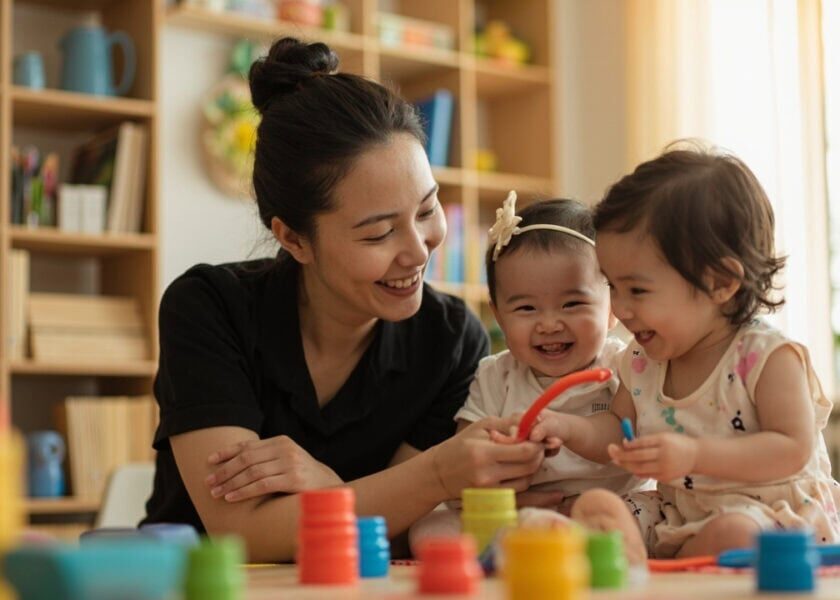
Here is what happens when attunement continues. When the same caregiver is there not just on the first Monday, but on the hundredth Monday. When she learns the particular sound your child makes just before a meltdown, and she meets it before the storm arrives. When she remembers that your child processes new textures with caution and designs an afternoon around that knowledge without being asked. When she has been present through enough ordinary Tuesdays that she can read your child’s mood the way you do — not because she is replacing you, but because she has earned the fluency that only sustained presence provides.
That kind of sustained attunement builds something extraordinary inside a child. It builds what developmental psychologists call a secondary secure base.
You are your child’s first and primary secure base — the person to whom your child will always return, the foundation upon which everything else is built. But a child who has experienced one secure base and then meets another, over time, in the context of consistent and respectful care, does not choose between them. That child carries both inside.
That child walks into preschool with something richer than a single blueprint for relationship. That child has seen, lived, and internalized the experience that connection is reliable. That people can be trusted. That when they reach for someone, that someone will reach back.
Why Consistency Is the Differentiator
Think about what this means in practice. A child who has been in sustained attuned care does not panic when a new child enters the play space, because she has learned that new people are not threats. She watches the caregiver’s response and reads safety from it. She regulates her own alarm through the caregiver’s calm, and over time, she internalizes that calm as her own.
A child who has been with the same caregiver for a year walks into her first preschool session with a quiet confidence that says, without words: I know how to be in relationship. I have done this before. I know how to trust someone who is not my mother and still feel safe.
That is not a small thing. That is everything.
Because the question that keeps many Singapore parents awake at night is not really about the caregiver at all. It is about the future. It is: Will my child be able to trust people? Will my child be able to manage big feelings? Will my child walk into a classroom and feel like they belong? Will my child form friendships with the same openness and security they feel with me?
The answer to those questions is not found in the first week. It is found in the years.
In most centre-based infant care settings, a structural reality exists that rarely gets discussed openly: caregiver turnover. When the person caring for your infant changes every few months, the relational architecture I have been describing cannot be built. The secondary secure base cannot form. The child expends emotional energy on adaptation rather than development.
You cannot build relational capacity in a child through a rotating cast of caregivers. You cannot develop emotional regulation through a checklist. You cannot create the conditions for a secondary secure base if the caregiver changes before the relationship has had time to deepen.
This is not a criticism of centre-based care as a category. It is an observation about a structural constraint that affects many Singapore families — and that informed parents deserve to understand when they are making one of the most consequential decisions of their child’s early years.
What Quality Childminding Looks Like in Practice
Quality childminding is not about supervision. It is not about safety, though safety is the baseline that no one should compromise on. It is not even about stimulation, though age-appropriate activities matter.
Quality childminding is about relationship. Sustained, attuned, consistent relationship. And this is not a soft ideal. It is a structural demand.
Here is what it looks like in the everyday:
- The caregiver notices the shift in a child’s mood before the child themselves knows something is wrong — and gently intervenes
- The caregiver remembers that your child needs a few extra minutes to warm up to unfamiliar visitors, and protects that need without apology
- The caregiver tracks your child’s developmental milestones not because it is on a checklist, but because she has been present long enough to notice the subtle progressions
- The caregiver communicates honestly with you about the day — not just the feedings and naps, but the moments of connection, the small triumphs, the challenging moments that revealed something important about who your child is becoming
This is what developmental continuity looks like. It is not simply that the caregiver shows up. It is that the relationship shows up. Again and again, over months, through ordinary afternoons and challenging ones, through growth spurts and developmental leaps and the times when a toddler’s world feels impossibly large and frightening.
How EduNanny Approaches Care Differently
EduNanny by BUTLER was built on a conviction that has been absent from too much of the infant care conversation in Singapore: that what children need most is not just supervision, not just safety, not just stimulation. They need relationship. And relationship cannot be built at scale.
Through the ECDA Childminding Pilot, EduNanny operates home-based care with ratios of up to one caregiver to three infants. One to three. Let that number settle.
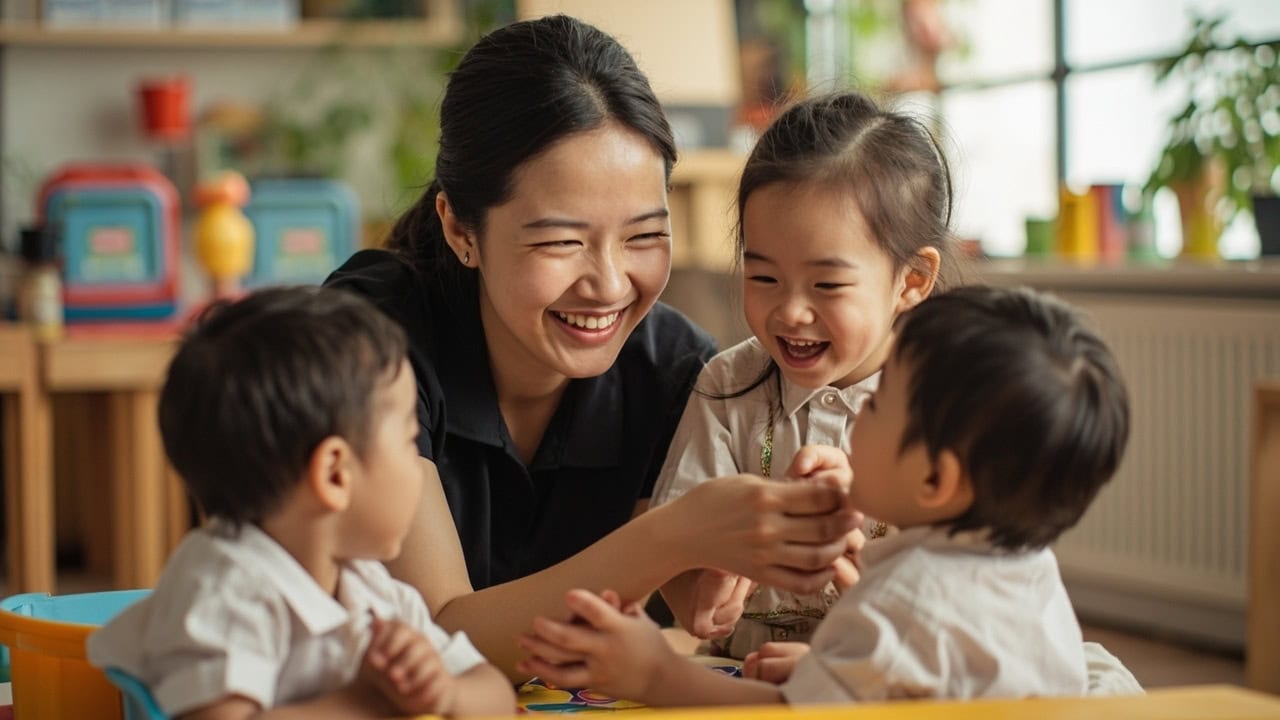
In that ratio, a caregiver is not managing. She is noticing. She is present to the full emotional and developmental landscape of each child in her care. She has the bandwidth to respond with attunement rather than reaction. She has the time to build what cannot be rushed — the deep, patient, earned trust of a child who knows, in the cells of their body, that this person will be here tomorrow and the day after and the day after that.
The care is home-based, which means your child is not navigating a large centre environment with high turnover and unfamiliar faces each term. It means consistency. It means home. It means a caregiver who is not just doing a job but building a relationship in a setting that feels, for a young child, like an extension of the world they know.
For families navigating the practical terrain of Singapore parenting, EduNanny also integrates with existing support structures. CDA funds and Baby Bonus can be used, which means the financial architecture of caring for your child is not something you have to reinvent. Monday to Friday care blocks are structured to align with the rhythms of working parents. In homes where CCTV is deployed, parents have the visibility that brings peace of mind without the anxiety of wondering.
Questions Parents Ask — and the Honest Answers
“Will my child forget me?”
No. Your child’s primary attachment to you is not fragile. It is robust. A child who knows how to attach securely to one person and then another is a child whose primary attachment is strong, not compromised. A child who feels genuinely held by the caregiver walks into your arms at the end of the day with a deeper capacity for presence, not a shallower one.
“Am I being selfish by returning to work?”
You are making a choice that is common to most families in Singapore, and you are making it with your child’s welfare in mind. What research consistently shows is that what matters most for development is not the quantity of hours you spend with your child, but the quality of care your child receives in your absence. Consistent, attuned, professional care in your absence is not a compromise. It is an investment.
“How do I know if the caregiver is really good?”
Look for signs of relational depth rather than activity variety. Ask yourself: Does my child show signs of recognizing this caregiver? Does the caregiver know things about my child that go beyond the basics — temperament patterns, preferences, subtle emotional cues? Does the caregiver communicate about the relationship, not just the routine? These are the markers of attunement that cannot be faked in the short term but that become unmistakable over months.
“Is home-based care as safe as a centre?”
EduNanny caregivers are trained, supported, and accountable through the ECDA Childminding Pilot framework. Home-based care with low ratios allows for closer observation of each child, and transparency measures such as CCTV in deployed homes give parents direct visibility into daily life.
The Long Game: What Your Child Carries Forward
The caregiver who has been there through the long arc is the caregiver who has built something that cannot be built in weeks. She has built your child’s relational architecture — the internal scaffolding that will support how that child enters a classroom, makes a friend, handles a disappointment, reaches out for help.
You came into your child’s life as the first architecture of their inner world. Every smile you returned, every cry you answered, every moment you showed your infant that they were seen — that was the foundation. And it will hold. It will always hold.
But the world your child lives in is not only the world you share together. It is also the world outside your door, where they will spend their days, where they will learn to be human in relationship with others.
And the question is not whether that world will touch your child. It will. The question is what that world will teach them.
EduNanny’s answer is: the same thing you are already teaching them. That people can be trusted. That connection is safe. That when they reach, someone will reach back.
The caregiver who stays, who shows up, who attunes, who builds over months and years — she is not a stranger who learned your child’s name. She is a person your child will carry forward into everything that comes next. Not as a substitute for you. But as proof, lived experience, that the kind of love you gave your child is not unique to you. That it exists in the world. And that your child now knows how to find it.
Years from now, when your child navigates friendships and partnerships and the full complex landscape of human relationship, they will carry forward the experience that began in those early years: that connection is reliable. That people can be trusted. That when they reach, someone will reach back.
That is not a small inheritance. That is the foundation of a life.
This is the long game. Not the first week, not the first month, not even the first year in isolation — but the accumulation of days, the repetition of attuned response, the quiet accumulation of trust that becomes the internal working model your child uses for every relationship they will ever have.
That is not a loss. That is the whole point.
Ready to Explore Sustained, Attuned Care?
EduNanny is here for the years. For the ones that come after the first hello, after the settling, after the fears have settled into understanding. We are here for the child who has been with us for two years and walks in without hesitation. We are here for the parent who, somewhere in that second year, stops checking the camera every afternoon and instead trusts — trusts the caregiver, trusts the relationship, trusts the process.
We are here for the family that comes to see that the caregiver was never a rival for their child’s heart. She was the second pair of arms the child needed to grow wings.
If you are a parent in Singapore exploring infant care options and want to understand what sustained, attuned childminding looks like in practice, we invite you to have a conversation with us. Not a sales call. A real conversation about what you are looking for, what your child needs, and whether the long game of care is the right fit for your family.
You can also learn more about EduNanny and our approach to home-based childminding through the ECDA Childminding Pilot — or explore our full range of services to see how we support working parents across Singapore.