Why Working Parents Can Trust Their Child Is Safe
The Question Every Working Parent Carries
There is a silence that lives in the hearts of working parents in Singapore. It is not the silence of indifference. It is the silence of a question that feels too painful to ask out loud.
What happens to my child when I am not there?
More specifically, the question beneath the question: Will my child still know that they are mine? Will they still feel secure in my love when the hours we are apart begin to outnumber the hours we are together?
You are not wrong for asking this. You are not being overprotective. You are being a parent. And this conversation is for you.
What the Research Actually Tells Us
If you are short on time, here is what developmental science consistently shows:
- Attachment is not a fixed quantity. It does not deplete in your absence. It grows through the quality of responsiveness.
- Secondary caregivers can reinforce—not replace—your bond. When a trained, attentive caregiver consistently meets your child’s emotional needs, they build on the same internal working model you are creating.
- Quality matters more than hours. A child in six hours of attentive, attuned care develops more securely than a child in twelve hours with a distracted or emotionally unavailable caregiver.
- The evening reunion tells you everything. When your child runs to you with openness and joy, that is evidence that daytime care is working with your bond, not against it.
- Choosing quality childcare is not leaving your child. It is building a village that reinforces what you already give them.
We will walk through each of these points in depth, because the fear you carry deserves a real answer—not a comfortable deflection.
The Science of Attachment in the First Thousand Days
In the first three years of your child’s life, their brain is building what psychologists call an internal working model. Think of this as a blueprint—a set of foundational beliefs your child develops about how the world responds to their needs.
When a caregiver consistently notices distress, responds with warmth, and returns the child to a state of calm, your child builds three deep, lasting beliefs:
- I am worthy of care.
- Other people can be trusted.
- The world is a safe place to be.
This is what you are giving your child every time you pick them up when they cry. Every time you come when they call. Every time you show up, again and again, in ways that are predictable and kind.
These beliefs do not form in a single moment. They are built through hundreds—thousands—of small interactions over time.
Here is the truth that most childcare marketing will not tell you: this internal working model does not only form in your presence. It forms in the presence of any consistent, responsive caregiver who behaves in these same ways.
This is not a marginal finding. Secondary attachment figures play a documented role in healthy emotional development. When your child forms a secure bond with a trained, attentive caregiver, that caregiver is not replacing you. They are reinforcing the same internal working model you are building.
The key word is consistent. Research tells us that consistency in the quality of caregiving matters far more than the number of hours spent together.
What Quality Childminding Actually Looks Like
Let us move from philosophy to practice. What does responsive caregiving actually look like in daily life?
Noticing
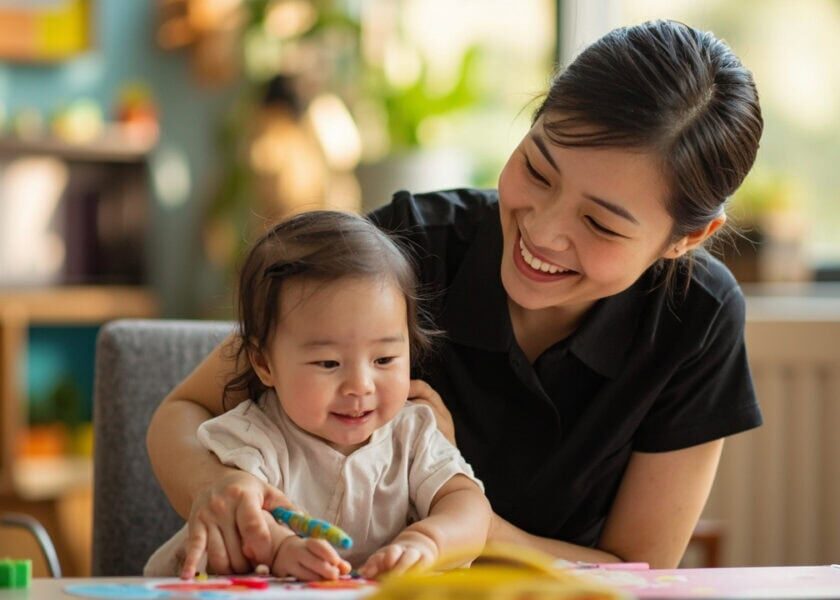
A trained caregiver watches for the subtle cues that indicate your child is hungry, tired, overstimulated, or seeking connection. The slight furrow of the brow before a cry. The reaching arms that mean more than just wanting to be held. The moment a child’s play shifts from engaged to frustrated.
In Singapore’s fast-paced environment, where parents often work long hours, this quality of noticing is not a luxury. It is the foundation on which everything else is built.
Attunement
Attunement means the caregiver is not simply watching your child. They are reading your child. They are learning the specific language of this particular child, because every child expresses need differently.
A caregiver who knows your child will respond in a way that feels understood—not generic. When a child feels genuinely understood, their stress response calms. They learn that their needs matter and that others can meet them.
Warm Physical Presence
Research on infant development consistently shows that touch, gentle holding, and close physical contact are necessities—not luxuries in childcare.
When a caregiver holds your infant during feeding, when they carry a restless toddler against their chest during a moment of overwhelm, they are not just comforting that child in the moment. They are building the neurological pathways that will allow that child to eventually self-soothe, to manage their own emotions, because they have experienced being soothed by another.
Predictable Routines
Young children do not experience freedom from structure as freedom. They experience it as chaos.
A consistent daily rhythm—where feeding, sleeping, playing, and transitioning follow a predictable sequence—gives your child the deep security of knowing what comes next. It is in this predictability that they can truly relax, explore, and learn, because they are not spending their emotional energy on uncertainty.
The Evening Reunion: What It Tells You
Now let us return to the voice inside you that says: But what about me? What about our bond? Will my child still run to me?
Here is where the evening reunion becomes the evidence that matters most.
We have seen this unfold thousands of times. A parent arrives at the end of the workday. The caregiver hands over the child with a warm account of the day. The child’s face registers the parent.
And then something remarkable happens.
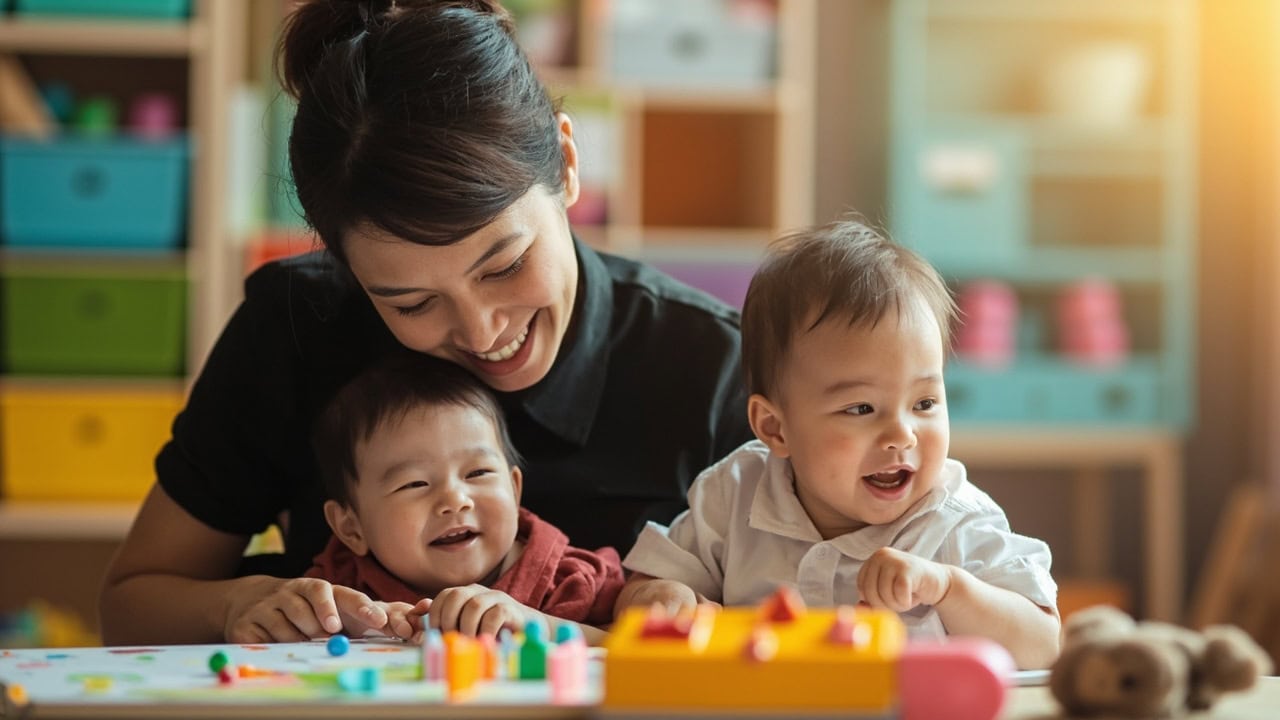
The child who has been in consistent, secure, attentive care all day runs into your arms with an openness and a joy that can feel almost startling. Not because they have forgotten you. Because they have not had to hold anxiety about your absence all day. Because they have been held—literally and emotionally—in a way that freed them to trust that you would return.
Conversely, the child who has been anxiously waiting, who clings and cannot be consoled, who seems angry at you for leaving—this is often a child who has not had that quality of daytime care. The anger and clinginess are not signs of love. They are signs of unresolved stress, a stress response system that has been activated all day because no caregiver provided the consistent regulation the child needed.
Your child’s reunion with you at the end of the day is diagnostic. It tells you something true about the quality of care they received while you were away.
When your child runs to you more connected, not less, that is the evidence that quality childcare and secure attachment are not opposites. They are partners.
Reframing the Choice: Building a Village
The premise that your presence is the only thing standing between your child and emotional insecurity is false. It is heavy with guilt, but it is not true.
Your child needs your presence, yes. But they also need a consistent, responsive caregiving environment, and those two things can and should coexist.
Choosing quality childcare is not leaving your child. It is building a village that reinforces what you already give them.
This is not a compromise. This is how human beings have always raised children—in community, across generations, with multiple trusted adults contributing to a child’s sense of security. The nuclear family living in isolation, where only parents raise children, is a modern anomaly.
Our ancestors raised children in villages. We are rebuilding that village, with intention, with training, with the support structures that modern families need.
EduNanny: Our Commitment to Your Family
At EduNanny, we understand this responsibility with full clarity. We are an ECDA-certified Childminding Pilot operator, and this designation represents our commitment to operating within the highest standards of infant and early childhood care—standards that have been designed with attachment science at their center.
Caregiver Ratios That Protect Responsiveness
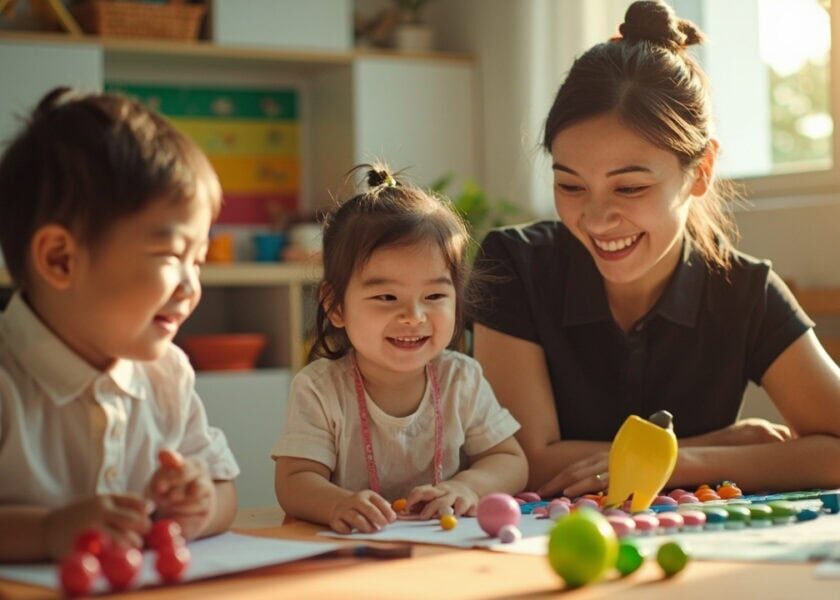
Our caregivers work in small ratios of up to one to three infants, because we know that responsiveness requires capacity. A caregiver who is responsible for six or eight children cannot attune the way a caregiver with one or two can.
Every additional child divides the attention that your infant needs to build secure attachment. We have structured our model to protect that ratio, because we are not willing to sacrifice quality for volume.
Pathways That Fit Your Family
Our pathways include both home-based and centre-based options, because families are different and needs are different.
- Home-based care takes place in your own home, where the environment is familiar and the schedule is fully customized to your family’s rhythm.
- Centre-based care offers peer interaction and a broader community of caregivers, which can enrich your child’s social development.
Both pathways operate under the same principles: attentive, consistent, responsive care.
Affordable Access for Singapore Families
Quality care should not be a privilege. Our fee structures are designed to be affordable within the pilot framework, and we support families in accessing applicable schemes including the Child Development Account (CDA) and Baby Bonus, so that financial considerations do not become a barrier to quality care.
Transparency in Every Hour
We know that Singapore parents need more than quality care. They need to know what is happening in the hours they are away.
That is why we have implemented communication practices designed to keep you connected to your child’s day, including observational tools and reporting that let you see actual insights into your child’s wellbeing, development, and emotional state—not just photographs.
When CCTV measures are deployed, they are deployed not as surveillance but as transparency—because we believe that what we do should be open to your witness, not hidden from it.
Answering Your Real Concerns
“Will my child feel abandoned?”
Children do not experience abandonment when they are in consistent, responsive care. They experience the world as a place that responds to them. Your child learns that you leave and you return—predictably, lovingly—and that the world does not fall apart in your absence. This is not abandonment. This is building resilience.
“Can anyone really care for my child the way I do?”
No one will care for your child exactly the way you do—and that is not the goal. The goal is consistent, attentive responsiveness, and that can come from multiple trusted adults. Your bond with your child is not fragile. It is built on a thousand moments of presence, of return, of being known and loved. It will hold.
“How do I know if a caregiver is truly attuned?”
Look for these signs: Does the caregiver notice your child’s subtle cues before they escalate? Do they respond with warmth rather than frustration? Do they describe your child’s day with genuine attention to their emotional state—not just activities? Ask about their training. Ask about their ratios. Ask to see their communication practices. Can you observe a session before committing? Watch how caregivers interact with children. Do they seem present? Warm? Attentive?
“What if my child has a hard transition?”
Transitions can be difficult, especially in the first weeks. This is normal. A secure transition means the caregiver takes time to help your child feel safe in the new environment, does not rush the goodbye, and gives your child permission to feel whatever they feel. The fact that transitions can be hard does not mean the arrangement is wrong. It means your child is learning to trust a new person—and that is exactly what secure attachment looks like.
The Truth for Every Singapore Parent
Returning to work does not mean choosing between your career and your child’s emotional security. It means choosing the right partner to help you raise your child in the way you intend.
It means trusting that your love is not diminished by distance. It means understanding that your child is resilient, adaptive, and capable of forming multiple secure attachments—because that is how human development has always worked.
You are not failing your child by returning to work. You are providing for your child, modeling resilience, and building a village around them.
And when that village is built with intention, with training, with the science of attachment at its center—your child does not lose anything. They gain a fuller, richer, more secure experience of being loved.
The silence you have been carrying, the question you have been afraid to ask, has a real answer.
Your child can be secure, attached, and thriving in your absence, when the presence they experience in your absence is one of genuine care, consistent responsiveness, and deep attunement.
Your child’s bond with you is not fragile. It is built on a thousand moments of presence, of return, of being known and loved. It will hold.
And with the right village around it, it will grow stronger still.
If you are ready to explore what an attachment-focused childminding partnership looks like for your family, we invite you to connect with EduNanny or learn more about our ECDA-certified childminding programme.