Why the Morning Goodbye Reveals Everything About Quality Childcare in Singapore
The Morning Goodbye: What Every Singapore Parent Is Really Looking For at Drop-Off
Every morning, across Singapore, the same scene plays out in countless doorways, lobbies, and childcare entranceways. A parent kneels down. A small hand grips a bag strap a little tighter. There is eye contact that carries more weight than any contract ever could. And then, inevitably, the moment arrives — the gentle or firm, the tearful or the brave — the morning goodbye.
This is the moment most parents never get to hear validated. It is dismissed as routine. It is tucked between checking the lunchbox and rushing to the MRT. But the truth is something else entirely.
The morning goodbye is the most revealing, the most emotionally charged, and the most developmentally significant moment in your entire relationship with your child’s caregiver. Understanding why changes everything about how you choose, how you trust, and how you show up for your child.
Why the Morning Goodbye Reveals More Than Any Tour
When parents tour potential childcare options, they are told to look at credentials. They are walked through curriculum frameworks. They are shown facilities, ratios, food menus, CCTVs. All of that matters. But none of it tells you what happens when you are not there — and more specifically, none of it tells you what happens in that charged, vulnerable, honest ten minutes at drop-off.
That is the one window where you can watch attunement in real time. Not read about it in a brochure. Not infer it from a report written at the end of the day. Watch it. Feel it. Read it in your child’s face.
A tour is a performance. Evening reports are reflections, filtered through time and documentation. But the morning goodbye is unscripted. The caregiver has not prepared for your arrival. Your child is not on their best behavior. You are tired, perhaps slightly anxious, carrying the weight of leaving your infant or toddler in someone else’s hands.
In that raw, unpolished moment, you can see something true. You can see whether the person caring for your child is genuinely present, genuinely warm, and genuinely ready to receive your child as a full human being — not just a name on a register.
What Quality Looks Like at Morning Drop-Off
Quality shows up in specific, observable ways. Here is what to watch for.
The Caregiver Greets Your Child First
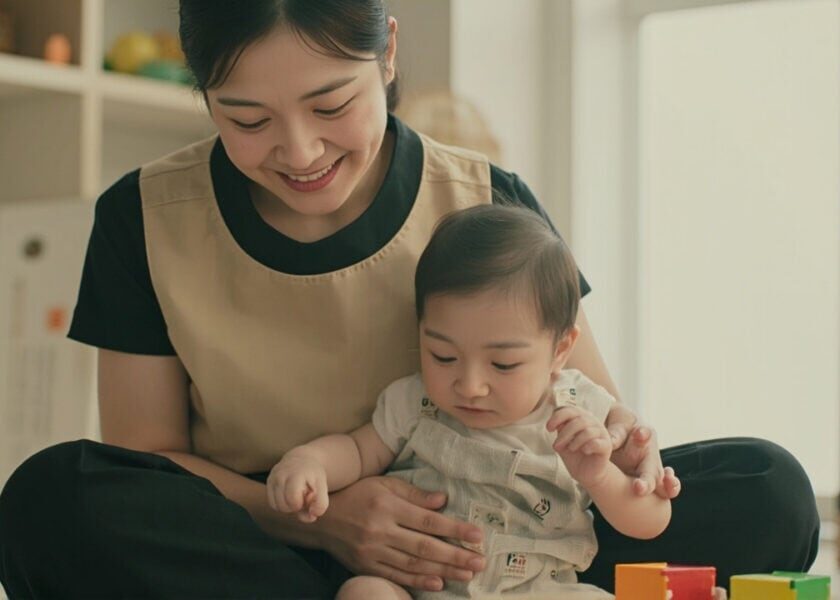
A quality caregiver will greet your child before they greet you. This sounds simple, but it is everything. When a caregiver bends down, meets your child’s eyes, and says something that is clearly just for your child — a small ritual greeting, a question about a favorite toy, a running joke between them — that is not incidental. That is attunement made visible.
That is the caregiver signaling that your child’s inner world matters, that they have been thinking about this child even before the morning drop-off, that there is continuity in the relationship.
The Caregiver Acknowledges You as a Partner
A quality caregiver will also turn to you. Not as a courtesy. As a parent. They will receive the handoff with care — asking a real question, listening to a real concern, confirming something specific about your child’s morning.
This is not small talk. This is the beginning of a partnership. When a caregiver genuinely acknowledges you as the expert on your own child, you know they understand that their role is not to replace you. It is to extend you.
Your Child’s Transition Feels Like a Relay, Not a Drop
Watch what happens to your child. Does the transition from your arms to the caregiver’s presence feel jarring, or does it feel like a relay — a gentle passing of the baton?
A child who has been warmly received, who is met at their level, who is given a predictable next step — a routine, a ritual, a familiar face — will still feel the weight of separation. But they will feel it as something survivable.
There Is a Predictable Ritual
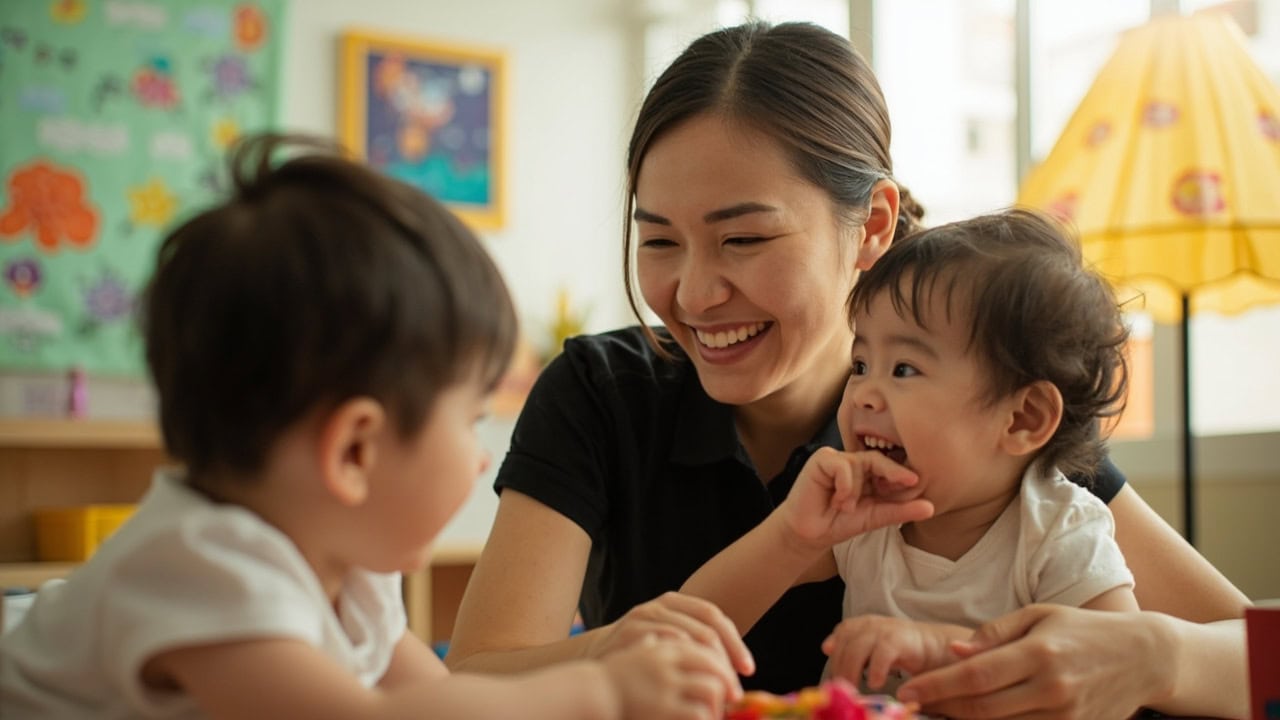
Quality caregivers build rituals into their morning transitions. A special wave from the window. A song sung at the doorway. A consistent sequence of greetings that your child can anticipate. These are not decorations. They are the scaffolding that makes separation feel safe.
What to Watch For
During your next drop-off, notice these specific signals:
- Does the caregiver have a routine greeting — something your child has begun to anticipate?
- Does your child move toward the caregiver with any sense of familiarity, or do they cling to you with visible distress that goes unaddressed?
- When your child is upset, does the caregiver respond with presence — kneeling down, using a calm voice, offering a comfort object — or does your child simply get redirected until the tears stop?
- Does the caregiver communicate with you about your child’s specific state that morning — a note about a poor night’s sleep, a preference your child expressed, a small detail that proves they were paying attention?
- When you leave, do you feel like the caregiver genuinely has your child in mind, or like your child has been absorbed into a room with no single adult holding them?
Parents who learn to read the morning goodbye become better partners in their child’s care. They notice more. They communicate more. They trust more — because trust is built on understanding, not on faith alone.
Separation Anxiety and How Children Adapt
Let me speak directly to something that is rarely named but widely felt.
Morning separation anxiety is not a sign of bad parenting. It is not a phase to be medicated or managed away. It is your child’s brain telling you that you matter enormously, that losing sight of you is significant, and that they need to know you will return.
This is precisely what you want your child to feel. The anxiety is proof that attachment is working.
What your child needs is not an absence of that anxiety, but a caregiver who can hold it with them — who does not shame it, rush it, or extinguish it, but who sits alongside it with patience and presence until your child finds their footing for the day.
A quality caregiver understands that tears are not a failure to be managed. They are an emotion to be witnessed. They are the sound of a child learning that big feelings can be survived, and that the people around them will stay close even when things are hard.
Patterns of Adaptation Over Time
Children adapt, but not all at the same pace. Some children move through morning goodbyes with growing confidence within weeks. Others take months. This is not a race. The phases of adaptation to morning separation are normal, and a quality caregiver understands this as developmental work, not behavioral correction.
They will not tell you that your child “should be fine by now.” They will tell you where your child is today, and they will walk alongside you and your child through it.
| Timeframe | What You Might Notice | What Quality Care Looks Like |
|---|---|---|
| Weeks 1–2 | Tears, clinginess, protest at drop-off | Caregiver receives child with calm presence; parent handoff is unhurried |
| Weeks 3–6 | Tears may persist but shorten; child shows some recognition of routine | Ritual greeting is consistent; caregiver offers specific comfort |
| Weeks 6–12 | Growing familiarity; child may pause at doorway but settle more quickly | Child shows signs of anticipating the ritual; caregiver notices and names this |
| Months 3+ | Smoother transitions for most children; occasional regressions during change or stress | Caregiver welcomes questions; understands regressions as normal |
If your child takes longer than these general timeframes, that is not a red flag on its own. What matters is whether the caregiver is present, patient, and consistent throughout.
The Morning Goodbye and the Caregiver Who Understands It
The philosophy behind quality childminding begins here — with the understanding that the morning goodbye is not incidental to the work of caring for children. It is central to it.
Across Singapore’s childcare landscape, the most thoughtful approaches to infant and toddler care share a common thread: they treat the daily transitions of a child’s life as intentional moments, not logistical necessities. Low infant ratios matter because they allow a caregiver to be fully present at moments like drop-off. Structured guidance for caregivers matters because it builds the capacity to read a child’s state and respond with warmth rather than routine. Home-based and community-based settings alike benefit when the caregiver-to-child relationship is treated as the primary vehicle of a child’s emotional and developmental wellbeing.
What this means for parents is that the choice you make at the beginning of your child’s care journey has lasting implications — not because any single day is make-or-break, but because consistency, attunement, and trust accumulate over time. When your child is received with the same warmth, the same ritual, the same genuine attention every morning, they are learning something profound about the reliability of the people who care for them.
Parents deserve to feel that trust too. When communication is woven into every part of a caregiver’s approach — when you leave each morning knowing that someone truly has your child in mind — the weight of that daily goodbye becomes lighter. Not because it stops mattering, but because you know it matters to someone who is ready for it.
Understanding what quality looks like at morning drop-off is not about finding perfection. It is about finding presence — the kind of care that shows up, consistently, with attention and intention. That is what allows children to learn that separation is survivable, that trust holds, and that the people who love them will return.
The Morning Goodbye: Your Daily Partnership in Trust
Let me bring this back to that doorway, that morning, that moment you know so well.
Every morning, when you hand your child to someone else, you are making a statement. You are saying: I trust that this person will love my child the way I would. I trust that they will keep my child safe, not just physically, but emotionally. I trust that they will see my child — really see them — and respond with care.
That statement is not small. It is one of the most profound acts of faith a parent performs.
That moment deserves to be met with equal intention. It deserves a caregiver who has prepared for it, who receives your child with warmth and with genuine attention, who holds the transition with care because they understand what it means. It deserves a routine that your child can rely on, a ritual that signals safety, a goodbye that does not have to be rushed because the caregiver understands its developmental weight.
The morning goodbye is not the beginning of the childcare day. It is the first lesson your child learns every single day about trust, about separation, about return, about the reliability of the people who love them.
And it is the first lesson you learn every single day about whether the choice you made was the right one.
You deserve to leave that doorway feeling something real. Not just relief. Something deeper. The quiet knowledge that your child is in hands that are ready, that are warm, that are worthy of the trust you are extending.
That knowledge does not come from a tour or a brochure or a five-star review. It comes from showing up, morning after morning, and finding that the goodbye feels right. That your child is met. That the caregiver is present. That the ritual holds.
The next time you stand in that doorway, pause for just a moment longer. Watch. Notice. Trust what you feel.
Finding childcare that understands the weight of that morning moment is not a luxury. It is what your child deserves. It is what you deserve.
At EduNanny Singapore, our approach to childminding is built around the belief that every morning goodbye should be met with the presence, warmth, and intention your child — and you — deserve. Learn more about how we work with families across Singapore as part of the ECDA Childminding Pilot, or reach out to begin a conversation about what quality, relationship-centered care looks like for your family.