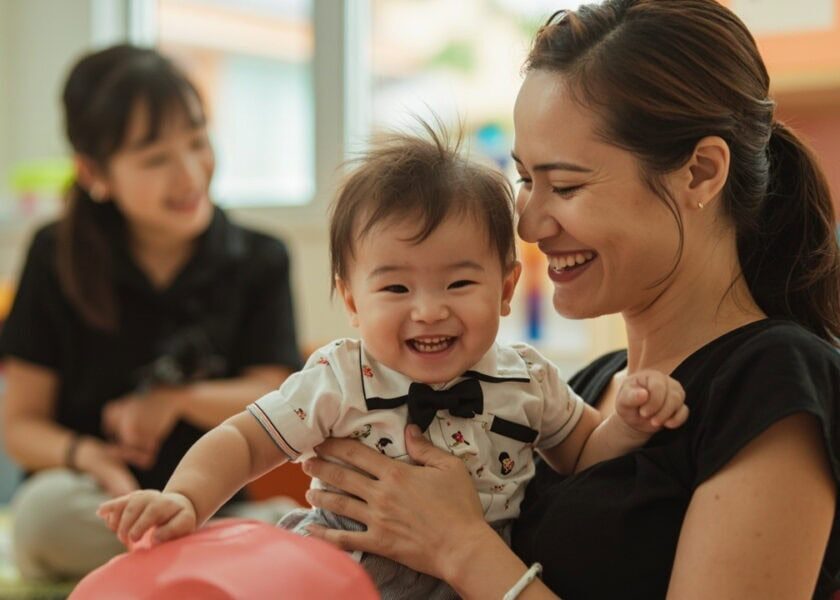
Why Singapore Families Are Expanding Their Childcare Village
Quick Summary
- Grandparent care is not inadequate care. Most grandparents provide loving, devoted attention that no childcare service can replicate.
- But loving care and developmentally-aligned care are not the same thing. Your child can be deeply loved and still benefit from additional support.
- Recognizing a gap is not disloyalty. It is attentiveness—the beginning of building a childcare village that can grow with your child.
- The best childcare choice is one the whole family can feel good about. That is always possible with honest conversation and the right partner.
The Singapore Village: Why Grandparents Matter So Much Here
In Singapore, we are part of one of the most extraordinary intergenerational caregiving systems in the world. More than half of all young children here receive regular care from their grandparents. This is not simply a matter of convenience or cost. It is rooted in something deeper—our values, our culture, our understanding that raising a child takes a community, and that the elders in that community have wisdom, love, and time to offer.
When I speak to parents in Singapore, many of them grew up in exactly this arrangement themselves. They remember grandmother’s home, grandmother’s patience, grandmother’s way of knowing exactly what they needed before they could say it. The trust runs deep. The expectation that grandparents will be involved is not just practical; it is cultural, relational, and in many ways, sacred.
So when a parent begins to feel that something is not quite working—that their child seems restless, or that the learning environment is not quite what they envisioned, or that their own parenting philosophy is diverging from how their parents approach discipline and development—they face a profound dilemma. How do you honor the very people who are helping you, while also honoring what you know your child needs?
The Difference That Matters: Loving Care vs. Developmentally-Aligned Care
Let us be clear about something from the outset: grandparent care is not inadequate care. The idea that grandparents somehow shortchange grandchildren is not only untrue; it is unkind. The vast majority of grandparents provide loving, devoted, attentive care. They are often more patient than parents themselves. They bring generations of accumulated wisdom, a deep personal investment in the child’s wellbeing, and the kind of unconditional love that only family can provide.
But there is a distinction that matters enormously, and it is one that Singapore parents often feel but struggle to articulate. There is a difference between loving care and developmentally-aligned care.
- Loving care means your child is safe, fed, comforted, and adored.
- Developmentally-aligned care means your child’s cognitive, emotional, social, and physical growth is being actively supported through interactions, environments, and activities that are intentionally designed for where they are and where they are going.
Both matter. One does not replace the other. But they are not the same thing, and pretending otherwise does a disservice to parents, to grandparents, and most importantly, to children.
The challenge is that loving care can sometimes mask gaps in developmental support. A child can be deeply loved and still not be talked to enough, or challenged enough, or given the structured opportunities for exploration that their growing brain requires. A grandparent may not have been trained in early childhood pedagogy, and that is not a failure—it is simply a difference.
The question is not whether grandparents love your child. The question is whether your child is getting everything they need to thrive at every stage of their development.
When Your Child’s Needs Are Evolving: Signs to Watch For
Here is what makes this so complicated in the Singapore context. The moment you suggest that grandparent care might need supplementation, you risk something precious. You risk offending parents who sacrificed for you. You risk disrupting an arrangement that has worked for years. You risk being perceived as ungrateful, as demanding, as someone who has forgotten where you came from.
This is why so many parents stay silent. They schedule worry in the evenings after the children are asleep. They read about developmental milestones and wonder if their child is on track. They watch other children the same age hit benchmarks their own child seems to be missing, and they feel a quiet panic they cannot mention at the family dinner table.
If this is you, I want you to know something. The fact that you are thinking about this at all—that you are asking whether your child is getting what they need—is not a sign of ingratitude. It is a sign of being a good parent. The very thing that makes you anxious about raising this question is the same thing that makes you a parent who cares deeply about doing right by your child.
So what should you actually be watching for? Here are the signals that often emerge as children approach toddlerhood and beyond:
- Language development seems slower than expected—your child is not picking up words at the pace you see in other children their age.
- Social cues seem difficult to read—your child struggles with sharing, turn-taking, or responding to other children’s emotions.
- Behavior becomes harder to manage—and your parents, despite their love, do not have the training or energy to implement consistent developmental approaches.
- Your child begins asking for more—for learning activities, for structure, for peers to interact with in ways that grandparents, however devoted, cannot always provide.
- You notice a gap between your parenting philosophy and the grandparent approach—and it is causing tension that affects your child.
These are not judgments on grandparents. They are simply the natural evolution of a child’s needs. And recognizing them—naming them, even—is not disloyalty. It is attentiveness.
What Quality Childminding Looks Like
Before we talk about solutions, let us be clear about what we mean by quality care, because the term gets used so often it can lose meaning.
Quality childminding is not just about keeping your child safe and fed. It is about creating an environment where your child’s whole development—cognitive, emotional, social, and physical—is actively nurtured. It is about caregivers who understand developmental stages, who respond to your child with intention rather than habit, who create learning opportunities within everyday moments.
In practice, this might look like:
- Responsive interactions—caregivers who tune into your child’s cues and respond warmly and consistently.
- Language-rich environments—conversations, songs, stories, and explanations woven throughout the day.
- Structured play—activities designed to build specific skills while allowing for exploration and creativity.
- Social exposure—opportunities to play with peers and learn how to navigate relationships.
- Developmentally appropriate challenges—support that meets your child where they are and gently pushes them toward what is next.
None of this diminishes the love your child receives from grandparents. It simply fills the gaps that loving care alone cannot always address—gaps that emerge naturally as children grow and their needs become more complex.
How EduNanny Fits Into Your Family
The framework we use at EduNanny is simple but important. We do not see childcare as a binary choice between family and institution, between free and paid, between what feels familiar and what feels right. We see it as an ecosystem—a village, if you will—that can include many different kinds of care, each contributing something valuable.
EduNanny, established by BUTLER, operates under the ECDA Childminding Pilot—a framework designed to bring quality, home-based and centre-based childcare to families across Singapore. We are not here to compete with grandparents. We are here to complement them, to support them, to step in where and when your family determines that additional support serves your child best.
Our infant care ratios are designed with intention. We maintain up to one-to-three caregiver-to-infant ratios in our infant care settings, ensuring that every child receives the attentive, responsive care that early development requires. This reflects our understanding that the first years of life demand individualized attention, and that quality cannot be achieved when caregivers are stretched too thin.
We offer Monday to Friday care blocks, because we know that Singapore families need consistency. We understand the financial realities that families navigate, and our pilot fee structures are designed to be accessible. Singapore’s Child Development Account and Baby Bonus mechanisms are available to help families invest in quality care.
Communication matters deeply to us. We know that leaving your child in anyone’s care requires trust, and that trust must be earned through transparency. Where our services include CCTV measures, we offer parents the visibility they need to feel secure. Where we communicate regularly with families about their child’s day, their progress, their discoveries, we do so not as a feature but as a reflection of our belief that parents are partners, not bystanders.
Making the Transition Gracefully
How do you actually navigate this in your family? Here is what we have learned from working with Singapore families who have done it well.
Approach it honestly
Frame supplementary care not as a criticism of grandparents but as an acknowledgment that children benefit from multiple caring adults, from diverse learning environments, from exposure to different ways of being and playing and growing. Tell your child that they are so wonderful that everyone wants to be part of their life—their grandparents, their teachers, their friends.
Let your parents see the bigger picture
You are not replacing them. You are expanding the village. There is still a role for them that is irreplaceable. In fact, many grandparents tell us that having EduNanny as a partner actually reduces their stress—they can enjoy being grandparents again rather than feeling like they are the sole source of care.
Choose a partner who respects your values
Not every childcare arrangement will feel right for your family. Look for a provider who is willing to listen to your priorities, who communicates regularly, who sees you as a partner in your child’s care rather than a customer to be served.
Give it time
Transitions are hard for everyone—your child, your parents, and you. It is normal for adjustment to take weeks or even months. The goal is not instant perfection but gradual comfort, for everyone involved.
A note on guilt
I want to speak directly to the guilt that many Singapore parents carry around this topic.
Guilt is often a signal that you care deeply about doing the right thing. But not every feeling that guilt produces is accurate. You are not ungrateful for wanting your child to have every opportunity to thrive. You are not disloyal for recognizing that your parents’ generation raised children in a different context with different knowledge. You are not a bad child for acknowledging that free grandparent care, however valuable, is not the same as developmentally-aligned care.
The guilt you feel is often borrowed—it comes from an unspoken expectation that you should be satisfied with what you have, even when you know something is missing.
Let me be clear: you are allowed to want more for your child. You are allowed to build a village that can support their evolving needs. You are allowed to have difficult conversations with people you love.
One parent told us recently, “EduNanny helped us stop feeling like we had to choose between respecting my mother-in-law and doing what was right for our son. We found a way to do both.”
That is the heart of what we are trying to do. We are not in the business of making parents feel guilty for wanting more. We are not in the business of suggesting that grandparents cannot provide excellent care, because many of them do, and we honor that completely. We are in the business of recognizing that families are complex, that children’s needs evolve, and that sometimes the most loving thing a parent can do is build a bigger village.
What This Is Really About
When you invest in quality childcare—when you choose an arrangement that supports your child’s development not just for today but for the years ahead—you are not simply solving a logistical problem. You are making a statement about what you believe your child deserves.
You are signaling that your child’s potential matters enough to navigate difficult conversations, to spend resources thoughtfully, to build something that can flex and grow as your family evolves.
Singapore has always been a place that values family. That is not going to change. What is changing is our understanding of what modern families need, and how quality childcare can serve as a bridge rather than a wedge.
The children in our care today are the Singapore of tomorrow. The way we support them—the way we nurture their curiosity, their resilience, their love of learning—will shape what this country becomes.
At EduNanny, we do not take that responsibility lightly. We believe every child deserves to be known deeply, to be supported patiently, to be challenged lovingly. We believe families deserve partners who respect their values and support their choices without judgment. We believe grandparents deserve to be honored for the irreplaceable role they play, and that sometimes honoring them means acknowledging that they, too, are allowed to want a little more rest, a little more time to be grandparents in the way they choose.
Ready to Explore Your Options?
If you have read this far, you are probably the kind of parent who thinks carefully about what your child needs. You care enough to ask the difficult questions. You are trying to honor everyone involved—your parents, your child, yourself—while building something that works.
We would like to be part of that conversation.
Whether your family is currently in full grandparent care and wondering what comes next, or already supplementing grandparent care and looking for a partner who understands your values, or simply beginning to think about how you want to raise your child in a city that is changing faster than ever—we are here. We are listening. And we are ready to be part of your village.
The village is still there. It has always been there. We are simply here to help you build it a little bigger, and to ensure that every member of your family—your children, your parents, and yourself—has a place in it where they can thrive.
Because great childcare is never about replacement. It is always about addition. It is always about love finding new ways to reach the children who need it most.
EduNanny Singapore. Working alongside your family, because every child deserves a village that can grow with them.
Get in touch with us to explore how EduNanny can support your family.