Why Observation Is the Heart of Quality Infant Care
The Difference Between Watching and Witnessing Your Child
The answer, of course, is no—you are not less of a parent for missing a moment. But the question itself reveals something important about how Singapore parents love their children.
We do not simply want our children to be safe. We want to know them. We want to be the parent who understands why our toddler melts down over the blue cup, who notices when our baby is developing a new sound, who feels, with quiet certainty, that we are reading our child correctly.
We want to be perceptive. We want to be present—even when presence is impossible.
Modern life asks something of us that no generation of parents before has had to navigate with quite this intensity. We must work. We must build. We must contribute to the world in ways that pull us away from the small, unfolding moments of early childhood—the moments that seem, in retrospect, to define everything.
There is a difference—subtle but significant—between watching and witnessing. Between supervision and understanding.
Anyone can watch a child. It takes something more to witness them: to notice the pattern in their play, the hesitation before a new skill, the way their face changes when they figure something out. To hold their development in mind. To remember what they could not do last week. To recognize what they are reaching toward today.
What Professional Observation Means for You
When a caregiver tells you that your child has been practicing a new grip on the crayon, you do not just learn a fact. You learn to look for that grip at home. You begin to see your child with freshened eyes.
This is what professional caregivers do when they are trained to observe. They are not simply keeping children from harm. They are tracking the quiet architecture of growth—the way language builds syllable by syllable, the way trust develops in small moments of responsiveness, the way a child learns that the world is safe enough to explore.
The observation changes your perception. And perception, over time, becomes partnership.
What Quality Infant Care Actually Looks Like
In Singapore’s childcare landscape, it is easy to focus on the tangible: ratios, facilities, operating hours. These matter. But they are not the whole picture.
Quality infant care begins with attention. It asks:
- Who notices when your baby discovers their hands?
- Who tracks the moment your infant first pulls to standing?
- Who listens for the new syllables in your child’s babbling?
- Who watches how your toddler navigates a new social situation?
These are not dramatic moments. They happen between the photographs, in the spaces between major milestones. What makes a childcare arrangement truly valuable is not just that your child is supervised. It is that someone is holding the thread of their development with intention.
The Moments Parents Often Miss
Consider the everyday milestones that often escape notice:
- The first time a baby consistently reaches for a toy with one hand rather than both
- The shift from scribbling to intentional mark-making
- The day a toddler starts sorting objects by color—then moves on, and that window closes
- The emergence of pretend play: feeding a doll, driving a toy car to the “shop”
- The way a child’s face changes when they solve a small problem they have been working on
These moments matter. Not because milestones define development, but because they reveal it—the quiet unfolding of a person you are coming to know. When someone is watching for these moments and sharing them with you, you are not receiving a report. You are receiving the thread of your child’s story, one small scene at a time.
How EduNanny Singapore Approaches Shared Care
EduNanny Singapore’s approach is built around a simple idea: professional care should strengthen your bond with your child, not replace it. We are not simply placing caregivers in homes or managing childcare arrangements. We are building a system of shared awareness—a methodology designed to make professional observation useful to parents, not just visible to them.
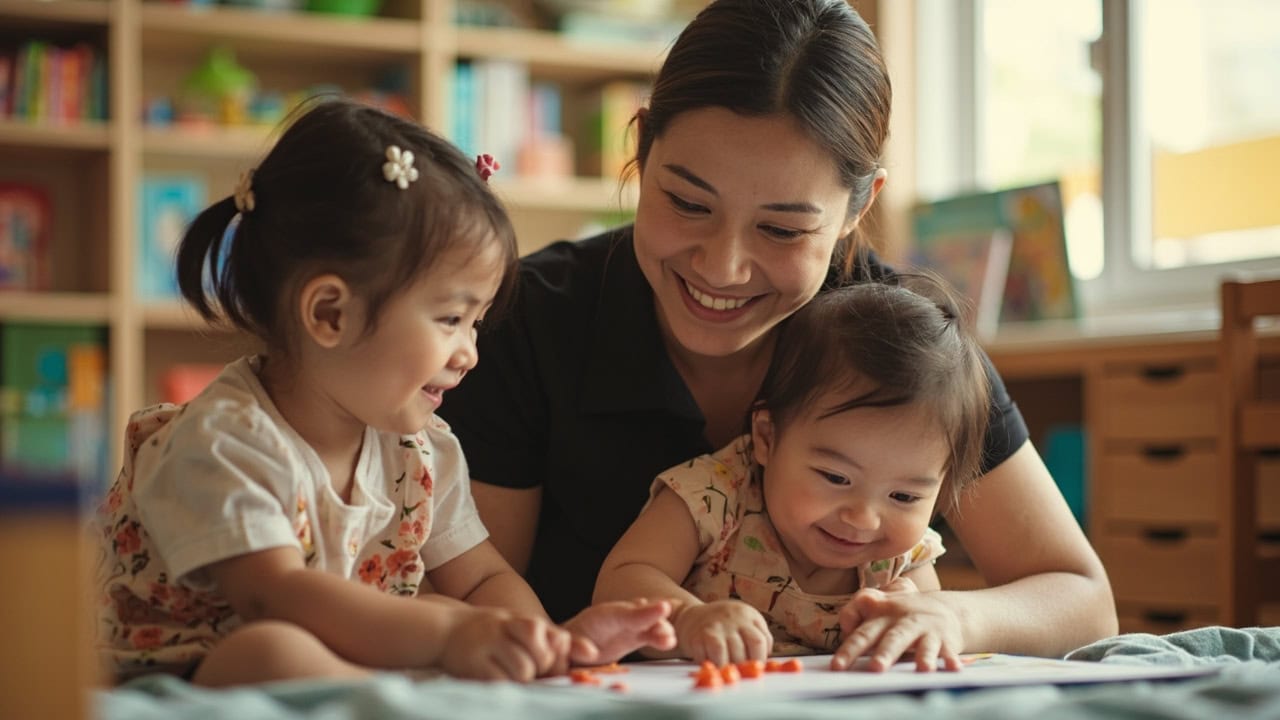
When your child’s caregiver notices that your toddler has started sorting objects by color—a cognitive leap that often emerges suddenly and then disappears again if no one catches it—that observation is recorded, reflected upon, and shared with you in language you can understand and act upon.
You do not have to guess whether your child is on track. Someone is watching alongside you, and their watching translates into your own clarity.
Transparent Communication That Builds Trust
Singapore parents deserve honest answers to honest questions. Quality care should offer meaningful glimpses—not just that your child ate and slept, but what made them laugh, what they were drawn to, what they reached for.
These are not surveillance. They are threads of trust that connect you to the hours you cannot see:
- The photograph of your child’s painting
- The note about a new word
- The update about how they slept or ate or played
Practical Support for Busy Parents
The early years are demanding in ways that are hard to explain to anyone who has not lived them. The logistics alone—schedules, fees, subsidies, the paperwork of arranging care—can feel like a second job on top of an already exhausting one.
Singapore parents should not have to navigate this complexity alone. Meaningful support includes clear guidance on CDA and Baby Bonus usability, help accessing subsidies, Monday to Friday care blocks that fit real working lives, and transparent fee structures that make planning easier. These are not afterthoughts. They are part of making the partnership real.
Redefining What It Means to Be a Good Parent
Perhaps the deepest thing EduNanny offers is something harder to measure: a reframing of what it means to be a good parent in Singapore today.
The old narrative said that good parents were always present. That presence was proof of love. That any time spent away from your child was time lost, time guilty, time that could not be recovered.
But that narrative does not survive contact with reality.
In a city like Singapore, where both parents often work, where grandparents may live far away or have their own lives to live, where the cost of living demands two incomes more often than not—presence is not always possible.
And the parents who are living this reality know something the old narrative does not: that love is not diminished by the hours you are apart. That your child knows you, trusts you, reaches for you—not because you were there for every moment, but because of who you are when you are together.
The Village That Helps You See
What EduNanny offers is not a solution to the guilt Singapore parents sometimes feel. It is an alternative to the premise that produces that guilt.
We believe that parents are not meant to witness their children’s development alone. The village may not look the way it once did—may be made of trained caregivers and structured pathways and thoughtful communication systems—but the function remains the same: to help parents see, to help children grow, to hold the future of a family in careful, professional hands.
When you choose quality childcare, you are not choosing a replacement for your role as a parent. You are choosing an expansion of it. You are choosing to receive, each day, the gift of someone else’s careful attention—translated into language you can understand, shared in ways that strengthen your bond with your child, designed to make you more perceptive, more confident, more present when you are together.
A Practical Guide to Choosing Infant Care in Singapore
There is a moment, familiar to many parents, when you pick up your child at the end of the day and they show you something—a drawing, a rhyme, a small accomplishment they are proud of—and you realize that you are seeing it for the first time, even though it happened hours ago.
The caregiver has held that moment for you. Has witnessed it on your behalf.
This is what we mean when we talk about partnership. Two sets of eyes, focused on the same small person. Two attentions, aimed at the same unfolding. Your caregiver sees what you cannot see. And then, through careful communication and shared observation, you see it too.
Questions to Ask Potential Care Providers
- How do you track and share my child’s development over time?
- What does a typical day look like, and how will I hear about it?
- How are observations recorded and communicated to parents?
- What training do your caregivers receive in child development observation?
- How do you handle the transition and communication between home and care?
- What does your approach to infant ratios look like?
Questions to Ask Yourself
- Do I feel heard when I speak with this provider? Do they understand what matters to me?
- Do their communication practices make me feel more connected to my child, or less?
- Do I trust that they are watching for the same things I would watch for?
- Do I feel like a partner in my child’s care, or a passive recipient of updates?
- Do they make the logistics easier, or harder?
At the end of the day, the right childcare is not the one with the flashiest facilities or the lowest fees. It is the one where you feel that someone is watching your child with love and attention—and sharing what they see with you in a way that makes you a more confident, more perceptive parent.
That is not a feature. It is a philosophy. And it is what makes the difference between childcare that supervises and childcare that witnesses.
Start a Conversation with EduNanny Singapore
Your child is already remarkable. They are learning things you have not seen, saying things you have not heard, becoming someone you are still discovering.
EduNanny Singapore exists for the families who want more than supervision. For the parents who know that attention is love, and that professional care, done well, is attention offered not just to your child but to you—to your need to understand, to witness, to be present even when presence is impossible.
Our role is simple: to help you see them more clearly. To watch alongside you. To notice what was always there, and to help you notice it too.
That is not just childcare. That is partnership in its truest sense. And it is how we believe every Singapore family deserves to experience the early years—not as a time to be survived, but as a shared discovery to be witnessed, one small milestone at a time.
Because the early years are brief, and they matter enormously. And no parent should have to navigate them alone.
If you are ready to explore what a partnership in observation and shared awareness could look like for your family, we welcome the conversation.
To learn more about EduNanny Singapore’s approach to thoughtful, development-oriented childcare, visit our about page or start a conversation with our team.