When Separation Extends Love: The Science of Secure Attachment for Singapore Parents
“`html
Let Us Begin With What You Are Already Feeling
There is a moment, somewhere between the nursery door and the car park, when a Singapore parent feels the full weight of what they have just done. They have handed their child to someone else. They have walked away. And in that walk, a thousand questions surge through them—Is my child crying? Is she okay? Does she feel abandoned? Did I make the right choice? Am I being a good parent by leaving?
If you have felt this, you are not alone. You are, in fact, in the most human of places a parent can stand.
Every parent who has walked away from a childcare centre or a childminder’s home has felt it—that tightening in the chest, that impulse to turn back. Singapore parents, perhaps more than many, carry this with particular intensity. Our cultural context amplifies it: the expectation of presence, the reverence for the bond between parent and child, the deep respect for family in our society—all of this makes separation feel not just difficult, but somehow wrong.
We want to speak directly to that feeling. Not to dismiss it. Not to tell you it is unnecessary. But to help you understand what is actually happening in those moments, and what developmental science has been quietly revealing about why the right kind of childcare does not interrupt your bond with your child—it extends it.
The Secure Base: What Your Child Actually Needs
The psychologist Mary Ainsworth, whose work on attachment theory transformed our understanding of early childhood, gave us a concept that remains perhaps the most important framework for understanding healthy child development: the secure base.
The secure base is not a place. It is not even a person, strictly speaking. It is a psychological experience—the knowledge that someone trusted and reliable exists, and that this person will be there when needed.
From this knowledge, a child ventures out. From this knowledge, a child explores. From this knowledge, a child grows.
When your child feels secure—when she knows, in her bones, that her caregiver is attuned to her, responsive to her, and will return—separation becomes possible. Not because she does not love you. Not because she does not need you. But because she has internalized your reliability so completely that your physical absence does not threaten her sense of safety.
The security was never about your constant physical presence. It was about the quality of the attunement, the consistency of the response, the reliability of the return.
Two Kinds of Security: Which One Is Your Child Building?
| Type of Security | What It Means | Long-Term Impact |
|---|---|---|
| Presence-Dependent Security | Your child only feels safe when you are physically there | Limited exploration, difficulty with transitions, higher anxiety in new situations |
| Presence-Capable Security | Your child carries your reliability inside her, like a quiet compass | Confident exploration, resilience in new environments, ability to separate and return strengthened |
Quality childcare, when it is truly quality, does not replace you as the secure base. It creates a secondary environment—a bridge, if you will—where your child practices the skill of secure separation and return.
Every time your child goes to a trusted caregiver, explores a new activity, engages with other children, and then settles back into connection with you at the end of the day, she is building neural pathways that will serve her throughout her life.
She is learning that the world is explorable. That relationships are trustworthy. That she can be separate from you and still be wholly, securely yours.
What the Research Actually Shows
This is not a theory without evidence. Before we go further, here is what decades of developmental psychology have established:
- The ability to separate from parents is a developmental milestone, not a threat to your child’s security
- Quality childcare creates secondary secure bases where children practice healthy separation and return
- Children with multiple secure attachments show stronger social skills, greater emotional resilience, and more confident approaches to learning
- What matters most is not the separation itself, but how caregivers respond to your child’s distress
- When childcare is truly quality, it does not replace you—it extends the secure base you have built
Attachment research consistently shows that children who form secure attachments with multiple caregivers—including grandparents, extended family, and quality childcare providers—demonstrate:
- Stronger social competencies and more sophisticated peer interactions
- Greater emotional resilience when facing challenges or disappointments
- More confident approaches to learning and curiosity about the world
- Better ability to regulate emotions when upset or frustrated
Multiple secure attachments multiply developmental benefits. They do not divide them.
Understanding Separation Distress
When your child cries at drop-off, it is tempting to interpret this as evidence that separation is harming her. But let us look more carefully at what that cry might mean:
- It might mean: I notice something new and it unsettles me
- It might mean: I am tired, and I express my tiredness through tears
- It might mean: I am protesting a change because change is hard, even when the change is good
- It might simply mean: I love you so much that parting from you, even briefly, is significant to me
A child’s protest at separation is not, in itself, a sign of insecure attachment or impending harm. What predicts harm is not the separation—it is what happens in the caregiver’s response to that protest.
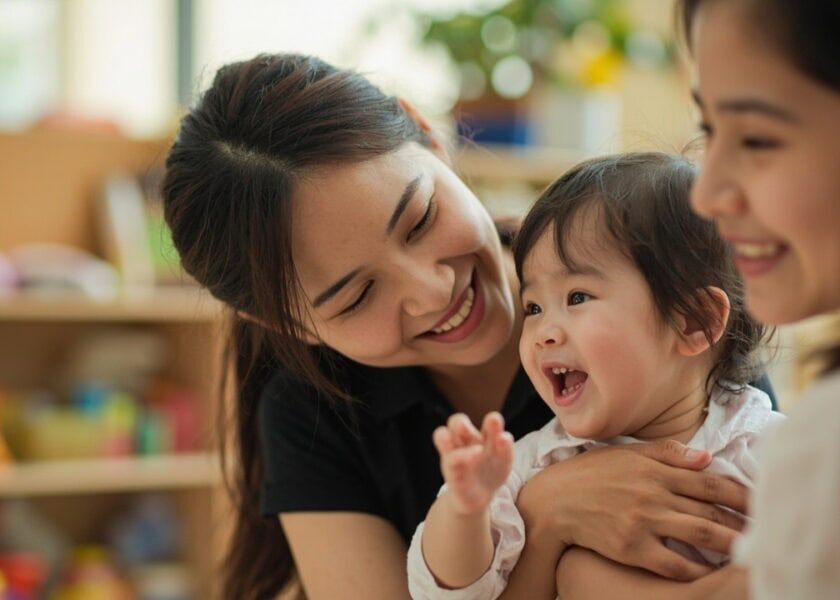
When a trusted, attuned caregiver acknowledges the child’s distress without minimizing it, remains calm and emotionally regulated, offers comfort without judgment, and demonstrates consistently that they are a reliable person in the child’s life—the child processes the separation, integrates the experience, and develops trust in the caregiver’s reliability.
Over time, the protests diminish. Not because the child has learned to suppress her feelings, but because she has learned that the feelings are manageable and that the caregiver will stay with her through them.
This is what quality infant care looks like at the level of emotional experience. It is not distraction from feelings. It is not absence of feelings. It is the skilled, patient, science-informed presence of an adult who understands that separation is a developmental passage, not a wound.
Signs Your Child Is Thriving in Childcare
How do you know if your child is using childcare as a secure base rather than merely enduring it? Observable signs include:
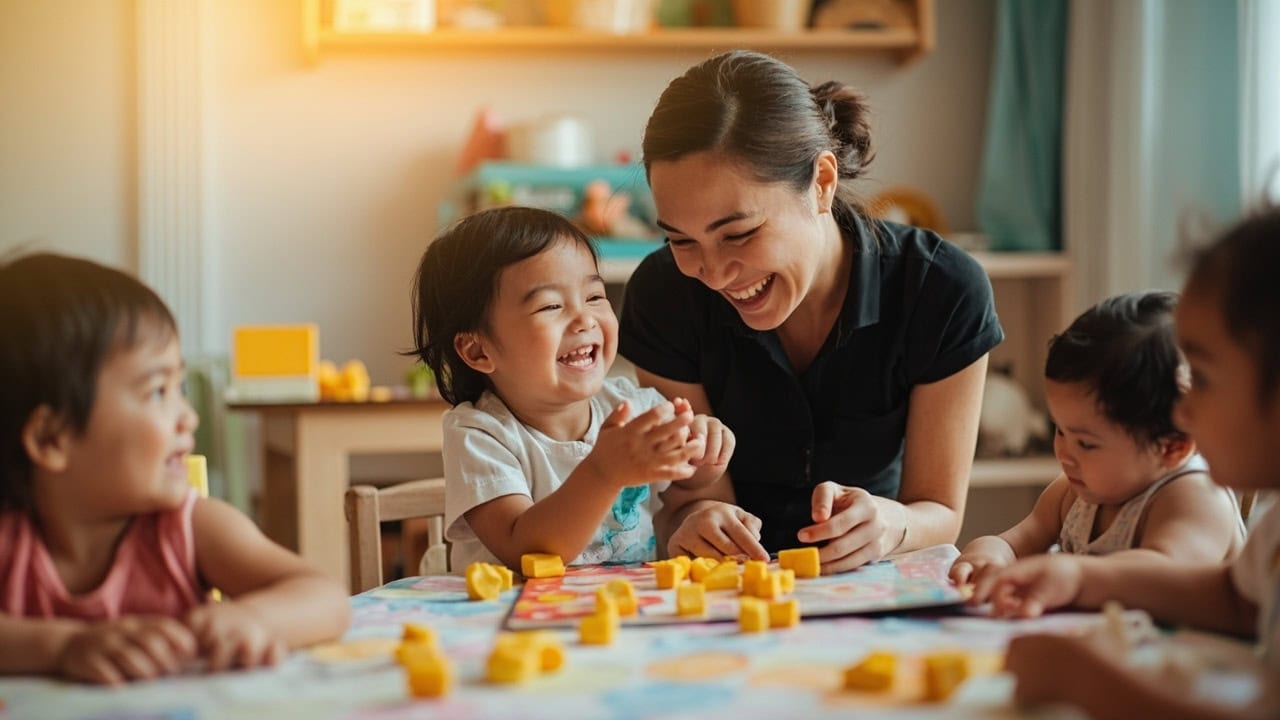
- Increased confidence in exploring—crawling to investigate, reaching for new toys, engaging with unfamiliar spaces
- Sharing discoveries rather than seeking rescue—a new block tower, a butterfly in the garden, a song learned with the group
- Socially competent behaviour—the ability to engage with peers, negotiate play, recover from minor disappointments, and return to positive engagement
- Approach behaviour at pickup—running toward the caregiver or parent from a place of security, not panic
- Curiosity and engagement rather than withdrawal or constant vigilance
What Quality Childminding Looks Like
Understanding attachment science is one thing. Recognising quality in practice is another. Here is what research tells us matters most:
- Responsive ratios—lower ratios of caregivers to children allow for genuine attunement, the ability to notice each child’s signals and form consistent, reliable relationships
- Consistent caregivers—young children need predictability to internalize trust; sporadic arrangements leave children constantly re-adapting, never fully settling
- Attunement over activity—quality infant care is less about elaborate programming and more about responsive, individualised attention; the caregiver who notices when your child is becoming overstimulated, who matches their pace to your child’s rhythms
- Transparent communication—parents deserve to know what their child’s day looked like in ways that let them extend the narrative at home, opening conversations and connecting worlds across the hours of separation
EduNanny: Grounded in Developmental Science
EduNanny emerged from a recognition that Singapore families deserve childcare grounded in developmental science—staffed with caregivers trained in attachment-informed practice, and structured in a way that makes quality infant care accessible rather than exceptional.
By participating in the ECDA Childminding Pilot, EduNanny offers Singapore families access to regulated, quality-focused childminding through both home-based and centre-based pathways. The pilot establishes ratios and standards informed by attachment research—not arbitrary compliance minimums, but the conditions that allow caregivers to attune to each child’s signals and form the consistent, reliable relationships that secure attachment requires.
EduNanny’s caregiver development framework means that the adults holding your child’s emotional world are supported, trained, and treated as the skilled professionals they are. This investment in caregiver quality is not separate from the care your child receives—it is the care your child receives, seen from another angle.
Addressing Your Concerns
“Will my child feel abandoned?”
Your child will not feel abandoned if the adults around her are attuned, responsive, and reliable. Abandonment is not a function of physical separation—it is a function of emotional unavailability. A child with a secure base at home who enters quality childcare with attuned caregivers is not being abandoned. She is being extended.
“What if the crying never stops?”
Persistent distress that does not improve over time may indicate that the caregiving arrangement is not meeting your child’s needs. But initial protest? Weeks of adjustment? Gradual settling? These are normal parts of the developmental process, not warnings of damage. The key is observing whether, over weeks and months, your child shows increasing confidence, engagement, and the signs of secure attachment described earlier.
“Am I being selfish by going back to work?”
You are not choosing between your child and your career. Research shows that children thrive when their parents are secure in their own identities and economic wellbeing. A stressed, financially anxious parent is not serving their child better than a parent who returns to work feeling supported and purposeful. Quality childcare enables both.
“How do I know if this childcare is actually quality?”
Ask questions. Observe transitions. Notice whether caregivers are present with children or distracted. Notice whether your child’s specific temperament and needs are accommodated. Notice whether communication is routine and detailed. Trust your observations, not just your anxiety. Quality childcare feels different—it feels like partnership, not transaction.
Making the Decision: A Practical Framework
When you are ready to choose infant care in Singapore, here is what to prioritise:
- Observe caregiver-child interactions. Are they attuned? Do caregivers get down to the child’s level? Do they respond to distress with comfort, not dismissal?
- Ask about ratios and consistency. How many children per caregiver? Will the same caregiver be with your child most days?
- Evaluate communication practices. What will you know about your child’s day? How often? In what format?
- Notice your own gut feeling. You are entrusting someone with your child’s emotional world. Do you sense professionalism, warmth, and genuine engagement?
- Consider alignment with attachment science. Does this arrangement reflect what research tells us about how children develop secure foundations?
Trust the Process, Trust Yourself
The separation you make each morning when you leave your child at a trusted caregiver is not a failure of love. It is an act of profound love—of trust in your child’s capacity to grow, of trust in the caregiver who holds her, and of trust in the developmental process that asks children to venture forth from the secure base you have built together.
The guilt you feel, when it comes, is the shadow of your devotion. Honor it. Let it remind you of how much you care. But do not let it paralyze you into believing that your presence is the only thing standing between your child and harm.
Your child does not need a parent who never leaves. She needs parents who return, who are attuned, who listen, who hold her experience with respect. And she needs caregivers who do the same in your absence—not as substitutes, but as skilled, reliable, nurturing adults who extend the secure base rather than replace it.
That desire, that care, that refusal to approach your child’s early years carelessly—this is not a sign of doubt. It is the foundation of everything good that will happen in your child’s life.
If you are exploring childcare options grounded in attachment science and designed for Singapore families, EduNanny welcomes the opportunity to walk this path with you.
“`