What Your Observation Already Knows About Choosing Quality Childcare
What You Are Already Seeing
Singapore parents are not short on information. You are surrounded by options—reviews, accreditations, ratios, programmes, price points. There are frameworks and scorecards and comparison tables. What you may be short on is confidence in your own capacity to read what is in front of you.
To trust that your attention, your observation, your instinct—these are not weaknesses to be overcome by better research, but tools that have been quietly preparing you for this decision all along.
Let me walk you through what you already know how to see.
The Caregiver’s Presence
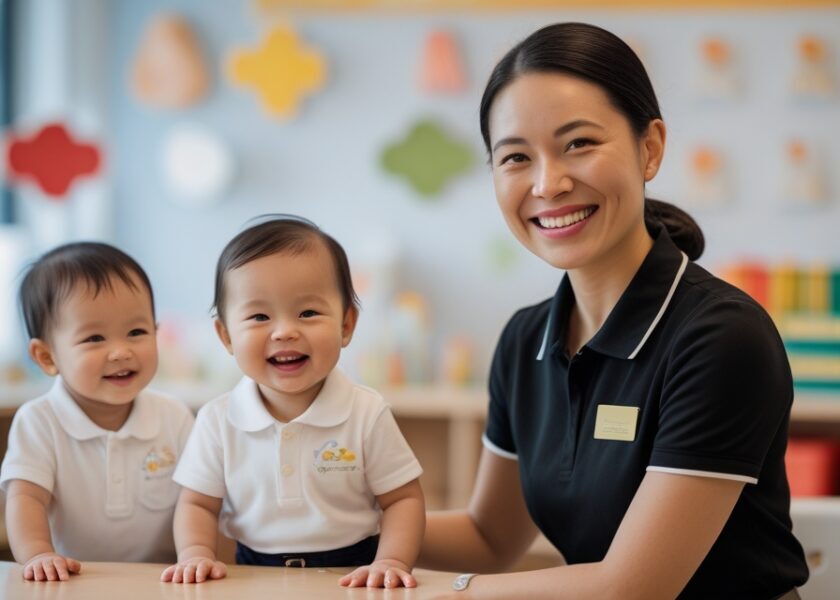
The first thing you noticed when you entered that room was not the toys or the wall charts. It was the caregiver.
Not what she was doing, necessarily, but how she was being. There is a quality of presence that some adults carry in a room full of children and some adults do not. You can feel it.
It has something to do with their posture, the unhurried quality of their movements, the way they speak—not the words, but the tone, the rhythm, the warmth that does not feel performed.
When a caregiver moves through a room with calm authority, when she is not checking her phone, not glancing at the clock, not visibly managing anxiety or exhaustion, when she is simply there, attentive, grounded—that is not a coincidence. That is not a personality trait that showed up by accident. That is the result of conditions. Training. Supervision. A culture that takes care of the people who take care of children.
You may have watched her interact with a child in that first minute and felt something shift in your chest. Perhaps she was kneeling to a child’s level, or she paused in her conversation with a colleague when a small hand tugged at her sleeve, or she spoke to a crying infant not with the brisk efficiency of someone managing a task, but with the patient, unhurried attention of someone who understands that this moment—this single, small moment—is the whole job.
That is what quality looks like from the outside. It looks like people who are present.
And here is what you can trust: you noticed it. You did not need anyone to point it out to you. Your observation was already working.
The Children’s Ease
Now look at the children.
Not at the curriculum on the wall or the developmental milestones posted in the hallway. Look at the children themselves, and ask yourself a simple question: do they look at ease?
There is a particular quality of freedom that you can observe in children who are in genuinely good care. They move through the space with a kind of settled confidence. They are not performing for adults. They are not anxious or watchful or clenched. They play without constantly glancing up for approval. They explore without fear of interruption. When they need something, they know how to ask—or they know that someone will notice anyway.
You can also watch for how they move their bodies. In a well-designed environment, children are not kept still. Movement is not a disruption to be managed. It is a natural expression of development, and a quality space accounts for it—not by restricting it, but by designing for it.
The room has space. The children are not packed in like boxes. They can reach, climb, crawl, run, stretch without the room becoming a hazard.
This ease, this freedom, this physical comfort—these are not luxuries. They are indicators. When children are at ease in their bodies, it means the environment is supporting them, not just supervising them. It means the adults in the room have the capacity to hold space for movement without anxiety, because they are not overwhelmed by numbers.
What the Room Reveals
Close your eyes for a moment and remember the spaces you have visited. What do you recall?
Light
The quality of the light matters more than most parents realize. Natural light, or light that approximates it, changes everything—the children’s moods, the caregivers’ energy, the overall atmosphere of the room.
A space that relies entirely on fluorescent lighting and sealed doors will feel different from one that opens to daylight, that has windows positioned at a child’s eye level, that allows sunlight to move across the room through the morning.
Sound
Listen to the sound. Not just whether it is loud or quiet, but what kind of sound it is.
Is there a background hum of children’s purposeful activity—laughter, conversation, the sound of play? Or is there an uneasy silence punctuated by adult commands?
A quality environment does not need to be perfectly silent, but it should not feel tense. The sounds you hear should be the sounds of children who feel safe.
Air
What does the air feel like? A room that has been properly ventilated, that has good air circulation, that does not smell of disinfectant or damp or stale breath—these are not superficial observations. They are health indicators. They are signs that the environment is being maintained with genuine care, not just managed to pass inspection.
Materials
Look at the materials on the shelves. Are they real? Are they beautiful? Do they invite touch and exploration?
Or are they cheap plastic fillers meant to look busy rather than useful?
The objects in a room communicate something about what the adults in that room believe about children. Do they believe children deserve things that are worth touching? Things that teach them something about weight and texture and colour and shape?
Space
Is it organized in a way that makes sense to a child? Are the shelves at a height where a two-year-old can reach what interests them? Can a child move from one area to another without navigating a maze of furniture or adult belongings?
Is there evidence that someone has thought about how this space feels from the ground—from a child’s perspective?
Quality is not hidden. It is not something you need special credentials to detect. It is written into the room. It is audible in the sounds. It is present in the light. It reveals itself to anyone who pays attention.
Why Quality Is Designed, Not Accidental
All of this—the caregiver’s presence, the children’s ease, the sensory quality of the room—none of it is accidental.
Every environment is designed, either with intention or by default.
A room that feels rushed and chaotic was designed that way, even if no one sat down with a plan. It was designed by the number of children in the room, by the stress levels of the staff, by the budget constraints that determined how many adults were available, by the culture that decided what mattered and what could be cut.
A room that feels calm and alive and purposeful was also designed. The difference is whether the design was thoughtful.
When you visit a childcare and feel something positive, you are not imagining it. You are reading the evidence of intention. You are seeing the result of decisions made—sometimes years before you walked in—about ratios and training and space and light and materials and culture.
Quality is not a happy accident. It is the visible output of a coherent philosophy, applied consistently, over time.
And when you feel something is off, when the room feels cold or the children feel subdued or the caregiver seems stretched too thin—that is also evidence. It is the evidence of a different set of decisions, made somewhere upstream.
Your feelings are not guessing. They are reading.
What Singapore Parents Are Really Navigating
You are navigating something genuinely complex. You are making a decision about who will care for your child during hours when you are not there—hours that matter enormously for your child’s development, for your family’s wellbeing, for your own capacity to work and breathe and be the parent you want to be.
This is not a small thing. It is one of the most consequential decisions you will make in these early years.
And yet the pressure to make it quickly, to choose from the options that are available, to feel confident in a system that does not always make confidence easy—these pressures are real.
The framework you need is not a checklist. It is not a scorecard. It is the very capacity you are already exercising when you walk into a room and notice how it feels.
What you need is not more information. What you need is permission to trust what you are already seeing.
The Trained Parent Eye
There is a kind of parent who walks into a childcare and immediately starts cataloguing: the certifications on the wall, the teacher qualifications, the curriculum structure, the food options, the bathroom facilities.
This is not a bad instinct. But if it is the only tool in your kit, you will end up choosing the childcare that looks best on paper, not the one that will feel best for your child.
The quality you are looking for is not always the quality that appears on a brochure. It is the quality that appears in the room, in the moment, in the quality of the presence you observe. It is the quality that shows up in how the children move and breathe. It is the quality that reveals itself in the caregiver who notices what is happening before it becomes a problem. It is the quality that you can feel in your body before you can articulate it in words.
Learning to trust this is not irrational. It is the culmination of everything you have been developing as a parent—the attention, the sensitivity, the attunement that has been growing since the day your child was born.
You have been paying attention to your child’s cues for months or years now. You have learned to read their cries, their smiles, their body language, their silences. You have become an observer of the person you love most.
That skill is not limited to your child. It is a general capacity. When you walk into a room full of children, you can see what attunement looks like. You can see what ease looks like. You can see what a responsive adult looks like.
You are not starting from zero. You are bringing expertise.
How to Use Your Next Visit
When you visit your next childcare—because there may be several, and that is fine—here is how to use your visit well.
Before You Enter
- Walk in without your phone. Give the space your full attention.
- Take a breath at the door. Let the room speak to you before anyone explains it.
In the First Five Minutes
- Notice the light. Is it natural or artificial? Does it feel warm or harsh?
- Notice the sound. Is there purposeful activity or tense silence?
- Notice the air. Does it feel fresh?
Watch the Caregiver
- Observe her posture and movement. Does she seem unhurried?
- Watch how she responds to a child. Is it attentive or performative?
- Notice whether she is present or managing.
Watch the Children
- Do they look at ease or anxious?
- Are they free to move or restricted?
- Do they play with confidence or perform for adults?
Ask Yourself
- Can I imagine my child here, safe, growing, at ease?
- Do I feel something positive in my body when I watch this room?
- Does what I see match what I was promised on paper?
EduNanny Singapore: Quality Designed to Be Visible
EduNanny Singapore was built on a particular belief: that parents deserve to be able to see quality clearly, and that quality should be designed to be visible.
This means designing conditions that make observation meaningful. It means creating ratios that allow caregivers to be present in the way you noticed in that first moment. When you have the gift of attentive ratios—sometimes one to three, sometimes one to two in the youngest rooms—you see the difference in how children inhabit their bodies. You see them breathe easier. You see them play deeper. You see them develop the quiet confidence that comes from being truly seen, not just watched.
It means investing in the sensory environment—the light, the materials, the space—not because it looks good in photographs, but because it matters for children. It means training staff not just in procedures, but in presence, in the art of being with children in a way that is attentive and unhurried and warm.
The ECDA Childminding Pilot
When EduNanny joined the ECDA Childminding Pilot, this was the philosophy that guided the work. The pilot created pathways—home-based and community-based and centre-based options—that could adapt to the real lives of Singapore families.
The care blocks run Monday through Friday, because families need consistency. The ratios are designed to allow the kind of attention that you recognized the moment you saw it. The communication is transparent—because parents who can see what is happening develop trust more naturally than parents who have to take the word of a brochure.
There are practical elements that support this philosophy. CCTV measures where deployed, CDA and Baby Bonus usability, pilot fee structures that make quality more accessible—these are not peripheral. They are part of the conditions that allow caregivers to do their work well and allow parents to choose with confidence.
But the heart of it is not the paperwork. It is what happens in the room when the door closes.
Trust What You Already Know
There is a version of this that would tell you what to think. That would hand you a framework and ask you to apply it. That would position someone as the authority that knows best and you as the parent who needs to be informed.
This is not that.
What we want for you is not anxious parents who follow instructions. What we want for you is parents who feel confident. Parents who can walk into a room and read it. Parents who trust their observation. Parents who choose from a place of clarity rather than a place of checklist-anxiety.
And so the work of creating quality conditions is not just to be good. It is to be legible. To create conditions that are so genuinely intentional, so thoroughly considered, that parents who visit can see quality with their own eyes.
Not because they were told what to look for. But because they finally have space to notice what they already knew.
After You Choose
After you choose well, something changes.
The language you have for childcare develops. You begin to notice things you did not notice before, not because you learned new skills, but because choosing quality has calibrated your eye.
You start to see the difference between children who are in responsive care and children who are not. You start to notice when a caregiver is truly present and when they are managing. You develop a fluency.
Choosing well teaches you how to keep choosing well. It gives you a reference point. It makes the abstract concrete.
This is what we want for you. Not to hand you a list. Not to tell you what to look for in a way that overwhelms you or makes you second-guess yourself.
We want to help you see what you already know how to see.
The caregiver’s composure. The children’s ease. The light in the room. The sound of purposeful play. The feeling in your body when you walk through the door.
You have been developing this capacity since before your child was born.
Trust it.
Your Next Step
If what you have read here resonates—if you have walked into spaces and felt that signal and wondered if you could trust it—the answer is yes.
Your instincts are not noise. They are the most reliable tool you have.
If you are ready to visit a space designed to make quality visible, we invite you to experience EduNanny Singapore for yourself. Walk through the door. Feel the light. Watch the caregivers. Watch the children. See what you already know how to see.
Because when you find the place that feels right—when you walk in and something settles in your chest, when you watch a caregiver kneel to a child’s level and you feel your shoulders drop, when you see children moving through a space like they belong there—that is not a guess.
That is reading.
That is what you have always known how to do.
EduNanny Singapore offers development-oriented childminding and childcare grounded in warmth, standards, and thoughtful care. Learn more about our approach or connect with our team to explore your options.
#ChildcareSingapore #InfantCare #ChildmindingSG #QualityChildcare #ParentingInSingapore