What Your Child’s Morning Tears Are Teaching You About Quality Care
The Moment Every Parent Knows
There is a moment that every parent in Singapore knows. It happens before the MRT rush, before the first meeting of the day, before you have had your coffee. Your child, who you dressed and fed and kissed just minutes ago, begins to cry. Not ordinary fussing you can soothe with a song or a snack. Something deeper. Your child clings to you as if you are the only solid thing in a dissolving world, and the caregiver waiting at the door smiles with genuine warmth, but you hesitate. You doubt. You wonder: are they ready for this? Are you?
That moment is the subject of what we want to share with you today. Not to make you feel worse about the mornings you have survived, but to tell you something that took us years at EduNanny to fully understand: that moment — that painful, ordinary, universal moment — is not a failure. It is a window. And what you see through that window tells you everything about the quality of care your child is receiving.
The way your child moves through transitions — from you to their caregiver, between rooms, from infant care to toddler care — is not a logistical challenge to manage. It is a developmental milestone being reached. And the way it is handled shapes your child in ways that no lesson plan ever will.
We do not talk enough about transitions. In the world of childcare, we talk endlessly about curriculum and teacher qualifications, about ratios and safety protocols, about whether the activities are stimulating enough and the meals nutritious enough. All of that matters. But in the background, invisible and underappreciated, the real learning is happening in the minutes between goodbye and hello — in the space between your hands and the caregiver’s hands. And it is some of the most consequential education your child will ever receive.
For a Singapore parent, this is not an academic insight. You live it. You feel it in your chest when you hand over your infant and watch them look back at you with those wide, searching eyes. The weight of that moment is compounded by everything else you are carrying — the return to work after maternity leave, the guilt that sits beneath your professional resolve, the trust you are extending to someone you have known for only a few days or weeks. You are handing over not just your child’s physical care but the entire world as they know it. That is terrifying. And it is also why what happens in those transition moments matters so profoundly.
What Is Really Happening in Your Child’s Brain
Here is what neuroscience tells us. When a young child experiences a transition — a handover, a change of environment, a shift in caregiver — their developing brain is not simply waiting. It is working through one of the most complex tasks it will ever face.
Your child’s brain is asking a fundamental question: Is this person safe? Is this place safe? What happens when you leave — do you come back?
These are not abstract philosophical questions. They are concrete neural events, firing and wiring in real time, building the architecture of your child’s future capacity to handle change, to trust new people, and to move through the world with confidence.
For a Singapore parent navigating the return to work, this insight changes everything. The fear you have in that handover moment is not a sign that you should not be working. It is a sign that you love your child. It is a sign that you understand what is at stake. And the care you choose for your child — care that acknowledges the significance of that moment, that does not dismiss your child’s distress or rush past it — that care is not a compromise. It is an act of love. You are choosing people who will hold your child when you cannot.
Supervision Versus Intentional Transition Care
At EduNanny, we have stood in that moment thousands of times. We have seen children who arrive crying and leave calm. We have seen children who resist the handover but settle within minutes once they are engaged with a familiar activity and a trusted face. We have also seen children who take longer, who need more, who communicate their distress loudly and unmistakably.
What we have learned is that every one of these responses is meaningful. None of them is a sign that something has gone wrong. Each one is a communication — a child telling us something about where they are in their journey of emotional development, and about what they need from us in that moment.
This is the philosophy that sets apart a childcare environment that merely supervises transitions from one that builds transition competence. The difference is not in the facilities or even in the training. It is in the understanding of what a transition actually is.
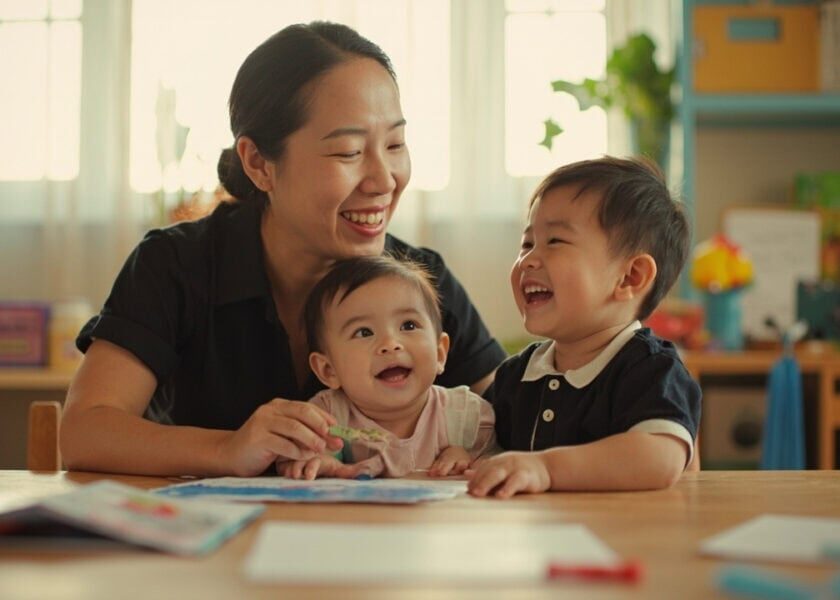
When a child arrives at EduNanny, our caregivers greet them with attention — not with a clipboard and a checklist. They know that child’s name, their mood that morning, the small rituals that help them settle. They know which children need a moment of quiet before they engage and which children need to be met with energetic enthusiasm. They know because they have been paying attention, and because they have the time and the support to pay attention. Our infant ratios are structured to make this possible — we maintain ratios that allow caregivers to truly see each child, not just supervise them.
When it is time for the handover, we do not rush. The goodbye is allowed to be real. It is warm, it is honest, and it acknowledges that leaving is hard and that it is okay to feel that. There is no pressure to hurry away, no suggestion that the tears are an inconvenience to be resolved. The caregiver stays close, offers comfort, and gives the child time to process. The parent is invited to leave with confidence — not because their child has stopped crying, but because they know their child is in hands that will hold them through it.
This is the difference between distraction and attunement. In a less intentional environment, a child who resists handover might be gently redirected, offered a toy, carried off to an activity while their parent slips away. The crying stops, but the emotional work is left unfinished. The child learns to suppress their feelings, or to distrust the moment of separation because it felt unresolved.
At EduNanny, we stay with the feeling. We attune to it. We do not let it go until the child has moved through it — not past it, not under it, but through it. And that is when something shifts. That is when the child begins to learn that they can feel something difficult and still be okay. That they can be held by someone new. That goodbye is not the end.
Secure Attachment and What It Looks Like in Practice
When a child has a secure base — a caregiver they trust, a relationship they can count on — they are better able to venture out. They are better able to separate. They are better able to return.
This is the paradox at the heart of early childhood development: the more securely attached your child is, the more resilient they become in moments of transition. Not because the transitions are easy, but because they know that something solid remains when everything else changes. They have internalized that reliable presence. It lives inside them now. And that is what allows them to greet a new caregiver, explore a new room, or face a new stage of care with growing confidence.
At EduNanny, we invest in building those secure attachments. Our caregivers are not interchangeable. They are consistent, present, and trained to recognize and respond to the subtle cues that indicate a child’s emotional state.
When a child moves from infant care to toddler care, we manage that transition with intention. We do not simply move them to a new room on a predetermined date. We prepare them gradually, introduce them to their new caregivers, share information about their rhythms and preferences, and allow overlap and visits so that the new environment becomes familiar before it becomes permanent. We watch for signs of stress and respond to them. And we communicate with parents throughout, because a transition that is not discussed and understood on both ends is a transition that is only half-managed.
The way your child handles transitions is not a reflection of your parenting or your child’s temperament alone. It is, in significant part, a reflection of the quality of the care they are receiving. And it is one of the most revealing windows into that quality that exists.
- If your child’s caregiver rushes through the handover, if your child is swept away before they are ready, if the goodbye is brief and anxious — your child may cry louder tomorrow and the day after. Not because they are poorly behaved, but because they are learning that goodbyes are things to fear.
- If the handover is calm and consistent, if your child is given time and warmth and presence — they may still cry today, because transitions are genuinely hard for young children, but they will cry less tomorrow. And in a month, they will walk through the door with confidence.
That trajectory is not magic. It is the result of intentional, skilled, caring support in the moments that matter most.
EduNanny’s Approach: Built for This Moment
EduNanny was built for parents like you — parents who feel the weight of that morning handover, who understand what is at stake, who want more than supervision for their child. We are part of the ECDA Childminding Pilot, operating within a framework designed to make quality care accessible to Singapore families.
We offer home-based care pathways for families who prefer a more intimate setting, and centre-based care for those who value community and peer interaction. Our infant ratios are structured so that your child is not one of eight or ten in a room — they are one of at most three, and they are seen. They are known. They are held.
We understand the financial realities that Singapore families navigate. That is why our pilot fee structures are designed to be accessible, and why we make it easy to use your Child Development Account and Baby Bonus funds.
One of the things that sets EduNanny apart is our commitment to communication. We know that trust is built through transparency. When you hand over your child in the morning, you want to know what is happening during the day. Some of our locations have CCTV measures in place — not because we doubt our caregivers, but because we understand that visibility builds confidence.
We share updates, photos, and observations with parents throughout the day. We debrief at pickup. We ask questions and we answer them. We treat you as a partner in your child’s care, not as a client whose concerns are an inconvenience.
When your child has a hard morning, we tell you. Not to alarm you, but because you deserve to know what your child is working through, and because your response when you pick them up matters. When your child has a breakthrough — when they settle faster than before, when they wave goodbye without tears, when they run to their caregiver with something like enthusiasm — we celebrate that with you. Those moments belong to all of us. Because transitions are not something that happens to your child. They are something we do together.
Your Questions, Honestly Answered
“My child cries every morning. Is something wrong?”
Not necessarily. Crying during transitions is normal, especially for infants and toddlers who have not yet developed the cognitive capacity to understand that you will return. What matters is not whether your child cries, but how the crying is responded to. Is your child given time and presence? Is their distress acknowledged rather than dismissed or rushed past? The trajectory matters more than the moment.
“How do I know if the care is really good, not just apparently good?”
Ask about transitions. Ask specifically how the morning handover is handled, what happens if a child resists, how long caregivers spend on the goodbye. A quality childcare environment will have thoughtful, intentional answers. A less intentional one will redirect, hurry, or deflect. The way a caregiver handles your child’s hardest moments reveals their training, their values, and their commitment.
“Is home-based or centre-based care better for transitions?”
It depends on your child and your family. Home-based care offers intimacy, consistency, and a smaller environment — which can make transitions easier for some children. Centre-based care offers peer interaction and a broader social world. At EduNanny, we offer both pathways, and we help families find what works best for their child’s temperament and needs. What matters most is not the setting, but the intentionality of the care within it.
Building the Foundation for School Readiness
As your child grows, the transitions become more complex. The move from infant to toddler care is not simply a change of room. It is a developmental leap. Your child is learning new skills, encountering new social dynamics, and developing a sense of themselves as someone who can do things independently.
At EduNanny, we prepare children for these shifts with care that extends beyond the physical move. We talk to them about what is coming. We read stories about growing up. We introduce them to their new environments gradually, with visits and overlapping time so that the new room is not a stranger’s room but a familiar place with a new adventure waiting.
The move from preschool to primary school is, of course, the transition that weighs most heavily on Singapore parents. You worry about academic readiness — can they read, can they count, can they sit still. And those things matter. But what matters more, and what is far less discussed, is transition readiness.
- Is your child able to navigate a new environment, a new teacher, a new set of expectations?
- Can they manage the anxiety of the first day, the first week, the first month?
- Can they recover from setbacks and keep going?
These are the skills that EduNanny builds, not because we neglect academic preparation, but because we understand that a child who cannot transition cannot learn. Confidence in change is the foundation that makes everything else possible.
What to Look for When Choosing Infant Care in Singapore
- Ask about handover routines. How is the morning transition handled? Is there time built in? Are parents encouraged to stay and settle, or hurried out?
- Observe how caregivers respond to distress. Do they attune to the child’s emotions, or redirect quickly? Do they rush to stop the crying, or stay with the feeling until it passes?
- Check infant ratios. Smaller ratios mean more attention for each child, including the attention needed during difficult transitions.
- Ask about consistency. Are caregivers consistent day-to-day? Consistent over months? A rotating cast of caregivers makes secure attachment nearly impossible.
- Look for communication. Will you know what is happening during the day? Will you be told about both the hard moments and the breakthroughs?
- Trust your gut. If something feels rushed, clinical, or dismissive in the centre, that is information. The way you are treated as a parent is often a preview of how your child will be treated.
Every Goodbye Is a Foundation Being Built
Let me close with what I believe is the most important reframe I can offer you.
Every morning, when you hand your child to their caregiver, you are not just completing a logistical task. You are not just managing a separation that you will reverse at pickup. You are, if you are fortunate enough to have found the right care, giving your child an opportunity to learn something extraordinary.
You are giving them the chance to discover that they are more capable than they knew. That they can feel afraid and still move forward. That the world has people in it who will hold them when you cannot. That goodbye is hard but it is not permanent, and return is always coming.
EduNanny was founded on the belief that these moments — the small, invisible, underappreciated moments between goodbye and hello — are where children are made ready for everything that comes after. Not just school, but life. We believe that a child’s ability to navigate transitions is not a side effect of good care. It is the point. It is the proof. It is the skill that, once built, opens every door.
So when you walk through our doors tomorrow morning, and your child clings to you, and the caregiver leans down to meet their eyes, and the moment stretches and slows and then finally resolves — know that you are not just surviving a hard moment. You are watching your child learn something that will serve them for the rest of their lives.
You are watching them learn to trust. To separate. To return. To be human in a complex and changing world.
And we are honored to be part of that.
EduNanny. Where every transition becomes a foundation.
Ready to learn more about care that takes transitions seriously? Connect with EduNanny to explore our infant care and childminding options, our pilot fee structures, and how we support both you and your child through every morning handover.
Learn more about who we are and the standards we hold ourselves to.