What Your Child’s Caregiver Teaches Before They Learn to Speak
The Question Beneath the Question
We spend enormous energy in Singapore preparing for parenthood—choosing confinement helpers, researching developmental toys, mapping school pathways before our children can walk. We plan with a precision that would have bewildered our own parents.
And yet, when it comes to the caregiver relationship—specifically, what your child is learning from the first adult outside your family who knows them by name—the conversation has been almost entirely about you. About your anxiety. About whether you should feel guilty. About whether the arrangement serves your needs as a working parent.
Those are not the wrong questions. But they are incomplete.
There is a morning that every parent who chooses professional childcare remembers. You arrive at the door. Your child looks up. And instead of reaching for you, they reach for someone else.
In that moment, something shifts. Somewhere beneath both of those feelings, a question forms that you may not yet have words for: What is my child learning from the person who is not me?
That question deserves an answer that goes deeper than what most conversations about childcare offer. This is that answer.
What Your Child Is Actually Learning
Developmental science has understood this for decades, but it has not yet become the story we tell parents in Singapore.
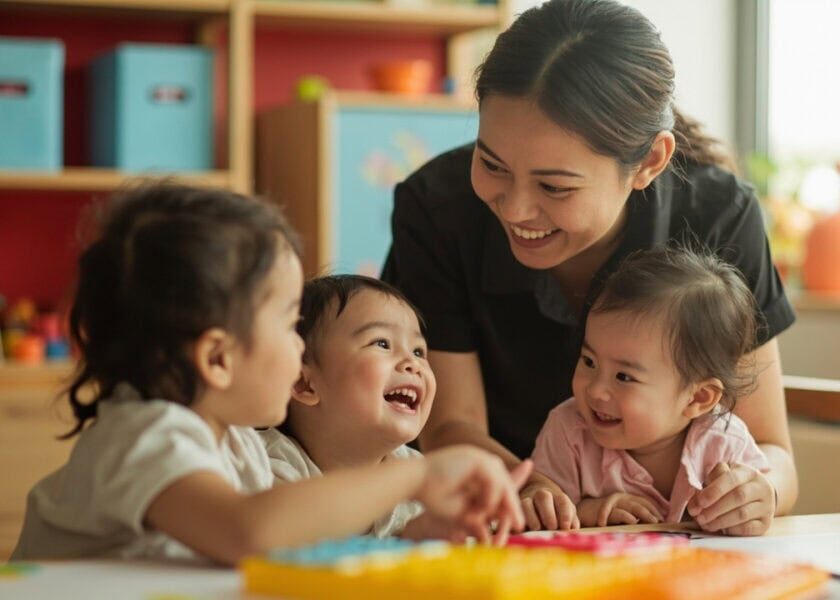
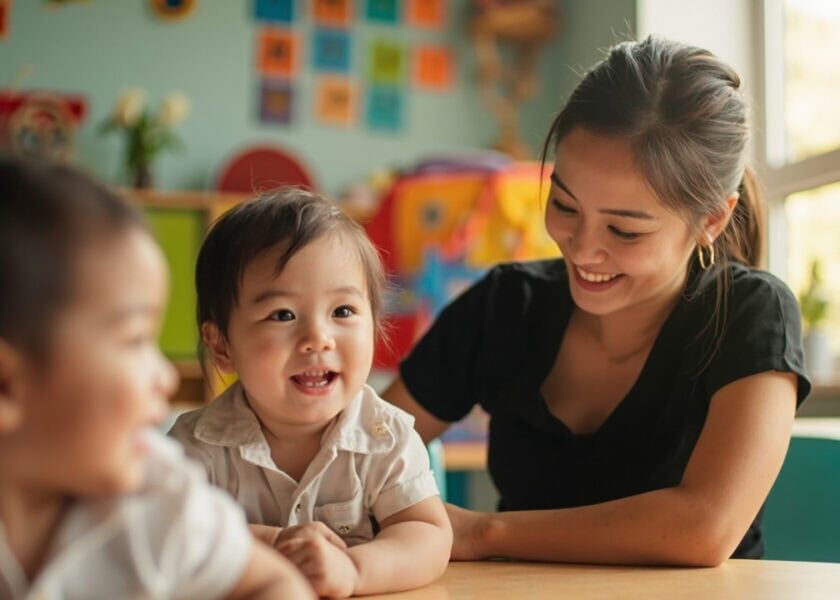
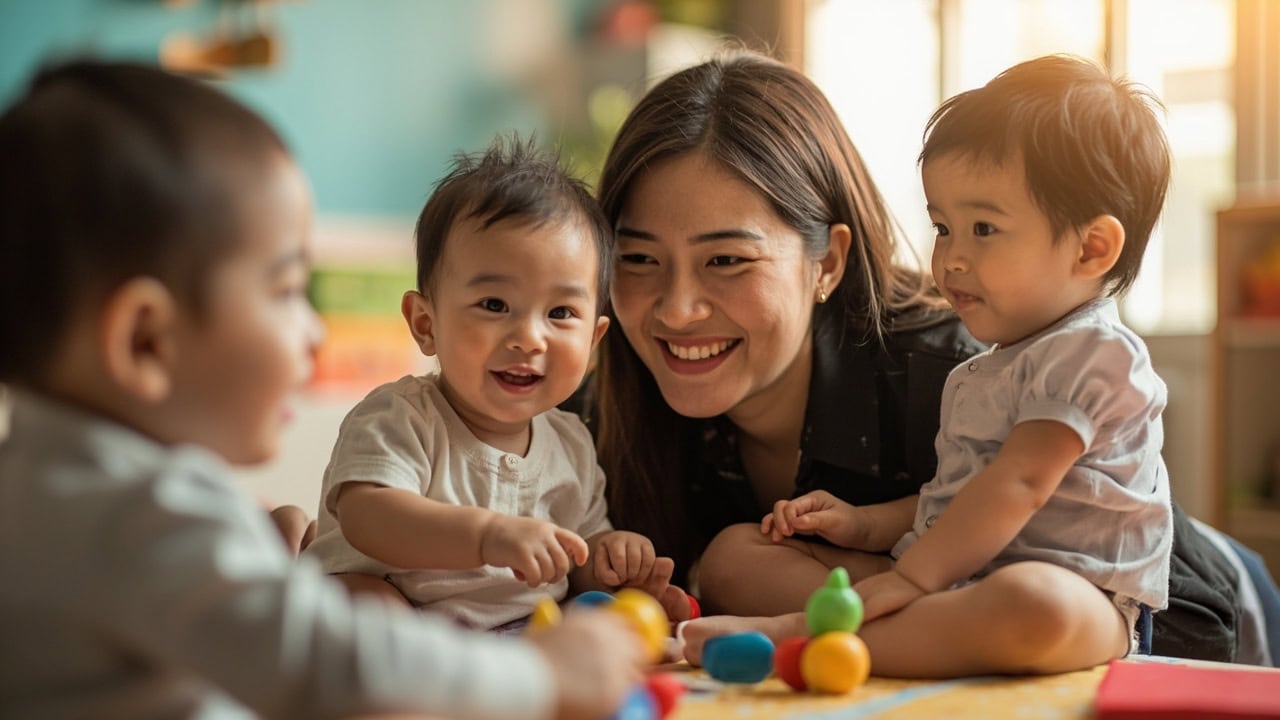
When your child forms a relationship with a quality caregiver outside your family, they are not simply being watched. They are being formed.
Children who develop secure attachments to secondary caregivers—who learn, in those first years, that there are capable, warm adults beyond their parents who can know them, respond to them, and keep them safe—enter school differently. They negotiate peer relationships differently. They manage their own emotions with greater fluency. They ask for help when they need it, rather than collapsing or withdrawing.
They believe, at a level deeper than thought, that the world contains adults who are trustworthy, skilled, and kind.
This is the difference between a child who believes the world is populated by strangers and a child who believes the world is populated by people. And that quiet, foundational sense that human beings can be relied upon is one of the most important things your child will ever carry.
Watching vs. Knowing: The Difference That Changes Everything
Not every caregiver relationship produces this outcome. I am not talking about adequate care—a place where a child is fed and kept safe and distracted until a parent returns. I am talking about a relationship.
Watching is what happens when a caregiver provides coverage. The child is clean. The child is fed. The child is not in danger. These are necessary things, and they matter. But they are not sufficient for what your child needs.
Knowing is what happens when a caregiver pays attention—really pays attention—over weeks and months. When they learn your child’s rhythms, their fears, the particular way they like to be held when they are tired versus when they are overstimulated. When they notice the face your child makes before a meltdown and intervene before it arrives.
When your child looks up at them and sees not a stranger but a person who has been paying attention, who shows up with consistency and warmth every single day.
Your child knows the difference. Long before they have language, they know the difference.
Children who have had a quality caregiver relationship enter their preschool years with a quiet confidence that is hard to name but easy to recognize. They are not necessarily more academically advanced. But they are more socially alive.
They read other children better. They recover from disappointment faster. They know how to be in a group—to contribute, to take turns, to assert themselves, to make space for others. They have what educators call social competence, and it is one of the single greatest predictors of how well a child will do not just in school but in life.
Because being in a group requires a child to manage their own needs while also attuning to others. It requires emotional regulation. The ability to trust that adults will keep things fair and safe. The willingness to ask for help.
It requires, in short, everything that a quality caregiver relationship teaches.
Addressing the Fear: Will Another Adult Replace Me?
I know this is where the weight sits for many of you.
You are afraid that this lesson will compete with the lesson you want to give. That another adult will matter too much. That your child will somehow love you less, or need you less, or feel that you have been replaced.
Let me speak directly to that fear, because it is real and it deserves a real answer.
The caregiver relationship does not compete with parental attachment. It extends it.
This is what developmental psychologists call secure base theory. Your child needs you to be their primary secure base—the person they return to, the person who anchors them, the person whose love they carry like a lantern inside themselves.
But a lantern does not diminish when another light is lit.
Your child can have you as their center and still have other adults who are warm and trustworthy in their orbit. In fact, this is exactly what healthy development requires.
What the caregiver relationship does, when it is done well, is prove to your child that the world beyond you is not a threat. That there are other capable, caring adults who exist, who see them, who will show up.
Your role in this is simple: honor the caregiver relationship as a gift you are giving your child, while remaining the anchor that your child returns to.
- Talk about the caregiver at home, positively. Your child should hear you value this person.
- Ask your child about their day in ways that show you value the relationship—not to interrogate, but to include.
- Share information with your caregiver about changes at home that might affect your child’s mood.
- Allow the caregiver to develop genuine knowledge of your child, and trust that knowledge.
- When you see that your child is thriving in the caregiver’s presence, let that be a source of peace for you, not anxiety.
You are not replaced. You are extended.
Why This Matters Differently in Singapore
We are a city of dual-income families. We are a city where grandparents sometimes cannot help, where the village that once surrounded a new family has dispersed across neighborhoods and schedules and generations who no longer live in proximity.
We are a city where parents make a choice to return to work—and make it thoughtfully, carefully, weighing what is gained and what is given up—and then carry the weight of that choice into every morning handoff.
Singapore parents are not opting for professional childcare because they do not love their children. They are opting for it because they are building a life in a particular place, at a particular moment in history, and they are doing their best to do it well.
Here is what I want you to hear: the best care you can give your child, in this context, is not the care that minimizes the time you are away. It is the care that makes every hour your child spends with their caregiver as formative as possible.
Cultural attunement matters deeply here—and it should not be treated as a luxury or a marketing point, but as a genuine developmental consideration.
Singapore is not one culture. It is many. And a caregiver who understands your family’s heritage—who speaks your home language, who knows the foods your child eats and the songs you sing and the small rituals that make your family feel like yours—that caregiver is not just providing care.
They are holding your child’s sense of identity while you work. They are teaching your child that who they are is valued, even in your absence. They are extending your family’s warmth in your absence.
What to Look For When Choosing Infant Care
If you are researching infant care options in Singapore, here are the questions that matter most:
| Look For This | Ask About This |
|---|---|
| Ratio and attention | How many children per caregiver? Can each child be truly known? |
| Cultural attunement | Does the caregiver share your home language? Do they understand your family’s heritage and rituals? |
| Communication systems | How will you know what your child’s day was like? Are updates regular and meaningful? |
| Consistency | Will your child have the same caregiver over time, or will faces constantly change? |
| Training in attunement | Is caregiver training focused on safety alone, or does it include emotional responsiveness and observation skills? |
| Transparency | What systems are in place to build trust between families and caregivers? |
The answers to these questions will tell you whether you are looking at a place that watches or a place that knows.
Returning to That Morning
Let me close by returning to that moment. The one you remember. The one where your child reached for someone else.
I see a child who is learning one of the most important lessons they will ever receive: that human connection is not limited to family. That the world contains capable, warm adults who can know them, respond to them, and keep them safe. That they are not alone when you leave them.
That someone is expecting them. That someone is glad to see them. That someone will hold the structure of their day with care.
This lesson will not appear on any report card. It will not be named in any assessment. But it will be present in every social interaction your child has for the rest of their life.
It will be present in how they trust their teachers. In how they form friendships. In how they collaborate, negotiate, recover from conflict, ask for help. In how they believe about the world and the people in it.
Your child is forming their first picture of what competent, caring human connection looks like.
Right now. In these early years. In the small, daily moments that seem ordinary but are anything but.
Make sure that picture is worthy of them.
That is the invitation. That is what thoughtful, development-oriented childcare is here to walk alongside you in doing—not to replace you, not to compete with you, but to be, for your child, the first proof that the world contains warm adults.
Adults who will show up. Who will pay attention. Who will know them. Who will hold them safe. Who will teach them, quietly and steadily, what it means to trust.
Your child is ready to learn this lesson. And with the right caregiver, with the right support, with your love as the anchor and the foundation—your child will carry this lesson with them wherever they go.
At EduNanny, we believe that quality caregiver relationships are one of the most meaningful gifts you can give your child in these early years. Our team is here to answer your questions, understand your family’s needs, and help you find the right match. We welcome the opportunity to connect with you.