What Your Child’s Body Is Already Telling You
“`html
The Language Your Child Is Already Speaking
That language is sensory. It lives in the body. It shows up in posture and grip and the way a child’s eyes move across a room. It is expressed in the register of their cry, the rhythm of their breathing, the tension in their shoulders when you pick them up.
Before children learn to narrate their inner world, they broadcast it constantly through sensory channels — and the parents who learn to receive these signals gain something remarkable: a daily connection to their child’s experience that does not depend on perfect recall or perfect presence. It depends on something more learnable than either. It depends on sensory-emotional literacy.
What Sensory-Emotional Literacy Actually Means
Sensory-emotional literacy is the ability to read your child’s behavioral and sensory signals as meaningful communication rather than random noise. It is the skill of noticing, for instance, that your toddler’s fierce resistance to handwashing is not defiance but a genuine sensory overwhelm — the unexpected sensation of water temperature, the feel of soap, the loss of control.
It is recognizing that the baby who turns her face away at every feeding is not rejecting you but communicating something about her sensory state, her regulation, her readiness. It is understanding that the child who cannot settle at bedtime after a full day of care is not being difficult — she is processing a day’s worth of sensory input that has nowhere else to go.
These are not soft or speculative ideas. They are grounded in decades of neuroscience research on sensory processing — the way the nervous system receives, modulates, and responds to sensory information from the moment a child is born.
Why Every Child Processes Differently
Every child processes sensory input differently. Some children are under-responsive to certain sensations; others are hyper-responsive. Some seek movement and rough-and-tumble play as a regulatory strategy. Others are easily dysregulated by exactly those experiences.
These differences are not character traits or parenting failures. They are data. And the parents and caregivers who learn to read this data enter a different relationship with their child — one built on daily attunement rather than daily guessing.
The Singapore Reality: Time Apart and the Sensory Gap
Here is what makes this especially urgent in Singapore. The average working parent here spends ten, eleven, sometimes twelve hours away from their child each weekday. That is a significant portion of a young child’s waking life.
During those hours, the child’s sensory experience — the textures and sounds and social rhythms of their care environment, the food, the light, the transitions between activities — is accumulating in their nervous system whether or not anyone is paying attention. By the time parents return, they are often receiving the residue of this experience in the form of behavioral shifts, regressions, difficulty settling, or conversely, a peculiar flatness that feels like distance.
This is not a failure of parenting. It is the predictable consequence of a system that asks very young children to process enormous amounts of sensory and social information without giving their parents the framework to understand what they are processing.
The anxiety that follows — the guilt, the second-guessing, the sense that you are not fully present or knowledgeable as a parent — is not a character flaw. It is a structural problem. And it has a structural solution.
A Child’s Body Is Their First Language
That solution begins with recognizing that children communicate their sensory world constantly. A child’s body is, in many ways, their first language. Before they can name their feelings, they express them through sensory preferences and aversions.
They seek out or avoid certain textures, movements, sounds, and temperatures. They regulate through their bodies — rocking, pacing, seeking deep pressure, clinging, flopping. These are not behaviors to be managed. They are communications to be understood.
When parents learn to read them, something shifts. The evening transition — that fraught window between care pickup and home arrival — transforms from a source of anxiety into an observation window. A window into your child’s sensory day.
The Evening Transition: Reading the Data at Pickup
Think about what you are actually seeing when you pick up your child and notice they are irritable, or distant, or uncharacteristically clingy. You are seeing the output of a nervous system that has been processing input all day.
The child who collapses into your arms at pickup is not weak or spoiled — she may be releasing a day’s worth of held tension, finally in the presence of the caregiver who helps her feel safe enough to let go. The child who refuses to eat dinner after a full day of care may not be manipulating you — she may have been offered food at a sensory time that did not match her regulatory state, or she may be so sensory-overloaded that eating feels impossible.
These are not guesses. They are legible patterns once you know what to look for.
Questions That Reveal More Than “How Was Your Day?”
As you develop sensory-emotional literacy, you learn to ask better questions. Instead of how was the day? — to which most toddlers will answer fine regardless of what actually happened — you learn to ask:
- What was mealtime like today?
- How did she handle the transition to outdoor play?
- Did he seem to seek out movement or calm?
- Were there moments where she withdrew or seemed overwhelmed?
- What seemed to soothe her when she was upset?
These questions tell you something real. They help you build a picture of your child’s sensory world — which activities they sought out, where they showed sensitivity, what challenged them, what stretched them in ways that supported growth.
What Quality Infant Care Actually Looks Like
This is where the partnership between parents and caregivers becomes essential — and where the quality of that partnership determines everything.
The best infant care is not simply supervision. It is sensory-emotional co-regulation. It is a caregiver who notices that a child is becoming dysregulated before the meltdown arrives and gently intervenes — changing the sensory environment, offering movement, adjusting the pace of the day.
It is a caregiver who can tell you not just that your child had a good day, but what their sensory day looked like: where they sought input, where they withdrew, what soothed them, what challenged them.
Signs of Genuinely Developmental Infant Care
This kind of observation is not intuitive for most caregivers. It is a trained skill. And it is the skill that distinguishes genuinely developmental infant care from mere childcare.
When you are evaluating care options, look for these indicators:
- The caregiver describes specific observations, not general reassurances
- They can tell you about your child’s sensory preferences and patterns
- They notice when something is atypical before you ask
- They involve you as a partner in understanding your child, not just a recipient of daily updates
- The environment allows for individual attention — small ratios, calm spaces, unhurried transitions
EduNanny Singapore: Built Around This Understanding
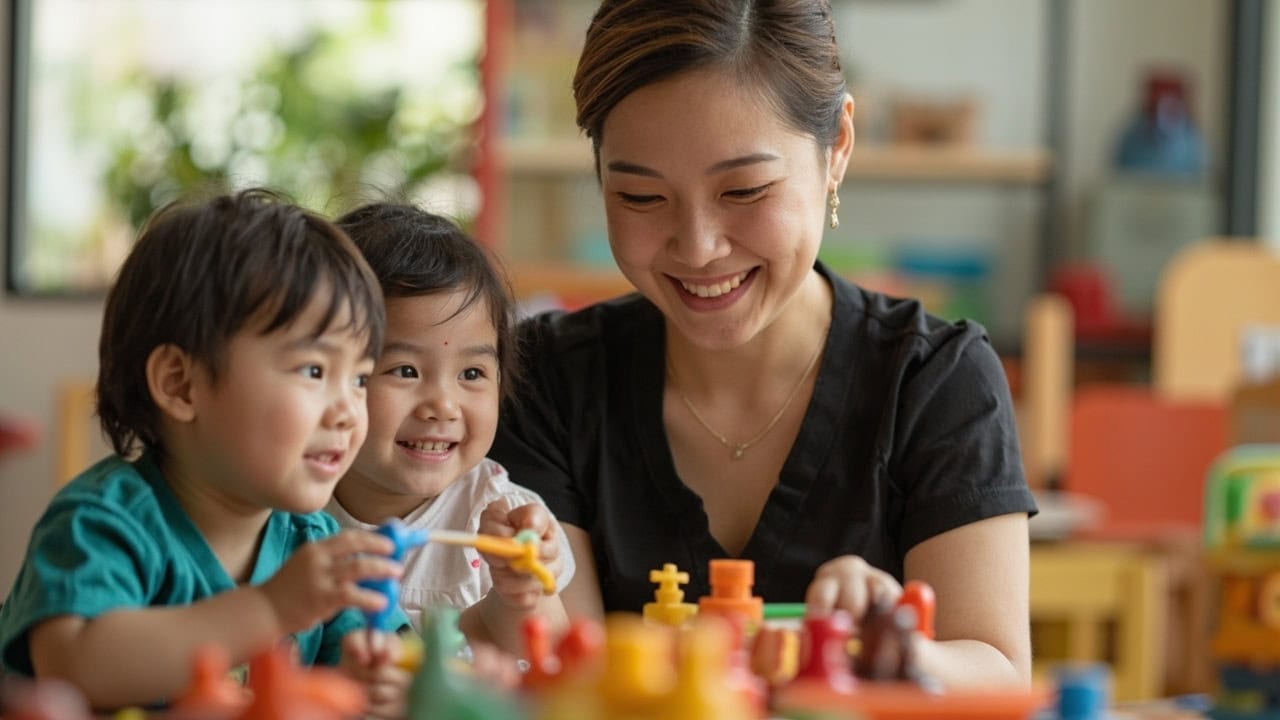
EduNanny Singapore, operating under the ECDA Childminding Pilot, is built around this understanding. The caregivers within this program are not simply present with your child. They are trained to observe — to notice the sensory patterns that reveal your child’s internal state, to document the small shifts that tell the story of their day, to communicate what they see in a way that helps you understand rather than simply reassure.
The infant ratios maintained within the pilot — up to one to three infants in certain home-based configurations — allow for this kind of attention. You cannot observe sensory patterns in a room of twelve infants. You can observe them when the ratio is small enough for the caregiver to truly see.
Not every family will need the same configuration. Some will thrive in home-based care with its intimate scale and family-like rhythms. Others will benefit from the community pathway with its balance of structure and connection. Still others will find centre-based care the right fit for their circumstances.
What EduNanny provides across all pathways is a consistent standard of observation, communication, and sensory attentiveness — and a commitment to transparency that helps parents feel genuinely informed rather than simply reassured.
Questions Parents Actually Ask
“Am I failing my child by going back to work?”
The anxiety that working parents carry is real. It is not irrational. It is a reasonable response to a genuine information gap — the gap between what you know about your child’s experience and what you need to know to feel truly connected to them.
No care arrangement will eliminate that gap entirely. But a good one will give you tools to navigate it. A good caregiver will help you develop the observational skills to read your child more accurately. They will treat you as a partner in your child’s sensory development, not a customer to be managed.
“How do I know if a caregiver is actually observant?”
Ask them to describe a specific moment with your child — not a summary of the day, but a scene. A good observer will notice details: how your child responded to a particular texture, how their posture changed during a transition, what seemed to calm them when they were upset. If their answers are vague or generic, that is information.
“Is this just about me learning to read my child better, or does the caregiver need training too?”
Both. Sensory-emotional literacy is a skill parents can develop — and the evening pickup is your daily practice ground. But it also needs to be present in your care partner. The partnership only works when both sides are fluent in the language. Look for caregivers who have been oriented to sensory observation, who document what they see, and who communicate it in ways that help you understand rather than just report.
“What practical questions should I ask when choosing infant care in Singapore?”
When evaluating care options, consider these alongside the practical ones:
- Can the caregiver describe your child’s sensory preferences in specific terms?
- Do they share observations that go beyond “she had a good day” or “he ate well”?
- Are they able to tell you about transitions — how your child handled moving between activities?
- Do they notice when something is atypical before you ask?
- Does the environment allow for individual attention — not just supervision, but observation?
- Do they treat you as a partner in understanding your child?
The answers to these questions tell you something important: whether this care arrangement will help you close the sensory gap, or whether it will leave you still guessing at the end of every day.
The Quiet Revolution in Reading Your Child
As you develop these skills yourself — as you begin to notice, with practice, the sensory patterns in your own child’s behavior — something changes. The guilt softens. Not because the hours apart have become less significant, but because you have developed a new language for staying connected across them.
You learn to read the child’s body at pickup as data, not as evidence of your failure. You learn to trust your own observations alongside the caregiver’s report, and slowly, over weeks and months, you build a picture of your child’s sensory world that becomes a source of confidence rather than anxiety.
This is what sensory-emotional literacy makes possible. Not perfect knowledge. Not omniscient parenting. But a steady, growing ability to read your child — to understand what they are communicating before they have words for it, to respond to their actual needs rather than the needs you assume they have, to feel present and knowledgeable in your own child’s life even when the hours apart are long.
From “Is This Normal?” to “What Is My Child Telling Me?”
There is a quiet revolution in this. It is not dramatic. It does not announce itself. But it changes everything about the relationship between parent and child — and between parent and caregiver.
When you know how to read your child’s sensory signals, you stop asking is this normal? and start asking what is my child telling me? When your caregiver knows how to observe those signals, they stop being a stranger who watched your child and start being a partner in understanding your child.
The evening transition stops being a source of dread and becomes an invitation — an invitation into your child’s sensory world, which is always communicating, always revealing, always ready to be heard by the parent who learns to listen.
That invitation is always open. But it helps to have someone standing beside you who understands the language.
An Invitation to Begin
EduNanny Singapore was built for this. For the working parents of this city who love their children fiercely and still feel, on some days, that they do not know them well enough. For the caregivers who want to be more than supervisors and know that their observations matter. For the children who are broadcasting their inner world every single day through posture and preference and protest, waiting for someone to receive the message.
The sensory world your child cannot yet tell you about is not a mystery you will never solve. It is a language you can learn. And the first step is the simplest and the hardest: to believe that your child’s behavior means something, and that the effort to understand it is one of the most important things you will ever do as a parent.
That is the work. That is the partnership. And that is what EduNanny Singapore is here to walk alongside you in — day by day, observation by observation, signal by signal — until reading your child becomes not a challenge but a habit, not a source of anxiety but a source of wonder.
Your child is speaking. Every day, in every moment, through every cell of their body. The question was never whether they are saying something.
The question is whether you are ready to hear it.
Ready to explore care options that take sensory-emotional development seriously? Learn more about EduNanny Singapore’s ECDA-licensed childminding pathways and discover how trained caregivers support your child’s daily observation and communication.
Sensory-Emotional Literacy · Singapore Childminding · Infant Care Singapore · Working Parents Singapore · Child Development
EduNanny Singapore · About Us · Contact
“`