What Your Child Really Learns When You’re Not There
What Your Child Actually Feels in the Hours You Are Apart
Most conversations about childcare focus on what parents need to know before they choose. Fewer conversations ask a more illuminating question: what does your child actually experience during those hours? Understanding this does not minimize your worry. It honors it. And it changes how you think about the choice you have made, or the choice you are considering making.
- Separation is not a fracture in attachment; it is a crossing that builds the child’s internal map of trust
- Quality care environments are designed for active discovery, not passive waiting
- Children in attuned care are not merely supervised; they are known
- Research shows children benefit most when secure parental attachment and quality alternative care work together
- What children bring home after quality care reflects real growth: new words, new gestures, new social confidence
The Moment of Separation: Resilience in Real Time
Let us begin where every care day begins: with a small hand reaching up from the ground, fingers curling around nothing but air, reaching for a parent’s hand that is slowly, gently letting go.
This is the moment that haunts parents most. The image of their child watching them leave. The worry that this moment is painful, traumatic, a fracture in the bond between parent and child.
But step closer. Look at what is happening in that child’s body.
There is a caregiver nearby whose voice is warm and unhurried. There is a room full of light and small tables and chairs built for bodies that are still learning how to be held by the world. There is a mat where another child is stacking blocks, and the sound of that stacking, that small clatter of wood on wood, is interesting. There is a window where the morning sun makes patterns on the floor.
And then something happens that most parents never witness: the child’s hand, still reaching for a parent who is now out of sight, slowly lowers. The body turns. The eyes find the blocks. The legs carry the child toward something that catches the light just right.
This is not resilience as a performance. This is resilience as a process, happening in real time, in a body that is learning that the world contains more than one source of safety, more than one pair of arms that hold.
What separates adequate care from quality care is whether the environment, the caregiver, and the rhythm of the day give the child’s nervous system the time and support it needs to find its footing again. In quality care, this moment of separation is met with attunement. Not a scripted greeting, not a distracted acknowledgment, but a genuine meeting of attention between caregiver and child.
The caregiver notices the child’s pace, the child’s mood, the particular quality of this child’s entrance on this particular morning. She does not rush the adjustment. She allows the child’s internal clock to set the pace of the transition.
Because she knows, and research confirms, that when a child’s nervous system feels understood rather than managed, the child’s capacity to explore and learn activates far more quickly.
This is the first lesson of quality care, and it happens before most parents have even reached the car park: your child is not simply waiting for you to return. Your child is already living, already learning, already building the architecture of trust that will shape how he or she approaches every new experience for years to come.
Inside the Morning: Discovery, Exploration, and Being Known
Follow the child further inside the morning.
For a child in quality care, every object in the room is a teacher. The shape-sorter with its geometric holes is not just a toy. It is a lesson in cause and effect, in the satisfaction of persistence, in the vocabulary of inside and outside, in the pleasure of getting something right after getting it wrong. The play dough is not just mess. It is sensory information that builds neural pathways in ways that worksheet activities cannot replicate. The picture book on the low shelf is not decoration. It is an invitation to language, to narrative, to the idea that things that happen in one place can be described in another place, that stories live in words, that books contain worlds.
Watch a child in quality care for a full morning, and you will see something remarkable: the child is in a state of active discovery that is qualitatively different from what happens at home. Not because home is insufficient, but because the care environment is designed for this. The caregiver has intentionally arranged the space to offer choices, challenges, and invitations. She has considered what the child is ready for, what stretches the child’s current abilities without frustrating them, what sensory experiences the child’s body and mind need to grow.
In a home-based childminding setting, caregiver ratio matters enormously. When an infant-to-caregiver ratio is kept low, the caregiver has the space to truly know each child. Not just their names and their allergies, but their rhythms, their preferences, the particular face they make when they are about to have a breakthrough in language, the way their body relaxes when they are truly secure versus when they are merely compliant.
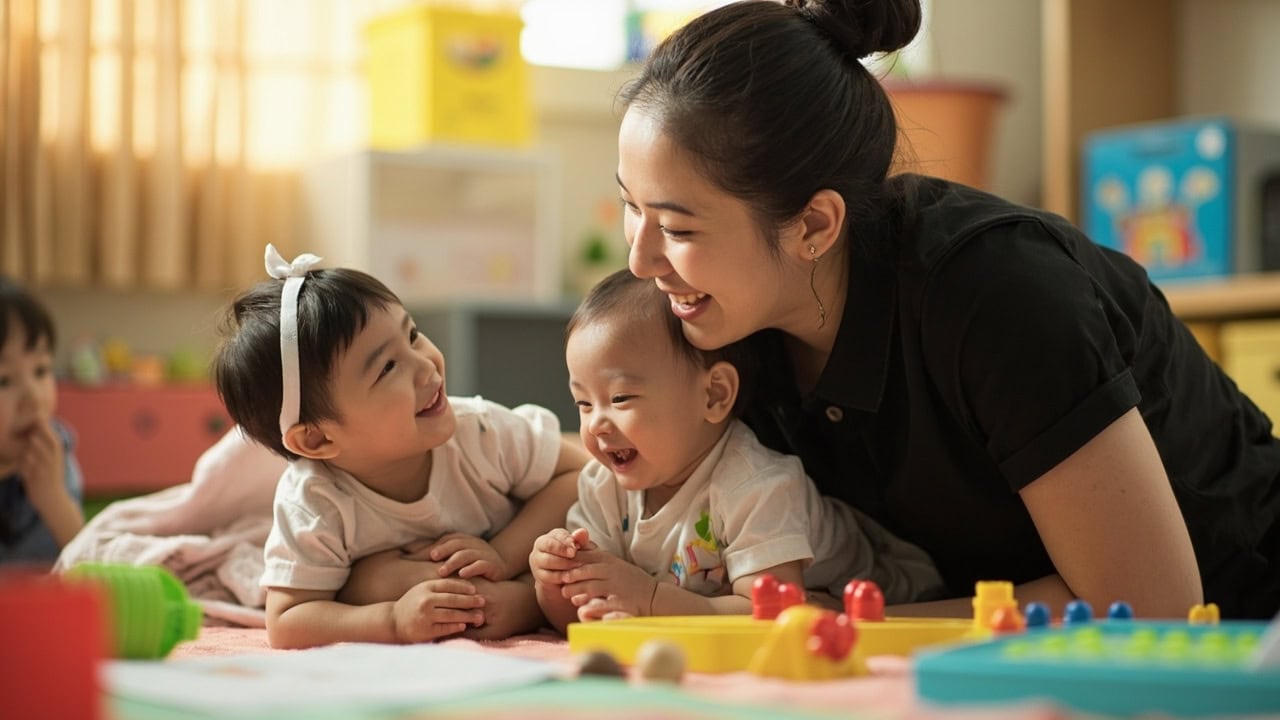
Your child, in quality care, is not merely supervised. Your child is known. And being known by an adult who is attentive and warm and consistent is one of the foundational experiences that shapes a child’s sense of worth, their belief that they matter, that they are worthy of attention, that the world is a place where their presence registers.
What Quality Childminding Actually Looks Like
There is a narrative in some childcare discourse that suggests quality care is equivalent to parental care, that children in childcare settings receive everything they need and that parents need not worry. This is not what the evidence says.
Parental attachment is irreplaceable. The bond between a parent and child carries a biological and emotional weight that no caregiver relationship can replicate. What quality care provides is not a substitute for this bond but a complement to it. A second secure base from which the child can explore. An additional set of attuned eyes on the child’s development. A consistent, warm relationship that adds to the child’s relational world rather than replacing what parents provide.
Research consistently shows that children benefit most when they have secure parental attachment and quality alternative care. These two experiences do not compete. They collaborate. They give the child multiple templates for trust, for relationship, for exploration.
If you could watch your child for a full week in quality care, not through a window or a livestream, but with the eyes of someone who understands child development, you would see something extraordinary.
You would see the child arrive each morning with less hesitation than the week before. Not because they have forgotten you. Because they have learned, through consistent, warm, attuned care, that leaving is survivable. That the world is navigable. That they are capable of moving through new experiences and returning to what is familiar.
You would see the child initiate play with peers, then pause, then initiate again. You would see the negotiation, the sharing, the frustration, the repair. You would see social competence being built in real time, brick by brick, in a context that is supervised but not controlled, supported but not rescued.
You would see the caregiver respond to your child’s distress with a kind of calm that communicates safety. Not by eliminating all discomfort, which is impossible and also unhelpful, but by showing your child that feelings can be held, that being upset does not mean being abandoned, that there is an adult in the world who can sit with the hard stuff without needing to fix it immediately.
You would see your child’s language expand in ways that no class can teach. Not because the caregiver is drilling vocabulary, but because language is modeled, narrated, invited, responded to. Because a child in quality care hears thousands more words directed at them than a child in a less attentive setting, and each of those words builds the neural architecture for future language, for future literacy, for future thinking.
You would see your child’s confidence grow in increments so small that they are invisible from one day to the next but unmistakable from one month to the next. The child who would not touch the play dough now has it in both hands. The child who hid behind their parent’s leg now walks into the room. The child who did not know what to do with other children now has a friend.
The Singapore Parent’s Reality: Guilt, Context, and Academic Readiness
Singapore parents navigate something unique. You are raising children in one of the most academically rigorous cultures in the world. You understand, perhaps more acutely than parents in many other countries, that the early years are not just play. That the foundations laid in infancy and toddlerhood shape cognitive pathways, social capacities, emotional regulation, that these things matter in ways that compound over time.
At the same time, Singapore parents are navigating a society where dual-income households have become the norm, where the cost of living demands that both parents work, where the extended family that once provided informal childcare is increasingly geographically dispersed. You are not choosing between family and career. You are trying to do both, with excellence, with intention, and without guilt.
The Weight of Guilt Is Not Irrational
The guilt is real. It is not irrational. It is the echo of a cultural shift that has happened faster than our psychology has been able to adapt. For most of human history, children were raised within an extended network of family, clan, village. Separation from primary caregivers for extended hours was not the norm. Our nervous systems are calibrated for a world that no longer exists.
So when you feel the weight of leaving your child, you are not being weak or irrational. You are being human.
But here is what also needs to be said: you are making a choice, often a difficult, logistics-heavy, emotionally taxing choice, to provide for your child. To create the financial stability your family needs. To model for your child, in ways they will not consciously remember but will deeply absorb, that family is a project that requires sacrifice, that love is expressed through action, that the people who matter most are sometimes the people who let go so that something else can be built.
And when that choice includes quality care, something else is built. Your child’s capacity to relate to adults outside the family. Your child’s social skills with peers. Your child’s ability to adapt to new environments. Your child’s confidence.
Challenging the Academic Readiness Assumption
Singapore parents often worry that early childcare will diminish their child’s Singapore edge. That the academic culture they want to nurture will be diluted by what they perceive as babysitting.
Quality childcare in Singapore is not a retreat from academic culture. It is a foundation for it. The child who enters Primary One having spent their early years in attentive, play-based, developmentally sound care has already built the executive function skills that academic success requires.
They know how to focus. They know how to persist when something is difficult. They know how to take turns, how to manage frustration, how to ask for help, how to collaborate. These are not soft skills. They are the hard architecture of learning.
And they are built, not through flashcards and worksheets, but through the hundreds of small moments in a quality care day: the moment when a caregiver notices a child is about to give up on a puzzle and offers just enough challenge to keep them engaged, the moment when a caregiver narrates a child’s action back to them, building the vocabulary of self-awareness, the moment when two children negotiate over a toy and a caregiver is there to scaffold the conversation without taking over.
What Your Child Brings Home
When your child returns home at the end of a care day, something has been added to him or her. Not taken away, not substituted, but added. A new word perhaps, one learned from a caregiver or a peer. A new gesture, a new way of solving a problem. A story about what happened in the morning. A reference point for how another adult, outside the family, responded to their needs with care and attention.
What your child brings home is not evidence that care was okay. It is evidence that care was alive, active, formative.
When your child tells you, in their limited but rapidly expanding vocabulary, about the song they sang, or the sand they touched, or the friend who shared a toy, they are processing. They are integrating. They are weaving the experience of care into the fabric of their sense of self.
And you are there, on the other side of that experience, to welcome them back, to hold them, to be the steady presence that makes everything else possible.
You are part of this. Your trust, your choice, your act of leaving and coming back, of being consistent, of showing up at the end of each day, of listening to your child’s babbled accounts of the morning, of validating that the care experience mattered even though it happened somewhere else. All of this is part of your child’s development.
Quality childcare does not replace your role as a parent. It collaborates with it.
How to Choose Quality Infant Care in Singapore
When researching infant care and childminding in Singapore, look beyond the marketing language. What you are really assessing is whether your child will be known, not just watched. Here are the questions that matter most:
- Ratios and group size: How many children are there per caregiver, especially for infants? Lower ratios mean more individual attention, more observation, more attunement.
- Caregiver training: Do caregivers understand early childhood development, not just safety protocols? Can they recognize schemas, developmental leaps, and signs of secure attachment?
- Transition support: How does the caregiver handle the morning handoff? Is there space for the child’s adjustment, or is the pace rushed?
- Environment design: Is the space intentionally arranged to invite discovery? Are materials accessible and developmentally appropriate?
- Communication systems: How will you know what happened during the day? Are updates built into the philosophy, or added as an afterthought?
- Regulation and transparency: Is the provider registered with ECDA? Are there transparency measures that respect both trust and verification?
What EduNanny Offers Singapore Families
EduNanny by BUTLER is a childminding pilot registered with ECDA, the Early Childhood Development Agency. It operates within a framework of standards designed to protect and nurture your child, offering pathways for both home-based care and community settings.
The infant ratios in this pilot are designed to ensure attunement is not a promise but a reality. When there are only one to three infants per caregiver, every cry is noticed. Every developmental leap is observed. Every child’s internal experience is attended to, not as an afterthought, but as the central purpose of the care day.
For Singapore families, practical considerations matter. Child Development Account funds can be used. Baby Bonus benefits apply. These are not marketing talking points. They are practical realities that make quality care feasible for families across Singapore’s economic landscape.
Communication is built into the system as a philosophy. Parents receive regular updates about their child’s day, because EduNanny understands that the trust gap exists precisely because parents are not present to witness what is happening. Where deployed, transparency measures such as CCTV allow parents additional peace of mind, not because trust is absent, but because transparency and trust are not opposites. They are companions.
Thomas, the AI chatbot that serves as a 24-hour parenting companion, is a digital extension of the care philosophy that says: you are not alone in this. Thomas is not a replacement for human care or human connection. Thomas is a bridge. A place where parents can ask questions at 11 p.m., after the house is finally quiet, about what they observed in their child’s behavior, about developmental milestones, about the thousand small uncertainties that arise in parenting.
The Child Who Flourishes
EduNanny exists to be your partner in this work. Not to replace what you do. Not to be the primary source of your child’s development. But to provide the quality, the attention, the attunement, the careful ratio, the trained caregivers, the transparent communication, the innovative support systems that make this collaboration possible.
We see the child. We see your child. Not as a charge to be supervised, but as a person to be known.
And we believe, with evidence and with heart, that when a child is truly known, something extraordinary happens. They begin to flourish. They begin to show you, at home, what they discovered at care. They begin to bring back pieces of themselves that grew in your absence, and to lay those pieces alongside the pieces that grew in your presence, and slowly, beautifully, a whole child emerges.
A child who is ready. A child who is curious. A child who knows how to trust and how to relate and how to learn.
That is what EduNanny is here for. That is what quality childminding in Singapore can be. And that is what your child deserves.
Your worry is love. And love deserves to be met with truth.
The truth is this: quality childcare is not a necessary compromise. It is a gift you are giving your child. Not instead of yourself, but alongside yourself. Not despite your love, but because of it.
The child who enters quality care, who is known and seen and gently challenged by attuned caregivers, who builds relationships with peers and environments and rhythms beyond the family, who learns that the world contains trustworthy adults who notice them, who learns that separation is survivable and return is guaranteed, who builds the invisible skills of confidence, curiosity, and social readiness that will carry them through school and relationships and the challenges we cannot yet imagine. That child is being built, in part, in those hours.
And you, the parent who made the choice, who showed up, who trusted, who brought your child home at the end of the day and held them and listened to their stories, you are part of that building.
Come and see what this looks like in practice. Ask the questions that matter most to you. Watch how your child responds when walked into a space designed not just to supervise, but to know.
Because understanding your child’s internal experience changes everything about how you feel about the choice you have made. And that understanding begins with a conversation.
Ready to explore what quality childminding looks like for your child?
Reach out to EduNanny by BUTLER to learn more about our ECDA-registered childminding pilot, our infant ratios, and how we support both children and parents through the childcare journey. You are also welcome to learn more about our approach and what makes EduNanny different.