What Your Child Learns in Their First Community
The Missing Word in the Childcare Conversation
For too long, the way we talk about childcare in Singapore has centred on logistics, on guilt, on whether we are doing enough or the right thing. And those feelings are real, and they deserve to be honoured.
But there is another dimension to this decision — one that is quieter, and more profound — and it is the dimension of what we are actually giving our children when we place them into a thoughtfully designed social world.
Here is what most of us were not taught to understand: in the first years of life, children are not only learning language, or motor skills, or how to stack rings in the right order. They are also — and this is the part that often goes unseen — learning how to be a person in relation to other people.
And this is not something they can only learn from us, no matter how much we love them, no matter how present we are. Love from family is foundational. It is the soil. But the skills of living with others — sharing, negotiating, resolving conflict, reading social cues, feeling empathy, learning what it means to belong to a group — these skills require a community. They require peers. They require a social world that is larger than the one any family, however loving, can provide alone.
This is the truth that sits at the heart of quality childcare. And it is why the decision you are making — or have already made — is not a logistical decision. It is a developmental one. It is a decision about your child’s social world, and that social world matters more than we have been conditioned to believe.
What Quality Childcare Looks Like: The Social Curriculum
Think for a moment about what happens in a quality childcare setting, hour by hour, through the lens of social development.
The Morning Rhythm
A child wakes from rest and is gently guided back into the group. There is a rhythm here — a morning circle, perhaps, where children sit together and listen to a story or sing a song. This is not incidental. It is the first daily practice of what it means to be part of something larger than yourself.
You sit. You listen. You participate. Others are here too, and your presence matters to the group, and the group’s presence matters to you.
Free Play: The Real Curriculum
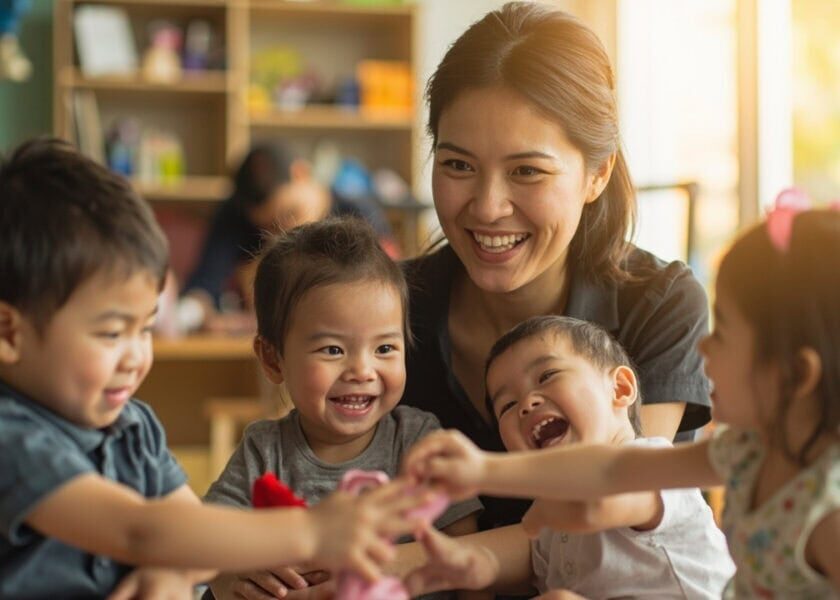
Then there is free play, and this is where the real curriculum unfolds — the social curriculum, the one that does not appear on any lesson plan but that your child is absorbing with every interaction.
Two children reach for the same wooden truck. One pulls it away. The other cries. And here, in this moment, a skilled caregiver does something remarkable. They do not simply solve the problem and move on. They create a space where the children can begin — begin, with patient guidance — to find their way through.
These are not small moments. They are the building blocks of your child’s social intelligence.
What Children Learn
Children who have rich early peer experiences develop something precious. They develop:
- The capacity to cooperate before they can fully articulate cooperation
- Empathy — the ability to feel what another person might be feeling — because they have been in situations where they saw that feeling reflected back, and where they were helped to understand it
- Conflict resolution skills — not the avoidance of conflict, but the capacity to move through it — because they have been in environments where conflict was not shameful, but was an opportunity for learning
None of this happens perfectly, of course. Children still push. They still grab. They still have big, hard feelings that overflow without warning. That is what children do, and that is what childhood is for.
But in a community designed with care, those moments are met with patience and guidance, not punishment and isolation. And over days, and weeks, and months, something accumulates.
- A child who began the year unsure how to join a group finds their way in by October
- A child who responded to frustration with biting learns, slowly, to use words
- A child who never had a peer to share with finds a friend
This is not luck. This is design.
What Children Teach Each Other
In a childcare community, children do not only learn from adults. They learn from each other. And this peer learning is different in kind from anything a parent or caregiver can provide.
When a four-year-old patiently shows a two-year-old how to fit the puzzle piece into place, the four-year-old is not just helping. They are developing leadership. They are practising patience. They are seeing themselves as capable, as someone who has something to offer.
And the two-year-old is not just receiving help. They are watching someone slightly ahead of them in development, and they are thinking: if she can do it, maybe I can too.
That is not a lesson you can teach with words. That is a lesson you learn by being part of a community.
Caregivers as Architects of Social Experience
What EduNanny caregivers are trained to do goes beyond supervision. They are architects of social experience.
They notice when a child is about to escalate, and they intervene with a question instead of a command. They narrate what they see — “I see that Mei Ling wanted the red cup and Ethan was using it” — because naming the social situation helps children develop the language to understand it themselves.
They model negotiation, patience, and repair. They create the conditions for children to practise being in relationship with others, under just enough guidance to keep them safe, and enough freedom to let them grow.
This is what it means when we say caregivers are architects. They are not building walls. They are building a social world, one small interaction at a time.
Small Ratios Matter
At EduNanny, small ratios — up to one to three in infant care settings — are not just a safety measure, though they are that too. They are a design choice that allows caregivers to know each child deeply, to read the social dynamics between children, to protect the shy one from being overwhelmed and to challenge the bold one to consider others.
When there are only a few children in a space, each relationship matters more. Each interaction can be seen, and named, and gently guided.
This is community by design, not community by accident.
Excellence Is Designed, Not Assumed
Excellence in care is not assumed. It is designed, trained, and held accountable. EduNanny Singapore, operating under the banner of EduNanny by BUTLER, participates in the ECDA Childminding Pilot — a structured, accountable commitment to standards of care that meet and exceed national benchmarks.
Caregivers are trained to observe social dynamics closely, to intervene with patience rather than authority, and to see every small interaction as an opportunity for growth. This is the standard that distinguishes quality care from adequate care.
The Architecture of Trust
Where CCTV measures are deployed, they are deployed not as a surveillance tool but as a trust tool — a way of showing families that there is nothing to hide, and that the doors of the childcare community are always open to examination.
Communication is ongoing, daily where possible, and it is honest. When something does not go well, you are told. When something goes beautifully, you are told that too.
A parent who feels trusted and who trusts in return is a parent who can fully embrace what childcare is offering their child. Without that trust, the guilt remains. Without that trust, the community feels like a place you are leaving your child rather than a place you are placing them.
The Evening Bridge: Bringing the Community Home
There is a moment in the late afternoon, perhaps at the dinner table or in the bath, when your child comes back to you carrying something from their day. It might be a song they learned. It might be a story about a friend. It might be a bruise from an encounter with a toy that did not go their way.
What your child brings home is not random. It is the residue of their social day. It is evidence of what they have been learning in that first community.
How to Receive What They Bring
When you ask your child — genuinely ask, with curiosity and attention — “Who did you play with today?” you are telling them that their social world matters to you.
When you listen to their story about sharing a crayon, and you say, “That was kind of you to let her use it first,” you are reinforcing what they learned.
When you notice that your child came home and offered to help set the table without being asked, and you name that — “I saw what you did, and it made me feel so proud” — you are weaving the social learning from their childcare community into the fabric of your home.
The evening is not separate from the childcare day. It is the bridge between the first community and the family.
From Guilt to Gratitude
When parents understand this, something shifts. The guilt that sometimes accompanies dropping your child at childcare in the morning can soften into something else — something closer to gratitude.
You are not leaving your child behind. You are placing them into a world that is being built, with care and intention, for their growth. And when you pick them up, you are not rescuing them from that world. You are joining the conversation that world has started.
This is what EduNanny calls extended partnership — the idea that the childcare community and the family are not separate spheres but part of the same ecosystem of care. When caregivers share what happened during the day — not just that your child ate and slept, but who they played with, how they handled a difficult moment, what they seemed proud of — you are receiving a window into your child’s social world. And that window allows you to build on what is happening there, at home, in the hours when you are together.
The Long View: Why This Matters Beyond Today
What happens in your child’s first community — in those early years, in those small daily interactions over sharing and conflict and friendship and belonging — does not stay in those early years.
This is what developmental science has shown us, and what every parent intuitively senses when they watch their child navigate a new situation with unexpected skill.
Children who have secure, rich early peer experiences tend to transition more confidently into formal schooling. They tend to form friendships more easily. They tend to have a stronger sense of their own social worth — the quiet, deep-down knowledge that they are someone other people want to be with, that they have something to offer, that they belong.
But the social learning that happens in your child’s first community matters right now. Today.
- It matters when your three-year-old looks at a child who is crying and feels something — a pull toward that child, a desire to help
- It matters when your four-year-old learns that conflict is not the end of a friendship but the beginning of a deeper understanding
- It matters when your child, who has never lived anywhere but with you, walks into a room full of children and feels, for the first time, the particular joy of being known by people who are not their family
That joy is not a luxury. It is a developmental milestone. And it is one of the greatest gifts you can give your child.
Choosing Infant Care in Singapore: A Practical Guide
If you are beginning your search for infant care or childminding, here are the questions that matter most:
Observe the Social Environment
- How do caregivers interact with children during transitions?
- What happens when two children want the same toy?
- Are children given time and space to work through conflicts, or are problems solved for them?
Ask About Ratios and Training
- How many children are there per caregiver?
- What training do caregivers receive in social-emotional development?
- Are caregivers trained to narrate social situations, or only to manage behaviour?
Consider the Communication Rhythm
- Will you receive daily updates about your child’s social day?
- Can you speak with caregivers easily at pick-up time?
- Is there a system for sharing observations about your child’s friendships and development?
Trust Your Instincts
Visit more than once, at different times of day. Watch how your child responds to the environment. Notice whether caregivers seem present, warm, and attuned — or rushed and detached.
The right childcare community will feel like an extension of the care you want for your child, not a departure from it.
A Wider World to Belong To
Let me return to the image I started with.
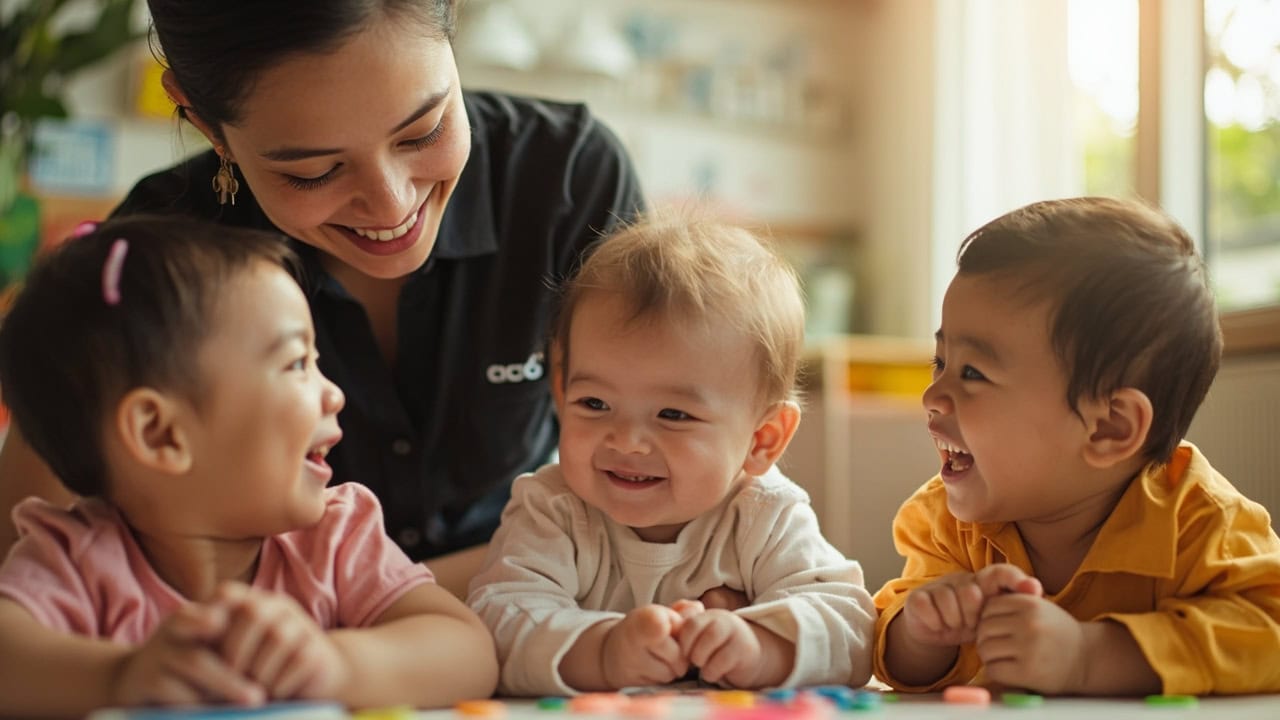
There is a moment, perhaps you have felt it, when your child looks up from the floor of a room full of small tables and wooden toys and coloured mats — a room that is not your living room, not your grandmother’s house, not anywhere they have ever been — and then looks back at what they were doing.
In that moment, the world your child knows has become larger.
And you — the parent who brought them here, who kissed their forehead, who said the words and walked away to the car and the desk and the list of things that require your attention — you made that possible.
You did not leave your child behind. You placed them into their first community. And that community, built with care and intention, is teaching them what no family can teach alone: how to belong, how to cooperate, how to resolve conflict, how to care for others, how to see themselves as part of something larger.
EduNanny Singapore is proud to walk alongside families in this work. We know what we are entrusted with. We know that the child in our care is not just a child being watched — they are a child being shaped, day by day, interaction by interaction, into a person who will one day walk into Primary One with social confidence, into friendships with empathy, and into their own lives with the deep knowledge that they belong.
The childcare decision was never about logistics. It was never about time management.
It was about this: giving your child a wider world to belong to, and trusting that world to help them grow.
If you are ready to explore what a thoughtfully designed childcare community looks like for your family, we would be glad to hear from you.