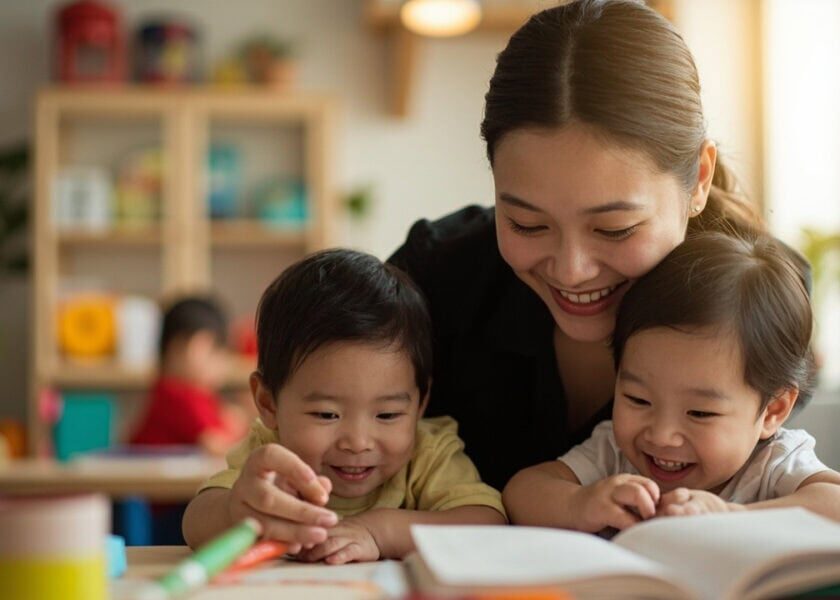
What Your Child Is Really Telling You at Pickup Time
Quick Summary: Reading Your Child’s Well-Being in Childcare
- The quiet worry you carry is normal—and it is actually a sign of deep attunement, not parental inadequacy.
- Quality childcare shows up in specific, observable ways: a visible softening at arrival, relaxed and expansive play, and an easy joy at pickup rather than mere relief.
- Adjustment behaviour and genuine distress look different—adjustment eases over time; genuine well-being shows positive signs like curiosity, security, and engagement.
- You are your child’s most important interpreter—no one else will know them as deeply as you do.
- A child who is thriving in quality care will not love you less—they will have more resources, not fewer, for the connection they come home to.
What Settling Looks Like: Reading the Signals at Arrival and Pickup
Let us begin with what happens inside quality childcare, from your child’s perspective—because this is where the answers live.
When a young child arrives at a well-resourced care environment in the morning, their nervous system is already doing an enormous amount of work. They are leaving the most secure attachment figure they have—you—and entering a world of new sounds, new faces, new rhythms. For a child under three, this transition activates the same neural architecture that handles any meaningful separation.
And yet, in a quality setting, that activation does not stay elevated for long. The difference between a child who is merely adjusting and a child who is genuinely settling lies in what happens next.
At Arrival: The First Minutes Matter
In the first few minutes after arrival, watch for how the care environment responds. A well-staffed arrangement—one with ratios that allow for real attention—will have someone ready to receive your child warmly, to acknowledge the transition, to help bridge the gap between your arms and the new space.
This is not about being cheerfully performative. It is about attunement. The caregiver reads your child’s state, matches their pace, and offers presence without pressure.
What you might observe in a child who is moving toward genuine comfort is something quite specific:
- There is a visible softening. The shoulders drop slightly.
- The child’s grip on your leg, their bag, or a familiar object loosens.
- They look around not with the darting alertness of alarm but with the curious, open scanning of a child who is beginning to register that this space is not threatening.
- Within a reasonable window—every child is different, and this is not a rigid measure—they begin to engage with something: a toy, a book, another child.
This is not distraction from missing you. This is the beginning of trust.
At Pickup: What Genuine Well-Being Looks Like
A child who feels genuinely secure in their care environment will show it in how they play. Play is the child’s medium for processing, exploring, and expressing their internal state. When a child is relaxed, their play is expansive. They move between activities with creative freedom. They experiment. They take small risks within the safety of the environment.
When you arrive, observe before you speak. Watch what happens in the first ten to fifteen seconds.
A child who has been genuinely well in their care environment will often show a burst of recognition and warmth upon seeing you. But notice the quality of that response. Ask yourself:
- Is it relief, as though a long-held tension is releasing?
- Or is it the easy, effervescent happiness of a child who was already content and is now delighted to share that contentment with you?
Both can look like joy. They tell different stories. The first says: I managed. The second says: I was okay, and now I am so happy to see you.
After that initial greeting, notice how your child moves. Does their body feel fluid and relaxed? Do they begin to point at things, to show you something, to lead you somewhere in the room? This is a child who is oriented toward connection and sharing—not just managing their day.
At Home: What a Good Day Looks Like
When your child comes home from a warm, responsive environment, you will see it. The child will not merely be physically intact. The child will be emotionally textured in ways that feel like wellness:
- There will be a lightness.
- There will be a capacity to be soothed.
- There will be an ease with transition—moving from care to home to bedtime—without the child’s nervous system being stuck in high alert.
- There will be the capacity for connection: the child who runs to you, who wants to show you something, who is genuinely happy to be in your presence.
The Difference That Changes Everything: Adjustment vs. Genuine Well-Being
This distinction is perhaps the most important thing a parent can learn to read, and it is where so much unnecessary anxiety lives.
When children first enter any care arrangement, they show adjustment behaviours. These are normal. They are the expected neurological and emotional responses to a significant life change. A child might be clingier than usual at pickup. They might have changes in sleep or appetite. They might seem more needy in the evenings, or have stronger reactions to small frustrations than is typical for them.
These behaviours are not signs that the care is wrong. They are signs that your child is working hard to integrate a new experience.
Adjustment behaviour is characterised by a pattern of gradual easing:
- The clinginess that was intense in week one is noticeably milder in week three.
- The sleep disruption that was significant in the first days begins to normalise.
- The child who was quiet and watchful in the first weeks begins to show more spontaneous engagement.
This trajectory tells you something profoundly important: your child is adapting. The care environment is becoming familiar. Their nervous system is registering safety.
Genuine well-being, on the other hand, is not just the absence of distress signals. It is the presence of positive indicators:
- Joy—not just the absence of sadness, but genuine delight.
- Curiosity—seeking out new experiences, new interactions, new challenges.
- Security—crying briefly at separation but recovering quickly, because they trust that the caregiver will remain present and that you will return.
- Engagement—following caregivers with their eyes, responding to their names, seeking interaction out of genuine relational interest rather than anxiety.
If the signals you are seeing do not fit either of these patterns—if the distress behaviours are not easing over weeks, if your child seems to be shutting down rather than gradually opening up, if the joy and curiosity are not emerging at all—then it is time to ask questions.
Communicate more deeply with your care provider. Trust that your attention to your child’s inner experience is not anxiety but attunement. A quality care arrangement will welcome that conversation.
What Quality Care Looks Like: Responsiveness, Warmth, and the Human Foundation
Responsiveness is not merely reacting to a child’s needs. It is the quality of that reaction.
- A responsive caregiver notices the small grimace before the cry and acts before discomfort escalates.
- A responsive caregiver matches their tone of voice to the child’s state—calming when the child is agitated, matching delight when the child is joyful.
- A responsive caregiver is not just present but attuned.
Warmth is the felt sense of being valued. A warm caregiver holds a child with a quality of attention that communicates: you matter, I am glad you are here, your needs are not an imposition.
You can see this in how a caregiver holds a child who is upset—not with impatience, not with the mechanical efficiency of getting through a moment, but with genuine presence that says: I am with you in this.
Why Ratio Structures Make This Possible
When there are only one, two, or three infants in the immediate care of one attuned adult, there is space for that adult to notice the small signs of a child’s settling. There is space to offer a warm word, a consistent routine, a moment of eye contact that says: I see you, and you are safe here.
EduNanny Singapore, operating under the ECDA Childminding Pilot, maintains these ratios precisely because they understand that settling is not a passive process. It is actively supported—or it is not reliably achieved.
The Caregiver: The Living Core of Quality Care
The childminder is not a background figure. The childminder is the person who holds your child’s world for the hours you are apart. The quality of their attunement, their warmth, their professionalism, their consistency—this is not a detail. This is the thing itself.
When caregivers are trained, compensated fairly, and supported in their work, they bring that quality of care to the children in their charge. The ECDA Childminding Pilot recognises childminding as a profession worthy of investment and respect.
Your child does not just need a warm room and age-appropriate toys. Your child needs a person. A specific person who knows how they take their bottle, who notices when they are tired before they do, who greets them by name each morning with the kind of recognition that says: I have been expecting you.
This is the human architecture that cannot be replicated by any amount of technology or curriculum. And it is why the selection, training, and support of caregivers is not a secondary concern but a primary one.
Why This Matters Especially in Singapore: Honoring the Choice You Have Made
Singapore is a city that asks a great deal of its parents. The rhythms of work, the logistics of commuting, the pressure of careers and ambition and the desire to give your children every possible advantage—these forces are real. For many families, the decision to place a young child in care is not a choice born of preference but a necessity born of circumstance.
The guilt that sometimes accompanies this decision is understandable. But I want to suggest that the decision itself, when made in the context of quality care, is not something to be managed or apologised for. It is something to be honoured.
The First Thousand Days Are Not a Waiting Period
The experiences that shape a child’s sense of security, their capacity for relationship, their neurological architecture for stress response—these are being built now. A child who is in a warm, responsive, attuned care environment during these days is not being deprived. They are being supported.
They are having an experience of relationship that teaches them something profound about the world: that adults can be trusted, that their needs will be met, that the world is a place where they can venture and explore and know they will be held.
This is not a sentimental idea. It is a developmental one. And it is why the structure of childminding matters so much. When we talk about ratios of one caregiver to every three infants, we are not talking about an administrative requirement. We are talking about the condition that makes attunement possible. We are talking about the difference between a child who is supervised and a child who is truly seen.
From Doubt to Understanding: Trusting What You Observe
I want to speak directly to something that lives in many parents’ minds: the doubt.
The doubt that maybe you should not have enrolled your child. The doubt that maybe another arrangement would be better. The doubt that because you cannot observe every moment, you cannot possibly know what is really happening.
Here is the reframe I want to offer you: the doubt is not your enemy. The doubt is your most reliable compass.
The parent who worries is the parent who is paying attention. The parent who wonders if their child is okay is the parent whose nervous system is calibrated to register threat and safety in their child—which is to say, the parent whose nervous system is doing exactly what millions of years of evolution designed it to do.
Your doubt is not a sign of failure. Your doubt is the shadow side of your love. And when you learn to read your child’s signals with confidence, your doubt transforms into something far more useful: it becomes the fuel for attunement.
The parent who knows how to read their child’s inner state is not the parent who never worries. It is the parent who knows how to move from worry to observation to interpretation to action. It is the parent who can look at their child’s behaviour after pickup and say: this tells me something. This tells me whether the day was one where my child felt held and curious, or one where my child felt stretched and unsafe. And when I know that, I can respond appropriately.
This is not overthinking. This is the fundamental work of parenting.
Questions to Ask When Evaluating Infant Care
If you are in the process of choosing an arrangement, here are the questions that matter most:
- What are the caregiver-to-child ratios? For infants, ratios of one caregiver to two or three children make attunement genuinely possible.
- How do caregivers handle arrival transitions? Look for a warm handoff that acknowledges the separation, not a rushed drop-off.
- What does a typical day look like? Routines that are predictable but not rigid support children’s sense of security.
- How do caregivers communicate with parents? Regular updates—not just at pickup, but throughout the day—signal transparency and partnership.
- What training do caregivers receive? Look for ongoing professional development, not just initial certification.
- How do they handle crying, separation anxiety, and developmental leaps? The answer will tell you whether they see your child’s distress as a problem to solve or a signal to attune to.
And finally: trust the way you feel when you are in the space. Your nervous system reads rooms too. If you feel welcomed, if you feel seen, if the caregivers seem genuinely interested in your child—not children in general, but your child—that is information.
An Invitation: You Are Already Ready
You are a parent who has made a choice. You have weighed the options, toured the arrangements, asked the questions, and made the enrollment. And now, in the quiet moments, you wonder if your child is okay.
I want you to know that your child is probably more okay than you fear. Not because the world is simple, and not because every arrangement is adequate, but because children are remarkably resilient when they are in environments that are genuinely attuned to their needs.
And because you—precisely you, with your deep attention and your love that organises itself as worry—are doing exactly what your child needs you to do. You are paying attention. You are learning to read the signals. You are becoming fluent in the language your child speaks through their behaviour, their play, their body, their way of being with you at the end of the day.
When you do this—when you trust your observations and move toward understanding rather than simply doubting—you become not just a good parent but an expert on your own child. You develop the kind of attunement that no questionnaire, no tour, no director’s presentation can give you. You develop the knowledge that comes from love disciplined by attention.
If you are looking for a partner in this work—a care arrangement that matches your child’s developmental needs with ratios that allow for true attunement, communication that builds trust, and caregivers who are trained and supported to do this work with excellence—then consider EduNanny Singapore.
Not because they are the only option, but because they are built around a conviction that the child’s inner experience matters most. That the first thousand days are not a waiting period but a foundation. That parents deserve not just logistics but partnership. That the signals your child is sending you are worth learning to read.
EduNanny operates under the ECDA Childminding Pilot, offering home-based and community-based pathways designed around the developmental needs of young children—not merely the logistical convenience of parents. Fee structures are designed to be accessible, with CDA and Baby Bonus funds applicable. Care runs Monday through Friday, across Singapore, so that families in different neighbourhoods can access quality.
Communication practices—including CCTV measures where deployed—allow parents to see what their child’s day looks like. This is not surveillance for its own sake. It is trust-building. It is saying to parents: we know you cannot be here, and we want you to feel connected to what is happening in your child’s life even when you are apart.
You are already noticing things. You are already wondering. You are already paying attention.
That is enough. That is, in fact, everything.
Your child is telling you everything. And now, perhaps, you are ready to listen.
Written for parents navigating infant care in Singapore, with warmth for the journey you are on. To learn more about EduNanny’s approach to developmental childminding, our story, or to begin a conversation, we are here.