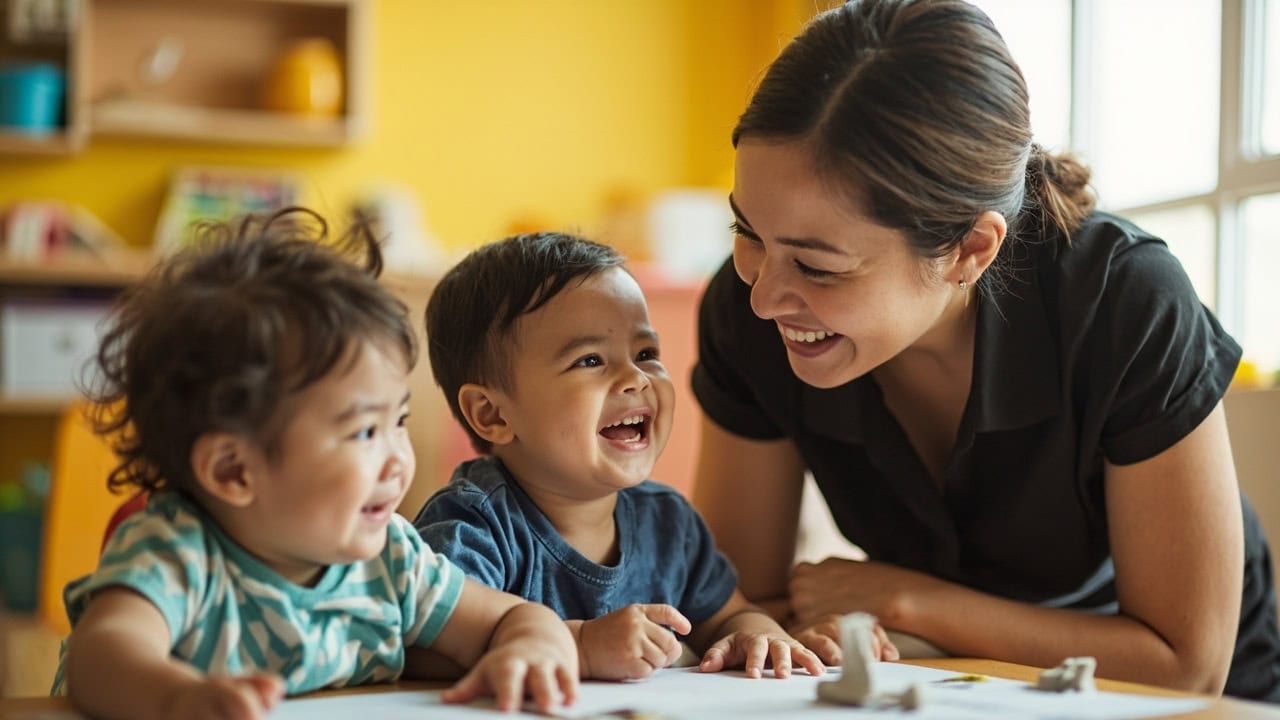
What Your Child Is Really Learning While You Are Apart
What Really Happens at Childcare When You’re Not There
There is a moment familiar to every parent in Singapore who has stood at a doorway in the morning, kissed their child goodbye, lingered just a moment longer than necessary, and walked back to the car or MRT station wondering: what happens now?
Not anxiety, exactly. Something quieter. More persistent. You made this choice for reasons that made sense on a Tuesday evening when both parents were exhausted, when the meeting ran late, and the grandmother was unavailable. Now you want to understand what that choice is actually doing.
Quality childcare is not passive. It is not a waiting room between your mornings and evenings. It is an active, structured, developmentally intentional environment. Once you understand what to look for, you will see that the ordinary moments of a childcare day are doing something remarkable.
Here is what your child is learning while you are apart:
- Emotional security through predictable daily rhythms that help the nervous system settle
- Social intelligence through peer interaction, conflict navigation, and learning to share space with others
- Language growth through conversational exposure, storytime, and caregiver responsiveness
- Physical competence through gross and fine motor activities disguised as play
- Character development through the hidden curriculum of cooperation, empathy, and community
The Architecture of a Quality Day
From the outside, a childcare day may look like a series of small activities strung together: arrival, free play, snack, circle time, outdoor time, lunch, rest, story, pick-up. This is not randomness. This is architecture.
Why Predictability Matters More Than You Think
The daily schedule is not administrative convenience. It is developmental infrastructure. Children, especially in their first thousand days, build their sense of security through repetition and anticipation. When your child knows that snack comes after free play and before circle time, when the morning routine has a shape he can predict, his nervous system settles. He does not have to spend energy wondering what happens next. That energy goes somewhere else: into exploration, engagement, and the hard work of learning.
You may notice this at home without knowing what you are noticing. The child who melts down when bath comes unexpectedly late. The toddler who insists on the same goodnight routine, word for word, every night. This is not stubbornness. This is a child building his internal model of the world, and the world needs to be reliable.
A quality childcare environment provides that reliability as a foundation, not an afterthought. The rhythm of the day is the first lesson your child encounters, and it is a lesson in emotional regulation that will serve him for years to come.
What to Look For
- Does the classroom follow a predictable sequence day to day?
- Are transitions handled calmly with verbal cues (“After we finish our snack, we will wash our hands and go to circle time”)?
- Does your child seem settled rather than constantly on alert?
The Social Classroom: Learning to Be With Others
Peer interaction is where many parents feel particular unease, watching their only child navigate a room full of small strangers. What happens when a toy is grabbed? When a turn must be taken? When a new face appears at the sand table?
In that moment, your child is enrolled in a curriculum no parent can replicate at home. He is learning, in real time and at real cost, how human beings negotiate space, share attention, manage disappointment, and repair social ruptures.
Why Conflicts Are Not Failures
Social skills cannot be taught through lecture or absorbed from picture books. They must be lived. A quality childcare environment provides the conditions for that living, not by letting children figure everything out alone, but by having a skilled caregiver present to step in when escalation threatens, to narrate what is happening so children develop language for their social experience, to model words and gestures that turn conflict into conversation, and to scaffold moments of negotiation and turn-taking.
When you pick up your child and he tells you that Ming took his truck, you are not seeing evidence of failure. You are seeing the raw material of social intelligence being worked and reworked, hour by hour, in the presence of people who know how to guide that work.
The Hidden Curriculum Between Activities
The curriculum that is not on any schedule. The one that happens in the spaces between activities, in the brief moments when no one is formally teaching anything at all.
This is the curriculum of cooperation and empathy. The child who pauses to notice that another child is upset and offers a toy—not because an adult told him to, but because he has begun to internalize what others feel. The child who waits for a turn not out of rule-compliance but because she has begun to understand that her own needs exist alongside the needs of others. The child who helps clean up not because of a reward system but because he has absorbed, through months of example, that we take care of the spaces we share.
These are not moral lessons delivered through instruction. They are habits of the heart and mind that develop through immersion in a community where such habits are modeled, expected, and gently reinforced.
The Caregiver: The Single Most Important Variable
Not the institution. Not the curriculum. Not the beautiful photographs on the website. The human being who is with your child in the moments you cannot see.
The quality of caregiver interaction is the single greatest predictor of developmental outcomes in early childhood settings. This is not opinion. Decades of research consistently demonstrates it. Children develop not through exposure to programs, but through the quality of their relationships with the people who care for them.
What Quality Interaction Actually Looks Like
It looks like attunement. The caregiver who notices that your child is rubbing his eyes before he yawns. Who pauses in her own agenda to follow your child’s lead, even for a moment. Who gets down to eye level when a small person is distressed, names what she sees, and does not rush to fix but stays to understand.
Responsiveness is the soil in which language grows, attachment deepens, and emotional resilience takes root. When a caregiver is not overwhelmed, when she can truly see your child, when she has the time and capacity to attune, the ordinary moments of the day become saturated with developmental opportunity.
Language Growth Through Everyday Connection
You may think of language exposure as vocabulary lists or flashcards. But quality language exposure in a childcare setting is conversational. It is embedded in the fabric of the day.
It is the caregiver who narrates what she is doing as she changes a diaper—not to perform, but because your child is listening, absorbing the cadence and vocabulary of adult speech. It is circle time where songs include new words in new combinations. It is the story that is read not as a ritual but as an invitation to wonder, where the caregiver pauses to ask what might happen next, to repeat a phrase the children can anticipate, to delight in language as a shared experience.
Children in language-rich environments do not just learn more words. They learn that words have power. That communication is a bridge. That there is pleasure in being understood and in understanding others.
Why Ratios Matter
Attunement requires time. When a caregiver is responsible for too many children, the quality of attention fragments. That is why EduNanny Singapore, operating through the ECDA Childminding Pilot, maintains ratios of up to one caregiver to three infants in its home-based and community-based pathways. Every child receives the attention that developmental science tells us matters most.
Physical Development: The Body at Work
Development is not only cognitive and emotional. It is physical, and this dimension of a quality childcare day is often the most visible—yet paradoxically, the least understood.
Gross Motor Development
Gross motor development happens when children run, climb, jump, balance, and navigate space. These are not just activities to fill the time. They are the means by which children build the neural architecture that will later support handwriting, self-care, and the thousand small physical competencies we take for granted in older children.
Fine Motor Development
Fine motor development happens when children pour, stack, manipulate, and create with their hands. Sand play, water play, block building, playdough—each activity builds hand strength and coordination that will matter enormously when your child learns to write.
Why Outdoor Time Is Not a Break From Learning
The uneven surface of a playground challenges balance. The social negotiation of who goes down the slide first is simultaneously physical and social. The resistance of sand when a bucket is filled is sensory education. The climb to the top of the structure is a triumph the body will remember long after the mind has moved on.
Free play—that seemingly unstructured time some parents wonder about—is where children integrate everything they are learning. They experiment with cause and effect. They test the limits of their own capability. They build the persistence and problem-solving that will later characterize a confident learner.
From Wondering to Witnessing: Understanding Your Child’s Day
How do you move from wondering to understanding, from anxiety to informed observation?
It starts with knowing what questions to ask. When you receive your daily report—and at EduNanny, communication and transparency are built into the approach—you can begin to read it not as a summary of activities, but as a map of development.
What to Look For in Daily Reports
| Area | What to Notice |
|---|---|
| Social Interaction | Did your child play alongside others or engage in sustained cooperative play? How were conflicts resolved? |
| Language | Was she participating during storytime? Attempting to communicate in new ways? Words like “exploring,” “responding,” “initiating” are developmental markers. |
| Physical | Was your child climbing, jumping, pouring, manipulating? Were emerging physical skills noted? |
| Engagement | Did the caregiver note your child’s level of interest? Was he settled, curious, engaged? |
Questions to Ask Your Child
When you pick up your child in the evening, ask questions that invite him to tell you about his day—not as a test, but as an opening:
- What was your favorite part of the day?
- Who did you play with?
- What happened at circle time?
- Can you show me what you did outside?
The answers may be fragmentary, especially for younger children. But each fragment is a window into the world he inhabits while you are apart.
Questions to Ask Yourself
- Does the environment feel chaotic or calm?
- Are children engaged or merely occupied?
- Does the caregiver get down to children’s level?
- Does she follow the child’s lead or impose her own agenda?
These observations matter more than any checklist or accreditation, because they reveal the relational quality that research tells us is the single most important variable.
Addressing Common Concerns
Is my child too young to benefit from childcare? The first thousand days represent the period of most rapid brain development in the human lifespan. Infants and toddlers are not passively waiting to become capable learners. They are actively, remarkably developing right now. The question is not whether your child is learning during these hours, but whether the learning environment is aligned with what we know about healthy development.
What if the caregiver and I have different parenting values? Quality childcare does not replace parenting. It extends it. The best childcare settings see themselves as partners with families, not alternatives to them. When you choose a provider like EduNanny, you are not handing over your role as your child’s primary influence. You are adding a qualified, attentive adult to your child’s world who reinforces the same principles you care about at home.
EduNanny Singapore: Built for This Understanding
EduNanny Singapore, a service by BUTLER, has been designed with this understanding at its center. Through the ECDA Childminding Pilot, EduNanny offers Singapore parents pathways that are accessible, transparent, and grounded in the developmental science of early childhood.
What EduNanny Provides
- Small ratios that allow for genuine attunement—one caregiver to up to three infants
- Trained caregivers who are supported and developed, not just deployed
- Communication systems that keep you informed about what is happening in your child’s day
- Home-based and community-based pathways through the ECDA Childminding Pilot
Designed for Singapore Families
Monday to Friday care blocks. Fees structured within the pilot framework to be affordable. The ability to use CDA and Baby Bonus funds where applicable. For Singapore families navigating the real economics of childcare, these details determine whether quality care is accessible at all.
The old model of childcare was one-way: parents handed over their children and hoped. Hoped that the teachers were kind. Hoped that the children were safe. Hoped that something good was happening in the hours of separation.
The new model—the one that EduNanny represents—is built on transparency. On the assumption that parents are intelligent, that they want to understand, and that when they do understand, they become better partners in their child’s development.
What happens at childcare and what happens at home are not separate worlds. They are two environments in which your child is constructing the same fundamental thing: himself. His sense of security, his language, his physical competence, his understanding of how to be with others.
When you know what to look for, you can reinforce at home what is happening at childcare. You can extend the rhythm. You can follow his lead as the caregiver does. You can narrate your own activities and invite his participation. You can read his social experiences with new eyes.
The child who knows that his parents and his caregivers are aligned—that they are both watching him with the same attention and the same hope—is a child who is held by a web of security that no single relationship can provide.
Now You Know What to Look For
The next time you stand at that doorway in the morning, and the question arrives—what happens now?—let it arrive differently.
Let it arrive as an invitation. An invitation to trust your eyes and your judgment, because you have chosen well. An invitation to learn, because the answers are there for those who ask. And an invitation to see your child as he truly is: not passive in your absence, but profoundly, actively, remarkably developing.
The ordinary moments of his day are teaching him everything. Now you know what to look for.
Explore EduNanny Singapore’s infant care and childminding pathways to find an arrangement that fits your family’s needs. With small ratios, trained caregivers, and transparent communication, EduNanny is designed for parents who want more than supervision—they want understanding.
Speak with the EduNanny team to learn more about how they support Singapore families.