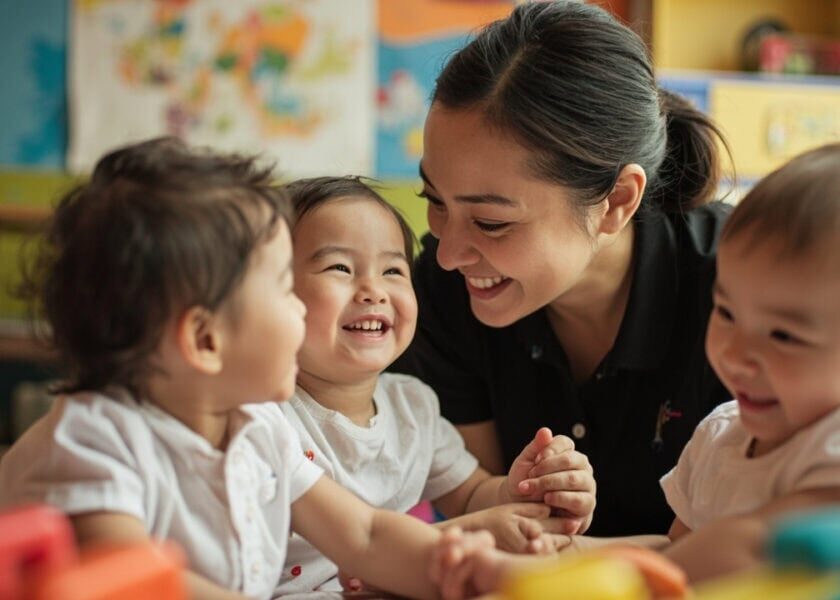
What Your Child Is Really Learning in Quality Childcare Daily
A Quick Look Inside Your Child’s Day
Before we go deeper, here is what research tells us about what a quality childcare day actually contains:
- A secure, responsive caregiver who becomes a secondary safe base for exploration
- Predictable rhythms that help children feel safe enough to learn
- Sustained interactions that extend a child’s natural curiosity
- Peer experiences that build social intelligence
- Language-rich environments that expand communication skills
- Physical spaces designed for movement and sensory exploration
- Observations that personalize care to each child’s emerging needs
Each of these elements works together to create something remarkable: a day that is not a pause in your child’s life, but a living, growing part of it.
The Science of Safety: Why Your Child’s Brain Is Not Waiting
When a child enters a quality childcare setting, something important is happening beneath the visible act of arrival. The child’s brain is not waiting. It is working.
It is taking in the room—the light through the windows, the arrangement of materials, the sounds of other children, the presence of a caregiver who knows this child’s name, this child’s rhythms, this child’s current fascination with wheels or animals or the sound of music.
The child’s nervous system is reading the environment and asking a question that researchers have studied for decades: Is this place safe enough to learn in?
In a quality childcare environment, the answer is yes.
That safety is not passive. It is built into every interaction, every routine, every thoughtfully arranged corner of the room. It is the result of something called secure base theory—the understanding, rooted in decades of developmental research, that children learn best when they have reliable access to someone who responds to them with warmth, consistency, and attention.
The secure base is not a place. It is a relationship.
The Caregiver as a Secondary Secure Base
In quality childcare, the caregiver becomes precisely that—a secondary secure base from which the child can venture out to explore, experiment, and return to for reassurance.
This is not a replacement of the parent. The research is clear on this point. What quality childcare provides is an extension of the secure base, not a substitution of it.
Children who experience responsive caregiving from multiple attuned adults in their early years do not love their parents less. They develop what researchers call a broader base of security—the capacity to feel safe exploring not just with one person, but with a constellation of trusted adults who know them well.
This is one of the most meaningful gifts that quality professional care offers: the understanding that love is not diminished by being shared. It is enriched by it.
Inside a Quality Childcare Day: Hour by Hour
Consider what a day in quality childcare actually contains. Not as a list of features, but as a lived experience for the child inside it.
The Morning: Welcome and Transition
The morning begins with welcome. The caregiver recognizes the child—greeting them by name, noticing something about how they arrive. Perhaps the child is tired today, a little clingy, not quite ready to let go.
The caregiver receives this without judgment, without pressure, without trying to rush the moment. They hold the space. They give the child time to see the room, to notice that other children are already engaged, to feel the pull of something interesting.
And then, when the child is ready, they step into play. The parent leaves. The child stays.
What the child finds is not emptiness, but a world that has been prepared for them.
Sustained Shared Thinking: Where Learning Actually Happens
Throughout the morning, the child encounters what developmental psychologists call sustained shared thinking—the practice of following the child’s lead, matching their pace of discovery, and deepening their engagement with whatever has captured their attention.
When a fourteen-month-old points at a butterfly on the window, a responsive caregiver does not simply say, “Yes, butterfly.”
They pause with genuine attention. They look where the child is looking. They name what they see together. They extend the moment—where did the butterfly come from, where is it going, shall we look for another one?
This back-and-forth, happening dozens of times throughout every day, is not incidental care. It is the substance of cognitive and language development. It is building the neural architecture for thinking, communicating, and understanding the world.
Peer Interaction: The Dimension Parents Most Often Miss
When a toddler plays alongside another child, something powerful is happening. They are learning to read facial expressions, to notice another child’s emotions, to negotiate, to take turns, to feel the satisfaction of shared laughter or the disappointment of a withheld toy.
A sixteen-month-old watching an older child solve a problem learns something about persistence and possibility that no adult instruction can replicate.
The peer group in quality childcare is not accidental. It is carefully composed, with attention to developmental spread, temperament, and the social mix that will create rich learning opportunities.
Children in quality childcare settings develop social intelligence—the ability to navigate relationships, read social cues, and cooperate with others—through daily, meaningful peer interaction that simply cannot be replicated in a home with one child and one caregiver.
Language: More Than Just Words
Language development follows a similar pattern. In a language-rich childcare environment, children hear what researchers call contingent talking—a continuous stream of responsive, varied, grammatically complete language that narrates their experience in real time.
Not simplified baby talk, but genuine, rich communication. The caregiver says, “You are trying to fit the blue triangle into the shape sorter. It has three sides, so it needs a triangle-shaped hole. Let’s find one.”
This kind of extended language, delivered with warmth and matched to the child’s focus, builds vocabulary, comprehension, and eventually the child’s own capacity for complex thought and speech.
Studies consistently show that children in high-quality childcare settings hear significantly more varied and sophisticated language than children in most home environments, even those with highly engaged caregivers. This is not a criticism of parents. It is an acknowledgment that quality childcare settings are designed with language development as an explicit goal, with trained caregivers who understand how to expand every interaction into a language-learning opportunity.
Physical Development: A Landscape for Movement
A quality childcare environment is not just a room. It is a landscape for movement.
- The floor has varied surfaces for tactile exploration
- Materials are placed at child height, inviting independent access
- There is space to crawl, to climb, to walk, to run
- There are objects that require grasping, releasing, stacking, pouring
- There are outdoor spaces where children feel the resistance of grass, the smoothness of a tricycle handle, the wind on their faces
Every material, every surface, every space has been considered for its developmental potential.
A quality caregiver understands that when a child spends twenty minutes trying to open a container, they are not frustrated. They are building persistence, problem-solving, and fine motor control. They are learning that effort leads to outcome.
The Invisible Architecture: Why Rhythms Matter More Than Schedules
Quality childcare settings operate on predictable rhythms—not rigid schedules, but reliable sequences that children come to anticipate and trust. Circle time before snack. Outdoor play after lunch. Story before home.
This predictability is not about control. It is about security.
Developmental research consistently shows that children who know what comes next can focus their energy on learning rather than on bracing for the unknown. A child who trusts the rhythm of their day does not need to ask what happens next because they already know.
They can let go of anticipation and sink into presence. They can play deeply, explore freely, and engage fully because the world around them is organized in a way they can predict.
By the second week in a new setting, most children have internalized the basic sequence of their day. By the third month, they move through transitions with growing confidence, checking briefly to confirm the next step is indeed coming, and then releasing into the flow.
This is not a small thing. This is the foundation of emotional regulation—the child’s first experience of understanding that the world can be organized, trusted, and safe.
When the Unexpected Happens
Quality care is revealed most clearly when something unexpected happens—a sudden rainstorm that cancels outdoor play, a fire drill that interrupts the morning routine, a change in the caregiver’s schedule.
The caregiver does not just manage logistics. They stay close. They name what is happening. They help the child regulate the uncertainty.
“The rain is too heavy for us to go outside right now, so we will play inside. That’s okay. We can still have fun.”
A child who has built security with a responsive caregiver can tolerate small disruptions because they have learned that the caregiver is steady, that the caregiver will stay close, that the caregiver will help them manage whatever comes.
This is what researchers mean when they talk about the caregiver as a secondary secure base. It is not metaphor. It is neurological reality. The child’s brain is literally building its capacity for resilience, for adaptability, for emotional regulation, through hundreds of these small experiences of being held steady through change.
Recognizing Quality: What to Look For
For parents researching childcare options in Singapore, knowing how to recognize quality matters. Here are the signals that indicate genuine developmental intentionality:
What You Might Observe in Your Child
- Your child settles into the routine with increasing ease over weeks
- Your child mentions specific caregivers by name, with warmth
- Your child talks about friends or play activities from the day
- Transitions—morning drop-off, pick-up—become easier rather than harder
- Your child seems genuinely engaged and curious about the world around them
What to Ask During Visits
- How do caregivers respond when a child is upset or distressed?
- What does a typical day look like, and how do routines support the children?
- How are activities chosen and adapted for individual children?
- How do caregivers document and communicate a child’s progress?
- What training do caregivers receive in child development and responsive caregiving?
What Your Child Gains Beyond What Any Single Caregiver Can Provide
The answer is not that professional care is superior to parental care. It is not. Parental attachment remains the bedrock of the child’s development, and no childcare arrangement can or should replace it.
The answer is that professional care, when it is genuinely quality care, provides dimensions of experience that enrich and extend what the child receives at home.
- A second secure base, responsive and reliable, that builds the child’s capacity for exploration
- A peer group of other children, each with their own ways of playing and learning, that expands the child’s social world
- A language-rich environment with trained caregivers who know how to extend every interaction into a learning opportunity
- An environment designed for movement, for curiosity, for sensory exploration, with materials and spaces that invite development
- Systematic observations that track progress over time, that notice the things a parent might miss because they are watching their child every day and therefore cannot easily see the change
- Rhythms that build predictability, security, and the internal sense of organization that will serve the child throughout their schooling and beyond
EduNanny by BUTLER: Grounded in Developmental Science
EduNanny by BUTLER operates within this framework. As part of the ECDA Childminding Pilot, EduNanny represents a commitment to quality childcare that is grounded in developmental science and designed to be accessible to families across Singapore.
The model offers both home-based and centre-based pathways, each with its own strengths, each designed with the child’s daily experience as the central concern.
Home-Based Care: Individualized Attention
In the home-based pathway, the ratio of caregiver to infant can be as low as one to three, a ratio that allows for genuine individualized attention throughout every moment of the day.
In an intimate home-based setting with one caregiver and two or three children, every interaction can be fully responsive. The caregiver can follow each child’s lead, observe each child’s emerging interests, and tailor every activity to each child’s developmental stage.
Centre-Based Care: Broader Peer Experience
The centre-based pathway offers a different but equally valuable environment. Here, children encounter a wider peer group, a more varied physical space, and the opportunity to learn from watching others at different developmental stages.
The ratios remain carefully considered, and the environment is designed with the same developmental intentionality—materials at child height, spaces for movement and quiet, opportunities for both group experience and individual exploration.
Communication and Consistency
What connects both pathways is a commitment to communication and consistency. Parents in the EduNanny programme receive regular updates—not surveillance reports, but thoughtful documentation of their child’s day. Photographs, learning stories, observations of milestones and moments that a parent would otherwise miss.
This is not technology for its own sake. It is a bridge between worlds. It allows parents to see what their child is experiencing, to feel connected to the developmental journey that is unfolding in their absence, and to carry that understanding into the conversations they have with their child at the end of the day.
EduNanny’s approach to scheduling—Monday to Friday care blocks—provides the consistency that developmental research tells us matters most. Children thrive on regularity. They build security through repetition. Knowing that certain days hold certain rhythms, that the childcare environment is a reliable part of the weekly landscape, is not a logistical convenience. It is a developmental necessity.
And for parents navigating the demands of work and family life in Singapore, this consistency is a gift that extends beyond the child to the entire household.
Making Quality Accessible
The usability of CDA and Baby Bonus funds through EduNanny means that families do not have to choose between financial feasibility and developmental quality.
This matters. The conversation about childcare should not begin and end with cost. It should begin with what is possible for the child—what kind of day, what kind of growth, what kind of security. And then it should ask, how can we make that possible?
EduNanny’s approach to fee structures within the pilot makes this question answerable for more families than might otherwise have access to this level of care.
The Reframing That Changes Everything
Every morning when a parent hands their child to a caregiver they believe in, they are making a statement about what they think their child can handle. They are expressing faith in their child’s capacity to be known, to be held, to be safe, to grow—even in a room that is not home.
The question you have been carrying—What is my child actually experiencing when we are apart?—is the right question.
And the answer is: something important. Something formative. Something that, when it is quality care, is building capacities in your child that you will see emerge over years—in their confidence, their curiosity, their ability to connect with others, their joy in learning.
The childcare day is not a pause in your child’s life. It is a living, growing part of it.
When that day is designed with intention, staffed with care, and filled with responsive relationships, it becomes something extraordinary. It becomes a place where your child is known, where your child is safe, where your child is growing even as you are apart.
That is what quality childcare provides. That is what EduNanny by BUTLER offers. And that is what every child in Singapore deserves—a day that is worthy of the person they are becoming.
EduNanny by BUTLER was built for this—for this child, this day, this work of early development that is quiet and daily and enormously consequential. If you are exploring childcare options in Singapore and would like to understand how EduNanny translates developmental science into meaningful daily experience, we invite you to connect with us or learn more about our approach.