What Your Child Is Building While You’re Not There
The Fear Most Parents Don’t Admit
There is something I want to name, because it sits deep in a parent’s heart when they leave their child in someone else’s care.
It is the quiet, often unspoken fear that you are paying for a label. That the promises on the website are marketing. That your child is not really thriving, not really learning, not really growing — that they are just being kept. Fed, changed, entertained, and returned to you at the end of the day, a little more entertained perhaps than they would have been at home, but not fundamentally changed in any way that matters.
This fear is not a failure of yours. It is a sign of how much you care. And it is more common than most childcare providers will ever admit to you directly.
The gap between adequate and excellent childcare is wider than most parents realise when they begin their search. An adequate setting will keep your child safe. It will feed them, change them, and make sure they don’t wander into traffic. That is real, and it matters.
But an excellent setting does something more. It treats every single hour of every single day as an opportunity to build the person your child is becoming.
The difference is not always visible from the outside. But your child’s brain absolutely registers it. Their neural pathways are being built differently. Their capacity for focus, for resilience, for curiosity, for connection — these are being shaped, quietly and continuously, by every interaction, every material, every responsive moment — or the absence of it.
Inside a Quality Childcare Day: What Actually Happens
Scene One: The Greeting
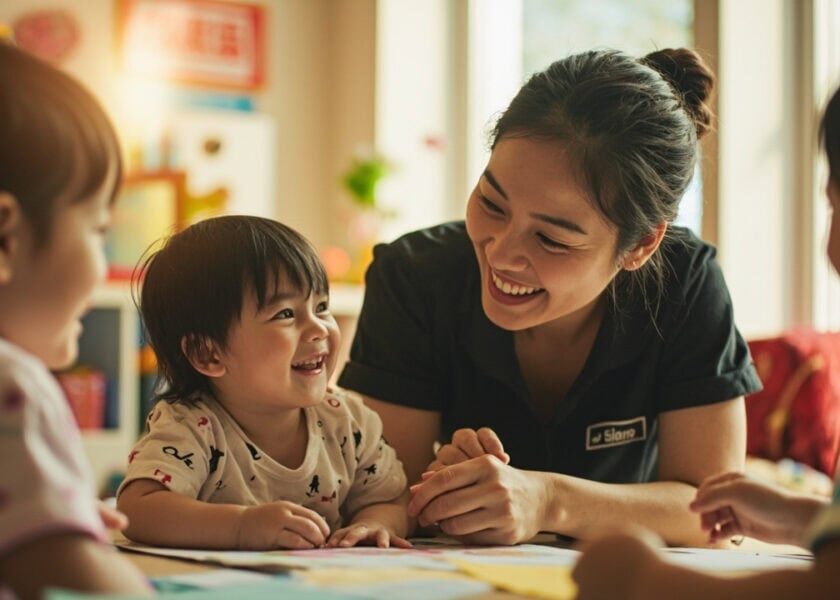
A child — let us call him Isaac, two years old — arrives at his childcare setting, still soft with sleep, still holding the last threads of a weekend morning. He is greeted by his caregiver, who bends down to his level. Not a wave from across the room. Not a distracted glance.
She meets his eyes, says his name, and tells him she’s glad he’s here.
In that greeting — all of three seconds long — something significant is already happening. Isaac is learning that he is seen. That his presence matters. That this place, and this person, are reliable.
He does not have the words for this yet. He will not remember this moment consciously. But his body relaxes. His cortisol levels shift. And his brain begins the slow, essential work of feeling safe enough to explore.
Scene Two: The Rice Tray
Now follow Isaac into the room. What does he see?
A low table set with shallow trays of rice, of dried pasta, of smooth pebbles. A water table in the corner. A climbing structure scaled to his size. A reading nook with soft cushions. These are not random. Every texture, every open-ended material, every carefully considered arrangement has been placed there by people who understand what young children need to build the world inside their minds.
Isaac walks to the rice tray. He runs his fingers through it. He watches the grains shift and settle. He pours them from one hand to another. He scoops, he dumps, he pours again.
You might watch this and think: he’s playing. And he is. But he is also doing something extraordinary.
Through this simple, sensory-rich activity, Isaac is building the foundations of mathematical thinking — size, quantity, volume, cause and effect. His fine motor skills are developing with every pinch of grain. His concentration is deepening, second by second.
And because his caregiver is nearby — not hovering, not interrupting, but present and warm — she will, at exactly the right moment, offer a word, a gentle challenge, a small narrative that extends his learning without breaking his focus.
You poured a lot. That was a big scoop. Can you count how many scoops you’ve done?
Isaac doesn’t know he’s learning. His parents won’t know, when they ask him what he did today, that this is what happened. But it did. And it matters.
Scene Three: The Block Negotiation
Three children are at the play table. A girl is building with soft blocks. A boy wants the same block she is using.
In an inadequate setting, this is where an adult might step in, resolve the conflict, and move on — protecting the peace, but missing the opportunity.
In a quality setting, the caregiver does something different. She stays close. She watches. She waits. She does not rush to solve the problem for them. Instead, she creates the conditions for the children to solve it themselves, while remaining close enough to support without rescuing.
Jia Le, Ethan wants to build with that block too. What might we do?
What follows is a small, imperfect, utterly human negotiation. Jia Le looks at Ethan. She holds the block a little tighter, then loosens. She says something in two-year-old logic that no adult could fully translate. He steps closer. She hands him a different block — one she has decided she can spare. He takes it. She keeps building.
The moment passes. And in that moment, both children have learned something that no lesson and no screen and no app could ever teach.
They have learned that other people have wants. That those wants sometimes conflict with yours. That there are ways to navigate those conflicts — to give, to take turns, to find another solution — and that those ways feel better than grabbing or crying or giving up.
They have begun, in the gentlest possible way, to build the capacity for empathy, for negotiation, for the social intelligence that will shape every relationship they ever have.
Why These Moments Matter More Than Most Parents Know
Developmental psychologists call what happened in those scenes social-emotional learning. It is happening in dozens of micro-moments like this every single day in quality childcare. But because it looks like just children playing, most parents never see it — and so most parents never know to value it.
The first years of life are not a waiting room before the real education begins. They are the education.
The brain at two years old has twice as many neural connections as it will have at adulthood. Every experience, every interaction, every moment of exploration is literally sculpting the architecture of your child’s mind.
The question is not whether this is happening. It is whether the environment it is happening in is worthy of the task.
Consider what this means in practical terms:
- In adequate care, children are supervised. In excellent care, children are engaged.
- In adequate care, the schedule runs. In excellent care, the caregiver reads the child and responds.
- In adequate care, conflicts are resolved. In excellent care, conflicts are used as learning opportunities.
- In adequate care, your child is safe. In excellent care, your child is building themselves.
The Caregiver: The Invisible Professional
No discussion of quality childcare is complete without acknowledging the caregiver — and yet she is so often the most invisible person in the room.
The caregiver in a quality setting is not a babysitter. She is not simply a warm pair of hands. She is a professional who has been trained to observe, to respond, to narrate, to extend, to protect, and to love.
She knows that when a child is frustrated but cannot yet say I am frustrated and I need help, her job is to name that feeling, to validate it, and to offer words where the child has none.
She is a scaffolder of minds. And the way she interacts with your child — hundreds of times a day, in moments you will never see — is laying down the neural foundations for your child’s capacity to regulate emotion, to persist with difficult tasks, to trust that their needs will be met, and to believe that the world is a place worth exploring.
This is not poetic language. This is what neuroscience calls serve-and-return interaction — the back-and-forth between a responsive adult and a young child that literally builds the circuits of the developing brain.
A child who receives consistent, attuned, responsive caregiving is building different neural architecture than a child who receives adequate but unreciprocal care. The difference is not visible in a photograph. But it is seismic in a life.
Why This Matters More in Singapore
If you are raising children in Singapore, your context is specific — and it shapes what your children need.
Your children are growing up in high-rises, in air-conditioned rooms, in environments that are clean and safe and ordered — and that are, by design, very different from the world that human brains evolved to develop in. They have less space. Fewer chances to run, to climb, to get dirty, to encounter the raw, unstructured textures of the natural world.
They are, by necessity, more indoor, more screen-adjacent, more scheduled.
And they are, at the same time, growing up in a city that prizes excellence, that expects high achievement, that can make even the most relaxed parent feel the weight of competition and development from a startlingly young age.
Quality childcare in Singapore is not a luxury. It is a counterweight. It is where your child gets the sensory richness, the gross motor development, the social navigation, the unhurried play time, and the responsive human interaction that their evolving brain needs — and that their daily life in this particular city cannot always provide in full measure.
What to Look For: A Practical Guide for Parents
Now that you understand what quality looks like, how do you evaluate whether a childcare setting is truly offering it? Here are the questions worth asking — and the answers worth listening for.
Observe the greeting
When you arrive for a visit or a trial session, watch how children are greeted. Does the caregiver kneel down? Make eye contact? Use the child’s name? A quality greeting is a reliable indicator of a relationship-based approach.
Notice the environment
Are materials open-ended (blocks, water, sand, fabric) or purely electronic or prescriptive? Open-ended materials invite exploration. Closed materials invite compliance. You want more of the former.
Watch what happens during conflict
Does the caregiver step in immediately to resolve disputes, or do they stay close and create conditions for children to work through them? Neither extreme is ideal, but a caregiver who never allows negotiation is missing daily learning opportunities.
Ask about ratios
For infants, smaller is almost always better. The ECDA Childminding Pilot allows ratios of up to one caregiver for every three infants in infant care — a ratio that enables the genuine responsiveness that quality requires.
Look for evidence, not promises
Ask: How will I know what my child did today? How will you communicate with me? Can I observe? In quality settings, transparency is not an afterthought — it is part of the trust contract with parents.
Trust your child’s response
After a period of quality care, you may notice your child is calm, engaged, using new words, showing new ways of playing, navigating frustration with unexpected composure. These are fingerprints of excellent care. If you don’t see them, ask why.
Will my child feel abandoned?
When children receive quality, responsive care, they do not feel abandoned — they feel held. The secure attachment formed with a primary caregiver extends to quality alternative caregivers. What matters is not the absence of other adults, but the presence of attuned, consistent, warm interaction.
Is this just expensive babysitting?
This is the fear I named at the start, and it is the right question to ask. The honest answer: some childcare is exactly that. And some is radically different. The difference is observable. Watch for it. Ask for it. Choose only what passes the test.
Will my child learn as much as they would at home?
Quality childcare does not replace what you do at home. It complements and extends it. The best childcare settings give children experiences — sensory, social, exploratory — that are difficult to replicate in a busy household. When you choose well, your child gains more than they lose.
What if something goes wrong?
Ask about safety protocols, communication procedures, staff training, and how concerns are handled. Quality providers welcome these questions because they have nothing to hide. Ask specifically: How will you tell me if my child has had a difficult day?
EduNanny Singapore: Built Around What Children Actually Need
When EduNanny designed its approach, it began with a question that every serious childcare provider must answer: what should a child experience in the hours we are trusted with them?
The answer EduNanny has built around understands development not as a curriculum to be delivered but as a series of moments to be created. Through its participation in the ECDA Childminding Pilot, EduNanny is building a model of home-based and community-based care that treats the caregiver as the professional she is — not as an afterthought, but as the centrepiece of everything.
With ratios carefully designed to allow for genuine responsiveness — up to one caregiver for every three infants in the infant programme — the environment is built around what actually happens when a skilled, caring adult meets a child where they are.
Whether through home-based pathways — where care is offered in a nurturing home environment, often with smaller ratios and a more intimate scale — or through community and centre-based options, EduNanny creates environments that are deliberately, thoughtfully built for the developing child.
The practical elements matter too. Care runs Monday through Friday, in structured blocks that give working parents the predictability they need. Fees within the pilot are structured to be accessible, and families can draw on their Children’s Development Account and Baby Bonus schemes — because premium care should not only be available to those who can afford to pay without thought.
Communication is open and transparent, with regular updates and measures that give parents a window into the world their child is living in all day. This is not about surveillance. It is about trust — and about the understanding that when you can see what is happening, you can trust what is happening.
Quality childcare leaves fingerprints. Not always obvious ones. Not always the ones you were looking for. But they are there, and they accumulate — and one day, when your child walks into a classroom, or stands up to speak, or reaches out to help a friend, or looks at a problem and does not give up — you will recognise them.
Your Child Is Building Themselves, Every Single Day
You dropped your child off this morning. You felt that small, sharp ache of letting go. You drove away carrying all the usual doubts and hopes and ordinary worries.
I want you to know something: your child is not just being looked after. Your child is being built.
Not by accident. Not by routine. Not by mere supervision. But by the deliberate, skilled, attentive work of people who understand that the ordinary hours of a young child’s life are, in fact, extraordinary.
You are not paying for a label. You are choosing, deliberately and carefully, an environment for your child’s development. And now — because you understand what happens in those hours — you can see what you are choosing. You can name it. You can trust it.
You can feel, in the truest sense, that your child is in a place where they are not just being looked after, but where they are being built.
That is what quality childcare is. That is what EduNanny offers. And that is what your child deserves — and, I believe, what you have always known, in your heart of hearts, that they are.
They are building themselves in there. Every single day. And now, so can your knowledge of that choice.
Quick Summary: What Quality Childcare Looks Like
Quality childcare has fingerprints you can observe:
- A deliberate welcome. Your child is greeted by name, at eye level, by a caregiver who has observed their mood and needs that morning.
- Sensory-rich, open-ended play. Materials like rice, water, blocks, and fabric are not distractions — they are tools for building mathematical thinking, motor skills, and concentration.
- Guided peer negotiation. When children disagree over toys, caregivers create conditions for resolution rather than stepping in to fix problems immediately.
- Responsive interaction. Every word, every pause, every “I see you’re frustrated” is a serve-and-return moment that literally builds neural pathways in your child’s developing brain.
- Evidence you can observe. Your child waves goodbye by name, uses new words, shows new ways of playing, navigates frustration with unexpected composure.
Ready to learn more about EduNanny Singapore’s approach to infant care and childminding? Reach out to discuss how the programme can support your child’s development during the hours that matter most.
You can connect with EduNanny directly, or learn more about their approach and their participation in the ECDA Childminding Pilot.