What Your Child Is Becoming While You’re Not There
Quick Summary: What Quality Childcare Actually Builds
For busy parents who want the key points first:
- Language development happens through thousands of brief, intentional interactions—not just bedtime reading
- Motor skills grow through supervised exploration, not just play
- Social confidence is built in small, manageable increments alongside other children
- Emotional regulation develops through practiced, safe separations
- Developmental growth is invisible day-to-day but compounds dramatically over weeks and months
- Quality care is designed, not just supervised—the environment itself shapes your child’s brain
The Question Beneath the Logistics
You arrive to collect your child. She looks up, perhaps mid-play, perhaps deep in some activity she cannot yet name or explain. And in the space between her recognition of you and the transition out the door, something crosses her face that you are still learning to read.
She is glad to see you. But she is also, you notice, reluctant to leave. There is something unfinished about the room, about the blocks she was stacking, about the friend she was watching. She has been living a life you did not witness, and part of her does not want to leave it.
You ask the standard questions. What did you do today? Did you eat? Was it fun?
The answers come in fragments. A song she cannot quite remember. A name she pronounces in her own way. A moment she acts out, incomplete, expecting you to understand what you cannot possibly understand.
And in that gap, between the day she lived and the day you can know, a question surfaces. Not always in words. Not always even as a conscious thought. But it is there, quiet and persistent, in the chest of almost every parent who leaves their child in someone else’s care:
What is my child actually experiencing while I am gone?
This is not a question about logistics. You trust the centre, or you would not have chosen it. You trust the caregivers, or you could not walk out the door each morning. You know she is fed, and safe, and loved in the way that adults can love a child who is not theirs.
But beneath the logistics, there is something else. Something about what is growing inside her while you are not there to see it. Something about who she is becoming.
That is the question worth answering.
What Parents Imagine vs. What Actually Happens
Most parents, when they imagine their child’s day in childcare, construct an image that sits somewhere between neutral and concerning. She plays. She waits. She watches the clock the way you do. She is, in the imagination of most parents, enduring.
This imagination is understandable. We are separated from our children, and separation makes us defensive. We protect ourselves by hoping that the hours apart are not consequential. We tell ourselves that childcare is a service, a convenience, a necessary architecture of modern family life. We hope it is good enough.
But quality childcare—the kind built on understanding rather than mere supervision—is not a neutral space. It is a generative one. And the difference between a child who attends and a child who flourishes is the difference between a room full of toys and an environment designed for learning.
What Quality Infant Care Actually Builds
Let us be specific about what that means, because specificity is where truth lives.
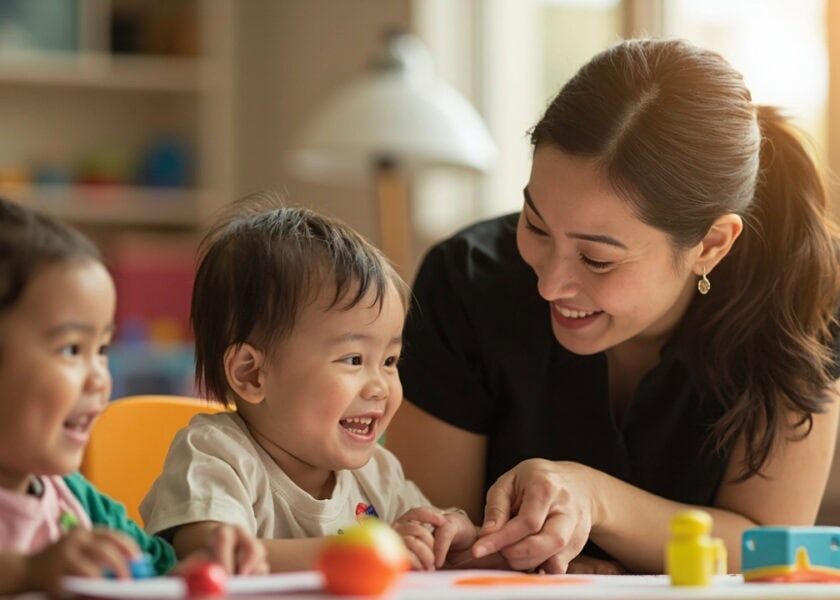
When a child is in a quality infant care environment with a ratio that allows for genuine attention—not just management, but observation, response, and growth—she is not simply being watched. She is being engaged. She is in a space where the adults around her are trained to notice what she notices, to name what she reaches for, to build on the small, astonishing acts of development that happen dozens of times a day and are visible only to those who are paying attention.
Language: More Than You Can Hear in an Evening
Language acquisition in the early years is not the product of a few dedicated hours. It is the product of thousands of interactions, most of them brief, many of them mundane, all of them cumulative.
In a quality infant care setting, your child is engaged in language-rich interaction throughout the day. Songs with repetitive phrasing. Conversations that go beyond commands. Questions that invite response, even from a child who cannot yet form words. A caregiver who narrates the child’s experience back to her, reflecting her expressions and sounds in a way that teaches her—long before she can articulate it—that communication is a two-way street.
Weeks of this, and then months, and then a year. And then one evening, your child points to a bird and says a word that is hers, that she learned somewhere other than your living room. And you wonder where it came from.
The answer is: from all those hours, in all those days, in the consistent and intentional language environment she inhabited while you were working.
Motor Development: Building the Body Behind the Mind
A child who is given space and encouragement to crawl, to pull herself up, to navigate stairs with supervision, to throw and catch and climb and balance—she is not just burning energy. She is building the proprioceptive and vestibular systems that will underpin her physical confidence for years. She is learning what her body can do. She is developing the coordination that will make writing, playing sports, and navigating a busy school hallway possible.
Social and Emotional Architecture: The Most Consequential Foundation
And then there is the social and emotional architecture that is perhaps the most undervalued and yet the most consequential dimension of early childhood development.
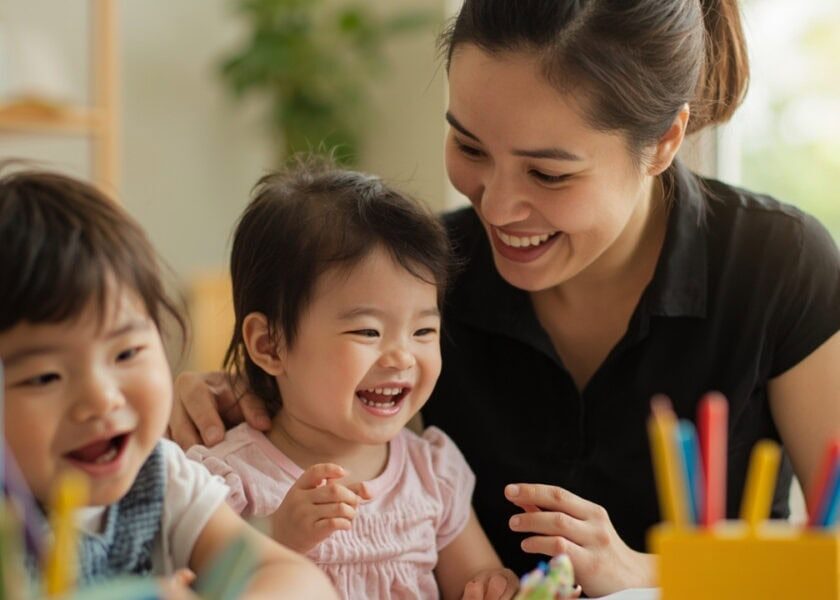
A child in quality group care learns, in small and manageable increments, what it means to be part of a community. She experiences sharing. She experiences the disappointment of a toy taken. She sees other children express joy and frustration and fear, and she begins to read those emotions—to develop the empathy that cannot be taught but must be witnessed and absorbed.
She learns, with a caregiver’s gentle guidance, how to navigate conflict without violence, how to express need without destruction, how to be a person among people.
Why You Cannot See It Day by Day
Parents often tell me they cannot see the development. They look at their child at the end of the day and they see the same child they left in the morning.
And I understand why they say this, because developmental growth in young children is not theatrical. It does not announce itself. It works slowly, beneath the surface, assembling itself into the visible self over weeks and months, and then one day something changes that has been building for a long time, and it looks like it happened overnight.
Your child, who always clung to you in new situations, walks into her childcare room and waves goodbye without hesitation. She has been preparing for this—through dozens of small separations, each one manageable, each one survived, each one building the internal model that says: people leave, but they come back. And I am still okay.
Your child, who never spoke at the park, walks over to another child and says something—not clearly, not with grammar, but with intention. And you watch from a distance, and you think: where did that come from?
It came from the compound interest of consistent, quality care.
What Attention Actually Looks Like
Consider this scene: A fourteen-month-old reaches for a stacking ring, misses, tries again.
In a supervision-only environment, she might receive encouragement or gentle redirection. In a quality developmental setting, she receives something more precise: a caregiver who recognizes that this is not just a game. This is a lesson in persistence, in hand-eye coordination, in the understanding that the world responds to effort.
The caregiver narrates the attempt. She models the motion. She offers just enough assistance to make success possible without making it hollow.
And in doing so, she is not merely entertaining a child. She is shaping the neural pathways that will, months from now, allow that same child to persist at a harder problem, to try again after failure, to believe that effort leads to outcomes.
This is happening, in small ways and large, all day long. And the parents who have chosen quality care for their children cannot see most of it.
This is the quiet difficulty at the heart of modern parenting: the most important work happening in your child’s life is work you are not present to witness.
Signs Your Child Is Thriving, Not Just Attending
The developmental domains that quality childcare touches are not mysterious, but they are often invisible to parents who are not trained to observe them. Here is what to look for at home:
- Language that is growing—new words appearing, attempts to form sentences, the energy of someone who wants to communicate
- Motor skills that are becoming more refined—new attempts at climbing, catching, drawing, self-feeding
- Social behaviors that show she is learning to be a person among people—sharing, turn-taking, showing concern when another child is upset
- Emotional regulation that suggests she has internalized—through practice and safe relationships—that she can manage big feelings without falling apart
- Curiosity that is active—that seeks out novelty, that is not afraid to not know, that asks questions
- Problem-solving attempts—trying different approaches when something does not work the first time
These are the markers. These are what you look for.
And when you see them, you will know something important: that the choice you made was not merely practical. It was developmental. You did not simply find a place to keep your child occupied while you worked. You placed her in an environment that is shaping her, deliberately and consistently, into someone who is more capable, more confident, and more ready for what comes next.
Questions to Ask When Choosing Infant Care in Singapore
If you are researching options, these questions will help you distinguish between supervision and genuine development:
- What is the caregiver-to-infant ratio? Lower ratios mean more individual attention and better observation of developmental milestones.
- How do caregivers communicate with parents? Look for regular, meaningful updates—not just feeding logs, but observations about your child’s development and day.
- What is the training and background of the caregivers? Quality care requires trained observers who understand developmental stages and can respond appropriately.
- Is the environment designed for development or just supervision? Look for intentional scaffolding of language, motor skills, social skills, and emotional regulation—not just a room full of toys.
- How does the programme handle separation and emotional regulation? Quality settings have strategies for helping children navigate the inevitable difficult moments.
- What flexibility is available for working parents? Consider whether the hours and payment options align with your family’s needs.
Addressing the Concerns Every Parent Carries
Before choosing any care arrangement, it is worth naming the worries honestly. They are real, and they deserve real answers.
“Will my child feel abandoned?”
Separation anxiety is real, and it is a sign that your child has formed a healthy attachment to you. But in quality care, your child learns something important: that separations are survivable, and that trusted adults remain consistent even when parents are not present. The caregiver becomes a secondary secure base—one from which your child can explore, knowing she can return to you at the end of the day.
“Am I failing as a parent by choosing childcare?”
You are not leaving your child in a waiting room. You are placing her in a space designed for her to grow—a space with caregivers who notice her, who respond to her, who build on what she knows and gently extend what she does not yet. The hours your child spends in quality care are not hours lost. They are hours invested. And the returns, though they accumulate quietly, are substantial.
“How do I know if the care is actually good?”
Look for these indicators:
- Caregiver-to-infant ratios that allow for genuine attention
- Staff who can articulate what they observe in your child—not just what she ate, but how she approached a problem, who she gravitates toward, what she seems curious about
- A routine that feels intentional rather than purely convenient
- Updates that go beyond logistics to include developmental moments
- Your child’s visible comfort with the environment over time—not the absence of all tears (that is unrealistic), but a general trajectory toward security and engagement
EduNanny: Where Development Is the Purpose
The insight that separates supervision from development is this: supervision keeps a child safe and occupied. Development transforms a child, week by week, into a more capable, more confident, more curious human being. And the work that makes this possible is largely invisible to the parent who cannot be there to see it.
EduNanny by BUTLER understands this distinction.
EduNanny is not offering a place where children wait until their parents return. EduNanny is offering a place where children grow—consistently, intentionally, and with attention to who each child is as an individual. This is the difference between a service and a purpose. And it is the difference that matters when you are entrusting someone with the most important work of your life.
Structured Quality Through the ECDA Childminding Pilot
EduNanny operates within the ECDA Childminding Pilot, which means it is part of a structured, regulated framework designed to ensure quality and accessibility. The pilot offers both home-based and centre-based pathways, because families are not uniform and neither are their needs.
Some children thrive in the intimacy of a home setting, with a consistent caregiver who becomes a trusted figure in their early life. Others benefit from the richer peer environment of a centre, where interaction and modelled behaviour from other children accelerates social learning. Both pathways maintain the standards and oversight that the pilot requires.
Why Ratio Matters
The ratio of caregivers to infants—up to one to three in the infant room—is not an administrative detail. It is a quality indicator.
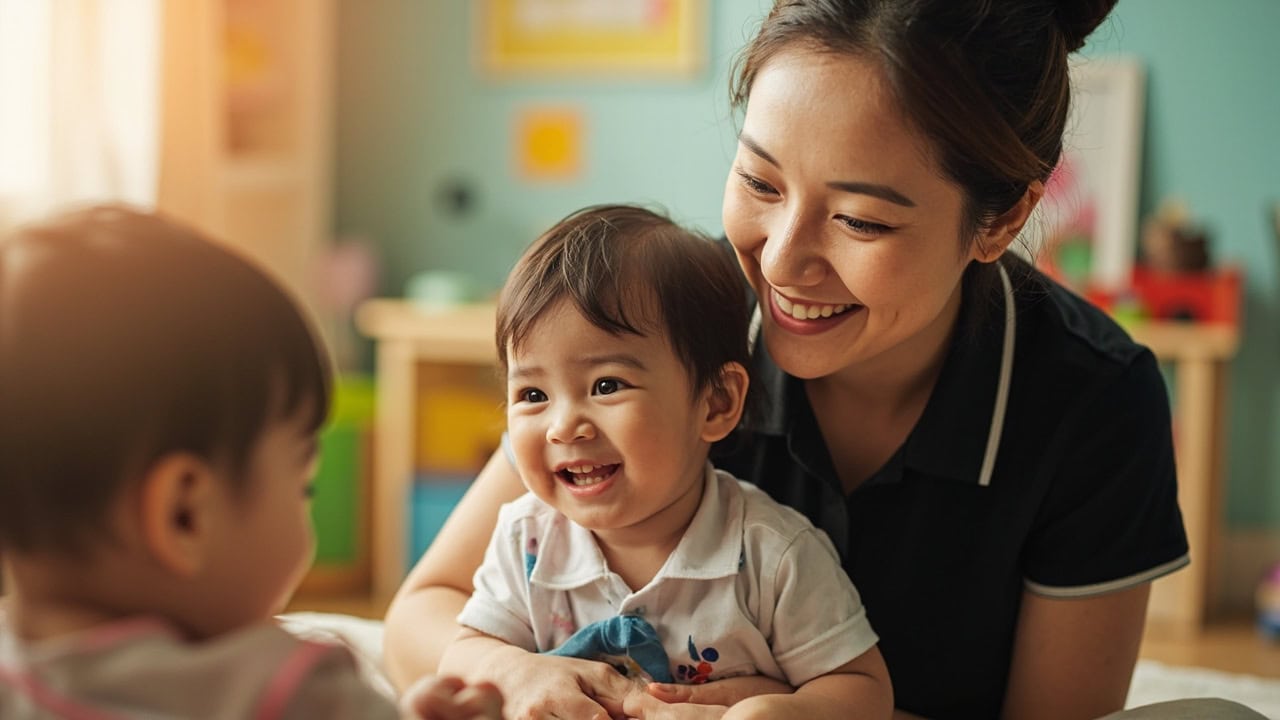
When a caregiver can give genuine attention to three infants instead of six or eight, she can notice what she needs to notice. She can respond in the way that builds security. She can observe the small developmental steps that, accumulated, become milestones. This ratio is how intentional care becomes possible.
Communication as Partnership
EduNanny’s approach to communication reflects the same principle. Parents receive regular updates about their child’s day—not just logistics, but moments. A new food tried. A skill attempted. A social interaction worth noting. Where CCTV measures are in place, parents have the option to access them, because transparency is not just a policy. It is a commitment to the partnership that quality care requires.
Practical Accessibility for Singapore Families
Monday through Friday care blocks. CDA and Baby Bonus usability, so that financial considerations do not become barriers to quality. Singapore-wide relevance, because every child in this country deserves access to developmental care that is more than supervision.
These are the practical foundations. But what makes them meaningful is what happens within them.
Your Child Is Becoming
When your child comes home changed—and she will—it will not always be dramatic. It may be a word she did not know on Monday and uses confidently on Friday. It may be a gross motor skill she suddenly attempts with new boldness. It may be the way she navigates a conflict, or the way she handles a transition, or the way she looks at a caregiver from whom she is separating with something that is not quite fear anymore.
These are the signs that your child is not just attending. These are the signs that she is thriving.
Every parent who brings their child to quality care is making a decision that is both deeply personal and profoundly consequential. Personal, because no one knows your child the way you do, and no one feels the weight of that separation quite the way you feel it. Consequential, because the early years are not a rehearsal. They are the work itself.
You are placing her in a space that is designed for her to grow—a space with caregivers who notice her, who respond to her, who build on what she knows and gently extend what she does not yet. A space where the ratio is small enough for her to be seen. A space where the communication is open enough for you to feel connected even when you are apart. A space where every routine, every activity, every interaction is part of an intentional design for development.
When your child comes home one afternoon and shows you something she learned, or tells you something she remembered, or plays in a way that she could not play before—that is the answer to the question you have been carrying.
What is my child doing while I am away?
In the right environment, the answer is: becoming.
That is what this decision was for. That is what quality care makes possible.
Ready to learn more about EduNanny’s approach to infant care and childminding in Singapore?
Speak with our team to understand how we support your child’s developmental journey, starting from the very first day.
Learn more about EduNanny and our commitment to quality, development-focused childminding for Singapore families.