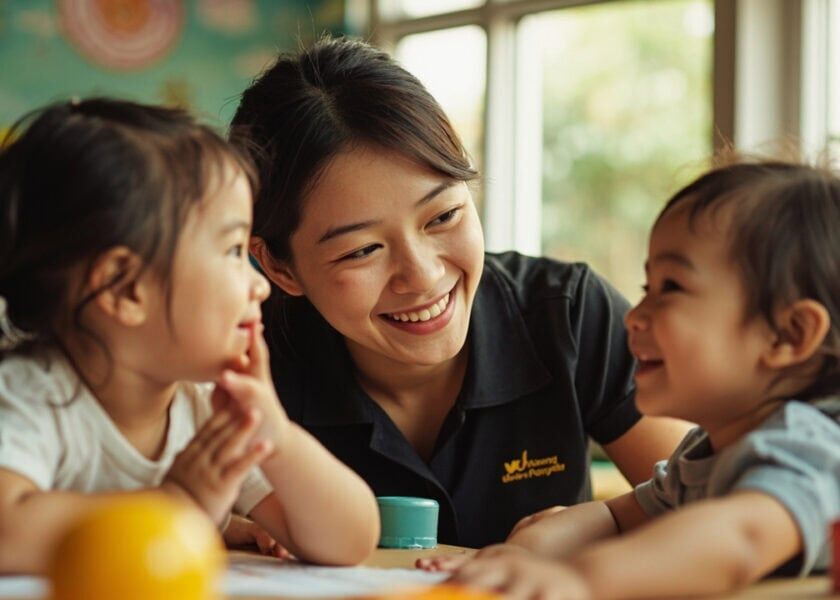
What Your Child Is Actually Learning in Singapore Childcare
The Gap Between Care and True Learning
Most childcare arrangements in Singapore are excellent at one thing: keeping children safe, fed, rested, and loved. That matters enormously. Safety and warmth are the foundation upon which everything else is built.
But safety and warmth alone are not education. They are the prerequisites for education.
Somewhere between the morning drop-off and the afternoon pickup, there is a difference between what most childcare looks like and what it could be. Most arrangements ensure your child is happy and secure. EduNanny’s approach starts from a different premise: that every moment of your child’s day is an opportunity for learning, and those opportunities should not be left to chance.
This is the gap EduNanny was designed to close—not by replacing warmth with rigour, but by building rigour on top of warmth. Not by turning infants into students, but by understanding that the first years of life are not a waiting room before education begins. They are education.
The problem is that this learning is invisible to most parents. Not because it is hidden, but because we have not been taught to see it. We know what a child’s body looks like when it is growing. We can measure height, count teeth, celebrate motor milestones. But the mind grows in ways that are harder to see and therefore easier to dismiss.
So Singapore parents find themselves paying for childcare that feels right, hoping it is also doing right by their child’s development—but lacking the framework to truly know.
What Learning Actually Looks Like in Practice
Let us describe what this means in real terms, because philosophy without practice is just noise.
Cognitive Development: When Play Is Thinking
When a one-year-old at EduNanny is given a set of stacking cups, something more than play is occurring.
The child is learning about size and sequence. They are discovering cause and effect—what happens when a smaller cup is placed inside a larger one, what happens when it is not. They are experiencing the satisfaction of solving a small spatial puzzle, building the foundation for mathematical thinking that will emerge years later.
But the childminder guiding that moment is not merely supervising. She is noticing which hand the child favours, whether language is accompanying the action, whether frustration is emerging and how it is being managed. She is reading the child’s developmental stage and responding with appropriate challenge—not too easy, not too hard, but exactly calibrated to stretch thinking without causing defeat.
Language Development: Beyond Reading Aloud
When a group of toddlers at EduNanny is gathered for story time, the childminder is doing more than reading aloud.
She is building vocabulary in context, modelling turn-taking, drawing attention to pictures that illustrate concepts the children are beginning to understand. She is pausing to let children point and name, extending their sentences, repeating their approximations with correct pronunciation in a way that feels natural, not corrective.
Language development at this age is not about flashcards. It is about rich, responsive interaction in a language-rich environment. Children who are exposed to more conversational turns and varied vocabulary in their first years develop stronger language foundations—not just in vocabulary size, but in comprehension, narrative ability, and the motivation to communicate.
Motor Development: The Body and Mind Are One
When infants are crawling and pulling to stand, the EduNanny environment is designed with developmental intentionality. Floor spaces are prepared. Materials are accessible but safe. Childminders rotate children between positions and activities in ways that challenge emerging motor skills without rushing development.
Motor development is not separate from cognitive development. The child who learns to navigate space, to judge distance, to balance against gravity, is also building the neural pathways that underpin mathematical thinking and spatial reasoning later on. When we design experiences that support motor development, we are simultaneously supporting cognitive development.
Social-Emotional Development: Where It Matters Most
And then there is the domain that is most invisible and most important: social-emotional development.
When a toddler at EduNanny has a conflict over a toy, the childminder does not simply resolve it by removing the toy or scolding the aggressor. She names the emotions involved, helps each child articulate what they feel, models negotiation, and guides the children toward a solution they have participated in creating.
This takes time. It would be faster to intervene and end the dispute. But EduNanny’s approach understands that the dispute itself is the learning. Emotional regulation, empathy, perspective-taking, problem-solving—these are not skills that appear when a child turns five. They are being built now, in every conflict and every comfort, in every moment of being seen and understood by a responsive adult.
The EduNanny Framework: Structure Behind the Approach
Singapore parents often tell us something telling when we explain this approach: they nod, they agree, they feel the recognition of something they already suspected. But then they ask the question that matters most. They say, how do I know this is actually happening? How do I know my child is not just in a beautiful room being kindly watched?
It is a fair question. And EduNanny’s answer is not just philosophical. It is structural.
Government-Backed Accountability
EduNanny operates within the ECDA Childminding Pilot, which means it is part of Singapore’s deliberate effort to expand quality early childhood options for families. This is not an unregulated arrangement. It is a government-recognised pathway that brings accountability, standards, and oversight to the childminding model.
Developmental Ratios That Make a Difference
Within the EduNanny model, infant ratios are maintained at up to one to three, meaning each child receives individual attention that is simply not possible in larger group settings. The research on early childhood attachment and neural development is clear: quality of attention in the early years matters enormously. One attentive, trained adult responding to three infants is developmentally richer than one overwhelmed adult responding to fifteen.
Affordable Access for Singapore Families
Fee structures within the pilot are designed to be affordable, and many families find that CDA and Baby Bonus subsidies apply, making EduNanny not just educationally superior but financially accessible. We do not want developmental childcare to be a privilege reserved only for the wealthiest families. We want thoughtful, intentional early childhood care to be within reach for the parents who want it most.
Two Pathways: Home-Based and Centre-Based
EduNanny supports both home-based and centre-based pathways, matching families to the arrangement that best fits their circumstances—not forcing a one-size-fits-all solution.
For parents choosing the home-based pathway, EduNanny childminders come to you. This offers unique advantages: children learn in the environment where they feel most secure, routines can mirror family life more naturally, and for infants under twelve months, the home setting can be the most developmentally appropriate choice available.
Communication and Partnership
Parents receive regular updates, meaningful observations, and genuine insight into what their child is experiencing. Childminders and families are partners in a child’s development. The learning that happens at EduNanny does not exist in isolation from home. It continues there, reinforced by parents who understand what to look for and how to engage.
Where deployed, technology such as CCTV provides additional peace of mind—but beyond systems and protocols, EduNanny builds relationships with families.
Developmental Care vs. Academic Readiness
One of the most important things Singapore parents need to understand is the difference between developmental care and academic readiness. They are not the same thing.
Academic readiness means knowing letters and numbers before others know them. It is about surface skills—early literacy, early numeracy, the performance of being “ahead.”
Developmental care means ensuring that the brain, the language system, the motor system, the emotional regulation system, and the social awareness system are all developing in integrated, healthy ways that make learning possible.
When those foundations are strong, academic learning comes naturally. When those foundations are weak, early academic push can actually be counterproductive—creating surface performance while leaving the underlying architecture unstable.
EduNanny vs. Other Options
Singapore parents are comparing EduNanny against preschool, Montessori environments, enrichment centres, and grandparent care. We respect all of those choices.
But preschools and enrichment centres are designed for children who are typically two and a half or three years and older. They are structured around group schedules, classroom transitions, and curricula built for older toddlers. They are not designed for infants. They do not maintain the ratios that infants need. They do not offer the individual developmental responsiveness that the first thousand days require.
What EduNanny offers is not a substitute for preschool. It is what comes before preschool. And what comes before preschool, if done well, makes preschool far more effective. Children who have had responsive, developmentally intentional care in their earliest years arrive at preschool with a foundation of security, curiosity, and language that allows them to learn from the preschool environment rather than merely survive it.
Signs Your Child Is Truly Learning
You do not have to take our word for it. You can watch. You can ask your childminder what your child was focused on today, and she will tell you—not in vague generalities but in specific, observable moments.
These are measurable, observable outcomes of good developmental care:
- Language: Is your child’s vocabulary expanding? Are they using more complex sentences? Do they narrate their experiences back to you?
- Social skills: Can your child share, take turns, negotiate? Do they show awareness of other children’s feelings?
- Emotional regulation: Does your child recover from disappointment more quickly? Can they wait? Do they have strategies for managing big feelings?
- Cognitive curiosity: Does your child ask questions? Do they explore new things with interest rather than fear?
- Motor confidence: Is your child navigating space with increasing competence? Are they willing to try physical challenges?
- Persistence: Does your child return to difficult tasks? Do they show satisfaction from effort, not just success?
What EduNanny Is Not
Before you make your decision, it helps to be clear about what EduNanny is not:
- EduNanny is not a substitute for parental presence. We work alongside you, not instead of you.
- EduNanny is not a substitute for preschool. It is preparation for preschool.
- EduNanny is not a place where children sit at desks and memorise facts. Learning at this age is experiential, relational, and embedded in play.
- EduNanny is not a guarantee that your child will be “ahead” of others in academic metrics. It is a commitment to building the foundations that make all future learning possible.
Questions to Ask Any Childcare Provider
If you are currently weighing your options, here are the questions we recommend asking:
About Ratios and Attention
- What is the child-to-caregiver ratio for my child’s age group?
- How is individual attention distributed across the day?
- How do caregivers notice and respond to moments of learning?
About Developmental Approach
- What is the philosophical framework guiding your care?
- How do you support cognitive, language, motor, and social-emotional development?
- How do you handle conflicts between children?
- What does a typical day look like, and how is it responsive to individual children’s needs?
About Transparency
- How will I know what my child is learning and experiencing?
- How do you communicate with parents?
- Can I observe or visit unannounced?
About Credentials
- Are you registered with ECDA or part of a government pilot programme?
- What training do your caregivers have?
- What subsidies am I eligible for?
Your Child’s Mind Is Learning Now
Your child’s mind is not waiting for school to begin learning. It is learning now, every moment, shaped by whoever is holding its attention.
And you have chosen, thoughtfully, deliberately, to ensure that what is holding your child’s attention is worthy of them.
We know what Singapore parents are navigating. The long hours, the dual-income pressures, the competitive landscape that begins earlier and earlier, the constant tension between wanting to be present and needing to provide. You are not negligent parents for choosing childcare. You are attentive parents who understand that quality care is not a compromise. It is an extension of your investment in your child’s future.
The question you walked in with—what is my child actually learning—is the right question. It is the question we built EduNanny to answer.
And the answer, when you see it, when you understand it, when you watch your child grow not just in size but in capability and curiosity and confidence, is this: your child is learning to be a learner. Not to perform ahead. Not to check boxes. But to engage with the world with wonder, to trust that effort leads to outcome, to feel secure enough to explore and capable enough to persist.
When you reunite at the end of the day, when they run to you with something to show, something to say, something they figured out in the hours between—you will know. You will know because you will understand what you are looking at.
That understanding is not just reassuring. It turns the anxiety of separation into the confidence of partnership. It turns childcare from a logistical necessity into a developmental opportunity.
EduNanny is more than childcare. It is the beginning of your child’s educational journey, and it happens at exactly the right time: now, when the brain is most open, most hungry, most ready to become what it was always capable of being.
To learn more about EduNanny’s approach to infant care and childminding in Singapore, or to explore how our developmental framework can support your child’s earliest and most important years, we invite you to get in touch.
Learn more about who we are and what makes EduNanny different.