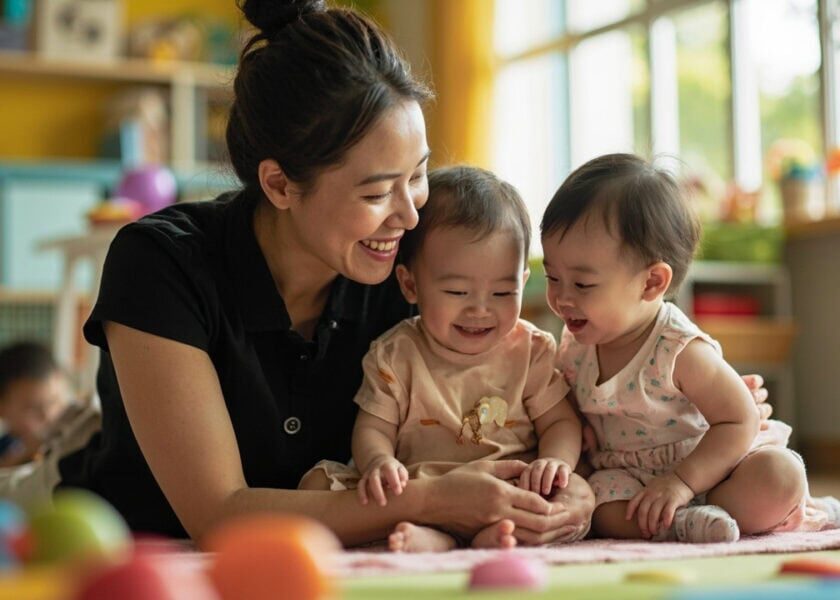
What Your Child Is Actually Learning Every Day
Why This Feeling Is Real — And Why It Matters
At EduNanny Singapore, we have spent years working with families across this island — in their homes, in community spaces, in the early childhood centres that partner with us — and we have come to understand something that shapes everything we do.
The gap between what parents observe and what they understand about their child’s development is not a minor inconvenience. It is one of the most significant sources of uncertainty in modern parenting.
It affects how parents read their child’s behaviour. It affects the decisions they make about care. And it affects the relationship they have with their child — because when you cannot interpret what you are seeing, you cannot fully accompany them through it.
You are not imagining this feeling. You are not overthinking it. The gap is real, and it is affecting your confidence — as a parent, as someone making decisions about your child’s care, and as someone trying to support their growth at home.
Behaviour Is Development — Not the Opposite of It
To understand why this gap exists, we need to first understand how children actually communicate what they are learning.
Every child, from the moment they are born, is in a state of continuous and astonishing development. Their brains are forming new connections at a rate that will never be matched again. Their bodies are learning to move, to coordinate, to master gravity and space. Their emotions are expanding in range and intensity. Their language is emerging from nothing.
All of this growth happens not in a vacuum, but through the medium of behaviour — through the way they play, the way they react, the way they express frustration or joy or confusion or wonder.
Behaviour is not the opposite of development. Behaviour is development.
When a toddler throws a cup off a high chair tray, over and over, they are not being naughty. They are learning about gravity, about cause and effect, about the permanence of objects, about the power of their own actions.
When a two-year-old refuses to share a toy and screams when another child touches it, they are not being selfish. They are in the middle of one of the most developmentally significant processes they will ever undergo — the construction of a sense of ownership, of self, of where they end and another person begins.
When a three-year-old builds a tower of blocks only to knock it down and rebuild it again, they are not being inconsistent. They are practising persistence, spatial reasoning, and the understanding that creation and destruction are both part of learning.
The problem is that without a framework for reading this behaviour, parents see only the surface. They see a child who will not share. A child who is throwing things. A child who seems stuck or stubborn or strange.
And when parents see problems rather than progress, they respond to problems — and may inadvertently interrupt the very learning process they would celebrate if they understood it.
What Trained Caregivers Actually See
A caregiver who has studied child development does not simply watch what a child does.
They watch how a child does it, when they do it, what they did before, and what comes after. They look for the patterns that reveal underlying development — the way a child’s play is becoming more complex, the way their emotional responses are maturing, the way their language is beginning to carry nuance and intention.
They recognise the signs of cognitive leaps before they become visible to the untrained eye.
They know that a sudden regression in behaviour — a child who was sleeping through the night suddenly waking frequently, a child who was toilet trained suddenly having accidents — may not signal a problem at all, but rather a developmental explosion happening just below the surface, where the child’s entire system is busy reorganising itself around new abilities.
Think about the moment you pick up your child at the end of the day. You walk through the door, and your child runs to you — or perhaps hangs back, needing a moment to warm up. You scan their face, their body, the way they are moving. You are looking for something, even if you do not have words for it.
Now imagine that in that moment, your caregiver meets your eye and says something specific.
“Today was a remarkable day for her language. She used sentences we have not heard before, and she started using pronouns consistently. She also had a long frustration episode this afternoon when she could not get a puzzle piece to fit. We sat with her through it, and she eventually succeeded, and the pride on her face was extraordinary. You might see some tiredness tonight — big language days often create that.”
“He spent most of the morning in parallel play with another child, which is exactly where we expect a child his age to be. But in the last hour, I noticed him watching another child build something, and then he went to build his own version nearby. That is early social learning — not quite cooperative play, but the awareness of others as models. It is a beautiful thing to witness.”
This is what we mean by reading development. This is the difference between being told your child had a good day and understanding what your child was actually learning.
Age-Appropriate Expectations: The Map That Changes Everything
One of the greatest sources of unnecessary parental anxiety is the absence of a developmental map. Parents hear that children develop at different rates, but they rarely receive clear guidance on what is appropriate at which stage.
Without this map, every deviation from expectation can feel alarming. A child who is not walking by twelve months. A child who is not speaking in sentences by two years. A child who is still having tantrums at three, four, or five.
The truth is that development follows broad patterns that are remarkably consistent across children, while allowing for tremendous individual variation.
When parents understand these patterns — when they know that the vast majority of children do not walk steadily until around fifteen months, that sentence complexity emerges gradually through the second and third years, that tantrums are a neurodevelopmental reality for most children under four — something changes:
- The anxiety decreases
- The judgment softens
- Parents begin to trust their child again, and they begin to trust themselves
Age-appropriate expectations do not excuse poor behaviour. They do not lower the bar for what we hope our children will become. What they do is free parents from the constant fear that something is wrong. They create space for patient, supportive responses rather than frustrated ones.
They allow parents to see a child who is struggling with sharing as a child who is learning, rather than a child who is defective. They allow parents to see a toddler who will not sleep through the night as a child whose brain is developing in exactly the way brains develop, rather than a parent who is failing.
This understanding is not a luxury. It is a fundamental tool of modern parenting.
What Quality Childminding Actually Looks Like
Choosing care for your infant or young child is one of the most consequential decisions a parent makes. It is also one of the most difficult, because the stakes feel so high and the variables feel so opaque.
How do you know if a caregiver is good? How do you know if an environment is right? How do you evaluate something as complex as early childhood development when you have no training in it?
Without a developmental framework, you are essentially making this decision in the dark. You look at cleanliness, at safety, at the warmth of the caregiver’s smile. You ask questions about routines, about food, about screen time. These things matter. But they do not tell you whether the people caring for your child are actually tuned in to what your child is learning.
With a developmental framework, the questions change:
- How does the caregiver observe and document progress?
- How do they describe a typical day in terms of learning, not just activities?
- What developmental milestones are they watching for, and how do they communicate them to parents?
- What do they do when a child is struggling, and how do they distinguish between a developmental phase and a concern?
This is the difference between choosing childcare as a leap of faith and choosing it as an informed decision.
EduNanny’s Approach: Reading Development Every Day
EduNanny was built on this understanding. We believe that the right childcare is not simply a safe, warm environment. It is a place where trained eyes are watching your child every day, reading their development, tracking their progress, and sharing that reading with you.
It is a place where the choices made about your child’s day — the activities, the interactions, the rhythms — are grounded in developmental science, not just tradition or convenience.
We know that every family is different, and that the right care arrangement is not one-size-fits-all. That is why EduNanny, operating under the ECDA Childminding Pilot framework, offers pathways designed to meet families where they are:
- Home-based care — a trained childminder comes to you, and your child stays in familiar surroundings
- Centre-based care — in a community setting with small group environments
- Infant ratios of up to 1 to 3 — because at this age, the quality of individual attention shapes neural development in ways that matter for a lifetime
- Care Monday to Friday — in structured blocks, because young children thrive on predictability and rhythm
Our fees are designed to be accessible within the pilot framework, and we actively support families in accessing available subsidies, including the use of the Child Development Account and Baby Bonus schemes. We believe that developmental quality should not be reserved for families with unlimited resources.
We also believe in transparency. We know that trust is built through openness, and that parents need to feel connected to their child’s day even when they are not there. That is why our approach emphasises regular, meaningful communication between caregivers and families — and why we have implemented measures including CCTV in applicable settings, not as surveillance, but as a layer of accountability and reassurance for the families we serve.
Common Worries Singapore Parents Have
“Am I choosing the right care for my child?”
You are making a decision about something you cannot fully evaluate without training. That is not a failure — it is the nature of the challenge. The question is whether the people you choose are equipped to help you understand what is happening. Quality care means you do not have to guess. You can ask, and you will receive meaningful answers.
“What if my child is falling behind?”
Behind whom? Development is not a race with other children. It is an unfolding process with its own timeline. A trained caregiver will help you understand where your child is in relation to broad developmental patterns — not in relation to arbitrary comparisons.
“I feel guilty about not being there.”
This guilt often decreases when parents understand what is actually happening. When you know that your child is in a place where trained eyes are watching, reading, and sharing — when you understand the science of what your child is learning — the guilt transforms into something else. You become an informed partner in your child’s development, not an absent figure who is missing out.
“What if my child has a problem I don’t know about?”
Trained caregivers are watching for developmental concerns, not just developmental progress. They are equipped to recognise when something may need attention and to communicate that to you clearly and compassionately. Early identification is only valuable when it comes with understanding — and the willingness to walk alongside you as you decide next steps.
Practical Signals to Observe at Every Age
You do not need to become a child development expert to begin reading your child more confidently. Here are some signals to notice at different stages:
Infants (0 to 12 months)
- Eye contact and social smiling — signals of early social-emotional connection
- Response to voices and faces — signs of auditory and visual development
- Reaching, grasping, and bringing objects to mouth — signs of motor and sensory exploration
- Babbling and consonant sounds — precursors to language
- Rolling, sitting, crawling — gross motor milestones
Toddlers (1 to 3 years)
- Walking and running — independent mobility and spatial awareness
- First words and word combinations — language emergence
- Parallel play alongside other children — early social awareness
- “Mine!” and possessiveness — healthy sense of self emerging
- Symbolic play — using objects to represent other things
- Frustration tolerance developing with appropriate support
Preschoolers (3 to 6 years)
- More complex play scenarios — imaginative and cooperative elements emerging
- Sentence complexity and vocabulary growth
- Emotional regulation — growing range of coping strategies
- Questions about cause and effect, time, and relationships
- Early literacy and numeracy curiosity
- Friendship concepts — sharing, taking turns, empathy
Understanding as Partnership: The Relief That Changes Everything
Here is what we have learned from thousands of hours with thousands of children: when parents understand what their child is learning, everything changes.
The guilt decreases. The anxiety softens. The relationship deepens.
Parents who once felt like they were guessing begin to feel like they are accompanying their child on a journey they can actually see. They start to recognise the moments that matter — the puzzle piece that finally fits, the word that emerges for the first time, the social smile that widens into a friendship. They stop interpreting every setback as failure and start seeing them as the necessary, beautiful struggle of learning.
The frustration episodes at home make more sense. The sleep disruptions have context. The clinginess after a weekend or holiday — which might once have worried you — becomes recognisable as a child’s system recalibrating between different environments.
You begin to see your child differently. Not as a series of problems to solve, but as a learner in the middle of a vast and complex process, one that is unfolding exactly on schedule, even when it does not feel that way.
EduNanny exists to close that gap. Not with generic reassurance, not with a checklist of milestones, but with something far more valuable: the trained ability to read what children are actually learning, and the willingness to share that reading with the parents who love them most.
We step in during those long days when you are not there, not to replace your role as a parent, but to support it. We do the daily reading that can be exhausting and overwhelming when you are also managing work, and family, and the thousand other demands of modern life.
And then we share what we see — not to take anything away from you, but to give you something back. The understanding that makes every interaction with your child more meaningful. The confidence that comes from knowing what is happening and why. The relief of seeing your child clearly, not as a mystery to worry about, but as a learner to marvel at.
Every child is speaking. Every single day, from the moment they wake until they sleep, they are communicating what they are learning through their behaviour, their play, their emotions, the way they move through the world.
The question is not whether they are speaking. The question is whether we are listening. Whether we have the tools to hear them.
If you have come here feeling uncertain about your child’s development, we understand. If you have felt the gap between what you observe and what you understand, you are not alone.
And if you are looking for childcare that takes that gap seriously — that does not just promise to keep your child safe, but promises to help you understand what they are learning every single day — we would welcome the opportunity to walk this path with you.
We are here to help you see.
At EduNanny Singapore, we believe every family deserves access to childcare that understands child development — not just supervises it. Learn more about our approach or get in touch to explore how we can support your family.