What Your Child Feels in Quality Care: Reading the Quiet Signs
What Your Child Feels in Quality Infant Care
When a child enters a new care environment, they are doing something far more complex than simply being away from their parent. They are building something — an internal architecture of trust, of expectation, of self-understanding — and they are building it from the inside out, through sensations, through the quality of responses they receive, through the felt sense of whether the world is a reliable place.
For a child in infancy or toddlerhood, this is a profound psychological event — not merely an adjustment in the way we might describe getting used to a new routine.
When your child enters quality infant care, they are asking — without words — a series of questions that will shape everything that comes after:
- Is this place safe?
- Are these people trustworthy?
- If I am upset, will someone come?
- If I reach out, will someone hold me?
- If I explore, will someone celebrate my discovery?
- If I fall, will someone help me up?
These are not abstract questions. They are the questions that construct your child’s sense of self in relation to others. They are answered not by words, but by the consistency, warmth, and attunement of every single interaction.
Why Caregiver Ratios Matter
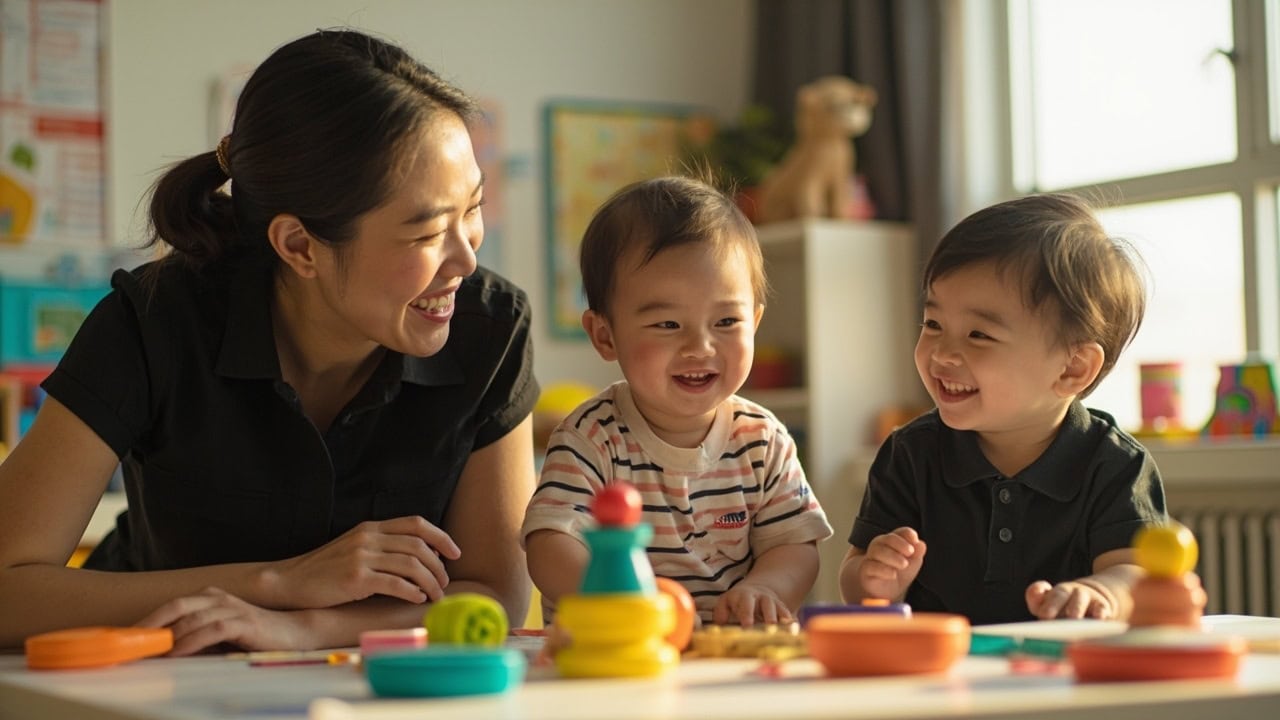
Consider what happens when one caregiver holds the attention of three infants instead of six or eight. Each child has the space to be truly noticed. Their distress is not managed but met. Their curiosity is not interrupted but supported. They are not waiting in line for comfort — they are learning, in their bodies and their nervous systems, that the world responds to them, that their needs matter, that their presence registers.
This is not a luxury. This is the foundation of everything your child will become — their capacity for trust, for learning, for connection, for resilience.
In Singapore’s childcare landscape, this reality shapes what quality infant care can look like. EduNanny by BUTLER, as part of the ECDA Childminding Pilot, operates with caregiver ratios that honor the individual child — ratios designed to allow each infant to be seen, heard, and responded to as the complete person they are. This is not simply a matter of logistics. It is a philosophical commitment to understanding that your child’s inner world is not a mystery to be managed, but a reality to be deeply respected.
The Child Who Feels Known
A child who is cared for in an environment of genuine attunement develops differently than a child who is cared for in an environment of mere adequacy. This is not a judgment on caregivers who are doing their best under difficult conditions, or on families with limited options. It is simply a recognition that the inner architecture of the child is shaped by the quality of the experiences they have — and quality is felt, not measured.
The Secure Internal Working Model
When a child feels known — when they sense that the adult in front of them understands not just their physical needs but their emotional states, their preferences, their emerging personality — something extraordinary happens. They begin to know themselves. They begin to trust their own inner experience.
Psychologists call this a secure internal working model — an unconscious understanding that they are worthy of attention, that their feelings are valid, that they can reach out to others and expect a response.
This is the difference that separates a child who is merely cared for from a child who feels known. And it is a difference that echoes across years.
How This Compounds Over Time
This is the gift that quality infant care gives, and it is a gift that compounds over time:
- A child who feels known learns to know themselves.
- A child who feels understood learns to understand others.
- A child whose inner world has been treated with respect develops quiet confidence — not arrogance, but a grounded sense of self-worth that says: I am worth paying attention to. I have something to offer. The world is interesting, and I belong in it.
Children who feel known tend to approach learning with curiosity rather than anxiety. They tend to form relationships marked by trust rather than wariness. They tend to have a stronger sense of their own voice — the quiet but essential belief that their thoughts and feelings matter.
In a city as fast-paced and demanding as Singapore, where children will face academic pressures and social complexities, this early sense of inner worth is a kind of armor. It is the foundation upon which resilience is built.
Reading Your Child’s Inner Experience
You cannot be at childcare to see through your child’s eyes. And yet this longing to understand — this desire to feel connected to your child’s inner experience even across distance and time — is one of the most beautiful and most human aspects of parenthood.
Here is what many parents discover: your child’s inner experience is not as invisible as it seems. It speaks. It leaves marks. It reveals itself in behavior, in mood, in the small details of how your child relates to you when you reunite at the end of the day.
Signs at Pick-Up Time
Consider the transition from caregiver to parent at pick-up time. A child who has spent their day in a supportive, attunement-rich environment often greets their parent with a particular quality of openness — not clinging or distressed, but genuinely glad. They have the confidence of someone who has had good experiences and trusts that the world continues to be a trustworthy place.
Conversely, a child who is in a merely adequate environment may show more ambivalence, more neediness, more difficulty separating from either parent or caregiver, because their nervous system has not yet learned to trust the reliability of their care.
Small, Telling Details
Notice how your child talks about their day — not in the elaborate narrative style of an older child, but in the small, telling details that toddlers and infants offer when they feel safe:
- A name repeated with pleasure
- A song hummed spontaneously
- A gesture that clearly references a moment of delight or discovery
These are not random. They are windows into your child’s inner experience — fragments of the world they have been living in, carrying emotional information that a perceptive parent can read.
What Quality Communication Looks Like
When families have insight into their child’s day — not through invasive surveillance or constant updates, but through thoughtful communication that reflects a genuine understanding of the child’s experience — parents gain something invaluable. They gain the ability to enter their child’s inner world, to understand what their child values, what brings them joy, what challenges them.
The communication practices that quality childcare providers employ are not simply about oversight. They are about invitation — an invitation for parents to feel present in their child’s day not as surveillance but as participation, not as monitoring but as understanding.
Quality Care in Singapore: What to Look For
For many families in Singapore, the cost and logistics of quality infant care have felt out of reach. The reality of raising a child here involves real financial considerations — the cost of housing, the demands of dual-income households, the difficulty of finding care that feels trustworthy and developmentally sound.
Making Quality Care Accessible
EduNanny was designed with this reality in mind. As part of the ECDA Childminding Pilot, EduNanny by BUTLER offers pathways thoughtfully structured to be accessible — not as a charity or a compromise, but as a genuine commitment to making quality infant care available to families across Singapore.
Key practical features include:
- Affordable fee structures designed within the reality of family budgets
- Use of CDA funds and Baby Bonus payments where applicable
- Monday to Friday care blocks aligned with working parents’ lives
- Both home-based and centre-based pathways to serve different needs
Home-Based vs Centre-Based
For some families, the intimacy of home-based care — where a caregiver comes to the child’s familiar environment — is the right fit. For others, the community and social dimension of centre-based care provides something their child thrives on.
The flexibility to choose the pathway that fits your family’s needs, rather than being forced into a one-size-fits-all model, is itself an expression of respect for your child’s individuality and your family’s autonomy.
A Guide to Choosing Infant Care
When evaluating infant care options, look for these indicators of quality:
- How do caregivers respond to distress? Do they soothe quickly and warmly, or does a child have to wait?
- What are the caregiver-to-infant ratios? Can each child truly be noticed?
- How does the environment feel? Is it clean and safe, but also warm? Is there space for your child to explore?
- How do staff speak about children? Do they describe individual personalities, preferences, and emerging traits? Or do they speak in generalities?
- What is the communication like? Will you receive thoughtful updates that help you understand your child’s inner experience? Or just schedules and meal logs?
- How does your child respond on visits? Watch their body language. Do they show curiosity or fear? Do caregivers kneel to your child’s level, or do they interact from above?
- What happens at pick-up? Observe how children leave. Do they go willingly, with openness? Or with clinging need?
Common Questions Answered
How do I really know what my child is experiencing?
The answer lies not in surveillance, but in observation. Quality caregivers observe and document your child’s responses, preferences, and developmental progress. They communicate not just what happened, but what it meant — how your child responded emotionally, what seemed to engage them, where they showed ease or hesitation.
Will my child feel abandoned or confused?
In quality care, the caregiver’s role is to be a consistent, warm presence who helps the child feel secure enough to explore and learn. This is not about replacing you — it is about extending the conditions of safety and trust that you have established at home into the hours when you cannot be there. When done well, your child does not feel abandoned. They feel held.
Is quality care really different, or is it just marketing?
The differences are real and observable. You can see them in caregiver ratios, in the attentiveness of interactions, in how staff speak about children, in documentation practices, and — most importantly — in your child. Does your child seem to feel safe? Do they show openness and curiosity? Do they seem to know themselves? These are the true measures.
Tonight, When You Pick Your Child Up
The desire to understand your child’s inner experience — to know what they feel, what they think, what they are becoming — is not a weakness to be managed or a worry to be alleviated. It is one of the most powerful forms of love there is.
It is the desire to truly see your child — not just as a small person in your care, but as a whole being with their own rich inner life, their own perspective on the world, their own emerging self.
Notice the quality of their greeting. Notice whether they reach for you with the openness of someone who has had good experiences, or the clinging need of someone who has been waiting to feel safe. Notice the small details — the song they hum, the word they repeat, the way they hold their body.
These are not random. They are messages from your child’s inner world, sent to you across the hours you were apart.
If you look closely — if you read these signs with the love and attention you already carry — you will begin to see what quality care creates. Not just a child who is safe, or occupied, or entertained. But a child who is developing a sense of self that is secure, curious, and resilient.
A child who feels known.
A child who is becoming, in the quiet hours you cannot see, someone remarkable.
Begin the Conversation
At the end of every day, what every parent wants is not simply to know their child is okay. What every parent wants is to know their child — to understand them, to see them, to feel the deep and abiding connection that comes from truly knowing another person.
That connection is not limited by the hours you are apart. It is, if you choose the right care, extended and deepened by them.
Your child’s inner world is waiting for you. Not as a mystery to be solved, but as a world to be entered, celebrated, and loved.
Ready to learn more about how EduNanny supports your child’s inner world? Reach out to start a conversation about what quality infant care can look like for your family.
EduNanny by BUTLER is part of the ECDA Childminding Pilot, offering trusted, development-oriented childcare for families across Singapore. Learn more about who we are or explore our approach to quality childminding.