What Your Child Feels at Childcare: Signs of Thriving
The First Hour: What Your Child Actually Feels at Childcare
When a young child enters a childcare environment, they enter a world that is entirely new in one very specific sense: it is a world without you.
Not abandoned—you have made a thoughtful, loving choice—but genuinely, physically absent. For a child under three, this is not a small thing. You are not simply their parent. You are their internal compass. And so when that presence is removed, even temporarily, even in the most loving and beneficial of circumstances, the child must navigate a profound internal shift.
In the earliest moments after you leave, your child is doing something quiet and enormous. They are calibrating. They are taking in this new environment with senses that are far more alert than we sometimes give them credit for. The texture of the floor. The sound of other children. The face of the person who has stepped in to care for them.
Young children are extraordinary observers. They are reading the room in a way that most adults have forgotten they ever did. For a toddler, every room is new data.
And here is where quality matters most. What your child is reading is not just whether the toys are interesting or whether the space is bright. They are reading whether the adults in this room are safe people. They are reading facial expressions, tone of voice, the way bodies move. They are asking, without words: Is this person going to take care of me the way my people do?
In a quality childcare environment, your child begins to find the answer to that question within minutes. Not because the caregiver performs care, but because they embody it.
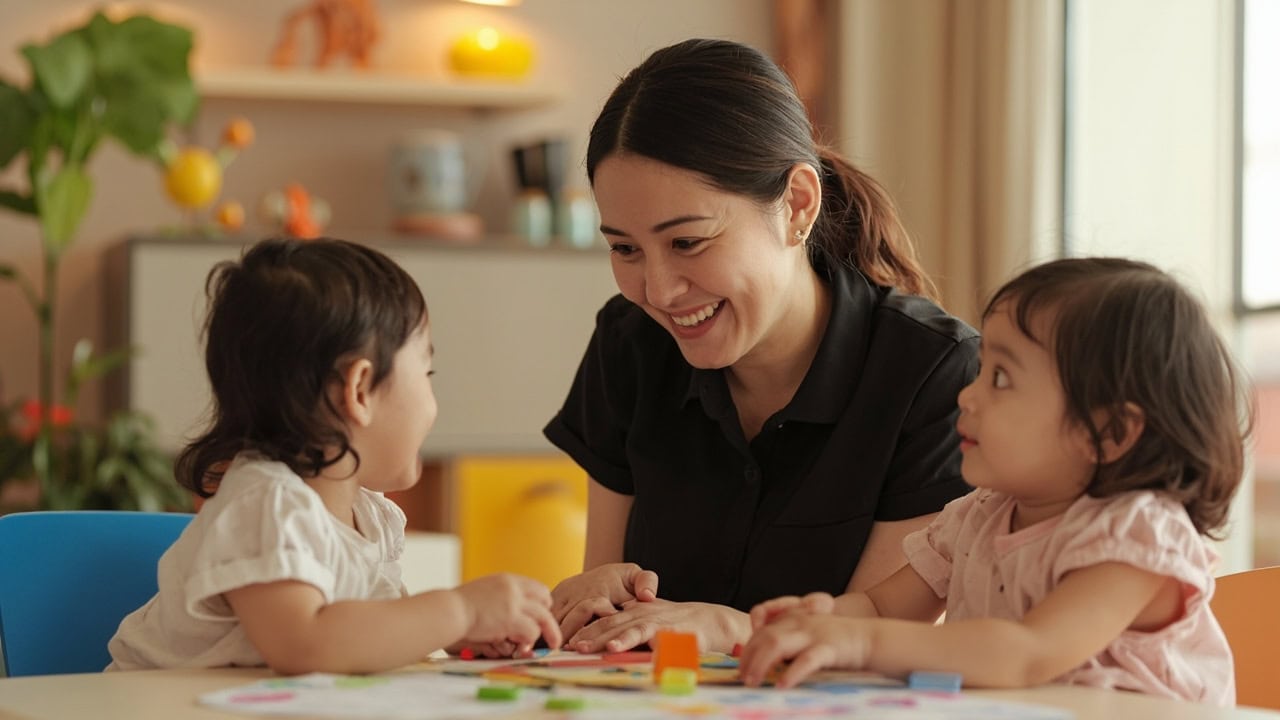
There is a quality of attention that a child recognizes immediately—the way a caregiver kneels to a child’s eye level, the way they name what a child is feeling rather than simply directing what a child does. This is not a technique. It is a posture. And children feel it the way we feel whether a room is warm or cold.
When one adult knows your child well enough to notice when they are beginning to feel overwhelmed before they begin to cry—when they move in with a quiet voice or a gentle hand or a simple redirection that says I see you, I see that this is too much, I am here—that is felt safety. That is the moment in which your child’s internal emotional world is being genuinely tended.
Building a Second Map of the World
What unfolds over the hours that follow is something that parents rarely get to witness, and that is precisely what makes it so important to understand.
Your child is not simply waiting for you to return. That is what we might assume from the outside, from the vantage point of our own longing. But inside the experience, something richer is happening. Your child is building a second map of the world.
The first map is the one you have given them at home—your rhythms, your voice, your particular way of soothing and celebrating and setting limits. That map is foundational. It is where your child’s sense of security begins. But the second map, the one that forms in a quality childcare environment, is where that security is tested and, crucially, confirmed.
It is where your child discovers that safety is not only found in one place, with one person. It is where they begin to understand, in a way that is felt rather than thought, that the world contains other trustworthy adults. Other good spaces. Other people who will care for them with patience and warmth.
This is not a minor developmental event. It is, in fact, one of the most important emotional achievements of early childhood. The capacity to form secondary attachments, to feel safe in new environments, to trust beyond the immediate family—this is the foundation of resilience.
Routines: The Architecture of Emotional Safety
Routines are the architecture of this safety. Young children do not experience routine the way adults do, as a matter of efficiency or scheduling. They experience routine the way a sailor experiences a lighthouse—as a fixed point that orients everything around it.
When your child knows that snack comes after circle time, and that circle time always begins with the same song, and that the song is led by the same person in the same spot in the room, something settles inside them. The world becomes less unpredictable. The anxiety of not knowing what comes next fades, and in its place, something remarkable emerges: freedom to explore.
This is the paradox that quality childcare offers. The more structured and consistent the environment, the more free a child feels to be curious. They can let go of the exhausting work of vigilance because the environment has quietly promised them, through its routines and its warm, attentive adults, that they are safe.
And in that safety, they play. And in that play, they discover—not just what things do, but who they are in relation to others. How to share. How to feel frustrated and recover. How to watch another child and feel fascinated rather than threatened. How to ask for help. How to delight in being noticed by a caregiver who remembers that they love the red truck best.
Emotional Regulation: The Hidden Curriculum
There is a distinction we make in quality childcare environments that I want to pause on. That word is felt.
Felt safety. Felt security. Felt warmth. We do not say that a child is merely supervised in a quality environment. We say they are felt with. And this distinction is everything.
Supervision is important—of course it is. You want to know your child is safe, that they are not in danger, that someone is watching. But supervision is an external act. It is about what is being prevented.
Felt safety, by contrast, is an internal experience. It is what the child is actually feeling inside their body as they move through the hours. And the two are not the same.
A child can be supervised without feeling safe. They can be physically cared for without feeling emotionally held. This is where the true measure of quality is found—not in the absence of harm, but in the presence of genuine attunement.
A caregiver who notices when a child is beginning to feel overwhelmed before they begin to cry—who moves in with a quiet voice or a gentle hand or a simple redirection—is doing something profound. They are walking beside that child through the experience, helping them find their way back to calm. And in that moment, your child is learning, in real time, how to manage big feelings.
The capacity to regulate emotion, to move from distress to recovery, is one of the most consequential skills a human being develops. And it develops in the soil of relationships—not abstractly, not from books, but from being soothed, and seen, and accompanied through difficulty by a consistent, caring adult.
Reading the Reunion: Signs Your Child Is Thriving
You cannot be in that room. You are at work, or navigating the particular pressures of a Singapore day that asks a great deal of parents. But there are things you can watch for. Understanding what emotional thriving looks like will deepen your confidence in your choice, and it will help you stay connected to your child’s inner world even when you are apart.
When you arrive to pick up your child, notice what happens in the first few seconds. Not after your child has performed something for you, not after the transition to your arms, but in those raw first moments.
- How does your child move? Is there a lightness, or a heaviness?
- Does your child move toward you with the relaxed ease of someone who has had a good day, or with the clinging intensity of someone who has been holding themselves together?
A child who has genuinely thrived during their day will often show it not in dramatic displays, but in a quiet contentment. They are glad to see you, warmly glad, but they are not in distress. There is a difference between a child who is relieved to be rescued and a child who is happy to reunite. The first child has been managing anxiety all day. The second child has been having experiences.
You can also notice how your child speaks about their day, when they are old enough to do so. Even before language, you can notice their body, their play, the way they handle transition.
- Does your child return to play with the same energy they left it with, or are they flat and depleted?
- Does your child ask to go back, not because they are desperate to leave you, but because they have found something there that brings them genuine pleasure?
- Does your child speak about specific caregivers or friends by name?
- Has your child developed any new ways of playing, expressing feelings, or relating to others?
These are the signatures of a child who is not merely tolerating childcare, but who is actually thriving inside it.
Questions to Ask When Choosing Infant Care in Singapore
Here is what this understanding does for you. It reframes the entire question of childcare choice.
Because if the question is only ever Am I okay leaving my child here?, then the answer is always about you. Your anxiety, your guilt, your need for reassurance. And those feelings are valid, but they are not the best compass.
The best compass is this: Is my child thriving inside this experience? Is their inner world growing richer, safer, more curious, more connected?
When you visit a potential childcare arrangement, let these questions guide you:
- How do the caregivers respond when a child is upset? What is their first instinct?
- How consistent is the environment? Will my child have the same caregiver each day?
- How do the children in this space move and play? Do they seem at ease?
- How does the caregiver speak to the children? Do they name feelings?
- How does my child respond during a trial visit? Do they show any signs of felt safety?
These questions will not be answered in brochures or websites. They require presence, attention, and the willingness to look past surface-level reassurance toward genuine understanding.
EduNanny’s Approach to Infant Care and Childminding in Singapore
EduNanny was built on a conviction that is simple and, we believe, profound. We believe that every child in Singapore deserves to be felt with. That infant care and childminding are not merely practical arrangements for busy families, but genuine opportunities to support a child’s emotional development during some of the most critical years of their life.
We believe that the hours a child spends away from their parents should be hours that build them up from the inside—not just keep them safe, but make them more whole.
Our approach is grounded in the ECDA Childminding Pilot, a framework that represents something we deeply believe in: that childcare is most powerful when it is rooted in genuine relational care. Small ratios allow each child to be truly known by the adult caring for them. Consistent caregivers give relationships time to deepen and trust to build. The environment is warm, structured, and safe enough to create the felt security we have been describing. And communication with families is not a formality but a genuine partnership in understanding the child’s inner world.
EduNanny offers both home-based and centre-based pathways, because families are not all the same, and the best fit is the one that serves the child and the family together. We offer Monday to Friday care blocks designed around the realities of working parents in Singapore, and our fee structures are built to be genuinely accessible. CDA and Baby Bonus usability are available where applicable.
Where we have deployed communication and transparency measures, including CCTV, we do so not as a substitute for trust, but as an expression of it. We want parents to feel connected to their child’s day, not disconnected from it.
We want you to be able to ask not just Is my child safe? but What did my child feel today? What did they discover? Who did they become for those few hours?
Your Child’s Inner World Is Being Built Right Now
Here is what we want you to carry with you from today.
Your child is not simply waiting for you. They are living a life while you are apart. They are feeling things, discovering things, learning who they are in relation to others. They are building the emotional architecture that will serve them for the rest of their life—not in some distant future, but right now, in these hours, in these relationships, in this space that you have chosen for them.
That is not a burden. It is an invitation.
An invitation to see childcare not as a necessary compromise, but as a genuine gift you are giving your child—the gift of a safe, warm, stimulating environment in which their inner world can flourish.
An invitation to ask better questions. Not Will my child survive this? but Will my child thrive in this? Not Am I comfortable leaving them? but Are they growing? Are they happy? Are they becoming more of who they are?
The child who comes home from a quality childcare experience is not a child who has been minded. They are a child who has been accompanied. They are a child who has felt seen. They are a child whose emotional world has been tended with the same seriousness and tenderness that you bring to it at home.
You made a brave choice to trust someone else with the most precious thing in your life. We do not take that lightly. We take it as the sacred responsibility it is, and every day, in every small interaction, in every moment of felt safety we create for the children in our care, we are working to be worthy of that trust.
At EduNanny, we are committed to this work—to the children, and to the families who trust us with them. Learn more about our approach or reach out to speak with us about your family’s needs.