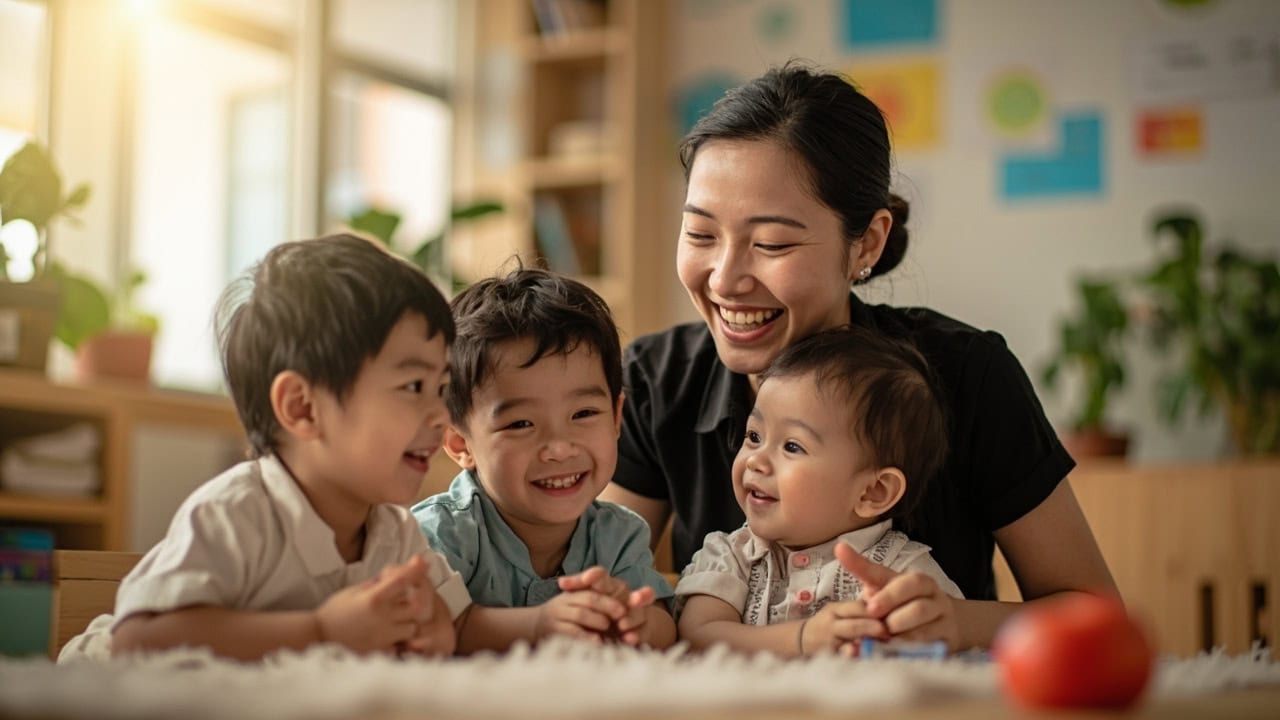
What Trained Eyes See in Singapore Childcare
Why Searching and Seeing Are Not the Same Thing
The search for childcare in Singapore is, by any measure, a bewildering undertaking. The range of settings, philosophies, and arrangements can feel like navigating a city without a map. Parents spend weeks, sometimes months, touring centres, calling agencies, asking friends, reading forums. They feel they should be doing something active, and so they search. They compile. They compare.
But the anxiety does not lift.
And why would it? You can walk through twenty centres and still not know what a quality interaction looks like when you are standing in one. You can read a hundred reviews and still not know what questions to ask when a caregiver bends down to speak with a toddler.
The search does not fail you. It simply asks something of you that you have not yet been given: a trained eye.
This is not about becoming a childcare expert. It is about becoming a more confident reader of the environment your child will live in — and this skill is learnable. It is not mysterious. It is not something you are born with or without. It is a matter of knowing what to look for, and then looking.
What Trained Eyes Learn to See
When you walk into a room full of young children, your untrained eye sees a room full of young children. There is noise, or perhaps quiet. There are toys on shelves and children on mats. It is a lot to take in.
But a trained eye does something different. It softens, and then sharpens. It does not try to absorb everything at once. It begins to watch a single moment, a single interaction, and it reads what is there.
The Caregiver: Managing Versus Attuned
Watch the caregiver. Not what she is doing with the children, but how she is with them. There is a difference that most parents do not notice until it is pointed out.
A caregiver who is managing will position herself centrally, face the group, give instructions. A caregiver who is attuned will be down at the child’s level. She will not just be in the same room. She will be in the same moment.
Watch her hands. Are they reaching, or waiting? Are they correcting posture, or adjusting a puzzle piece beside a child without interrupting? That small distinction — the willingness to work alongside without taking over — is one of the first things a trained eye learns to see.
The Children: Transitions and Signals
Watch the children. Not all of them. One at a time. Watch what a child does when they encounter something difficult. Do they look up? At whom? Is there a caregiver nearby who notices that look, or do they have to reach for help?
Watch what a child does when they are finished with an activity. Do they carry it to a shelf, or drop it and walk away? That small act of transition — whether a child knows what comes next, whether they have been helped to feel the next thing is available — is one of the quietest and most revealing markers of quality you will ever see.
These are not secrets. They are observations. And they become visible the moment you know they exist.
What Quality Looks Like at Every Developmental Stage
The early years are not one uniform stretch of time. The developmental reality of a six-month-old infant is fundamentally different from that of a two-year-old toddler, and the quality indicators shift accordingly.
This is where most parents, even well-read ones, lose the thread. They know what they want in general terms — safe, caring, stimulating. But they do not yet know what safety looks like in an infant room versus a toddler classroom, what caring sounds like when it is directed at a non-verbal child, what stimulation actually means for a brain that is building itself at extraordinary speed.
For Infants: Responsiveness
Your infant cannot tell you if the environment is warm. She cannot say whether her caregiver notices when she gurgles or when she cries. But she is telling you constantly.
Watch for the latency between a child’s vocalisation and the caregiver’s response. Not the absence of crying, but the rhythm of return. An infant who cries and is soothed within seconds, who is talked to even if only briefly as the caregiver picks her up, who is carried facing outward but periodically turned toward a voice or a face — this is an infant living inside a relationship.
This is not sentiment. It is neurobiology. The infant brain is building its template for what the world is like, and that template is formed one interaction at a time.
For Toddlers: Agency
By eighteen months, a child is driven by a fierce and beautiful need to do things for herself.
Watch a toddler classroom and ask: does the environment support this drive, or resist it?
- Are the shelves low enough that a child can reach what she wants?
- Are the activities open-ended enough that a child can choose, rather than wait to be directed?
- Is there a caregiver nearby who says yes, rather than a caregiver who mostly says no?
You will not see this in a tour brochure. You will see it in the ten minutes you spend watching the room before anyone knows you are watching.
For Preschoolers: Collaboration
By four, a child is beginning to understand that other children have minds different from her own.
Watch how conflict is handled. Not whether conflict arises, because it will, but what happens after. Does a caregiver step in and resolve, or does a caregiver step in and guide?
There is a world of difference. One teaches children that adults manage problems. The other teaches children that adults help them manage problems. That distinction, seemingly small, is the beginning of a child’s understanding of their own capability.
Questions to Ask on Any Tour or Home Visit
Give yourself permission to watch before you ask. You are allowed to stand at the edge of a room and observe.
When you do ask questions, ask about the small moments. These questions tell you far more than any philosophy statement on a website:
- Not what your child will learn, but what a typical morning looks like
- Not what the curriculum covers, but how they handle a child who is struggling to settle
Ask About Ratios
In an infant setting, the number of caregivers to children is not a bureaucratic detail. It is the architecture of attention.
When a caregiver is responsible for fewer infants, she can hear the difference between a fussy cry and a hungry cry. She can notice when a child’s face changes, when something shifts in the quality of their play. That attention is not a luxury. It is the substance of the care.
Ask About Communication
How will you know what happened in your child’s day?
Parents deserve to feel connected to what happens while they are apart. Where transparency measures are in place, they exist not because trust is absent, but because clarity matters.
Ask About the Caregiver Herself
- What is her background?
- What drew her to this work?
- How does she describe a good day?
These are not soft questions. They are the questions that reveal whether this is a job someone does or a calling someone lives. And you will know, from the way she answers, whether her answer comes from the head or the heart.
The ECDA Childminding Pilot and What It Offers
The ECDA Childminding Pilot represents something significant in Singapore’s childcare landscape, and it deserves to be understood on its own terms. It offers a pathway that is different from the centre-based mainstream — one grounded in home-based care, in smaller ratios, in the intimacy and flexibility that many families need and cannot find elsewhere.
The pilot fee structures are designed to be affordable. CDA and Baby Bonus funds can be used. The care runs Monday through Friday, in blocks that respect the rhythms of working family life.
This is not a compromise. It is a choice that has been thought through, and it is available to families across Singapore.
EduNanny by BUTLER sits within this pilot not as a newcomer testing the water, but as a programme that has taken seriously the responsibility of what it means to care for infants in the earliest years of life. When you bring your child to EduNanny, you are not entering a system. You are entering a relationship — one mediated by trained caregivers who understand infant development not as a credential but as a practice, something they do every day with every child in their care.
Trust Your Eye
None of what I have described is about perfection. No classroom is perfect. No caregiver is always at the right level, always patient, always attuned.
Quality is not the absence of difficulty. It is the presence of a pattern. It is the consistency of approach, the philosophy that underlies the small moments, the thousand daily decisions that shape a child’s day.
Your eye, once trained, does not look for flawless behaviour. It looks for the shape of care. And that shape is visible, if you know where to look.
This is why the best childcare decisions often feel less like choosing and more like recognising. Parents who have walked through EduNanny describe arriving not because they had solved the search, but because they had finally seen something that felt true. They had walked into a space and watched — perhaps for the first time — not just what was happening but how it was happening.
Children are not waiting for perfect parents or perfect programmes. They are waiting for attentive ones. They are waiting for environments where their signals are received, where their attempts at communication are met with response, where they are seen as full human beings in the earliest stages of becoming.
Every skill described here — every observation technique, every way of seeing — is ultimately in service of one goal: the ability to meet your child where they are. Not where you imagine they should be. Not where a milestone chart says they should be. Where they actually are, right now, in this moment.
Trained eyes see the child in front of them, not the child in the abstract. They respond to the real thing, not the ideal. And when that happens — in a home or in a centre, in any setting where care is given with this kind of intention — something extraordinary takes root.
If you are beginning your childcare search in Singapore, or if you are looking for something different from what the mainstream has offered so far, EduNanny by BUTLER invites you to come and see. Not to be persuaded. To observe. To watch. To trust what your newly trained eye tells you.
Trust your eye. It knows more than you think. You just have to let it learn.
If you would like to learn more about the ECDA Childminding Pilot and whether EduNanny might be the right fit for your family, we welcome the opportunity to start a conversation. You can also read more about EduNanny’s approach and what we believe about quality care in the earliest years.