What Trained Caregivers Notice That Parents Miss
The Singapore Reality: Making Decisions Under Pressure
Singapore has built an extraordinary environment for raising children — with infrastructure, support systems, and educational pathways that many other countries genuinely admire. But with that comes a pace of life, an expectation of productivity, and a cultural orientation toward excellence that begins earlier than most parents ever imagined it would.
We return to work when our children are still learning to walk. We make decisions about childcare arrangements that will shape our child’s earliest experiences of the world — often with incomplete information, often under pressure, and always with the weight of wanting to get it right.
You have toured centers. You have asked about ratios, checked credentials, read reviews. You have stood in bright, colorful rooms and tried to imagine your baby in that space, trying to feel whether this could be right.
That process matters. But it is worth being honest about a limitation that no tour can overcome: you cannot see what trained eyes catch. And that invisible difference is the architecture of everything that matters in your child’s early development.
Seeing vs. Watching: What Caregivers Notice That Parents Cannot
A parent watching their child in a room notices what is visible and immediate. They notice if the child is crying or laughing. They notice if the child seems upset or content. They notice the big moments, the milestones, the dramatic expressions of need.
This is not a criticism of parents. It is simply a recognition that parents are emotionally embedded in what they observe. You are not watching your child — you are experiencing your child. And that fierce protective investment, that love, is the most important thing in your child’s life.
But it also means that certain kinds of seeing become harder when you are the one who carried this small person, who knows every sound they make when they are tired versus when they are hungry versus when they are simply seeking attention.
Now consider what a professional caregiver with genuine training and experience observes.
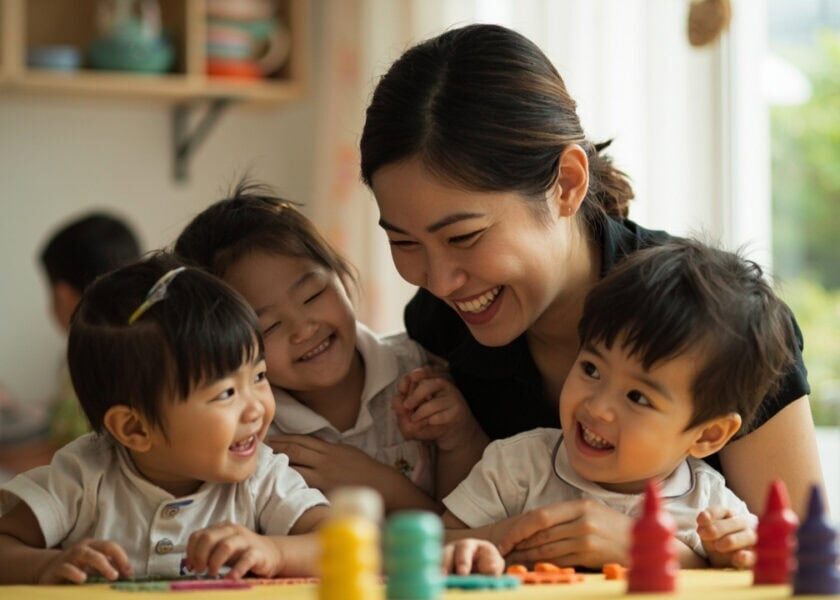
She notices the quality of play before a developmental shift. She notices that a child who typically engages confidently with other children has, for the past several days, been hanging back slightly — watching rather than participating. She notices that a child who usually eats well has begun leaving certain textures untouched. She notices that a toddler who was mastering a new physical skill seems to have regressed slightly, holding back in a way that might indicate a growth spurt, a change in sleep, or a minor discomfort that has not yet become visible to the untrained eye.
This is not passive watching. It is disciplined observation informed by training, by developmental frameworks, by hundreds of hours of knowing what typical development looks like and what variations within typical development can look like.
It is the same kind of trained perception that allows a musician to hear a slightly flat note in an orchestra when most listeners hear harmony — or that allows a seasoned physician to notice something in a patient’s gait that suggests an underlying condition. The trained eye does not see more things. It sees the same things differently.
And that difference is everything when we are talking about your child’s development in the years when the brain is forming at its most rapid rate, when patterns are being established that will influence everything from emotional regulation to social confidence to the relationship your child will have with learning itself.
What Trained Observation Actually Looks Like
Sensory Patterns
Consider the sensory world of an infant and toddler. Children process the world through their senses in ways that are still being mapped and refined.
A trained caregiver notices whether a child is consistently seeking intense sensory input — rolling and pushing and pulling — or whether a child consistently retreats from sensory stimulation, withdrawing from noise or avoiding certain textures.
These are not behaviors to be judged. They are information.
A child who is seeking heavy sensory input may be regulating their nervous system through movement and pressure. A caregiver who understands this can provide appropriate sensory experiences throughout the day, helping that child feel more settled and regulated. A child who is retreating may be showing signs of sensory sensitivity that, if understood and accommodated, becomes manageable rather than overwhelming.
Without trained observation, these patterns often become invisible or are misread as behavioral problems or personality traits. They are neither. They are signals. And signals require someone who knows how to read them.
Social-Emotional Cues
A child who bites another child in a toddler room is not simply being aggressive. A trained caregiver will observe the context carefully:
- Was this child tired or hungry?
- Was there a transition in routine that created stress?
- Was this a child who has been seeking connection but lacks the language or social skills to initiate appropriately?
The bite is visible. The causation is invisible.
What the caregiver does next — how she responds, how she helps both children process the moment, how she adjusts her observation going forward to prevent recurrence — all of this depends on understanding what she saw beneath the surface behavior.
The goal is not to stop the biting through punishment or isolation. The goal is to understand the child who bit and the child who was bitten, and to help both children develop more sophisticated ways of navigating their social world.
Attachment Signals
In the early years, children are building internal working models of what relationships feel like, what they can expect from caregivers, and how they can communicate their needs.
A trained caregiver observes attachment behaviors not to label or judge, but to understand how a particular child experiences closeness and separation. She notices whether a child has a consistent pattern of seeking comfort when distressed, or whether distress seems to leave the child without a clear path back to regulation. She notices whether a child uses the caregiver as a secure base from which to explore, or whether exploration seems tentative and anxiety-laden.
These observations are not clinical assessments. They are the foundation of responsive, individualized care. When a caregiver truly knows how your child seeks connection and comfort, she can provide care that feels right to your child — that meets them where they are, rather than imposing a one-size-fits-all approach that may leave some children unsettled without anyone understanding why.
Observation in Practice: From Seeing to Partnership
Observation at this depth is not a mental note taken occasionally. It is a systematic, disciplined practice that shapes every interaction throughout the day.
It begins with knowing each child as an individual — their rhythms, their preferences, their typical responses to different situations. It involves tracking developmental progress over time, watching for patterns and trends rather than reacting to isolated moments. And it requires the time and space to simply be present with children, which is why ratios matter. You cannot observe well when you are simply managing a room.
Where patterns emerge, they are recorded. A developmental concern is not ignored or hoped away. A shift in behavior is tracked across days and weeks to determine whether it is transient or significant. An emerging interest is noted and built upon. This is how responsive care actually works — not by following a rigid curriculum, but by letting the child guide the observation, and the observation guide the care.
One of the most powerful elements of quality childcare is what happens when observation findings are shared with parents.
When a caregiver sits with you at the end of a day or a week and tells you, with specificity and care, what she noticed about your child, something shifts. You begin to see your child through professional eyes, and that perspective complements your own parental knowing in ways that are genuinely illuminating:
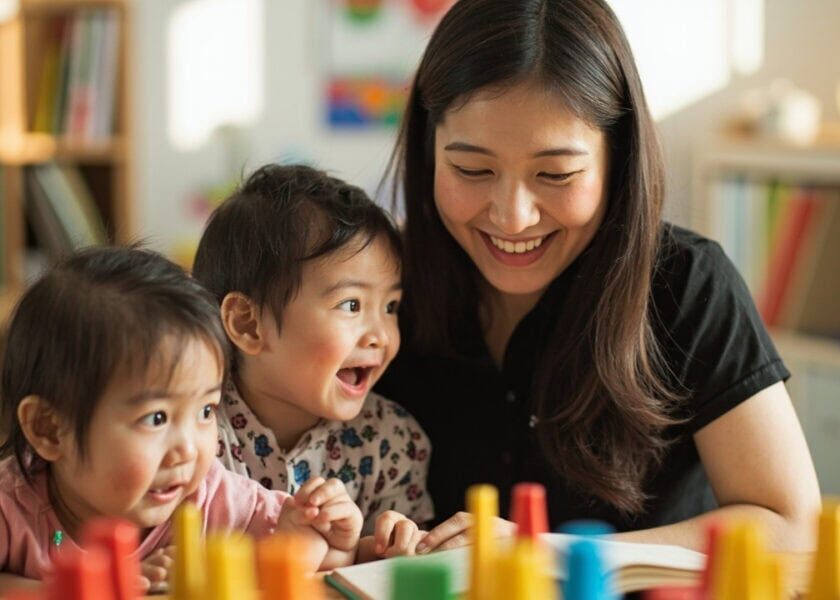
- You may hear that your child has become fascinated by how things fit inside other things — stacking and nesting with intense concentration. This tells you something about a cognitive leap that is happening.
- You may hear that your child has been showing a strong preference for one caregiver over others, and together you can think about what this means and how to support the transition.
- You may hear that your child seems to need more physical play before settling for naps, and this information helps you adjust routines at home in ways that reduce struggle and conflict.
This is not surveillance. It is not reporting. It is professional knowing offered in the spirit of partnership.
And it builds a different kind of trust than the trust that comes from simply being reassured that everything is fine. Because everything is not always fine. Children have difficult days, developmental challenges, periods of transition. The question is not whether difficulties will arise. The question is whether the people caring for your child are noticing what is actually happening — not just what is superficially visible.
How to Evaluate Observation Quality
Here is a practical question worth asking: how do you evaluate whether a childcare arrangement has genuine professional observation practices in place, or whether observation is something claimed on a website but not actually lived out in daily practice?
The checklist of ratios and credentials matters — but it does not tell the whole story. Here are questions that move beyond the surface:
- How are observations recorded? Is there a systematic approach to developmental tracking? You are not looking for bureaucratic paperwork. You are looking for evidence that someone is paying attention with discipline and intentionality.
- How are observations shared with parents? Is there a regular communication practice — not just the daily report of meals and naps, but genuine narrative exchange about how the child is developing and behaving?
- What happens when a caregiver notices something unusual? Is there a process for tracking, discussing, and deciding when to bring something to a parent’s attention?
- How are caregivers trained in observation? Is it part of their initial preparation, or is it something they learn on the job without formal frameworks?
- What are the caregiver-to-child ratios, and why do they matter? Observation at the depth described here requires time and space. You cannot truly know each child in your care if you are managing too many at once.
These questions will not give you a simple yes or no answer. But they will give you a sense of whether observation is a living practice or an aspirational claim.
You might also wonder: what if something goes wrong — will I be told? Professional observation is precisely what makes early intervention possible. The trained caregiver is not waiting for problems to become obvious. She is noticing shifts, patterns, and signals in real time. When observation reveals something worth attending to, there should be a clear process for tracking it, discussing it internally, and bringing it to your attention appropriately.
The EduNanny Approach: Where Observation Becomes Partnership
At EduNanny, professional observation is not an add-on to childcare. It is the foundation.
We participate in the ECDA Childminding Pilot, which reflects our commitment to regulated, quality care that meets national standards and goes beyond them. Our caregivers are trained to observe systematically, to track development thoughtfully, and to share their findings with parents in ways that build genuine partnership rather than one-way reporting.
We maintain ratios that allow for individualized attention, because observation at the depth described requires time and space. You cannot observe well when you are simply managing a room. You observe well when you truly know the children in your care — and that requires numbers that allow for presence.
We understand the financial realities that Singapore families face. CDA and Baby Bonus funds can be used, and we help families navigate these options without confusion or pressure.
We offer Monday to Friday care blocks designed to support families navigating the realities of work and parenting in Singapore. Our home-based approach, where applicable, allows observation to happen in the context of your child’s actual living environment — which provides its own kind of valuable information. Where community or centre-based pathways are available, we apply the same observation frameworks with the same intentionality.
The Invisible Architecture of Excellent Care
The best childcare is invisible because it is working.
When your child is in an environment where trained observation is guiding responsive care, where developmental tracking is happening systematically, where sensory patterns and social cues and behavioral shifts are being noticed and understood — the experience for you as a parent can feel almost disappointingly uneventful. Your child comes home happy. The day was fine. Nothing dramatic happened.
And you may wonder whether you are getting what you are paying for.
Here is what you need to know: this uneventfulness is the point. It is the evidence of care that is working.
- The developmental challenges that would have emerged into crisis are being noticed earlier.
- The sensory needs that would have created persistent discomfort are being understood and met.
- The social-emotional patterns that would have become problematic are being supported with skill and patience.
The invisible architecture of professional observation is doing its work quietly, constantly, and effectively.
What you want, ultimately, is for your child to be known. Not just supervised. Not just kept safe and entertained. Known. Understood. Seen for who they are, with all their particular patterns, preferences, strengths, and challenges.
The first years of your child’s life are not a period to be gotten through. They are a foundational chapter being written in real time, with real consequences for everything that follows.
The caregiver who observes your child with trained attention is not simply filling a gap while you work. She is contributing to the most important developmental project of your child’s life. She is noticing what matters. She is sharing what she sees. She is building the knowledge base that allows for care to be truly responsive rather than merely routine.
This is why professional observation is not a luxury or a marketing claim. It is a necessity — the invisible architecture that makes all other quality in childcare possible.
When you find a care arrangement where this is happening, where you can feel the depth of knowing even when you cannot see it directly, you have found something rare and valuable. Not just a service. A partnership. A shared commitment to your child’s development, built on professional expertise and genuine care, offered with the respect and seriousness that your child’s early years deserve.
And when you find it, we hope you will recognize it not by the drama it prevents, but by the quiet confidence it gives you — the confidence that comes from knowing that someone with trained eyes is watching, noticing, understanding, and caring for the person you love most in the world.
A Quick Summary
- Professional caregiver observation is a trained discipline, not passive watching — it catches developmental shifts before they become concerns
- Trained caregivers notice sensory patterns, social cues, behavioral shifts, and attachment signals that parents, who are emotionally embedded in their child’s life, cannot see clearly
- The best childcare is invisible precisely because it is working — the absence of drama is the evidence of quality
- When caregivers systematically share observations with parents, it builds a genuine developmental partnership, not one-way reporting
- Evaluating observation quality means asking the right questions — not just checking ratios and credentials
If you are navigating childcare decisions in Singapore and want to learn more about how EduNanny brings professional observation into every day of your child’s care, we welcome the conversation. Get in touch to discuss what your family needs.
You can also learn more about who we are and our approach to quality childminding in Singapore.