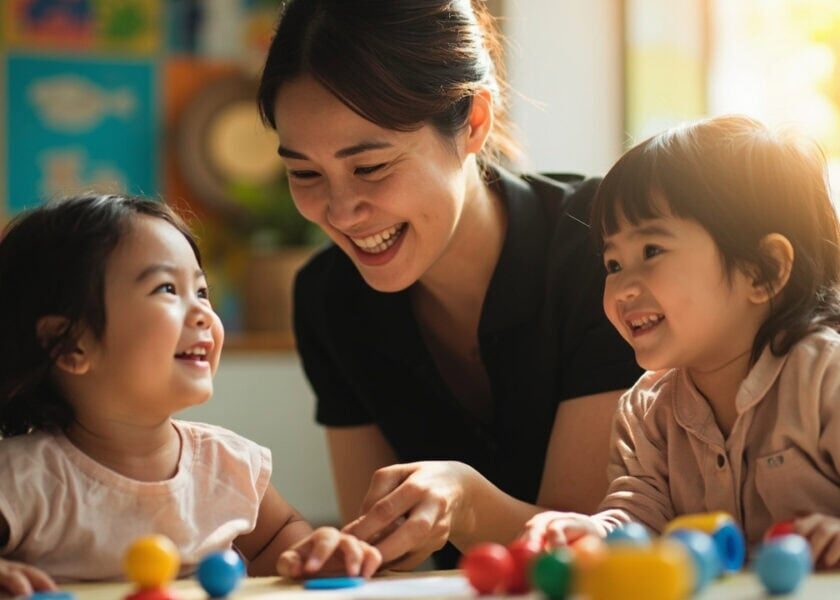
What Singapore Parents Notice But Cannot Name in Childcare
The Problem: You See It, But You Cannot Name It
And yet, when you try to put it into words — when someone asks you, how do you know this is good care? — the words do not come easily.
You sense something. You cannot name it. You feel uncertain even when you feel something is right, and you second-guess yourself even after you have made a decision.
This is not because you are a bad observer. It is not because you lack the skills.
It is because observation without a vocabulary is like seeing a language you cannot read. The signals are there. The meaning is not yet clear.
If you are a parent in Singapore researching infant care or childminding, this tension is probably familiar. You are paying attention. You are noticing more than most experts give you credit for. But without the right framework, without the right words, that attention can feel like anxiety rather than insight.
What you need is not more information. You need the vocabulary to use the information you already have.
The Five Quality Signals You Are Already Noticing
Signal One: Your Child’s Transition at Pick-Up
You arrive at pick-up. Your child is playing, or finishing a story, or sitting down for a late afternoon snack.
When does your child notice you? Not the moment your face appears in the doorway — we have all seen children who look up and keep playing — but the moment your child truly registers your presence.
There is a visible shift. A softening. Sometimes a quick glance that carries recognition, sometimes an immediate break in activity, sometimes a reaching or a running. That moment of noticing, and what follows it, is one of the most reliable quality signals you will ever observe.
A child in good care will often complete a small action before coming to you — putting away a toy, finishing a sentence, touching the caregiver’s hand on the way out. This is not disengagement. This is the hallmark of a child who feels secure enough to leave something in progress, who trusts that what they were doing mattered.
A child who is anxious about transitions will often drop everything immediately, without completion, as if the caregiver’s presence is a signal to flee rather than a signal to close one experience and begin another.
Ask yourself: Does my child seem to trust the people and spaces here enough to leave things in progress? If the answer is yes, that tells you something real. If the answer is no, that tells you something real too — and it is worth understanding why.
Signal Two: The Caregiver’s Warmth Is Not Performance
Now watch the caregiver.
This is where many parents stop looking. They look at their child, and they miss what is happening behind their child — the caregiver who is still in the room, the caregiver who is still with the other children.
But that moment when your child leaves, when the handover happens, is one of the most instructive moments you will ever witness.
A high-quality caregiver does not simply hand your child over and turn away. A high-quality caregiver completes the transition: they kneel or bend to your child’s level, they say something warm, they make eye contact with you, and in that eye contact, there is recognition. Not just the recognition of a face, but the recognition of a relationship. The caregiver knows your child. The caregiver has been paying attention. The caregiver can tell you, in a sentence or two, something your child did today that was meaningful.
Watch for the difference between a caregiver who performs warmth and a caregiver who is warm. The difference is in the timing. Warmth that is performed tends to happen when parents are watching. Warmth that is genuine tends to happen when parents are not watching, and continues even when parents arrive.
Watch for the caregiver who is still with the remaining children, still present, still responsive, even as your child leaves. That caregiver is not only warm when parents are there. That caregiver is warm because warmth is how they do this work.
Signal Three: Listen to the Way They Speak
There is another quality signal that is easy to miss because it happens so quickly.
Listen to the communication. Not what is said — though that matters — but how it is said. Listen to the tone the caregiver uses with children who are not your child. Listen to the way a caregiver corrects a child or redirects a child’s attention.
Listen for the difference between:
- Commands: “No.” “Stop.” “Sit down.” “Wait there.”
- Guidance: “Let’s try this together.” “I wonder what would happen if we waited a moment.” “Can you show me what you are building?”
Command-based communication is efficient. It gets things done. But it treats the child as an object to be managed. Guidance-based communication treats the child as a person to be engaged. It asks something of the child. It invites the child into the moment, into the relationship, into their own agency.
You can hear this difference in a single sentence. You do not need to observe for an hour. You need to listen, just once, to how a caregiver speaks to a child who is not paying attention to them. That is the real test — not how a caregiver speaks to a cooperative, happy child, but how a caregiver speaks to a distracted, resistant, or frustrated child. That is where quality reveals itself.
And when the caregiver speaks to you — at pick-up, during handover — notice whether the communication goes beyond logistics. A good caregiver will tell you what time your child ate, yes. But a great caregiver will tell you something your child said, or something that surprised them today. They will share a small observation that tells you: your child was seen. Your child’s day was attended to.
Signal Four: What the Room Feels Like
Now let us talk about the room itself.
Not as an inspection, but as a feeling. Walk into the space before you walk to your child. Stand for a moment. Breathe. Notice what the room feels like.
Does the room feel purposeful or merely safe? There is a difference.
A room that is merely safe has done the minimum. The children are not in danger. The room is clean. The ratios are met. But a room that feels purposeful has been designed with thought: the lighting is warm, the noise level is manageable, there are places to be alone and places to be together, the children’s work is displayed not as decoration but as acknowledgment.
Watch the way children move through the space. Do they move with ease, or are they constantly directed? Ease is a quality indicator. A room that works well is a room where children can move from one activity to another without constant instruction, where they know what is available and can make choices, where the space itself supports their autonomy.
Notice the children’s faces — not just your child’s face, though that matters most. Are they engaged? Not necessarily busy — busy is not the same as engaged. Are they absorbed in something? Do they look like they are in a place where interesting things happen? Are there moments of laughter, of concentration, of quiet pleasure?
Signal Five: Your Child’s Comfort Patterns Over Time
There is a quality of ease that develops over time, when a child has been in consistent, responsive care.
A child who has been in quality care for some time will know the rhythm of the day without anxiety, show genuine affection for their caregiver, express themselves freely — showing frustration, joy, curiosity — because they feel safe, and reference the caregiver or the space positively, even indirectly.
Pay attention to the emotional register of your child’s day. Does your child seem to be arriving with energy, or running on empty? Does pick-up feel like a release of tension, or a continuation of it?
A child in good care will have ups and downs — this is normal. But the overall trajectory should be one of growing comfort, growing confidence, growing connection. If you notice the opposite — persistent anxiety, resistance, withdrawal — that is worth understanding. And it is worth asking questions.
Why Observation Alone Is Not Enough
We have been speaking about observation. About the skills you already have and the vocabulary you can build.
But we want to be honest with you: observation alone is not enough.
You can see quality. You can name quality. But if the structure around you does not support quality, your observations will only tell you what is wrong. You will leave pick-up feeling unsettled, and you will not be able to do anything about it.
The best observation skills in the world cannot compensate for ratios that are too high, training that is insufficient, or oversight that is inconsistent. You can notice that something feels off. But without a structure designed for quality, you cannot change what you are noticing.
What Singapore parents need — and deserve — is not just the ability to observe quality. Parents need to actually find it.
And finding it requires more than good intentions. It requires ratios that allow real attention, training that prepares caregivers for complexity, oversight that maintains standards, and a model of care that treats childminding not as a service to be delivered, but as a practice to be developed.
When the structure is right, your observations become tools for confidence, not sources of doubt.
What EduNanny Singapore Offers
EduNanny was built on a simple conviction: that parents deserve more than the ability to observe quality. Parents deserve to actually find it.
We are proud to be part of the ECDA Childminding Pilot. This is not a small thing. The pilot represents a recognition — from the government, from early childhood experts, from Singapore — that home-based and community-based childminding can offer something that large-centre care often cannot: more individual attention, stronger caregiver-child relationships, a smaller, more consistent environment where children can develop at their own pace.
When the numbers are right, the care can be right too. EduNanny maintains ratios that allow the kind of attention quality requires — up to one to three infants in infant care — with affordable fees within pilot structures, supported by subsidies, and usable with your child’s CDA and Baby Bonus.
The Dignity of This Work
There is a dignity to this work that is sometimes overlooked. The work of caring for young children — of being present for their learning, their growing, their becoming — shapes a human being. It is consequential in the deepest sense.
And yet the people who do this work are too often treated as service providers, as babysitters, as interchangeable. At EduNanny, we reject this.
We believe that the childminder who knows your child’s face when they arrive at the door, who knows that your child likes to be sung to before nap time, who notices when your child is frustrated before your child knows how to name it — that childminder is not a convenience. That childminder is a collaborator in your child’s development.
That childminder deserves to be seen, supported, and valued as a professional in the most important work there is. This is why EduNanny invests in training. This is why we maintain the standards we maintain. This is why we build our model around relationship rather than transaction.
Not because relationship is a soft word, but because relationship is where development happens. Children do not develop in isolation. They develop in connection. In responsiveness. In the back-and-forth of attention and warmth and patience and challenge. The childminder is not a container for your child. The childminder is a partner in your child’s growth.
A Partnership, Not a Transaction
We believe that parents deserve to be partners too. Not clients. Not customers. Partners.
This is why communication flows in both directions at EduNanny. This is why we want you to observe, to ask, to notice, to share what you see.
Because you are not outside your child’s care, watching from a distance. You are the most important person in your child’s life. And the best care recognizes that, works with it, invites you in.
If you are researching infant care or childminding in Singapore, you probably have questions. Building observation vocabulary takes time, and some situations are genuinely ambiguous. What EduNanny offers is a structure where your observations can be confirmed, supported, or gently corrected — not dismissed. When communication flows in both directions, you are never left alone with your uncertainty.
Your felt sense matters. Paper qualifications, ratios, and regulatory compliance are necessary but not sufficient. The observable signals we have discussed — your child’s transition, the caregiver’s warmth, the communication tone, the room’s atmosphere — these are what actually matter. Trust what you see.
What Changes When You Have the Words
We have spoken about observation. We have spoken about structure. We have spoken about the dignity of the work.
Now let us speak about what we want for you.
We want you to walk away from pick-up feeling clear. Not perfectly assured — there is no such thing in parenting, and anyone who promises you certainty is selling you something. But clear. Confident. Informed.
We want you to know what you are looking at when you look at your child’s caregiver. We want you to know what quality looks like, in the specific moments of your specific child’s day.
We want you to trust what you see, because what you see is real. Your instincts are not guesses. Your observations are not anxieties. They are the accumulated wisdom of loving your child, refined over months and years into a sensitivity that experts can learn from.
When you can name what you are noticing — when you can connect a moment of warmth to the depth of relationship it represents, when you can see your child’s ease of transition and know that it means something about security, when you can hear the difference between command and guidance and know why it matters — then something shifts.
The uncertainty does not disappear entirely. But it changes shape. It becomes the ordinary uncertainty of a parent who cares, not the paralyzing uncertainty of a parent who cannot trust themselves.
Practical Guidance for Choosing Infant Care in Singapore
Before you choose:
- Visit at pick-up time, not just during a scheduled tour. Observe the transition. See how children respond to caregivers and parents.
- Notice whether you are invited to observe or only to be toured. Care that welcomes observation is care that has something to show.
- Ask the caregiver to tell you something about a typical day — and listen for texture, not just logistics.
- Ask about ratios, training, and oversight. These structural elements matter even if you cannot directly observe them.
After you choose:
- Pay attention to your own observations. Notice your child’s transitions at pick-up.
- Notice what your caregiver tells you at handover — does it go beyond meals and naps?
- Notice how you feel after pick-up. Do you feel clear or uncertain? That feeling is information.
- Share what you notice with your caregiver. Partnership flows both ways.
At your first pick-up, ask:
- What did my child enjoy most today?
- How did my child respond to the other children?
- Was there a moment when my child seemed particularly engaged or frustrated?
- How did my child handle the transition to nap, snack, or activity?
If a caregiver cannot answer these questions — or does not seem to know — that is a signal worth noting.
Closing
You arrive at pick-up. You notice the room. You watch your child. You watch the caregiver. You listen to the tone of voice, the quality of communication, the ease of transition.
And somewhere in all of that noticing, something settles.
Not because everything is perfect. Because you know what to look for. Because you are reading the room the way you have always been able to read it, and now you have the words.
That child running toward you. That caregiver who knows your child’s name and your child’s mood. That room that feels purposeful, not just safe. That communication that goes beyond logistics and into relationship.
These are not accidents. These are the products of a system designed for quality, of a caregiver trained for depth, of a model that believes children deserve more than supervision — they deserve attention. They deserve warmth. They deserve to be known.
You have always been paying attention.
Now pay attention with purpose.
You already know what matters. Now trust that you know.
And know that when you walk through our doors — or when a caregiver from EduNanny walks into your life — you are not alone in this. You are part of something that takes the work of raising children seriously. That treats your child’s early years as the foundation they are. That values the people who care for your child, and values you, and holds both with the seriousness they deserve.
This is EduNanny Singapore. This is childminding done well. And this is a partnership that begins, not ends, with your trust.
Ready to find care you do not have to second-guess? Connect with EduNanny Singapore today to learn about our ECDA Childminding Pilot options, infant care ratios, and how we support parents and caregivers in building quality relationships from day one.