What Singapore Parents Learn When They Stop Checking
There Is a Silence in That Car
There is a particular silence that fills the car on the way to childcare. Not the peaceful kind. The kind that holds everything you want to say but cannot find the words for.
Your child is in the backseat, still warm from home, still yours in the way that mornings allow. And you are driving toward a choice you made months or years ago, carrying a question that never quite goes away — no matter how many times you have made this drive before.
The question is not whether you chose well. You have answered that question a thousand times in a thousand ways. It is something deeper. Something that lives in the space between the morning handoff and the afternoon pickup:
Are we still a family when we are apart?
This is the question that almost no one talks about. Not because it is shameful, but because it is tender. We speak easily about choosing childcare — about visiting centres, meeting caregivers, and making that first decision with its weight of consequence. That part of the journey has been written about, discussed, worried over, and eventually resolved.
But what happens after? What happens in the months and years that follow, when the decision is behind you and the relationship is still very much alive?
This is where most stories about childcare end. But this is where EduNanny Singapore begins.
The Transformation No One Warns You About
There is a transformation that happens to parents in the weeks after enrollment. It is subtle and rarely acknowledged, but if you have lived it, you will recognize it immediately.
In the beginning, you are a monitoring parent. Not because you are anxious by nature, but because you have been given something irreplaceable and you do not yet know who else to trust with it. So you watch. You notice the way your child responds at pickup. You study the photos sent during the day. You ask questions that feel necessary even when they feel endless.
You are not doubting your choice. You are simply not yet finished with the process of making it.
This phase is honest and important. It is how trust is built — not through announcements, but through evidence gathered over time. A monitoring parent is not a bad parent. A monitoring parent is a parent who cares deeply and is still learning the shape of this new arrangement.
But here is what the existing conversation misses: this phase passes. Not because parents stop caring, but because something else grows in its place.
The First Time You Stop Checking
The first time you realize you have stopped checking is a small revolution.
You arrive at pickup and your child runs to you with the easy joy of someone who has had a good day. And for a moment — just a moment — you feel the old reflex rise. You want to scan the room, check the notes, ask about the morning. But then something else happens. You look at your child’s face and you see it there.
The evidence you no longer need to request. The story that has already been told.
This is the shift from observation to knowing. It does not happen overnight. It happens in increments, measured in routines that become familiar, in caregivers who remember the small things, in a communication rhythm that begins to feel less like reporting and more like sharing.
EduNanny understands this evolution. Their approach is built not for the moment of enrollment but for the months and years that follow. When a family joins the ECDA Childminding Pilot with EduNanny by BUTLER, they are not simply accessing childcare. They are entering into a partnership designed to deepen over time. The caregiver is not a service provider rotating on a schedule. She is a consistent presence who learns your child’s rhythms, your family’s language, the small preferences and larger patterns that make your child uniquely themselves.
This is the difference between transaction and relationship. And it matters more than we often admit.
What Partnership Actually Means
There is a word that parents rarely use when they first enroll their child — partner. They use words like caregiver, provider, centre, option. These are reasonable words. They describe the decision-making phase accurately. But they do not describe what happens next.
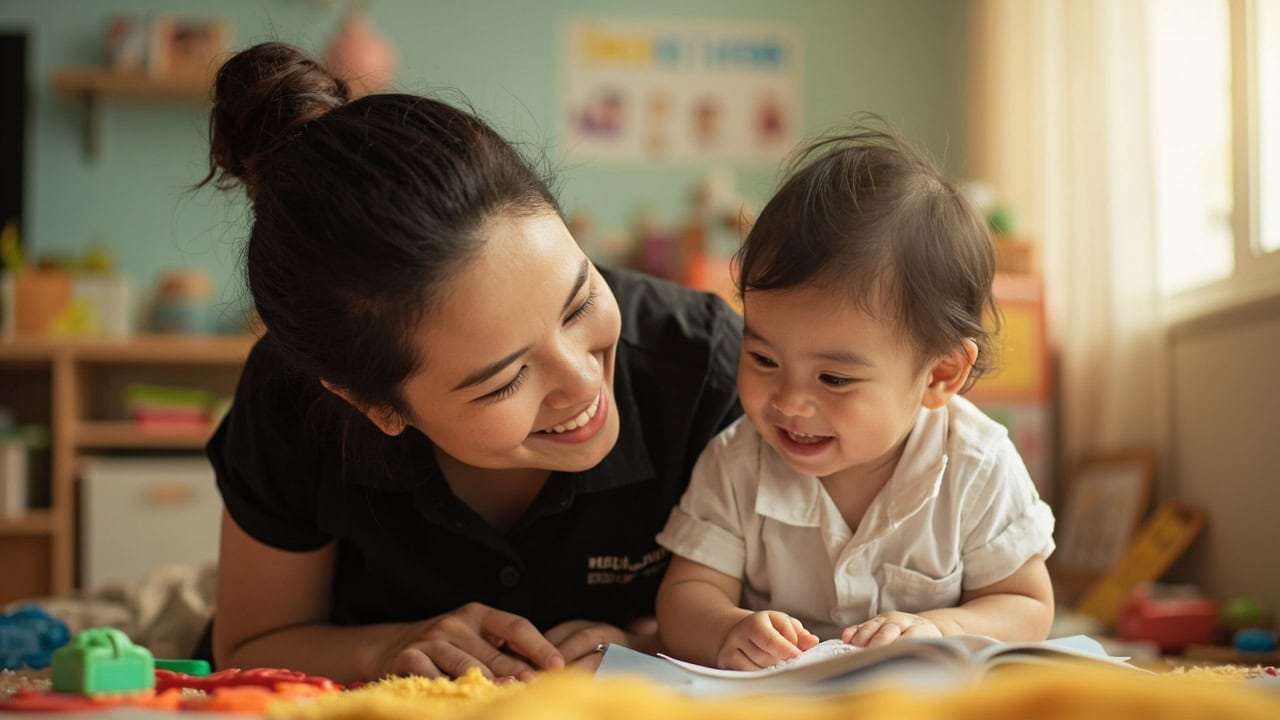
What happens next is that the relationship becomes something more than contractual. Your child’s caregiver becomes someone who knows things about your child that even you are still discovering. She knows that your daughter needs a few minutes of quiet transition after nap time. She knows that your son communicates frustration differently than other children his age, and she knows exactly how to respond.
She notices the things you would notice if you were there, and she tells you about them in ways that help you understand rather than worry.
What Changes for Parents
When parents arrive at this understanding, something shifts. The daily anxiety of separation does not disappear entirely — parenthood does not allow for that kind of certainty — but it transforms. It becomes a background hum instead of a foreground roar. You can think about your work because you know your child is known. You can breathe during the commute because you trust the people on the other end of the journey.
Through this sustained partnership, parents discover two quiet transformations:
- They learn to read their child differently. Not with the anxious vigilance of the early months, but with the calm attunement that comes from having another trusted adult confirm what they are seeing. When the caregiver tells you that your child has been working on something — a skill, a social moment, a language breakthrough — and you come home to see it for yourself, something deepens. Your understanding of your child expands. You begin to see them not just as your child, but as a person with a life that includes more than you.
- They learn to see themselves differently. There is a quiet pride that grows when you realize you have successfully navigated one of the hardest transitions of modern parenthood — the return to work, the letting go, the daily reconciliation of professional identity and parental love. You did not just survive it. You built something through it. A relationship with a caregiver who has become a trusted colleague in the work of raising your child. A confidence that did not exist two years ago.
This is the identity change that the existing childcare conversation does not capture. It is not just your child who grows through the childcare years. It is you.
What Quality Childminding Actually Looks Like
Now let us speak plainly about what this looks like in practice, because philosophy without structure is just sentiment.
EduNanny by BUTLER operates within the ECDA Childminding Pilot, which means families access a regulated, supported model of home-based and community-based care. The pilot was designed with specific structural commitments that allow partnership — not just supervision — to develop over time.
The Framework That Holds the Relationship
- Small ratios. In infant care settings, ratios are kept to one caregiver for every three infants. Love at scale requires intention, and that intention is built into the structure of the service.
- Consistent hours. Care blocks run Monday through Friday, aligned with the rhythms of working family life. Reliability is not a bonus — it is the foundation on which trust grows.
- Transparent communication. Where deployed, transparency measures including communication updates and CCTV access provide families with the visibility that sustained trust requires. These are not surveillance tools — they are reassurance tools, and there is a meaningful difference.
- Affordable access. Fees within the pilot structure are designed to be accessible, and payment mechanisms include CDA and Baby Bonus usability. Financial logistics should not add unnecessary weight to an already demanding season.
These are not glamorous details. They are the scaffolding that allows partnership to exist. Without consistent hours, without reliable ratios, without communication that feels like sharing rather than surveillance, the emotional evolution we have been describing cannot take place. Trust requires structure. Co-parenting requires schedule. The relationship between a family and their caregiver requires the kind of dependable framework that lets intimacy grow.
Common Questions About Sustained Childminding
“What if the relationship doesn’t develop the way it should?”
Not every family arrives at partnership easily. Some parents carry doubts that linger longer than they expect. Some children take longer to settle. Some seasons of family life bring stress that spills into the childcare relationship. This is normal. It is human.
And it is precisely why the sustained nature of the EduNanny approach matters.
A relationship built for the long term does not end at the first difficulty. It deepens through it. When a caregiver has been with your family for eighteen months or two years, she knows the difference between a temporary phase and a genuine concern. She can speak with calm authority when you arrive at pickup worried, because she has seen your child through enough variation to know what is typical and what requires attention.
This is what no amount of daily reassessment can provide. Daily reassessment is the posture of a new relationship. What you need, eventually, is the posture of an established one — the posture of people who know each other, who have history, who trust that the relationship itself will carry them through the uncertain moments because it has done so before.
“How do I know if this is the right choice?”
The right choice is not the choice without doubt. The right choice is the one you are willing to keep making — not out of stubbornness, but out of the growing evidence that it is working.
The question to ask is not “Will this be perfect?” but “Is this relationship designed to last? Is the caregiver consistent? Is the communication honest? Is there room for this to grow into something real?”
These are the questions that EduNanny is built to answer over time, not on the day of enrollment.
The Question You Carry — and the Answer You Will Find
If you are a parent who has already chosen EduNanny, I want to speak directly to you for a moment.
You may still be in the monitoring phase. You may still feel the reflexive urge to check, to question, to hold the relationship at a distance until it proves itself. This is not wrong. It is the beginning of something.
But I want you to know what is available to you on the other side of that caution.
There is a version of this relationship where you arrive at pickup and feel not relief but genuine delight — delight at seeing your child’s day reflected in their face, delight at the small update from someone who knows them well, delight at the simple fact of a day that has gone well in the ordinary, unremarkable way that good days do.
There is a version where you can think about your work without guilt because you know your child is not just cared for but cherished. Where the caregiver who spends forty hours a week with your child feels less like a service provider and more like a person whose judgment you trust, whose observations you value, whose presence in your family’s life feels like a gift rather than a compromise.
Are we still a family when we are apart?
The answer, offered by every parent who has walked this path before you, is yes. Not despite the separation, but through it. You remain a family because the love does not pause when you leave. It continues in the hands of people you have come to trust. It grows in the spaces where your child is known and held and nurtured in your absence.
It returns to you at the end of the day, transformed by the day itself, and you meet it with the fullness of a parent who has learned to let go without letting go.
This is what EduNanny Singapore offers. Not just childcare. Not just a service or a solution or a convenient arrangement for working families. They offer the sustained, intentional, human relationship that makes modern parenthood not just bearable but meaningful. That transforms the question from who will care for my child to who will grow alongside us.
The caregivers who walk this path with families are not invisible. They are not interchangeable. They are the consistent presence that makes trust possible. They are, in every meaningful sense, partners.
And the parents who learn to lean into this partnership — who stop managing and start co-parenting, who stop questioning and start trusting, who stop monitoring and start knowing — these parents discover something that no decision-making guide can prepare them for.
They discover that they were never meant to do this alone. That the village has a name now. That it operates Monday through Friday, in homes and communities across Singapore, within a framework built for the long term.
Welcome to the relationship. It only gets deeper from here.
If you are considering what sustained, development-oriented childminding could look like for your family, connect with EduNanny Singapore to learn about availability, the ECDA Childminding Pilot, and how their caregiver families are matched with your family’s rhythms and needs.