What Singapore Parents Feel at Pickup When They Have Two
The Pickup Moment Every Parent of Two Recognises
There is a moment at pickup that every parent of two or more children will recognise. You arrive at the gate and you are already calculating. Scanning both faces simultaneously. Reading both bodies simultaneously. Asking yourself two questions at once: Is my older child okay? Is my younger child okay?
And underneath those two questions, there is a third one that you rarely say aloud, the one that quietly follows you home: Am I seeing them clearly? Am I giving each of them enough?
This is not a dramatic moment. It does not feel like a crisis. It feels like Tuesday. It feels like the ordinary, persistent weight of loving more than one child and knowing, with absolute honesty, that you cannot be in two places at once.
We want to talk about that weight today. Not to amplify it, but to name it—because naming something that feels unspeakable is the first step toward easing it. What we have found, working alongside Singapore families in their homes and communities, is that this particular guilt is not a sign that you are doing something wrong. It is a sign that you are paying attention. It is the natural, inevitable tension of raising siblings, and it deserves more than a shrug. It deserves a framework.
The Individual Observation Gap: Naming What You Feel
When you have more than one child in childcare, you are not just managing logistics. You are managing perception. You are trying to observe two different developmental timelines at the same time.
You are watching your infant reach for a new milestone while your toddler navigates social complexity that has no neat stages at all. You are carrying the quiet fear that one of them is being noticed and the other absorbed into the family unit. That the easy one is overlooked because they are easy. That the intense one is consuming all the oxygen.
This is the individual observation gap. It is the space between what you know each of your children needs as separate people and what the logistics of modern family life allow you to give.
The question is not whether this gap exists. The question is who is filling it.
What Quality Childcare Does With That Gap
Quality childcare, done with intention, does not close this gap by pretending siblings are a unit. It does not manage your children as though they share one developmental trajectory. What it does, when it is done well, is see each child as an individual within a family context.
That distinction matters enormously.
When a caregiver tracks your children’s development separately, they are not simply keeping notes. They are holding a mental map of your older child’s emerging language skills while simultaneously tracking your younger child’s sensory exploration—which is different from language and just as important.
They are noticing that your child has a particular way of processing new environments: they hang back and observe before they engage. This is not shyness. It is a temperament. A valid, intelligent, worthy way of being in the world.
Because the quiet guilt you carry at pickup is not fundamentally about childcare quality. It is about whether your children are being seen. Whether each of them has a witness. Whether the person caring for your children during the hours you cannot be there knows the difference between your firstborn who needs space to lead and your second child who needs space to build the foundations your first child built years ago—and who deserves to be seen not as a smaller version of their sibling, but as a person at the beginning of their own extraordinary story.
Individual Recognition Across Stages
Individual recognition looks different at different stages, and understanding that is part of trusting the process.
For Infants: Physical and Sensory Recognition
For an infant, individual recognition is physical and sensory. It is the caregiver who knows that your baby settles best with a specific rhythm of holding, who notices the difference between your infant’s hungry cry and their overstimulated cry, who tracks the unique way your child explores the world through touch, sound, and movement.
It is someone who is not comparing your baby’s development to the sibling who came before or the sibling who comes after. Someone who understands that this particular infant, in this particular body, is building trust and neural pathways at their own pace—and that pace is exactly right.
For Toddlers: Social and Emotional Recognition
For a toddler, individual recognition becomes social and emotional. It is the caregiver who sees that your second child is not aggressive when they grab a toy. They are assertive. There is a difference, and the difference matters.
It is the caregiver who notices that your older child—the one who seems so capable—is still processing the arrival of a sibling, and that their independence at the childcare gate might be armour, not confidence.
It is someone who tracks these things separately, who does not let siblings define each other, who gives each child their own narrative.
For Pre-Primary Children: Identity Recognition
For a pre-primary child, individual recognition is about identity. It is the caregiver who sees that your child is beginning to understand themselves in relation to others—and who is careful not to reinforce patterns the family might be unconsciously creating.
The easy one. The difficult one. The leader. The follower.
These labels are seductive because they are efficient. But they are also limiting, and a caregiver who individualises rather than generalises protects something precious: your child’s sense that they are known for who they are, not who they are next to.
The Specific Guilt of Raising Siblings
There is a particular guilt that attaches to siblings, and it has a shape. Understanding that shape is part of releasing its power over you.
The firstborn who is losing their only-child status, who was once the sole recipient of your attention and is now learning to share.
The middle child who is neither the oldest nor the youngest, who has no developmental category all to themselves, who learned early to find their place in the family architecture—and who may be building something profound and invisible while no one is paying attention.
The child who is easy—who sleeps well, adapts, is not a problem—and whose quietness you sometimes wonder about. Who is building something invisible while the world attends to louder voices.
The child who is intense—who takes up space, has strong opinions, louder needs—and whose intensity you sometimes wonder about too. Whether you are meeting their needs or simply managing them.
These wondering thoughts are not cruel. They are the honest questions of a parent who loves multiple children and knows that time and attention are finite.
Quality childcare does not eliminate this guilt. But it holds some of it for you. It says: someone is watching the easy child, and they are not taking their ease for granted. Someone is engaging with the intense child, and they are not just managing them. Someone is noticing the middle child’s particular place in the family architecture, and they are not letting that place become an identity.
Someone is individualising.
The EduNanny Difference: A Methodology, Not Just Good Intentions
EduNanny was built around the understanding that home-based and community-based care is not a compromise. It is a context with distinct advantages.
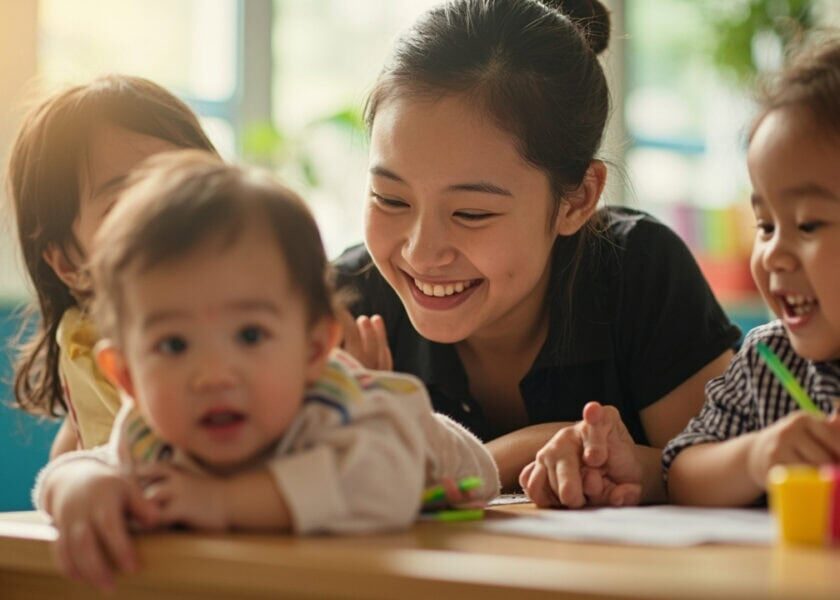
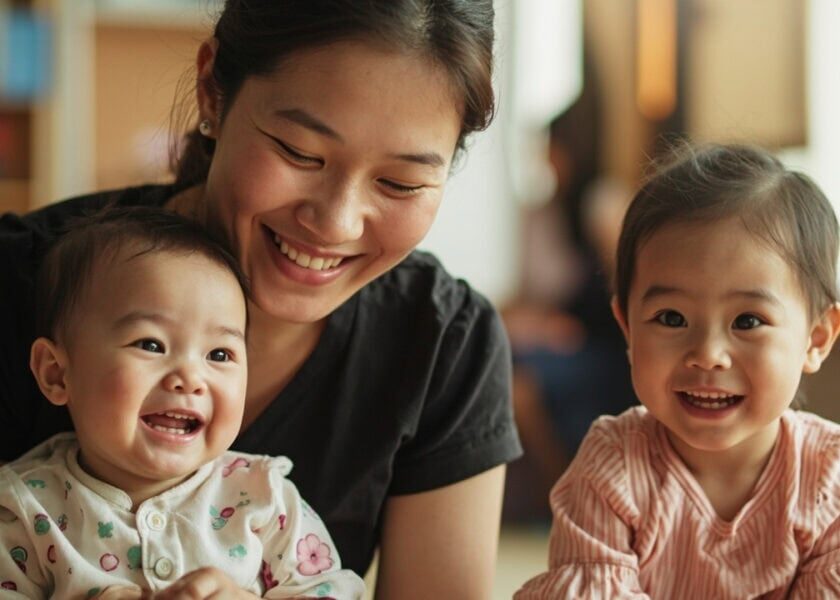
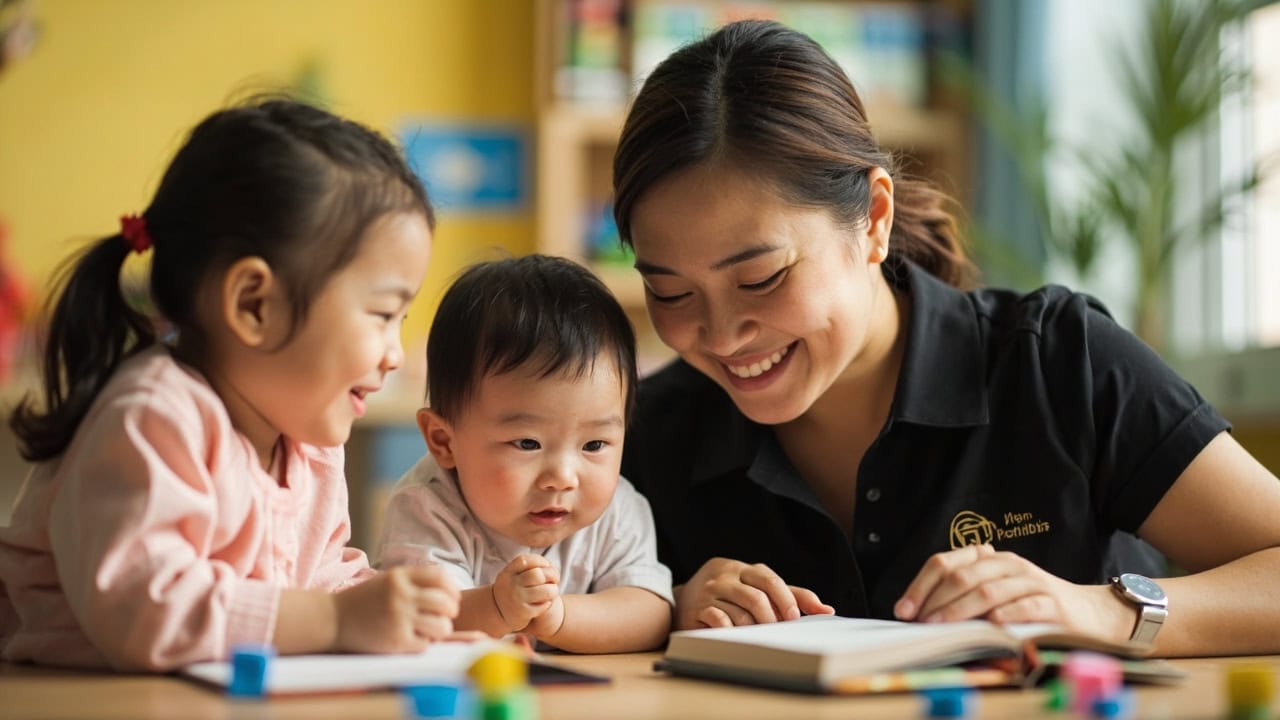
In a home setting, with ratios that allow up to one to three infants, a caregiver can observe each child with a quality of attention that is simply harder to achieve in larger group settings. They learn the rhythms of each child, the specific cues, the ways each child communicates before they have words. They individualise their response in real time, because they are not managing twelve children simultaneously. They are holding space for your family.
When your childcare arrangement is designed around individual observation, you receive communication that reflects it. You hear about your second child’s specific morning, not just what the group did. You hear questions that isolate what each child experienced rather than what the family experienced together.
You hear: “Your youngest spent twenty minutes today building a tower and knocking it down and rebuilding it. She was so focused. I had not seen that kind of persistence from her before.”
Not “The children played together.”
Those two reports sound similar. They are not the same thing. One sees your child. The other sees the family unit. Over time, the difference between those two reports is the difference between a childcare arrangement that manages your children and one that knows them.
The structural features that support this level of attention include Monday to Friday care blocks that give working parents predictability, CDA and Baby Bonus usability within applicable frameworks, and transparency measures such as CCTV deployment where families choose to use them—not for surveillance, but for the confidence that what you hear at pickup is consistent with what actually happened.
Practical Language for the Pickup Conversation
This is not just about naming an emotion. It is about giving you something to do with it. Here is the observation language that changes the pickup conversation.
Instead of asking, “How was school?”—which invites a single answer that both children can fight over or share—try asking each child separately:
- “Mama wants to hear one thing you did today that made you feel proud.”
- “I want to know about something that surprised you.”
- “Who did you play with, and what did you do together that was fun?”
These questions isolate individual experience. They train you to see each child in the same pickup window without comparing them to each other. They teach your children that they are each worth a separate question, a separate answer, a separate moment of your attention.
When you are receiving reports from your caregiver or childcare arrangement, ask for the same. Ask for one thing about each child specifically.
Ask: “Can you tell me something I would not know if I only picked them up together?”
That question does something remarkable. It invites the caregiver to share an observation that isolates rather than generalises. It creates accountability for individual noticing. And it signals to whoever is caring for your children that you expect each of them to be seen.
When You Arrive at Pickup
The sibling relationship is one of the longest your children will ever have. It will outlast your marriage, probably, and certainly your parenting. It will be there when you are not.
The question you are asking at pickup—about whether each child is being seen—is ultimately a question about what that sibling relationship is being built on. Whether each child has enough of a sense of their own individual worth to relate to their sibling as an equal, not as a reference point. Whether they know who they are separate from the family, so they can choose who they are together.
Quality childcare, individualised childcare, is not a luxury add-on to the sibling experience. It is foundational to it. It is what allows your children to grow up in the same household and not define themselves by comparison. It is what allows your easy child to know they are worthy of attention and your intense child to know they are worthy of calm. It is what allows your middle child to occupy their own place in the family story—not as a between, but as an and.
So when you arrive at pickup, and you are trying to read both faces at the same time, and the guilt is there because you cannot be everything to everyone at every moment—we want you to know something.
You are not alone in seeing them.
Someone has been paying attention all day. Someone has been noticing the quiet one’s small triumph and the loud one’s moment of stillness. Someone has been holding each child’s narrative separately, and at pickup, they will give you pieces of those narratives—and those pieces will help you see.
That is the promise. Not that childcare will solve the complexity of raising siblings. That complexity is permanent. It is the texture of family life.
The promise is that you do not carry it alone. That when you drop your children off in the morning, you are handing them to a system designed to see them individually. That when you ask at pickup how they were, the answer will be specific enough to make you feel something. Not a group report. A child report. Your child. Each one.
That is what thoughtful, development-oriented childminding looks like in practice: a daily discipline of observation, communication, and individualisation that takes intention, structure, and care. And it is why, when you drive away from pickup carrying the weight of two small names in the back of your car, you can set some of that weight down.
Someone else is watching. Someone else is noticing. Someone else knows who your children are individually, and they will tell you—if you ask—what they saw.
Because every child deserves to be seen. Especially the ones who share the back seat.
#SiblingDynamicsInChildcare #SingaporeParents #IndividualChildObservation #EduNannyByButler #QualityChildmindingSG