What Quality Childcare Looks Like When You Learn to See
What This Guide Offers
If you are a parent in Singapore who loves your child deeply but sometimes feels uncertain about whether the care they receive is truly producing results—this article is for you.
Here is what we will cover:
- Why observation is a skill, not just a feeling—and why loving your child does not automatically mean you can read their development
- The key developmental domains where trained caregivers read signs of genuine growth versus surface compliance
- Concrete behaviors to look for at home and in childcare settings that signal your child is truly thriving
- What quality childminding actually looks like—and how to recognize it when you see it
- How the right care partner bridges the knowledge gap every parent carries without realizing it
If you take away nothing else: there is a profound difference between hoping your child is thriving and being able to see it. That skill can be learned. And once you learn it, everything changes.
The Quiet Anxiety Singapore Parents Carry
In Singapore, we are, by instinct and by culture, attentive parents. We read the articles. We join the parenting forums. We ask our mothers, our friends, our colleagues with children. We tour the centres and scrutinize the caregiver ratios and compare the meal plans and enrichment schedules.
We are, by any measure, some of the most engaged parents in the world—and yet, beneath all that engagement, there is a quiet, persistent unease.
We want to know that what we have chosen is working. We want to know that our child is not just safe, not just comfortable, not just entertained—but thriving. Growing in the way that matters.
Here is the painful irony: the more we love them, the harder it can be to see clearly. Because love makes everything feel monumental. Every cry feels like a warning. Every smile feels like proof. And we have no map, no trained lens, no shared language to help us distinguish between what is surface and what is deep, between what is momentary and what is meaningful.
This is not a failure of love. This is the natural condition of every parent who has not been trained as an educator—because reading child development is, in fact, a trained skill.
Observation Is a Literacy You Can Learn
Consider two people listening to an orchestra. One has never learned to read a musical score. She hears sound—beautiful, perhaps, but essentially a blur of noise. The other hears argument, tension, resolution. She hears the French horn answering the strings. She hears the silence before the crescendo. The music is the same. The capacity to interpret it is not.
The same is true of your child’s behavior. The behaviors are there—your child is expressing them every single day. The question is not whether they are happening. The question is whether you have the framework to read them.
The Story of Two Children and a Toy
Consider two children in the same playroom, both roughly two years old. One watches another child take a toy from a third child, and he walks away. He does not cry. He does not escalate. He simply moves to a different activity.
Now, you might see this and think: He handled it fine. He is not upset.
But a trained observer sees something different. She sees a child who has learned—through consistent, responsive care—that losing something does not mean losing safety. She sees emotional regulation. She sees the internal working model of a secure environment taking shape in real time, expressed through the simple, almost invisible act of walking away without distress.
This is not luck. This is the signature of a care environment that has taught his nervous system what calm feels like. And once you can see it, you cannot unsee it. You realize that the moment your child walked away from that toy was not a small moment. It was a window into everything that is being built inside him.
Surface Compliance Versus Genuine Growth
Now consider a different child, in a different environment, who responds to the same situation with an identical behavior—he walks away. On the surface, it looks the same.
But the trained eye asks different questions. How quickly did he recover? Was the walking away smooth, or was it rigid? Did he glance back? Did he check the caregiver’s face before he moved on?
These small variations—the micro-behaviors between the behavior itself—are what separate genuine developmental growth from surface compliance.
Surface compliance is what a child produces when they have learned that certain behaviors earn approval. They have learned the correct answer. They perform it well.
Genuine growth is what a child produces when they have internalized security. When the care environment has given them the foundation to feel safe enough to grow. The behaviors can look identical on the outside. Only the trained observer knows where to look for the difference.
This is one of the most important things we can offer you today: the understanding that there is a difference between your child performing well and your child being well. And that the difference is visible, if you know how to look.
What Trained Caregivers Read: Key Developmental Domains
Now let us walk through the key developmental domains where trained observation becomes most powerful—and most transformative for how you understand your child’s experience.
Emotional Regulation: The Architecture of the Inner World
When you pick your child up at the end of the day, how does the transition happen?
Is there a visible recalibration—a brief, sometimes tearful moment of adjustment as they shift from the care environment to you—or do they seem strangely flat, almost disconnected?
Neither extreme is necessarily a warning sign on its own. But the pattern tells a story.
A child who is genuinely regulated, who has spent the day in a warm, consistent, responsive environment, will often show what we call a “secondary protest”—a brief moment of resistance to leaving a place they love. This is not distress at seeing you. It is the sign that they have formed a second secure attachment to the care environment itself. That is not a problem. That is the signature of quality.
Conversely, a child who shows no emotional response at all—neither warmth at seeing you nor distress at leaving—may be in an environment that has inadvertently taught them not to expect emotional responsiveness. The absence of feeling is not the absence of feeling. Sometimes it is the consequence of a feeling that was never met.
What genuine emotional regulation looks like:
- A child who can recover—not one who never cries
- A child who can be upset and then come back
- A child who can lose something and return to play
- A child who can be frustrated and still reach for a caregiver, not away from them
These are not small things. These are the earliest, most profound competencies of a human being—and they are being built in the daily, hourly, moment-to-moment interactions of a quality care environment.
Language: The Tool for Organizing Experience
In Singapore, many parents focus closely on language development—perhaps rightly so, in a society that prizes communication and intellectual growth. But the question is not just whether your child is speaking. The question is what kind of speaking, and what it reveals.
When a child in quality care begins to experiment with language, you will often notice something specific: they begin to narrate their own experience. My ball go. Mama come. This mine.
This is not just vocabulary. This is the child using language as a tool to organize their inner world, to give shape to their emotions and experiences. It is a sign that language has become meaningful to them—not just a performance of words they have memorized.
A trained caregiver hears this narration and builds on it—repeating it back with gentle expansion, introducing a new word in the context of what the child already understands. This is how language grows in a child’s mind: not through flashcards, but through relationship.
What to listen for at home:
- The quality of language engagement, not just the quantity
- Whether your child uses language to connect—to ask questions, to share discoveries, to negotiate
- Whether language feels meaningful or rote—a performance of words deployed for effect
- Whether your child asks why and how—signals not just of curiosity, but of the confidence that their questions will be met with attention
Motor Confidence: Security Made Visible Through Movement
Watch a child in a high-quality infant care environment and you will notice something specific: movement is encouraged, but it is not reckless. The caregiver is near enough to keep the child safe but far enough to let them test their own physical limits.
There is a careful, professional calibration between protection and challenge—a balance that is far harder to achieve than it sounds, because it requires the caregiver to read the child’s fear signals accurately and respond in a way that expands the child’s sense of possibility without ever making them feel truly unsafe.
What you want to see at home is motor confidence. Not the absence of falls—the falls will come, and should come—but the child’s relationship with their own body.
- A child who is genuinely motor-confident will try new things
- Will climb, and pause, and calculate
- Will fall, and get up, and try again without a catastrophic emotional collapse
- Will show you, through their body, that they trust the world enough to explore it
When you see your child navigate a new playground with visible, calm determination—not bravado, but genuine confidence—that is the physical signature of emotional security made visible through movement. And it is one of the clearest indicators that the care environment is doing its work.
Curiosity and Persistence: The Building Blocks of Learning
These are, perhaps, the most undervalued indicators of developmental quality in early childhood. These are the domains where quality care produces results that look, on the surface, like simple play—but are, in fact, the building blocks of everything your child will become as a learner, a thinker, and a person.
Watch your child when they encounter a problem they cannot immediately solve:
- Does frustration become abandonment, or does frustration become persistence?
- Does your child return to a difficult task after a break, approaching it differently the second time?
- Does your child show what we call “sustained attention”—the capacity to remain engaged with a challenging activity over an extended period, returning to it, refining their approach, not because anyone is prompting them but because the process itself is rewarding?
These are the behaviors of a child who has learned that effort leads to result. That failure is not final. That the world is interesting and that their engagement with it matters.
Where does this come from? It comes from a caregiver who has learned to sit with a child’s frustration without immediately rescuing them. Who knows the precise difference between helping and hovering. Who can tell, from the pitch of a child’s vocalization and the tension in their body, whether the child is in productive struggle or in distress that needs intervention.
This is professional skill. It is not instinct. It is trained observation, applied in real time.
Social Engagement: The Social Brain Taking Shape
In quality infant care, children learn to read social cues. They learn that other children have needs, desires, emotions. They learn the earliest forms of empathy, of sharing, of turn-taking—not because they are taught to, but because they are in an environment where these experiences happen naturally, daily, in the context of warm, mediated relationships.
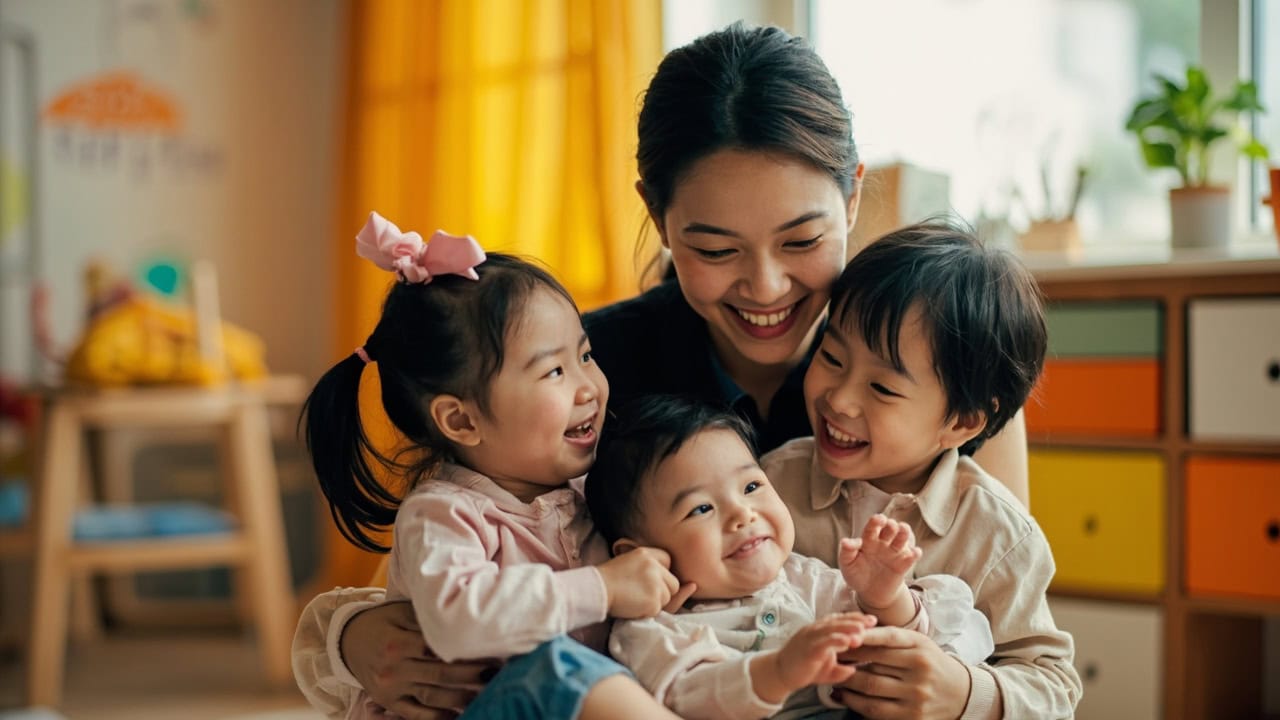
A trained caregiver in this environment does not just supervise play. She narrates it. She helps children name what they see in each other. She intervenes with just enough guidance to prevent escalation and just enough space to let the children find their own solutions. She is, in the truest sense, a social architect—building the early scaffolding of your child’s capacity to be part of a community.
What to look for at home:
- Not perfection in social situations—your two-year-old will not share willingly every time, and that is developmentally appropriate
- Increasing sophistication in social reasoning over time
- Whether your child uses language to navigate conflict rather than only crying or hitting
- Whether your child shows concern for another child’s distress, even a child they do not know
- Whether your child seeks out other children—not just for parallel play, but with a visible interest in what the other child is doing, thinking, feeling
When you see these signs, understand what you are witnessing: the social brain taking shape in real time, neuron by neuron, experience by experience.
How to Recognize Quality Childminding in Practice
Now that you know what to look for, let us address a practical question: what does quality childminding actually look like in practice?
Quality childminding is not a checklist of activities or a colourful photo album of crafts. It is a daily, hour-by-hour series of interactions that build the architecture of your child’s development. It looks like:
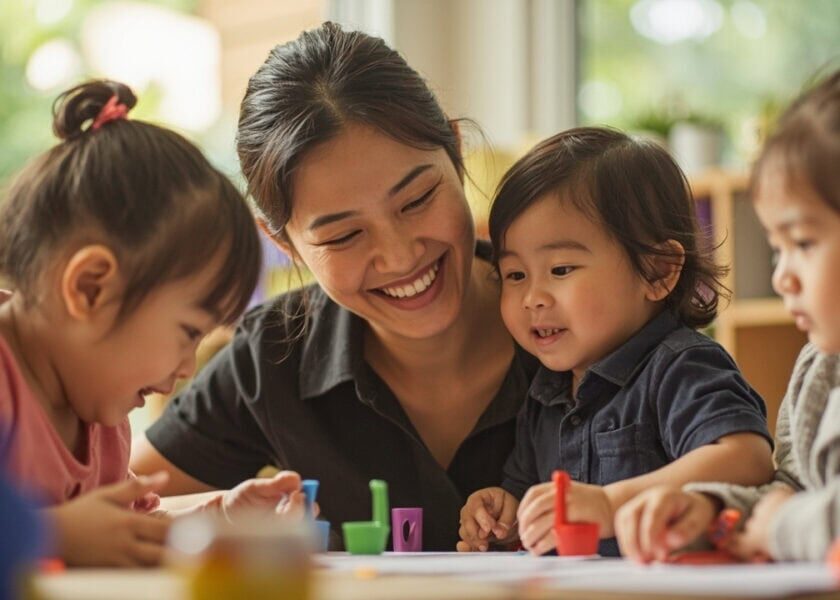
- A caregiver who is present, not just supervising. She is on the floor with your child, engaged, responsive, attuned.
- A caregiver who narrates, not just manages. She speaks about what is happening in the child’s world, building language and social understanding simultaneously.
- A caregiver who knows when to help and when to wait. She reads the difference between productive struggle and genuine distress.
- An environment that feels warm and familiar, not institutional. The home-based setting offers natural, domestic rhythms that help your child feel secure.
- A caregiver who shares what she sees. She does not keep her observations behind a wall. She translates them for you in language you can understand.
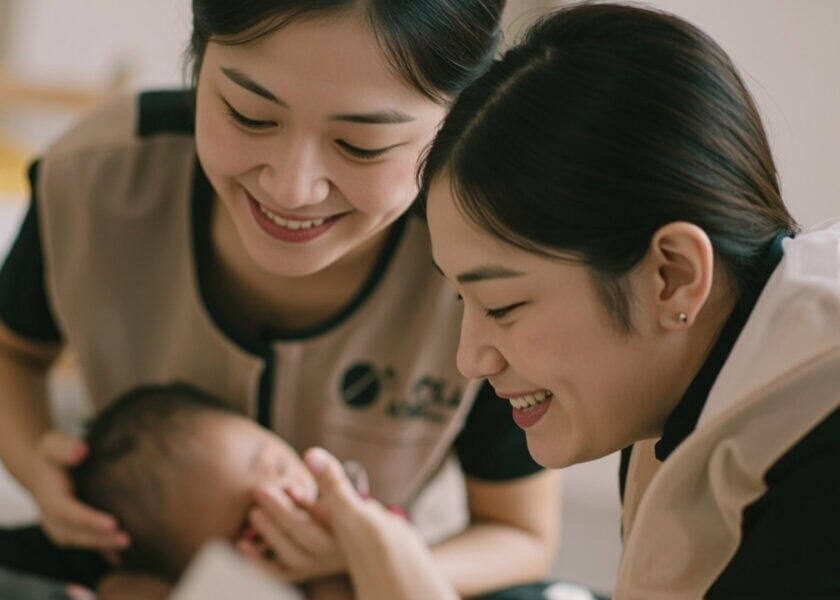
The small ratios that quality care requires are not a luxury—they are a necessity. A caregiver who is responsible for three infants can read their subtle signs. A caregiver responsible for twelve cannot. The ratio is not an administrative detail. It is the condition that makes observation possible.
Here is another truth worth sitting with: quality childminding should not be available only to those who can pay premium rates. The structural elements that enable quality—small ratios, trained caregivers, home-based settings, daily communication—are not extras. They are the baseline. Every Singapore child deserves a trained eye on their development.
The Knowledge Gap Every Parent Carries
Let us be honest about something that matters deeply.
All of this—the literacy, the observation, the reading of developmental signs—is not something most parents have ever been taught. It is not taught in schools. It is not typically part of prenatal preparation. It is not something your mother necessarily passed down to you, because the science of early childhood development has advanced enormously in the past thirty years.
You were not given this map. You were given a child you love more than you have ever loved anything, and you were left to figure out the map on your own.
That is not your failing. That is a gap—a gap in knowledge that does not reflect a gap in love, in commitment, or in capacity.
And filling that gap is exactly what the right childcare partner can do for you. Not by keeping you at arm’s length from your child’s development, but by bringing you in. By helping you learn to read what they see. By sharing their observation with you—not in clinical reports or scored assessments, but in the daily conversations, the updates, the moments they point out:
Did you see how she handled that? Do you know what that means? Let me show you what I am seeing.
This is what quality care looks like when it is working. It is not a service you hand your child over to. It is a partnership you enter into—one where you are not wondering from the outside whether something good is happening, but where you are being shown, day by day, what is being built, and why it matters.
The EduNanny Singapore Approach to Developmental Care
EduNanny represents not just a service, but a philosophy of care. Here is what that philosophy looks like in practice.
ECDA Childminding Pilot Partnership
EduNanny is part of the ECDA Childminding Pilot, and within that pilot, there is a commitment to something deeper than supervision. There is a commitment to the trained professional who brings developmental literacy to every interaction with your child.
Small Ratios for Real Observation
The pilot provides for small ratios—up to one caregiver for three infants in certain care settings. This means your child’s caregiver is not spread across a room but is present, attentive, and able to read the subtle signs that large-group care simply cannot accommodate.
Home-Based Pathways
Care happens in a familiar, domestic environment that is warm, structured, and safe. The home setting offers natural rhythms of living that help infants feel secure—a context that is fundamentally different from institutional centre-based care, and one that better supports the responsive, attuned caregiving that drives early development.
Affordability as a Principle
Quality developmental care should not be a privilege available only to those who can pay premium rates. The pilot fee structures, the usability of CDA and Baby Bonus—these are not administrative details. They are expressions of a conviction that every Singapore child deserves a trained eye on their development.
Communication and Transparency
When EduNanny says that communication and transparency are central to their model, they mean something specific: the trained observation we have been speaking about is not kept behind a wall. It is shared. It is translated. It is brought to you in language you can understand, so that you leave each day not with a checklist of activities but with a clearer picture of what your child experienced, what they achieved, what they struggled with, and what it means.
In homes or centres where CCTV measures are deployed, there is an additional layer of trust—not surveillance, but transparency. The knowledge that you can, if you ever need to, see for yourself. Not because trust is absent, but because transparency deepens trust.
Choosing Infant Care in Singapore: A Practical Framework
If you are evaluating childcare options, here is a simple framework for what to look for:
| Indicator | What to Look For |
|---|---|
| Ratios | How many infants per caregiver? Smaller is better for quality observation. |
| Training | Does the caregiver have specific training in child development, not just childcare certification? |
| Communication | Will they share what they observe? Will they translate their observations into language you can understand? |
| Environment | Does it feel warm and domestic? Is it safe but not over-stimulating? |
| Recovery at pickup | Observe how your child transitions when you arrive. What does the pattern tell you over time? |
| Questions they ask you | A quality caregiver wants to know about your child’s home life, preferences, and rhythms. They are building a complete picture. |
| Transparency | Are they open about their methods, their observations, and what they are building with your child? |
Trust your instincts—but inform your instincts with the framework we have described. You are not looking for perfection. You are looking for quality, consistency, warmth, and transparency. You are looking for a partner who will teach you to see what they see.
Everything we have described—the trained observation, the developmental literacy, the partnership, the transparency—all of it is in service of something very simple, very human, and very profound.
It is in service of your capacity to see your child.
Not the way you saw them before you knew what to look for. Not the way you saw them when every behavior felt like a mystery or a worry or a test of your worth as a parent.
But the way you see them when you have been given the language, the framework, and the trusted guide to help you understand what you are already witnessing.
There is a difference—a profound difference—between hoping your child is thriving and being able to see it. Between trusting that quality care is doing its work and knowing, because you have learned to read the evidence yourself.
That is the promise. That is the purpose. And that is what every Singapore parent deserves.
Ready to explore what quality developmental care looks like for your child? Connect with EduNanny Singapore to learn about the ECDA Childminding Pilot, understand your options for infant care and childminding, and find a care partner who will teach you to see what they see.
EduNanny Singapore is committed to thoughtful, development-oriented childminding rooted in warmth, trust, and professional standards. Learn more about our approach.