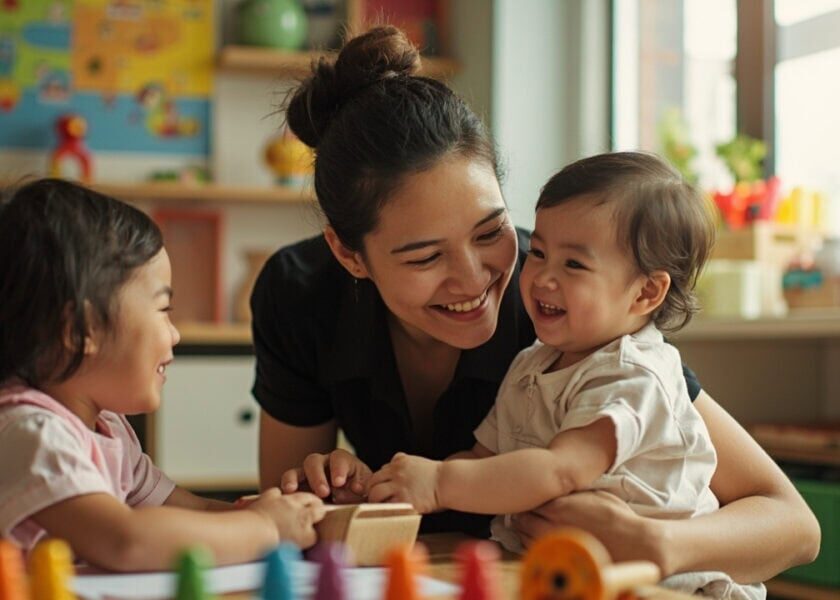
What Quality Childcare Looks Like in Singapore Right Now
The Hours Between: What Quality Childcare Actually Looks Like Inside Your Child’s Day
There is a moment, familiar to every parent who has stood at the edge of a childcare room and watched their child disappear into a morning. You handed your child over. You watched them turn away—perhaps without looking back, perhaps with a small lip that trembled only for a moment before a teacher’s voice drew their attention somewhere else. And then you walked to your car, or to the train, or back to your desk, and the day opened up between you.
Hours of it. Hours in which your child’s world becomes a place you cannot see, cannot hear, cannot reach. You trust. You have chosen to trust. But trust, for a parent, is not the same as knowing. And knowing is what you ache for—not out of anxiety, not out of guilt, but out of a love so practical that it wants to be informed. It wants to understand the actual texture of your child’s day.
This is the question that deserves a real answer. Not a brochure. Not a facility tour. Not a list of programmes on paper. An honest account of what is actually happening in the hours between drop-off and pick-up—and why it matters so profoundly for your child’s development.
- Sensory-rich experiences that actively build your child’s brain
- An intentionally prepared environment where light, texture, sound, and space are considered
- A consistent daily rhythm that gives your child the security to explore and grow
- Responsive caregivers who read and respond to your child’s cues in real time
- Deliberate rest and nourishment handled with the same intentionality as activities
The Prepared Environment: Why the Room Is Ready Before Your Child Arrives
Walk into a quality childcare room before the children arrive, and you will notice something that a brochure cannot capture: the space has already begun. The light through the windows has been considered—not just for brightness, but for the quality of it, the way it falls across the floor in patterns that catch a toddler’s eye and hold it.
The textures are arranged with intention: a wooden puzzle board here, a basket of fabric squares in muted earth tones there, a shallow tray of cool water with a few smooth stones at the bottom, waiting for small hands to discover them. The space smells of nothing artificial. It smells clean, and warm, and alive.
This is what educators mean when they speak of the prepared environment—a phrase that can sound abstract in a brochure but is deeply concrete in practice. A prepared environment tells a child, before a single word is spoken, that this space was made for them. That someone imagined their morning, their curiosity, their need to touch and explore and taste, and built something around it.
It is the first act of care in a day full of them.
When you evaluate childcare, this is what you are walking in to look for: not whether the shelves are clean, but whether the room feels alive. Whether it invites exploration or merely contains it.
The Transition That Follows
Your child arrives. There is a transition—not a handover, not a transaction, but an exchange. A brief, unhurried moment between caregiver and parent. Eye contact. A child’s hand releasing yours with varying degrees of willingness depending on the morning, the weather, the particular mood of Tuesday.
The caregiver receives your child not just physically but attentively. They note how your child is arriving today. They read it in the shoulders, the pace of walking, the way a child moves toward a particular corner of the room or hangs back at the threshold. This reading is not incidental. It is the beginning of the day’s real work.
Learning and Sensory Development: The Architecture of a Morning
In the first hours, the room fills with sound. Not noise—sound. There is the particular pitch of a toddler discovering that a wooden block makes a different sound than a plastic one when tapped against a metal tray. There is the murmur of a caregiver kneeling at a child’s level, narrating what the child is doing in quiet, unhurried language—not baby talk, but real language, specific and warm.
When a one-year-old squeezes a piece of ripe papaya between her fingers and watches the juice run over her palm, she is learning something about texture, about cause and effect, about the properties of solid things becoming liquid. When a two-year-old stacks blocks and watches them fall, he is learning about gravity, about persistence, about the relationship between effort and outcome, about the pure pleasure of building something and then choosing to bring it down.
When a toddler listens to a caregiver read the same book for the third time in a week and then pauses at a page because she wants to hear a particular word again—that is not repetition. That is the architecture of language taking shape inside a growing mind.
Why Sensory Experiences Cannot Wait
Sensory development in the first thousand days of life is not a luxury or an add-on. It is the foundation upon which everything else is built. The neural pathways that connect hearing to language, touch to emotional regulation, visual discrimination to later reading ability, proprioception to coordination and confidence—these are all being laid down now, in these rooms, in these hours.
A child’s brain at two years old is forming more than one million new neural connections every second. Every sensory experience, every moment of engaged play, every response from an attuned caregiver, is feeding that extraordinary process.
This is the truth that separates enrichment from mere supervision. Supervision keeps a child safe. Enrichment keeps a child safe and actively builds the person they are becoming.
The difference between the two is visible not in a programme schedule but in the sensory richness of an ordinary morning—in the materials on the shelves, in the language at a child’s ear, in the space given for a child to pause at a window and watch a leaf move.
The Rhythm of the Day: Why Predictability Is a Form of Love
A child thrives on predictability not because they are rigid, but because predictability is the condition under which a young mind can relax enough to explore. When a child knows—with their body, not just their intellect—that snack comes after outdoor time, that naptime follows lunch, that homecoming comes at the end of the same sequence each day, they are freed from the exhausting work of constant anticipation.
Rhythm is the architecture of security. And from security, curiosity grows.
Morning: From Free Exploration to Group Connection
Morning at a quality childcare setting moves from free exploration into a more structured group moment—circle time, perhaps, where children sit together and hear their names called, where a song invites them to move their bodies, where a story is told with expression and pauses that teach them the music of language. This teaches a child to be part of a group, to practice listening, to experience the pleasure of shared attention.
Outdoor and Movement Time: The Body as Partner in Learning
Then there is outdoor time—gross motor experience that is as essential to development as anything that happens indoors. A child’s body is not a delivery vehicle for a brain. It is a partner in learning.
Running, climbing, balancing, throwing, falling and getting up—these are not breaks from the real work of childcare. They are the real work. The vestibular system, which lives in the inner ear and governs balance and spatial awareness, develops through movement. Strong physical confidence in the body becomes strong cognitive confidence in the mind.
Midday: Nourishment as Care
Lunch is not just fuel. It is a sensory experience in its own right—the smell of food, the variety of textures on the tongue, the social experience of eating alongside others, the small domestic ritual of sitting together. Caregivers sit with the children. They do not rush. They model eating, they name the food, they respond to a child’s hunger cues with the same attentiveness they bring to every other moment of the day.
Rest: The Most Misunderstood Part of the Day
After lunch comes rest, and this is perhaps the most misunderstood part of a childcare day. In a culture that equates activity with productivity, it can feel tempting to measure the quality of a childcare day by how busy it looks.
But for infants and toddlers, rest is not a pause in development. It is development. Sleep is when the brain consolidates what it has learned. It is when the body grows. It is when the nervous system, which has been absorbing an extraordinary amount of stimulation all morning, gets to restore itself.
A rest period in quality care is handled with the same intentionality as an activity period. The room darkens. The noise softens. A caregiver sits nearby, offering the presence of a calm, attentive adult, the knowledge that someone is there, that sleep can come without hurry.
A child who has rested well emerges in the afternoon in a different state than a child who has not. They are available. They are ready. They are not depleted.
The Caregiver: The Thread That Holds Everything Together
Throughout the day, the caregiver is the thread that holds every experience together. This is why ratio matters so profoundly. With one caregiver for every three infants, or small group ratios for toddlers, each child can be seen. Each child’s face can be watched. Each child’s cues—hungry, tired, frustrated, fascinated, in need of help, in need of space—can be read and responded to in real time.
What Responsive Caregiving Looks Like
- When a caregiver notices a child is beginning to feel overwhelmed by noise and gently moves with them to a quieter corner
- When a caregiver notices a child is trying to do something just beyond their current ability and offers the exact right amount of help—not too much, not too little
- When a caregiver notices a child’s face changes in the moment between one activity and the next and pauses to name what they are feeling: I see you feeling big feelings right now, that is okay, I am right here
This responsiveness transforms a childcare environment from a place of supervision into a place of genuine developmental partnership with the child. The caregiver at quality childcare is not a placeholder. They are a trained, thoughtful professional who has chosen to do work that requires both scientific understanding of child development and an almost infinite capacity for presence.
What Singapore Parents Should Look For
Here is what you should carry with you as you evaluate childcare options. The decision you are making is one of the most consequential you will ever make—and you deserve more than a tour of clean facilities and a list of programmes.
The Walk-In Test
Ask to see not what the schedule says but what the room feels like. Walk in and notice:
- The quality of the light and the range of textures available to a child at different heights
- Whether the space feels alive or merely clean
- How a caregiver’s body is positioned—whether they are at the child’s eye level, whether they are speaking with the child or speaking over the child
- Whether the children in the room appear curious and engaged or merely occupied
- Whether there is language—real language, not just instructions and corrections—filling the air
Questions to Ask During a Visit
- How do you prepare the room before children arrive?
- How do you handle transitions between activities?
- What is your caregiver-to-child ratio?
- How do you support children during rest time?
- How do you communicate with parents about the day?
Supervision vs. Enrichment
| Supervision | Enrichment |
|---|---|
| Keeps child safe | Keeps child safe and actively builds development |
| Child is occupied | Child is curious and engaged |
| Activities fill time | Sensory experiences build neural pathways |
| Caregiver manages group | Caregiver reads and responds to individual cues |
| Rest is downtime | Rest is consolidation and growth |
Trust Your Sensitivity as a Parent
Fine is not enough. You are looking for something that feels alive. A room that invites exploration. Caregivers whose attention is genuinely present. Children who appear curious, not just occupied. If something feels off, keep looking. You know your child. Trust that knowledge.
EduNanny: Opening the Door to Quality
EduNanny was built on a conviction that Singapore’s children deserve quality care—not as a premium add-on for families who can afford the most expensive option, but as a standard. Thoughtful, sensory-rich, developmentally grounded care that treats every child as the extraordinary person they already are.
EduNanny operates within the ECDA Childminding Pilot, offering pathways that are both home-based and centre-based, with Monday to Friday care blocks designed around the realities of working families in Singapore. The pilot fee structures are built to be accessible. CDA and Baby Bonus funds are usable. The service is designed to reach the families who need it most.
Transparency is woven into how EduNanny operates. Communication with parents is ongoing, active, and honest. Where deployed, measures such as CCTV offer parents a real window into the day—not because EduNanny fears scrutiny, but because transparency is the foundation of trust, and trust is the foundation of everything we are trying to build here.
The BUTLER Ecosystem
EduNanny is part of the BUTLER ecosystem—a name that carries with it a commitment to excellence in how families are served, in the quality of the professionals who represent it, and in the ongoing innovation of the service. Thomas, the AI chatbot within the BUTLER platform, is designed to make the experience of parenting and childcare navigation simpler, smarter, and more responsive to the questions parents actually have. This is what it means to bring thoughtful design not only to the child’s room but to the parent’s experience of the whole system.
Addressing Common Parent Concerns
“I feel guilty for not knowing what my child does all day”
Your desire to know is not guilt—it is love translated into curiosity. You are not being overbearing. You are being attentive. The best childcare environments expect parents to ask questions and welcome the scrutiny.
“How do I know if it’s actually enriching, not just babysitting?”
Ask to observe—not a formal tour, but a casual visit during an ordinary morning. Watch for language at a child’s ear. Watch for materials at different heights. Watch for movement and for stillness. Watch for caregivers kneeling down. The quality of an ordinary moment will tell you more than any programme outline.
“Is the fee worth it?”
The neural pathways being formed in these years will never form again at this speed. The sensory experiences your child has now are painting the canvas of their perception for life. This is not a cost—it is an investment in the architecture of who your child is becoming.
The hours your child spends away from you are not lost hours. They are hours of your child’s life—hours in which their brain is forming the pathways that will later carry language, and reasoning, and emotional resilience. Hours in which their body is learning to move through the world with confidence. Hours in which their senses are painting the canvas of their perception, and every texture they touch, every sound they hear, every face that meets theirs with warmth is adding colour to it.
Not just supervised. Not just kept safe. But held inside a day that is as thoughtfully designed as the life you are building for them at home.
If you are standing at that edge—the edge of a morning, a doorway, a decision—know that the question you are asking is the right one. Ask it loudly. Ask it specifically. Ask what your child’s day actually contains.
And when you find a place that can answer that question with details, with sensory richness, with evidence of intentionality at every hour, with caregivers who kneel down and truly see your child—hold onto that. That is where you want your child to be.
Ready to explore what EduNanny can offer your family? Schedule a visit to see the prepared environment, meet the caregivers, and experience for yourself what a quality childminding day looks like.
#SingaporeChildcare #InfantCare #ChildmindingSingapore #EarlyChildhoodDevelopment #QualityChildcare