What Quality Childcare Looks Like in Action
What Actually Happens in a Day of Quality Childcare
Before we describe what quality looks like, it is worth naming what you are already looking for. You want an environment where your child is safe, engaged, and known. You want rhythms that create security. You want your child to be listened to, to move freely, to play with purpose. You want someone to notice what your child notices. You want your child to feel that their emotions are not too much—that an adult will stay with them in difficult moments. You want the hours to be worthy of the trust you are extending.
This is what quality looks like. And it is not as invisible as it seems.
The Environment Teaches Before Anyone Speaks
When your child arrives in the morning, the space is already working. Natural light enters through windows positioned to illuminate without glare—soft, considered lighting, not the flat institutional brightness that exhausts eyes. The room is organized into distinct zones: a space for active movement, a corner for quiet play, an area where children eat together.
On the shelves, materials sit within reach—real materials, not plastic abstractions. Wooden blocks. Cloth books. Baskets of natural objects: smooth stones, textured fabrics, wooden rings. When a child picks up one of these objects, the weight registers in the body. The temperature of the wood against the palm. The room is teaching before anyone speaks.
Listen to the sounds. In a quality childcare space, you do not hear silence. You hear the murmur of purposeful play, the occasional negotiation, the laughter that erupts suddenly and then dissolves. There is no constant crying, no elevated noise of distress. When you hear a caregiver singing, responding to a child’s babbling with a question, narrating what a child is doing back to them—you are hearing language exposure. You are hearing the work of communication.
The smell is clean, ordinary. Breakfast may have been served recently—perhaps rice porridge, soft scrambled eggs, or fruit cut into shapes small enough for small hands. The children sit at a low table, feeding themselves with growing competence. The ability to manage utensils, to experience the texture and taste of food without rushing—these are skills that develop through repetition, in an environment that allows for the mess and the time that self-feeding requires.
The Rhythm That Creates Safety
Quality childcare does not run on rigid schedules that treat children like items on a production line. It moves in rhythms—predictable sequences of activity, rest, eating, and play that children learn to anticipate. This rhythm is not a constraint. It is a gift.
When a child knows what comes next, when the morning routine unfolds in familiar order, the child does not waste energy on anxiety and uncertainty. The rhythm creates safety. And from safety comes the freedom to explore.
Watch a transition in a quality childcare environment. When it is time to move from free play to group time, the caregiver does not raise her voice or clap sharply. She moves to the gathering area, perhaps picking up a rhythm instrument and beginning to play. Children notice. One by one, they drift toward the sound, drawn by curiosity rather than commanded by authority. There is no rushing. There is an unhurried invitation, and children who need a few more minutes of play receive those minutes.
This unhurried quality is not possible without small numbers. In EduNanny’s ECDA Childminding Pilot arrangements, infant ratios are maintained at up to one to three. Three infants per caregiver. This is not a bureaucratic requirement. It is a recognition that attention is a finite resource, and that the quality of attention your child receives depends on how many children a caregiver must divide that attention among.
Learning Through Play, Observation, and Relationship
A toddler is trying to pour water from one container to another. The water splashes. Most of it misses. The caregiver watches. She does not intervene. She does not take over. The child tries again. The caregiver watches.
This is not passive supervision. This is patient presence—the understanding that the learning is in the trying, that the frustration of the splashing water is not a problem to be solved but a necessary part of the process. Eventually, with practice, the child learns to pour more carefully. But the learning happens because there was time for it.
Your child’s body is not an afterthought in quality childcare. It is the primary instrument through which the world is learned. The floor is where children live during much of the day—not in high chairs, not constrained, but free to crawl, to pull up, to take steps, to carry objects from one end of the room to another and back again. The muscles that will one day allow your child to run and jump and climb are being built right now, through the work of moving.
A child is watching ants on the ground outside the window. The caregiver notices, sits down beside the child, and watches too. She does not immediately name the ants or launch into a lecture. She simply watches, and then she says, softly: They’re carrying something. Look, that one is carrying a crumb much bigger than its body.
The child points. Makes a sound. The caregiver responds. This is language. This is conversation. This is the word carrying, the word bigger, the concept of comparison—embedded in a real moment of shared attention, learned not through flashcards but through the natural context of genuine curiosity.
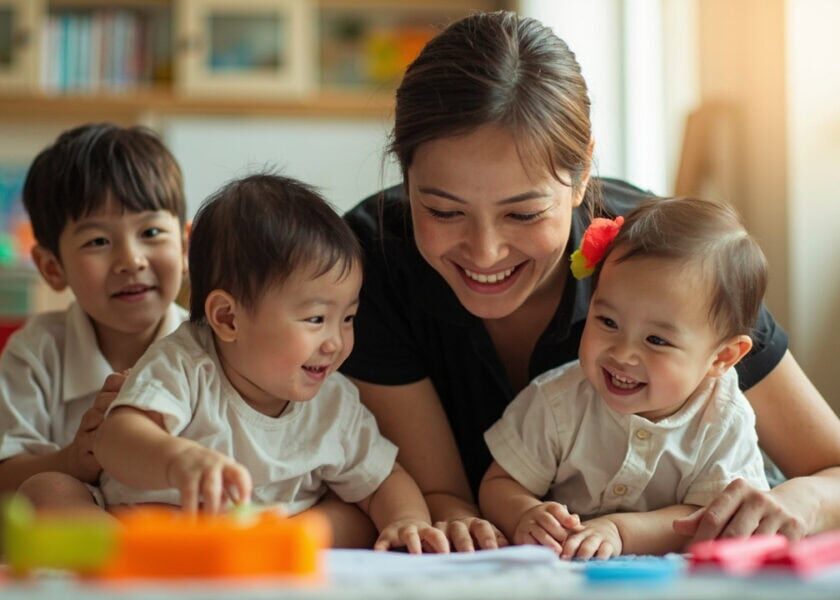
In a room with more than one child, something extraordinary happens. Children learn from each other. A one-year-old watches a two-year-old offer a toy, and something clicks. A toddler watches another toddler struggle with a puzzle, and then watches a caregiver gently demonstrate. The toddler’s eyes follow every movement. When a child watches another child, they see themselves—what is possible, what they might become.
Watch a moment of conflict in quality childcare. Two children reach for the same toy. The caregiver does not rush in. She watches. Usually, children solve these moments themselves. When intervention is needed, the caregiver sits down. She says the names of both children. She describes what she sees: Both of you want the truck. There is one truck. What can we do?
The children, hearing their feelings named, begin to think. A solution emerges. They learn that conflict is manageable, that adults can help without punishing, that their voices matter in solving problems.
There is something else that happens in these hours, something quieter and less dramatic than the play and the learning. It happens when a child is frustrated, or scared, or overwhelmed by the size of their own emotions. In a quality childcare environment, this moment is not ignored, or hushed, or distracted away. The caregiver kneels down. She makes eye contact. She says: I see you. I see that you are feeling sad. The blocks fell down after you worked so hard on them. That feels really frustrating.
She names the emotion. She does not say It’s okay. She does not rush to fix it. She sits with the child in the feeling, steady and present, until the feeling passes.
This is emotional regulation support. It is one of the most important things that happens in quality childcare, and it is almost invisible. When a child learns that their emotions are not too much—that an adult will stay with them in difficult moments, that they do not have to be alone with overwhelming feelings—they build resilience. They build the capacity to sit with discomfort, to recover from setbacks, to manage the inevitable frustrations of life without falling apart. By the time this child reaches primary school, the work will be invisible. The child will simply be known as calm, as adaptable, as someone who can handle their emotions. But the foundation was laid in these ordinary hours.
Recognizing Quality When You See It
What we can do is learn to recognize the signs. When you visit your child’s childcare environment, or when you pick up at the end of the day, notice what you see.
- Do the children look engaged? Is their play purposeful?
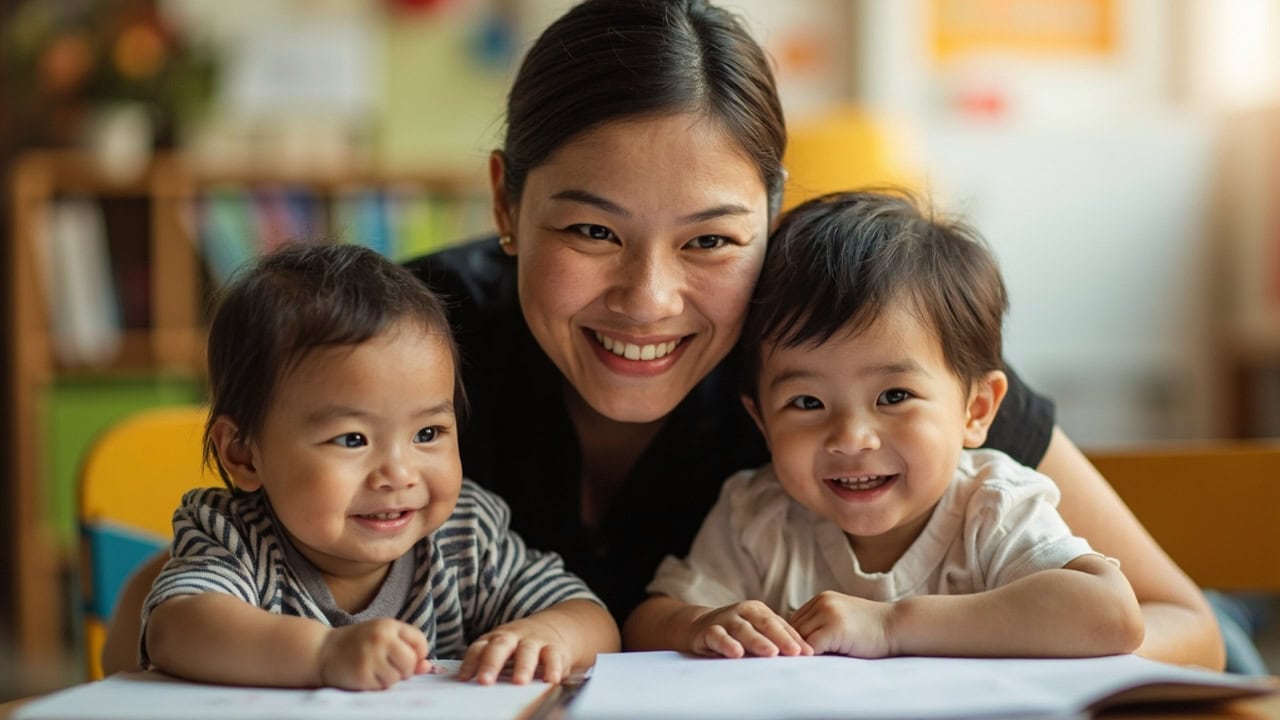
- Is the caregiver on the floor with them, at their level?
- Do the children seem comfortable with the caregiver’s presence?
- Do you hear conversation—not just noise, but back-and-forth exchange?
- Do the children interact with each other in ways that look like learning?
- Does the environment feel alive?
These are the signs of quality. They are not secrets. They are visible, observable, recognizable. And when you know what to look for, something shifts. You stop wondering whether your child is okay. You start seeing that your child is not just okay, but thriving.
What This Means for Your Family
For parents in Singapore researching infant care and childminding, the question is not just philosophical. It is practical. You need to know that your child is in an environment designed for learning, not just supervision. You need to know that the hours are unhurried, that the ratios allow for genuine attention, that the caregiver relationships are stable and warm. You need to know that when you hand over your child’s hand at the gate, the day that follows is worthy of the trust you are extending.
The Questions That Matter Most
Will my child feel abandoned? The goodbye moment is hard—for parents, not always for children. A quality childcare environment means your child builds a secondary attachment with a caregiver who is warm, responsive, and consistent. The goal is not to replace you. It is to provide a reliable, nurturing presence during the hours you are apart. Over time, your child will wave goodbye with confidence, turn toward the caregiver, and walk into the day.
How do I know what’s actually happening? You know by what you can observe. When you pick up, notice your child’s state. Are they calm? Engaged? Comfortable? Does your child reference the caregiver warmly? Does your child seem like themselves? These are the indicators that matter.
Is my child developing appropriately? Development happens in the context of relationship and environment. When children have time, space, materials, and attentive caregivers, they grow. The one-year-old learns to release objects. The toddler learns to climb, to pour, to communicate. These skills emerge through the ordinary work of the day. You will notice them at pickup, in the stories your child brings home, in the growing confidence you see week by week.
Is this worth the investment? Quality childcare is not a luxury. It is an investment in the foundation your child is building right now—in language, in emotional regulation, in motor skills, in the capacity to learn and grow and relate to others. The ordinary days matter most. The ordinary days are where childhood lives.
How EduNanny Singapore Supports Your Family
EduNanny Singapore understands that the hours parents cannot see are not lost hours. They are hours that matter, hours that accumulate, hours that teach.
Through the ECDA Childminding Pilot, EduNanny offers families in Singapore a pathway to quality infant care designed around the needs of both children and parents. Whether through home-based or centre-based arrangements, the standards remain the same: small ratios that allow for genuine attention, unhurried days that allow for real play, caregiver relationships that allow for trust to grow.
Pilot fee structures are designed to be accessible, and families can access support through CDA and Baby Bonus where applicable. This removes barriers to quality, so that the question of affordability does not prevent access to the kind of care that matters most.
EduNanny’s approach includes built-in communication with parents. You receive regular updates about your child’s day—from what was eaten to how play unfolded to small moments of connection that a caregiver noticed and thought you would want to know. Where CCTV measures are in place, parents have the option for additional transparency, not as surveillance but as reassurance. The goal is simple: to close the gap between what parents cannot see and what they need to know. To transform the question what fills those hours? from a source of uncertainty into a source of connection.
The Ordinary Days Are Where Childhood Lives
And then there is the growing. The slow, daily accumulation of capability that becomes visible over weeks and months.
The one-year-old who could not release objects voluntarily now opens her hand and offers you the block she was holding. The toddler who needed help climbing onto the low table now climbs alone. The child who would cry when you left now waves goodbye with confidence, turns toward the caregiver with a smile, and walks into the room without looking back.
This growing is not the result of any special program. It is the result of an environment that makes growing possible. When children have time, space, materials, and attentive caregivers, they grow. It is as simple as that.
The hours your child spends in quality childcare are not separate from your relationship with your child. They are part of it. When your child comes home and tells you—in their limited words—about the blocks that fell and were rebuilt, or the song that was sung, or the friend who shared a cracker, they are bringing you into the world they have been building all day.
And when you can recognize what they are telling you—when you can see, in their small story, the larger story of a day well spent—you become part of that story too.
What fills the hours? Learning. Growing. Feeling. Moving. Connecting. Failing and trying again. Discovering that the world is interesting, that other people are worth knowing, that they themselves are capable and loved.
These are not abstract outcomes. They are ordinary days, lived fully, and they are what your child is doing while you are apart.
Take the Next Step
When you research infant care options in Singapore, ask these questions:
- What is the caregiver-to-child ratio?
- How is the day structured? Is there rhythm and routine?
- Are caregivers on the floor with children, at their level?
- What does the physical environment look like? Is it warm, natural, organized?
- How does the programme communicate with parents?
- Are there opportunities for you to visit, observe, and ask questions?
- Do caregivers stay with the same children over time?
Trust your observations. Visit more than once if you can. Notice how you feel in the space. Notice how the children look. Notice whether the caregiver seems present, unhurried, warm. These are the indicators that no brochure can convey. They are what you have to see for yourself.
When you choose EduNanny Singapore, you are choosing to trust those hours to people who understand their importance. You are choosing a standard of care that does not treat childcare as supervision but as education. Not as a service to be delivered but as a relationship to be built. Not as time spent but as time invested.
The ordinary days matter most. The ordinary days are where childhood lives. And the ordinary days at EduNanny Singapore are days designed with intention, filled with care, and worthy of your trust.
We invite you to speak with our team and discover what a quality day looks like at EduNanny Singapore.