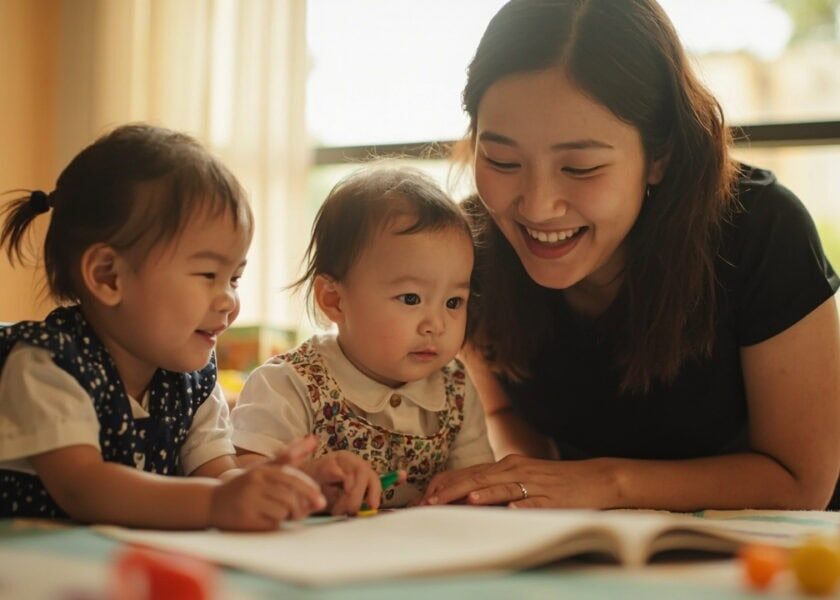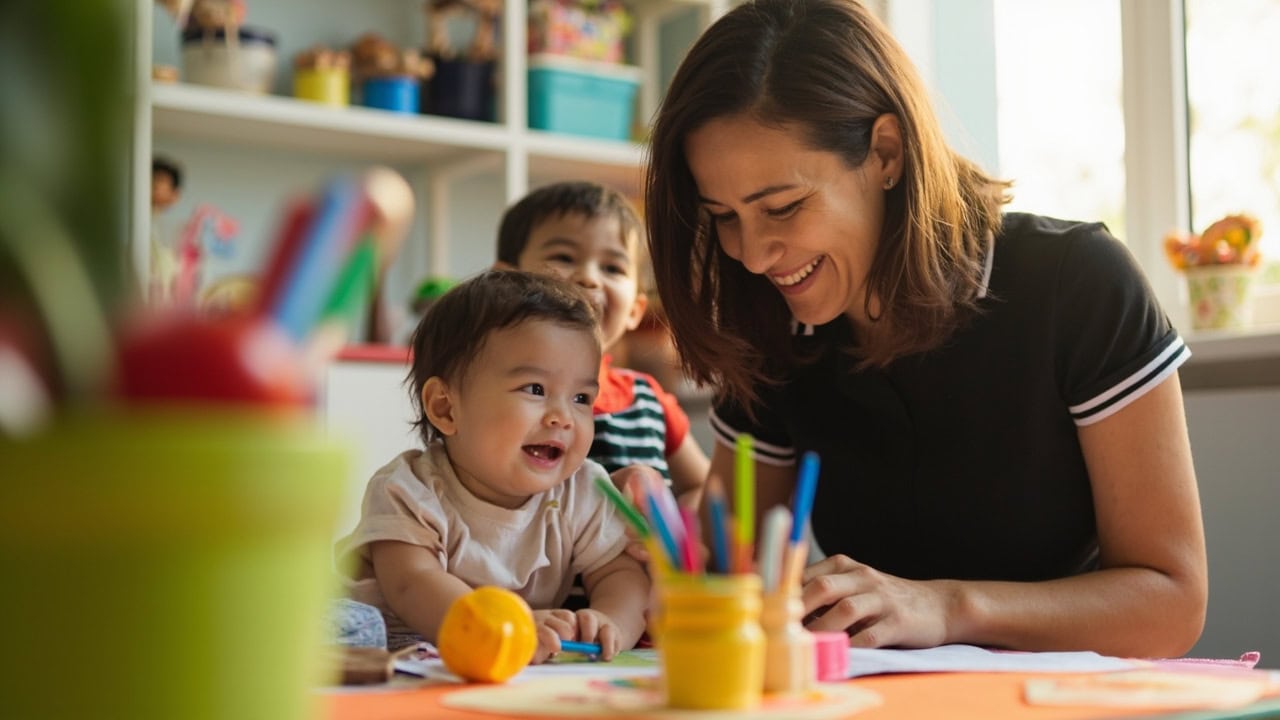
What Quality Childcare Leaves Behind in Your Growing Child
What Quality Childcare Actually Produces
Quality childcare does more than keep your child safe and supervised. It produces measurable, observable changes in how your child thinks, speaks, and relates to others. When you understand what to look for, the evidence becomes clear.
You cannot see what happens inside the classroom. You cannot observe the interactions that shaped your child’s morning. You cannot witness the moment they shared a toy for the first time, or the afternoon they built something ambitious and watched it collapse and decided to build it again.
All of this happens beyond your line of sight. All you have is what comes home with them—the words they use, the way they handle frustration, the stories they tell about their friends, the questions they ask, the games they invent.
What comes home with your child is not random. It is not the product of chance or temperament alone. It is the product of quality. And quality—real quality—produces developmental language: a specific, observable set of competencies that quality care builds in a child over weeks and months.
It is learnable. It is visible. And once you understand it, you will see it everywhere—in the way your child describes a feeling, in the way they navigate a disagreement, in the way they speak about themselves and others.
The Four Things You Will Notice
Emotional Regulation
The first thing you will notice is emotional regulation. A child who has spent time in quality childcare is learning, day by day, to name what they feel.
Consider the progression. A two-year-old who could only scream when frustrated begins, over weeks, to say “I feel angry.” A three-year-old who could only cry when a toy was taken begins to ask, “Can I have a turn when you are done?”
The evidence of this growth comes home with them. It appears in the words they use at the dinner table, in the way they describe what happened at recess, in the requests they make when something goes wrong. When your four-year-old says “I’m really frustrated right now” instead of melting down, that is quality made visible.
Language Growth
Quality childcare is a language-rich environment. Children are spoken to, spoken with, and spoken about. They hear stories. They learn new words in context. They practice sentences, experiment with tone, and discover the power of communication.
A child who returned home with fragments and gestures begins to return home with sentences. With questions. With observations that surprise you—
“Mummy, did you know that butterflies taste with their feet?”
Or: “Today at school, we talked about what makes people feel sad, and I told them I miss you sometimes.”
This too comes home. It is there in every conversation you share at the end of the day.
Social Confidence
Quality childcare is a social environment, and children learn to be social by being in relationship with others their age. They learn to negotiate. To share. To read cues. To assert themselves.
They learn that the world contains other people with desires and needs that differ from their own, and that this is not a threat—it is simply how things are.
A child who was shy in groups begins to seek out friends. A child who did not know how to join a game learns to ask. A child who had no language for peer relationships begins to talk about them with specificity:
- “My friend Sarah and I built a castle today.”
- “He was being mean, so we told the teacher.”
- “I sat with the big kids today at assembly.”
This social awareness, this confidence in navigating a world of others—this is also something quality care produces, and it comes home with them.
Independent Problem-Solving
The fourth thing you will notice is harder to name but unmistakable when you see it. It is the beginning of independent problem-solving.
A child who would only ask for help begins to try things first. A child who would give up at the first obstacle begins to persist, to adapt, to try another approach.
This is not because they have become different people. It is because they have been in an environment that gradually, respectfully, released them from constant adult intervention and trusted them to attempt what they could attempt. And they rose to that trust.
This too comes home. In the way they approach a puzzle. In the way they respond when something breaks. In the way they handle the small failures of an ordinary day.
The Invisible Curriculum: Why Singapore Parents Need This
What I am describing is not a fantasy of perfect children or miraculous outcomes. It is the quiet, daily curriculum of quality care—a curriculum that is invisible in the photographs you receive and in the brief notes that may or may not capture the texture of the day, but that becomes visible over time in the language and behavior of the child who comes home to you.
Quality produces a child who is learning to know themselves, to express themselves, to navigate relationships, and to trust in their own capability. These are not skills that appear suddenly, like a switch that has been flipped. They accumulate. They compound. They build on each other over months and years.
When You Learn to See It, Everything Changes
When you understand what quality care produces, you become an interpreter of your child’s development. You are not just a parent who hopes for the best. You are a parent who knows what to look for.
This changes the pickup moment. It changes the questions you ask. It changes the conversations you have with your child’s caregivers. It changes the way you listen to the stories they bring home.
Instead of searching for reassurance in the absence of bad news, you are searching for evidence of growth. And you know how to find it.
You cannot be with your child every hour of every day. Life in Singapore makes this especially clear. Long commutes, demanding jobs, the logistics of raising a family in one of the most dynamic and fast-paced cities in the world.
There are hours when your child is in the care of others. And what matters—what has always mattered—is not just that they are safe. It is not just that they are fed and rested and supervised. What matters is that those hours are producing something. That they are hours of growth, not just hours of waiting.
What Quality Childminding Looks Like (and How to Choose It)
If you are researching infant care or childminding in Singapore, here is what sets quality apart from adequate supervision:
- Trained caregivers who understand child development – Not just babysitters, but professionals who know how children learn and grow, and how to create environments where development happens naturally.
- Individualized attention – Small ratios that allow caregivers to truly know each child, respond to their needs, and support their specific developmental trajectory.
- Developmentally appropriate curriculum – Activities and interactions designed around how young children actually learn, not just what looks busy or impressive.
- Emotional safety – An environment where children feel secure enough to explore, take risks, make mistakes, and grow.
- Language-rich interactions – Constant, meaningful conversation that builds vocabulary, comprehension, and communication skills.
- Social learning opportunities – Structured and unstructured time with peers that teaches negotiation, sharing, empathy, and relationship-building.
- Respectful release of independence – Gradual support withdrawal that builds persistence, confidence, and problem-solving capability.
When you are evaluating childcare options, here is what to look for:
- Observe the interactions – Watch how caregivers speak to children. Is it warm and responsive? Do they get down to the child’s level? Do they name emotions and model language?
- Notice the environment – Is it organized but not sterile? Are there materials that invite exploration? Does it feel like a place where children are active participants?
- Ask about ratios – Small numbers matter. One caregiver to three infants is very different from one to six or more.
- Ask about training – What qualifications do caregivers have? What ongoing development opportunities exist?
- Ask about the curriculum – Not just what activities happen, but why. How do they support emotional development, language growth, and social skills?
- Talk to other parents – Ask what they have observed in their children’s development over time.
- Trust your instincts – If something feels off, pay attention. If something feels warm and purposeful, that matters too.
You are not just choosing a service. You are choosing a partner in your child’s development. You deserve to feel confident that the hours apart are hours of growth.
EduNanny Singapore: Built Around This Promise
EduNanny by BUTLER was developed as part of the ECDA Childminding Pilot, designed to address a real need that Singapore families face: the need for childcare that is not just convenient and affordable, but genuinely excellent. Not just a place for children to be, but a place for children to grow.
EduNanny offers families a choice between home-based and centre-based pathways, depending on what suits your child and your circumstances. In both settings, the focus is the same: quality interactions, individualized attention, and a curriculum built around the developmental needs of young children.
With infant ratios capped at one to three, children receive the kind of focused care that makes real learning possible. The caregivers are trained professionals who understand child development, who know how to create environments where learning happens naturally, and who take seriously the responsibility of being part of your child’s early growth.
Care is available across Monday to Friday, in structured blocks that work with the realities of working parents. Fees are structured with accessibility in mind, and families can utilize CDA and Baby Bonus funds to offset costs. There are no hidden surprises, no complicated enrollment processes designed to create friction. Everything is organized around making quality care reachable for the families who need it.
The communication structures at EduNanny are designed to bridge the gap that all parents feel. Where possible, updates and transparency measures are in place so that you are not left to interpret your child’s face alone. Where CCTV measures are deployed, they provide an additional layer of assurance. Where direct communication is part of the model, it is warm and informative.
None of this replaces the evidence that comes home with your child—but it supplements it. It gives you multiple ways to know that the hours were well spent, that the care was present, and that your child is in a place that takes their development as seriously as you do.
The Transformation That Awaits
When you understand what quality produces, you are no longer a passive observer, hoping that things are going well. You are an active interpreter of your child’s growth. You are the person who notices what they have learned. You are the person who asks the right questions. You are the person who celebrates the small, quiet victories that no report card will ever capture.
Your child’s face at the pickup gate is not a mystery to be decoded. It is a report to be read. And the language it speaks—the language of growth, of learning, of expanding capability—that language is the evidence that quality childcare leaves behind.
The guilt that many parents carry—the quiet worry that they are missing something, that they are not present enough—dissolves when you understand that the hours apart are not lost hours. They are hours of growth, hours of development, hours in which your child is building capacities that will serve them for the rest of their lives.
The real report cards are not the ones schools send home. They are the moments your child said “I feel frustrated” instead of screaming. The moment they asked to join a game instead of standing alone. The moment they tried to fix something before asking for help. These are the evidence that the hours apart were hours of learning.
When you see it, you will know. You will know that your child is growing in the way that children grow when they are truly cared for, truly taught, and truly seen. You will know that the trust you placed in your childcare arrangement was well placed.
And you will know that every hour, every interaction, every moment of learning that happened while you were apart has contributed to the remarkable, complex, capable person who is running toward you with arms open at the end of every day.
That is what quality produces. And now, you know what to look for.
Ready to Learn More?
If you are exploring infant care or childminding options in Singapore and want to understand how EduNanny can support your child’s development, we welcome you to learn more about our approach, our caregivers, and our pathways for families.
The hours you spend apart from your child are not a gap in their life. They are part of their life. And when those hours are filled with quality—with trained caregivers, intentional environments, developmentally appropriate interactions, and genuine care—those hours become part of the foundation your child is building for everything that comes next.