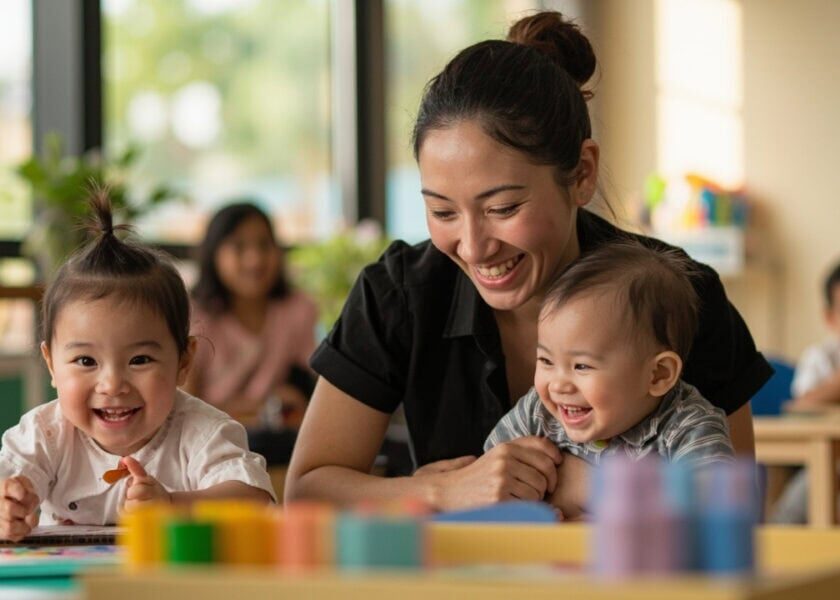
What Quality Childcare for Multiple Children Really Looks Like
The Moment You Realize One Arrangement Cannot Hold Two
There is a moment — quiet, rarely photographed, almost never talked about — when a Singapore parent realizes that the childcare arrangement that worked beautifully for one child cannot possibly hold two.
It does not arrive as a crisis. It arrives as a small calculation, done on a weekday morning, while one child is already settled and the other needs somewhere to be. You realize you are not just adding a child to a system. You are adding a person with a completely different nap schedule, a different food texture preference, a different set of fears, and a completely different relationship to the world.
And the system you have trusted for the first child was never built to carry all of that at once.
That is the moment we want to talk about today — not the first-child goodbye, which so many childcare conversations center around, but the story happening now in HDB living rooms and condominiums across the island. Parents who have done this once before. Parents who know what good care looks and feels like. Parents facing a question that no amount of first-child experience fully prepares them for:
How do you find care that serves every child in your family, not just one?
Understanding the Real Weight of Multi-Child Parenting
That question carries more weight than it might seem to. On the surface, it sounds logistical — a scheduling problem, a capacity problem, a cost calculation.
But underneath the logistics is something much more tender. It is the fear that you will love each of your children equally but manage them unevenly. It is the worry that adding a second child will dilute the quality of attention your first child has come to depend on. It is the guilt — and we use that word carefully, because we do not want to camp in it, but we must acknowledge it — of sitting in an office meeting knowing that your toddler is learning to walk and your infant is learning to reach, and you are not there to see either milestone arrive.
Singapore parents are not short on love. They are short on systems that can hold the full complexity of what they are carrying.
The Truth Nobody Says Out Loud
Here is the truth that the childcare industry has been slow to acknowledge: multi-child families are not just single-child families with more people. The dynamics, the developmental needs, the emotional textures — they are fundamentally different.
A sibling is not simply another child in the room. A sibling is a mirror, a competitor, a comforter, a challenger, and — in the earliest years — one of the most powerful developmental engines a young child will ever encounter.
The Sibling Learning Effect in Action
Developmental science has known this for some time. Siblings in quality care environments do something together that they cannot do alone. They model behavior for each other.
A twelve-month-old watching a three-year-old use a spoon with purpose is not just observing — she is encoding a future intention in her own neural architecture. A toddler who has just learned to stack blocks will often attempt the same feat with renewed concentration after watching an older sibling do it.
This is what researchers in early childhood development call the zone of proximal development made intimate. The older child reaches a little higher. The younger child reaches toward the older child. And something accelerates.
There is also an emotional dimension that is harder to measure but impossible to miss. When a child is genuinely distressed, the presence of a familiar sibling changes the architecture of that distress. It reorients it. The younger child looks to the older one and reads calm. The older child, in being looked to, often discovers a sense of capability that deepens their own emotional intelligence.
They are not just being cared for. They are learning to care.
The Critical Condition
But here is what must be said clearly: the sibling learning effect only works when the environment is secure enough for both children. When care is fragmented, understaffed, or impersonal, siblings do not accelerate each other — they compete for scarce resources, including the most precious of all, which is calm adult attention.
The question is not simply how do we care for two children at once. The question is how do we build an environment where two children can be fully themselves and fully together?
What Quality Multi-Child Care Actually Demands
Let us be honest about what that question demands from the people and systems trying to answer it.
Infant-to-Caregiver Ratios That Are a Living Reality, Not a Number
When an infant needs eye contact to feel secure and a toddler needs a hand to climb the stairs, you cannot stretch one pair of eyes and one pair of hands across both needs simultaneously and call it quality.
Small ratios in a home-based setting — up to one-to-three infant ratios — are not a luxury feature. They are the minimum condition for the kind of attention each child deserves. Small numbers are not about exclusivity. They are about the capacity to actually see.
Caregivers Who Relate, Not Just Manage
There is a difference — significant and measurable — between a caregiver who tracks milestones because a checklist requires it and a caregiver who knows that a child takes eighteen minutes to settle after a nap because she has been with him long enough to notice, and that his sister settles faster when he is already calm in the room.
This is not a personality trait. It is a practice built through continuity, consistent relationships, small ratios, and a training culture that treats observation as a discipline.
Communication Systems That Reduce Your Cognitive Load
When you have two children in care, you need to know what happened to both of them today — not in aggregate, not as a family summary, but individually.
How did each child sleep? What did each child eat? Where is each child developmentally? Were there moments of connection, moments of frustration, moments of breakthrough?
This is not an unreasonable ask. It is a fundamental expectation — and meeting it requires structured transparency that gives parents a clear, honest picture of each child’s day.
The Cost Reality Singapore Families Face Honestly
Because we owe each other honesty in this conversation: the cost reality of childcare for two or more children in Singapore is not a side issue. For many families, it is the issue that shapes every other decision.
The Baby Bonus CDA and existing government subsidies help, and they should be navigated carefully, because they make more than families often realize. But even with those supports, the arithmetic of two childcare arrangements — or two children in one arrangement that may not be equipped for both — can feel suffocating.
Here is the distinction worth making: the question is not whether premium childcare is worth the investment. That framing treats quality as a financial product to be justified.
The real question is whether you are paying for something that actually does what your family needs.
Because a cheap arrangement that fragments your attention, strains your children’s security, and adds to your daily anxiety is not saving you money. It is costing you something that cash cannot replace: the quiet confidence that your children are in a place where they are genuinely thriving, individually and together.
What Parents of Multiple Children Actually Need
If we are being honest about what parents of multiples need, it goes beyond the practical logistics. Here is what research and lived family experience tell us:
- Individual recognition. Each child has their own temperament, their own fears, their own trajectory. A childcare partner who sees them as individuals — not as a pair or a set — is non-negotiable.
- Rhythm management. Infant and toddler schedules do not align naturally. Quality care holds both rhythms without forcing one child to accommodate the other.
- Transition support. The drop-off with one child is hard. The drop-off with two — where you are leaving two separate human beings with their own anxieties and you can only attend to one at a time — is something else entirely. Parents need caregivers who understand this and make space for it.
- Developmental tracking for each child. Milestone monitoring that serves each child’s individual arc, not just documentation for its own sake.
- Flexibility as your family grows. When your family evolves — when a third child arrives, when children move into different developmental stages — your childcare partner should evolve with you, not require you to start over.
Answering the Questions You Are Actually Asking
“Will my second child get the same attention as my first?”
In a well-designed multi-child environment, the sibling learning effect means your children are not competing for attention — they are enriching each other’s experience. But this only happens when ratios are small enough for individual attention. Ask about infant-to-caregiver ratios. Ask how the caregiver manages different schedules. Ask how they track each child’s individual progress.
“How do I manage the drop-off with two children?”
Look for a care setting where small group size means caregivers have time for you. Where you can hand over one child, breathe, and then hand over the second — without rushing. Where the caregiver knows both children well enough to read their morning moods and respond accordingly.
“Can I really afford quality care for multiple children?”
Calculate not just the monthly fee, but what you are buying: the reduced anxiety of knowing both children are thriving, the time saved from not managing crises, the developmental advantage of siblings learning together in a secure environment. Government subsidies exist and should be fully utilized. The question is not whether premium care fits your budget — it is whether the alternative is actually cheaper in the long run.
“What if my children are at different stages and need different things?”
Quality multi-child care is designed for exactly this. Infant care and toddler care in the same environment, with caregivers who understand developmental stages and can hold different rhythms without forcing compliance. Ask how the daily schedule accommodates different nap times, different feeding needs, different play requirements.
The Tuesday Afternoon Moment Worth Moving Toward
There is a vision worth holding onto as you make these decisions.
Two siblings — one eighteen months, one three and a half — are in a home-based care setting. The older child is building a tower with soft blocks. The younger child is watching from the floor, reaching up toward the structure with open hands, not yet understanding that the blocks need to be stacked one at a time but understanding, on some cellular level, that her sister is building something, and that the building matters.
The caregiver is nearby. Not hovering, not directing, but present — close enough that if the tower falls, the younger child will look up and see a face that says, that is fine, you can try again, and the older child will see a face that says, go on, show her.
This moment will not appear in any developmental report. It will not be captured in a photo you post online. But in that moment, two children are learning something together that they cannot learn alone.
They are learning that the world is interesting. That someone is there. That they do not have to face it in isolation.
That is what quality multi-child care makes possible.
How EduNanny Holds the Whole Family
EduNanny was built for this moment — not as an afterthought, not as a scaled-up version of a single-child model, but as a deliberate, structured, warmly human response to the real shape of modern Singapore family life.
As part of the ECDA Childminding Pilot, EduNanny brings home-based and community-based pathways together under a coherent quality framework. This means your child is not in a sterile centre room with twenty other children and one overwhelmed educator. Your child is in a home environment — warm, scaled, relational — with a caregiver who knows them deeply.
Designed to Grow With Your Family
If your family grows from one to two, or if you have children at different developmental stages who need different rhythms, EduNanny is structured to grow with you. It does not require you to start over from scratch with a new arrangement each time your family changes.
Every transition in early childcare carries a cost — not just a logistical one, but an emotional one. For children, transitions mean re-establishing a sense of security. For parents, they mean re-earning trust with a new system. When your childcare partner can hold your family as it evolves, you reduce the number of transitions your children experience, and you reduce the emotional tax on yourself as a parent who is already carrying enough.
Caregivers Who Stay, Relationships That Deepen
There is something worth saying here about what EduNanny’s approach means for the caregivers themselves — and why it matters directly for your child.
A childminder who is supported, trained, and operating within a structured programme with manageable ratios does not just provide better care. They stay in the profession longer. They develop deeper relationships with the children in their charge. They bring a sense of professional dignity to the work that translates directly into the quality of attention your child receives.
EduNanny’s support structure for caregivers is not a human resources talking point. It is a quality mechanism. The children benefit because the adults are not burning out.
The Gift You Are Giving Your Children
If you are standing in that Tuesday morning moment right now — the one where you realize that one arrangement cannot serve your growing family — here is what we want you to know:
You are not overthinking it. You are not being difficult. You are seeing clearly.
And what you are looking for exists. It is not perfect — no human arrangement is. But it is designed with intention. It holds each child as an individual and understands that the sibling bond is not a byproduct — it is a gift that develops best when every child within it feels seen, secure, and held by someone who has the time and the training and the genuine care to do that work well.
When you evaluate childcare options for your multi-child family, look for:
- Small ratios that make individual attention possible
- Caregivers who know each child as a person, not just as part of a group
- Communication systems that give you a clear picture of each child’s day
- An environment flexible enough to hold different developmental stages simultaneously
- A partner that commits to growing with your family, not just managing your current situation
The children who grow up knowing they were each loved for who they are — not as a pair, not as a set, but as the specific, unrepeatable people they are — those children carry something forward into the world that no amount of screen time or crowded classrooms or stressed-out caregiving can give them.
They carry the knowledge that they mattered. That someone noticed. That when they reached, there was a hand to hold.
That is what good childminding has always been for. And that is what Singapore families, with all their complexity and all their love, deserve.
If you are ready to explore how EduNanny can hold your whole family — each child as an individual, each sibling bond with care — we invite you to take the next step.
Because the best care is not just about what happens while you are apart. It is about what becomes possible when you have a partner you can trust completely.
Explore EduNanny’s Childminding Pilot →