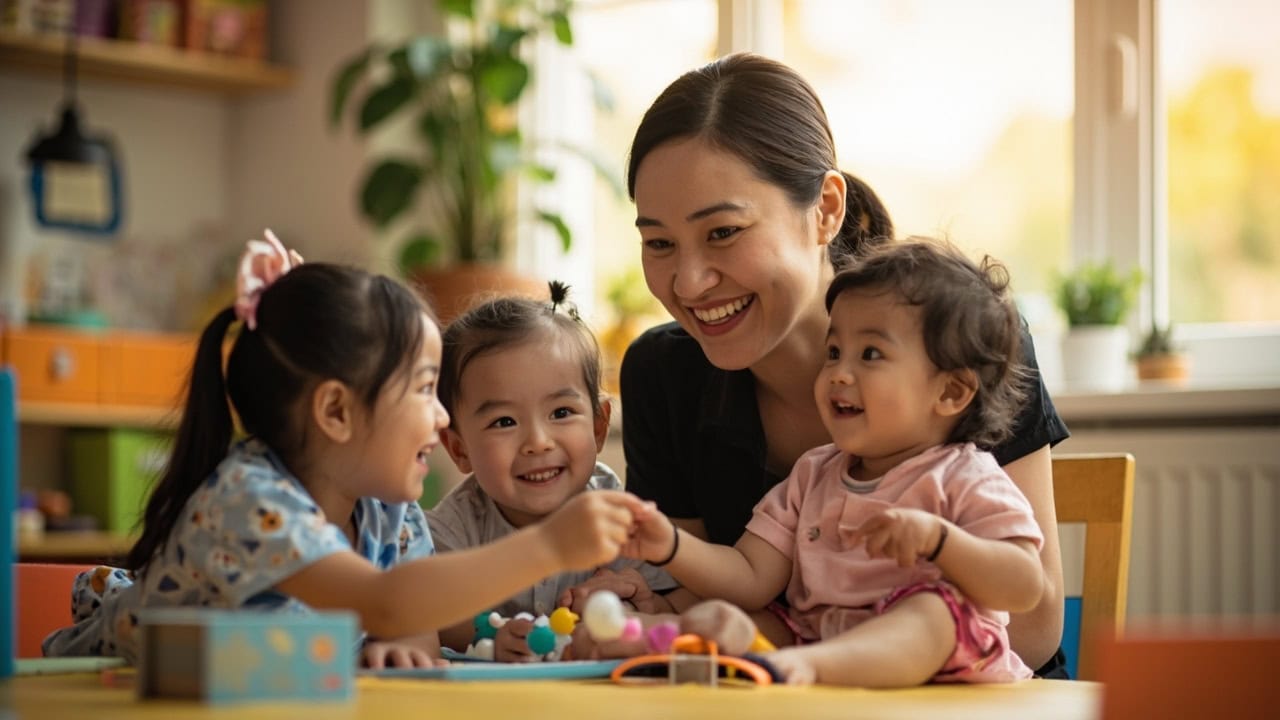
What Quality Childcare Develops Beyond Safety and Comfort
What Quality Childcare Actually Builds: A Science-Based Answer
You have probably caught yourself thinking it at some point. After the morning handover. During a workday meeting when your mind wanders. At bedtime, watching your child sleep. That quiet, almost unspeakable question: Is this actually working?
Not the logistics. Not the peace of mind. But the deeper thing. Is my child actually growing? Developing? Becoming more capable because of where they spend their days?
Most parenting content answers the first question—whether your child is safe, loved, settled. But very little speaks to the second, more urgent question. Is this making my child better?
That question deserves a real answer. Not platitudes, but evidence. Because if you are choosing quality over adequacy—and we believe you already have, or you would not be reading this—then you deserve to know what quality actually produces in your child’s brain, body, and emerging sense of self.
Here is what the science tells us quality early care produces:
- Secure attachment — a foundational sense of safety that enables exploration and resilience
- Accelerated language development — vocabulary advantages that compound over time
- Social-emotional regulation — the ability to manage frustration, wait, share, and recover
- Executive function — working memory, impulse control, and cognitive flexibility that predict school success more reliably than early academics
- Physical development — the body-brain connection that supports classroom readiness
These are not soft outcomes. They are measurable, observable, and consequential. Let’s explore each one.
The First Thousand Days: Building a Brain That Cannot Be Rebuilt
The brain your child is building right now—in these first thousand days, roughly from conception to age three—is a construction project of staggering complexity and equally staggering fragility.
During this period, the brain forms more than one million new neural connections every second. That is not a metaphor. That is a measurement. Every sound your child hears, every face they study, every time a caregiver responds to their cry with consistent warmth—the architecture of their mind is being literally shaped.
Physical development is intertwined with this process. Gross motor skills—running, climbing, jumping—develop through movement. Fine motor skills—manipulating objects, using utensils, eventually writing—develop through manipulation and play. These are not just physical milestones. They are cognitive ones. The brain regions involved in fine motor control are adjacent to and interconnected with language and executive function regions. Movement and cognition are not separate systems. They are integrated.
This is why the difference between adequate and quality care is not a matter of degree. It is a matter of architecture.
Adequate care maintains a child. Quality care builds the mind.
The neural pathways formed in these years become the permanent infrastructure for everything that follows—how your child learns, relates, copes, and grows. There is no equivalent window later in life. The opportunity is now, and it is irreplaceable.
Secure Attachment: The Foundation for Everything
Imagine two toddlers in a new situation. One explores freely, returns to their caregiver for reassurance, then ventures out again. The other clings, anxious, unable to engage.
These are not personality differences. They are attachment patterns—and attachment patterns are the first and most formative outcome of early caregiving.
Secure attachment develops when a caregiver is consistently responsive. Not perfect, but reliably warm. The child learns a fundamental lesson: When I signal need, someone responds.
This is not just emotional comfort. It is a foundational operating system for human functioning.
What Secure Attachment Produces
A securely attached child has what psychologists call a secure base. They can explore because they know home is safe. They can tolerate frustration because their nervous system has been repeatedly soothed. They can engage with other children because they trust adults to help if things go wrong.
In quality infant care, this is not left to chance. The caregiver ratio matters enormously here. When one caregiver is responsible for one infant—or at most three—the responsiveness that builds secure attachment becomes structurally possible. A child whose cries are answered in minutes develops a fundamentally different relationship with the world than a child whose needs are managed in rotation.
What You Will See at Home
Watch your child. A securely attached child shows it in:
- Their willingness to try new things
- Their recovery from minor setbacks
- Their ease in social situations
- A quiet confidence that says: I know how to be cared for, and I know how to care for myself
They might still be shy—shyness is temperament—but they move through the world differently. With trust, not anxiety. With curiosity, not fear.
Language Development: The Gap That Does Not Close
Here is something you can measure—and something Primary 1 teachers measure constantly: language.
Children in language-rich environments hear millions more words in their first three years than children in language-poor environments. Not different words—the same words repeated, but vastly more input. By age three, the vocabulary gap between children from high-language and low-language households can exceed three thousand words.
This gap does not close. It compounds.
By Primary 1, children who arrived with larger vocabularies are better at following complex instructions, understanding stories, making arguments, and sitting through lessons. Language is not just communication. It is the medium of thought itself.
How Quality Care Accelerates Language
Quality childcare settings accelerate language development through deliberate design. Caregivers narrate actions, expand utterances, read books interactively, and engage in what developmental scientists call contingent conversation—back-and-forth exchanges that respond directly to what a child has just said or done.
In a home-based setting with a one-to-three ratio, this contingency is possible. In a centre with one caregiver to eight or ten infants, it becomes structurally difficult. The research consistently shows that caregiver-to-child ratios predict language outcomes. Smaller ratios mean more individual language input, which means richer vocabularies.
What You Will Notice at Home
- Your child uses longer sentences earlier
- They make up stories
- They ask “why” constantly and actually care about the answers
- They remember and recount experiences with detail
- They engage in genuine conversation—not just request fulfillment
Executive Function and Social-Emotional Skills: The Real Predictors of School Success
Modern parenting discourse focuses heavily on academic preparation—letter recognition, number concepts, early reading. But the skills that actually predict school success, relationship quality, and mental health across a lifetime are social-emotional.
The ability to manage your own emotional states. To wait. To share. To recover from disappointment. To read social cues. To negotiate.
These skills are not innate. They are built. And they are built through repeated practice in environments that are both challenging enough to require regulation and supportive enough to make it possible.
Learning to Manage Big Feelings
In quality early care, children encounter peer interaction, the first friction points of sharing, waiting, feeling frustrated. With skilled caregivers present, they learn crucial lessons:
- I can feel angry and still be okay.
- Someone will help me.
- I do not have to hit when I am upset.
- I can use words.
Executive Function: The Research Behind the Results
Executive function is the set of mental capacities that allow us to control our own thoughts and behaviors:
- Working memory — holding information in mind while doing something else
- Inhibitory control — stopping an impulse to act on instinct
- Cognitive flexibility — switching between tasks or perspectives
The landmark research shows that executive function and self-regulation at age five predict academic achievement, health outcomes, and even criminal involvement at age thirty better than IQ scores. Not as well as academic skills matter—but more reliably. The capacity to focus, to persist, to manage frustration is a more consistent predictor of life outcomes than test scores at school entry.
This is what quality early care builds. Not through worksheets or drilling, but through the daily texture of a responsive, developmentally rich environment:
- Through play that requires waiting
- Through stories that require attention
- Through conflicts that require emotional regulation
- Through caregivers who do not solve problems for children but support them while they solve problems themselves
What Primary 1 Teachers Actually Notice
Primary 1 teachers who have taught long enough to see patterns will tell you what they notice in children who arrived with quality early care. Not just academic readiness, though that matters. Something more fundamental.
Children with quality early care:
- Can sit and attend—not perfectly, but appropriately for a six-year-old
- Can follow multi-step instructions
- Can manage the social complexity of a classroom—sharing, taking turns, recovering from small conflicts
- Are curious, ask questions, seem interested in learning rather than just avoiding discomfort
Children arriving without these foundations:
- Are academically prepared but struggle with attention
- Struggle with frustration tolerance and peer relationships
- Learned letters but not how to learn
- Can perform in structured academic settings but fall apart when things do not go their way
Teachers will tell you that executive function and social-emotional regulation—the capacities built in the first six years—mattered more in the long run than early academics. They can teach letter sounds. They cannot easily teach a child to manage their emotions or persist through difficulty.
What You Will Notice at Home
- Your child can wait for a preferred activity without complete meltdown
- They transition between activities with less difficulty
- They tolerate frustration in play and recover more quickly
- They follow multi-step instructions
- They hold a plan in mind and work toward it
These are not just good behavior signs. They are the measurable outcomes of cognitive development happening on schedule.
Adequate vs. Quality: The Real Difference
There is a difference between adequate childcare and quality developmental care.
Adequate childcare holds your child. It keeps them safe. It feeds them. It follows a schedule. It checks boxes.
Quality developmental care builds your child. Every interaction is intentional. Every environment is designed. Every developmental domain is supported—cognitively, socially, emotionally, physically. Your child is not just occupied. They are growing.
| Adequate Care | Quality Developmental Care |
|---|---|
| Maintains safety and basic needs | Builds neural architecture and developmental capacity |
| Follows a schedule | Responds to individual developmental cues |
| Manages children in rotation | Builds secure attachment through consistent responsiveness |
| Provides stimulation | Scaffolds language, executive function, and social-emotional skills |
| Checks developmental boxes | Systematically develops all developmental domains |
This difference is not about luxury. It is about outcomes. And it is not just theoretical. You can see it in the children themselves—in their confidence, their curiosity, their capacity to learn, their ease in the world.
Observable Signs of Healthy Development
As a parent, you are not expected to run developmental assessments. But you can observe. Here is what quality early care looks like when you pick up your child at the end of the day:
Language and Communication:
- Your child is chatty, curious, asking questions
- They can retell events from their day with detail
- They engage in back-and-forth conversation, not just requests
Social-Emotional Wellbeing:
- Your child is happy to see their caregiver
- They show appropriate attachment—not anxious, not avoidant
- They can name and express their emotions
- They are beginning to show empathy for others
Confidence and Self-Regulation:
- Your child approaches new situations with curiosity, not fear
- They can separate from you comfortably, knowing you will return
- They bounce back from minor setbacks and frustration
- They transition between activities with increasing ease
- They are developing impulse control appropriate for their age
These are the outcomes you are paying for when you choose quality. These are what developmental investment produces.
What This Means in Practice: Finding Care That Delivers
The research is clear. The question now is practical: how do you find care that actually delivers these outcomes?
EduNanny operates within the ECDA Childminding Pilot, offering both home-based and centre-based pathways designed to give Singapore families access to quality developmental care. Every element—from caregiver ratios to communication protocols—is structured around what developmental science tells us children actually need.
What Structural Quality Looks Like
Caregiver ratios of up to one to three for infants. Every child receives the responsive, individualized caregiving that builds secure attachment and accelerates language. This is not a marketing claim. It is structural design based on developmental science.
Care blocks run Monday through Friday, designed around working families’ actual schedules. Because quality care should not require you to choose between your career and your child’s development.
Transparent communication. Where deployed, communication protocols ensure you know what your child ate, how they slept, what they played, and how they seemed. This is not a luxury feature. It is the minimum that parents deserve and that quality care provides.
The Caregivers Behind the Care
The EduNanny caregivers are trained in the science of early development—secure attachment, language scaffolding, executive function building, and motor development sequences. They are not babysitters. They are developmental partners in your child’s earliest and most consequential education.
This is not accidental care. This is systematic care—designed around what developmental science tells us children need, delivered with the warmth and consistency that every child deserves.
Making Quality Care Accessible
The pilot structure is designed to make quality care more achievable for Singapore families. For families using available government support, CDA and Baby Bonus funds can be applied, helping to remove some of the financial friction that makes premium care feel out of reach.
Premium childcare is not a luxury expense. It is a developmental investment. And the first years are not just a phase—they are the foundation.
The Quiet Question, Answered
So let us return to where we started.
The quiet question beneath every childcare decision is not whether my child is safe. That is the baseline. That should be non-negotiable.
The real question is whether my child is developing. Growing. Becoming more capable, more curious, more confident, more prepared for the world they are entering.
The answer, if you have chosen quality care, is yes.
The science is clear. The outcomes are measurable. And the evidence is in your living room—in your child’s growing vocabulary, in their ease with other children, in their ability to manage frustration, in their curiosity about the world, in their readiness for everything that comes next.
Your child’s brain is being built right now. The choices you make today—the care you choose—shape the mind they will carry through every stage of life.
That is the answer to the question you have been asking.
And now you know how to recognize it. In your child’s eyes. In their development. In the quiet confidence they carry into every new room, every new situation, every new year of their lives.
EduNanny is a Singapore childcare and childminding service built around what children actually need to develop. To learn more about our approach, visit our website or connect with us directly.