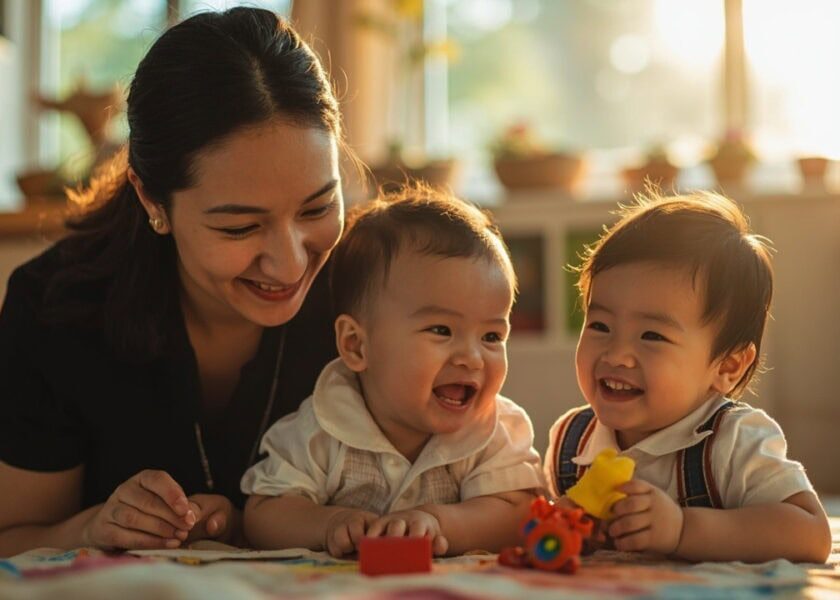
What Premium Infant Care Looks Like When You Pay Attention
The Sensory Environment: What Quality Looks Like When You Know Where to Look
When you walk into an infant care environment, the first thing that often hits you is not what you see but what you hear. The acoustic environment—the way sound moves through a space—is one of the most overlooked indicators of quality.
Inadequate acoustics create constant low-level noise that competes for an infant’s developing attention, draining cognitive resources needed for exploration and learning. In quality infant care, you will notice the opposite: soft absorbing surfaces on walls and floors, voices that do not have to compete with hard surfaces and echo, ambient sound that is neither silent nor chaotic.
Listen carefully. In a well-designed acoustic environment, the infants are not overstimulated by noise, and the caregivers do not have to raise their voices to be heard. When a caregiver speaks to a child, that voice carries warmth and clarity. It reaches the infant as communication, not as background noise.
During your next visit, pause for thirty seconds and simply listen:
- Is there a constant hum of competing sounds?
- Are voices sharp because people are straining to be heard over hard surfaces?
- Does the room feel like a place where words and sounds can land gently?
- Can a caregiver’s voice to a six-month-old carry the same warmth and intention as a lullaby?
If the answer to that last question is yes, you are standing in an environment that takes sound—and therefore infant brain development—seriously.
Sound and Language Development in Singapore’s Multilingual Context
Singapore’s infants grow up in one of the most linguistically rich environments in the world. They are exposed to English, Mandarin, Malay, Tamil, and any number of home languages and dialects. This is not a problem to be managed. It is a gift.
In quality infant care, this linguistic richness is not background noise. It is deliberate. Listen to how caregivers speak—not just what they say, but how they say it.
You will hear caregivers narrating the moment: “I am wiping your hands now. You had some rice on your fingers. All clean.” You will hear them responding to infant vocalizations with words, not just sounds. You will hear them moving fluidly between languages in culturally responsive ways that honor the child’s home context.
Language exposure in the first year of life is not passive. It happens in the quality of caregiver responsiveness—in the way an adult treats an infant’s earliest sounds as meaningful and worth responding to.
Lighting and Spatial Design
Move from sound to light. The lighting in an infant care environment is not a neutral detail. It shapes infants’ circadian rhythms, their mood regulation, and their ability to engage without overstimulation.
Natural light is ideal, and when it is not fully available, the quality of artificial lighting matters. Look for environments where lighting is soft and diffused, where harsh overhead fluorescents do not dominate the space, where there are pockets of different lighting quality throughout the room:
- A cozy corner with warmer light for winding down
- A brighter area for active, engaged play
- Dimmer spaces for rest and quiet alertness
These are not aesthetic choices. They are neurological support systems. An infant’s brain is still under construction, and the environment that supports that construction offers appropriate sensory input—light that is gentle and varied, not constant and flat.
Look also at how the space is designed for the infants’ bodies. Are the infants on the floor often? Are they in positions that allow them to move freely, to practice rolling, reaching, grasping? Or are they primarily in containers—in bouncers, swings, and carriers—that limit their movement?
In quality infant care, the physical environment is designed to support motor development. The flooring is safe for exploration. The materials are within reach. The space invites movement, not restricts it.
The Caregiver-Child Interaction: Where Quality Becomes Unmistakable
And then, once you have begun to read the environment itself, there is the most important element to observe: the caregiver-child interaction.
The quality of interaction between a caregiver and an infant cannot be faked in a tour or hidden behind a clean surface. It reveals itself in micro-moments, and once you know what to look for, you will see it everywhere—or you will feel its absence.
What Attunement Looks Like in Motion
Watch a caregiver kneeling down to lift an infant from the floor. Notice the speed of the movement. In quality care, it will be unhurried. The caregiver will approach with their face visible to the infant first, giving the baby time to register their presence before being lifted. The lift itself will be supported—the caregiver’s hand under the infant’s head, the other arm gathering the baby’s body close. There will be a word or a soft sound to accompany the action.
This is not performance. This is what attunement looks like in motion.
Now watch what happens next. Does the caregiver carry the infant into the next activity with the same quality of presence? Or does the moment become transactional—the infant lifted, deposited, the caregiver already turning away to the next task?
In a high-quality infant care environment, the caregiver’s attention does not fragment. Even during transitions, even when managing multiple infants, there is a continuity of engagement that communicates to the infant: I am here with you. You are not alone.
What You See in the Infants Themselves
An infant in attuned care looks at their caregiver differently than an infant in merely adequate care. There is a quality of recognition, of connection. When the caregiver speaks, the infant turns toward the voice with interest, not just reflexive startle. When the caregiver leaves the room, there is protest—not because the infant is anxious, but because there is a genuine bond that registers the absence.
Researchers call this attunement, and it is one of the most powerful predictors of healthy development in the first thousand days. When an infant’s caregiver is attuned—when they notice the infant’s cues and respond appropriately, when they match their tone and pace to the infant’s state, when they are genuinely present rather than merely supervising—the infant’s brain develops differently.
Why This Matters More in Singapore
Singapore parents face a particular combination of pressures that are not found elsewhere. You are navigating one of the world’s most competitive educational environments while simultaneously trying to raise emotionally secure, developmentally healthy children. You are often working long hours, managing complex family dynamics, and trying to do what is best for your child while being pulled in many directions at once.
The childcare decision is not made in a vacuum. It is made in exhaustion, in guilt, in the pressure of limited time and overwhelming options.
And yet, the stakes have never been higher. The first thousand days of life—the period from conception to approximately age two—are now understood by neuroscience to be the most consequential developmental window in the entire human lifespan. The brain is developing at a faster rate than it ever will again. The foundations for language, emotional regulation, social competence, and cognitive flexibility are all being established in these early months and years. What happens in infant care during this period is not custodial. It is developmental. It matters in the deepest biological sense.
Cultural Responsiveness in a Multicultural Society
Singapore is a multilingual and multicultural society. Your child is growing up in a context where English is the working language, but where Mandarin, Malay, Tamil, and a rich diversity of home languages and dialects are equally valid parts of who your family is.
Quality infant care in Singapore must be culturally responsive. It must honor the languages your child speaks at home. It must navigate the cultural expectations you have for how your infant will be cared for—expectations that may differ from Western norms and that are no less valid for being different.
When you evaluate infant care, ask how caregivers respond to cultural diversity. Ask whether they can greet your infant in your home language. Ask whether they understand the dietary and religious considerations that matter to your family. These are not superficial details. They are expressions of respect for your child’s whole identity.
Your Framework for Evaluating Infant Care
You do not need to become a developmental psychologist in five minutes. You need to trust your capacity to observe. During your next childcare visit, try this:
- Watch for thirty uninterrupted minutes if you can. Longer than a typical tour. Quality reveals itself over time.
- Watch how the caregiver responds when an infant cries. Not just whether they respond, but how—quickly or slowly, tensely or calmly, with words or just movement.
- Watch whether the caregiver’s face is relaxed and warm or tense and distracted. An infant reads faces long before they read words.
- Listen to the acoustic environment. Is it a place where voices carry warmth or where sound competes with sound?
- Notice the lighting. Is it varied and gentle, or flat and fluorescent?
- Ask about the daily rhythm. Does the pacing reflect developmental intentionality or just logistical convenience?
- Ask about language exposure. Is the answer generic or specific to your child’s cultural context?
You may be wondering: is all of this realistic? Can I really observe this much during a short visit? What if I feel too overwhelmed to know what I am seeing?
Here is the truth: you do not need to master this framework overnight. You simply need to start paying attention differently. Even noticing one or two of these qualities during a visit is meaningful. Over time, and with a few visits, the pattern becomes clear.
And if what you observe does not match what you were told? That is data too. Walk away from a place where your senses are telling you something is wrong. Your instincts exist for a reason.
Where This Quality Becomes Consistent
Understanding what quality looks like is one thing. Finding a place where it is deliberate and consistent is another.
EduNanny by BUTLER operates as part of the ECDA Childminding Pilot, contributing to Singapore’s national effort to expand quality infant care options for families. We offer both home-based and community-based pathways, because we know that families have different needs. Some families prefer the intimacy of home-based care, where a dedicated caregiver tends to their infant in a familiar environment. Others prefer the community-based model, where infants benefit from peer interaction in a carefully designed space. Both pathways, when done well, can be excellent. The key is not the model but the quality within it.
The Ratio That Makes Attunement Possible
One of the most significant quality indicators at EduNanny is our infant-to-caregiver ratio. We maintain ratios of up to one caregiver to three infants in our infant care programme. This is not an accident. It is a deliberate commitment to ensuring that every infant receives the attunement they need.
With three infants or fewer per caregiver, the caregiver can genuinely know each child. They can notice each child’s cues, respond to each child’s needs, engage in the kind of rich interaction that builds neural pathways. This ratio is not standard across all infant care settings in Singapore. It reflects a conviction that quality cannot be achieved at scale without compromising what matters most.
Affordability, Consistency, and Ongoing Communication
We understand that affordability matters. The ECDA Childminding Pilot includes fee structures designed to make quality infant care accessible to more families, including the use of CDA funds and Baby Bonus payments to help offset the cost of care. Quality infant care should not be the exclusive preserve of families with unlimited resources.
Our care operates Monday through Friday, in structured care blocks that provide consistency for both infants and parents. We believe that routine is not the enemy of development—it is the foundation of it. When infants know what to expect, when the rhythm of their day is predictable and calm, they are free to explore, to learn, to attach.
For families where CCTV measures are deployed, we welcome this. We have nothing to hide because we are confident in the quality of care we provide. Communication with parents is ongoing, responsive, and honest. You will not be left wondering what your child did today. You will know.
Support When You Need It
We know that parenting in Singapore can be isolating, that questions arise at odd hours, that the support you need does not always arrive during office hours. This is why we developed Thomas, our AI-powered chatbot. Thomas is not a replacement for human care and human connection. But Thomas is always available to answer your questions, to provide guidance, and to help you navigate the everyday challenges of parenting and childminding.
Trusting What You See
The next time you stand in a childcare centre and feel that familiar uncertainty, we hope you will remember this: you are not helpless. You are not lacking as a parent because you do not immediately know what to look for. You simply have not yet been given the framework.
Now you have it.
Slow down. Look. Listen. Watch the micro-moments. Feel the acoustic environment. Notice the light. Observe the caregiver-child interactions with fresh eyes. Ask the questions that matter. Trust what you see and what you sense.
And if what you see is quality—if what you observe is attunement, intentionality, developmental support, cultural responsiveness, warm and responsive caregivers in an environment designed to build brains and secure attachments—then you will know. Not because someone told you it was good, but because you can see it for yourself.
That is the confidence we want for you. Not blind trust, but informed trust. Not hope, but sight.
Your child’s first thousand days are happening now. The caregiver who holds your infant, who speaks to your infant, who responds to your infant’s cries and coos and curiosity—they are not just providing supervision. They are building the architecture of your child’s future. That deserves the best you can find. And now, you know how to find it.
EduNanny is here. We would be honored to walk this journey with you.
If you would like to learn more about who we are or how we can support your family, we invite you to visit our About Us page or get in touch to arrange a conversation.