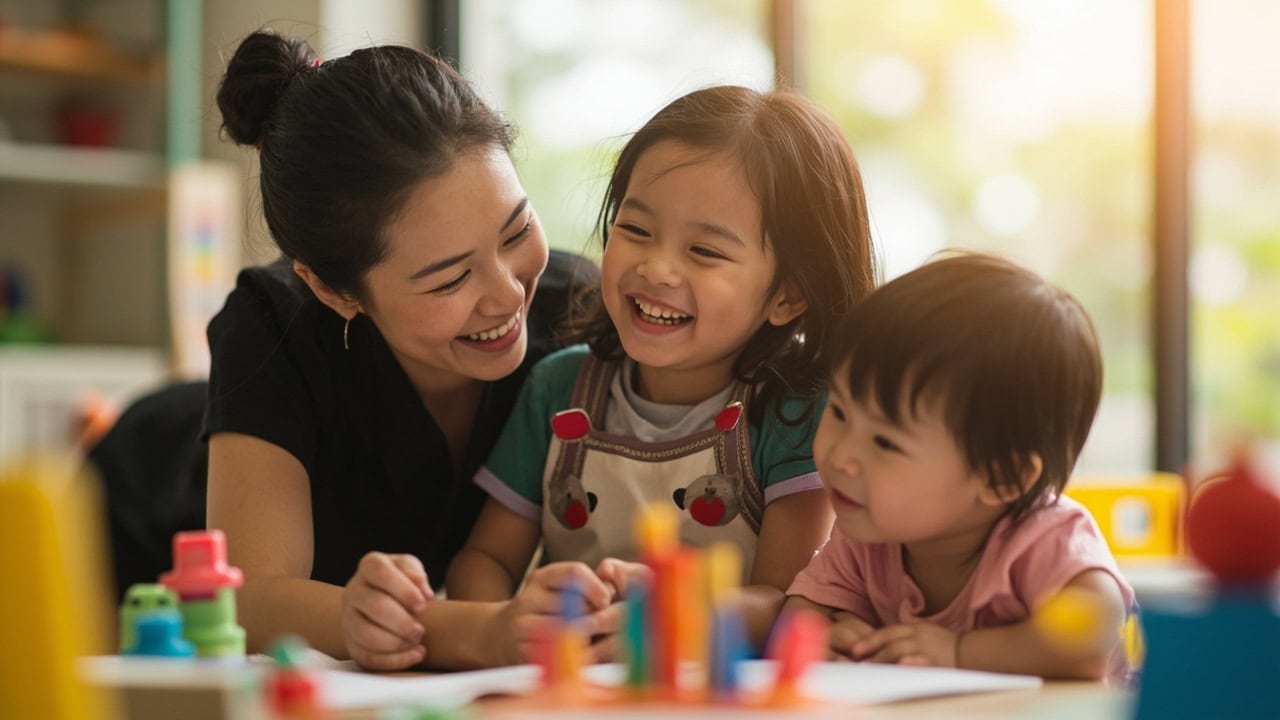
What Language Growth Really Looks Like in Quality Singapore Childcare
What Language Development Really Looks Like in the Early Years
There is a tendency, even among well-informed parents, to reduce language to vocabulary. To count the number of words a child knows. And yes, vocabulary matters—enormously—but language and communication in the first five years of life is so much richer and more complex than a word count.
It is the structure of a sentence. It is the ability to say not just what you want, but what you feel, and to say it in a way that another person can understand and respond to.
It is listening—truly listening, not just hearing. It is the ability to take turns in a conversation, to understand that someone else has something to say.
It is narrative: the capacity to string events together into a story that makes sense, that has sequence, that has meaning.
It is social communication. The way a child learns to greet, to request, to refuse, to negotiate, to comfort another child, to ask for help. These are not small things. These are the foundations of every relationship your child will ever have.
When we talk about language development in childcare, we are not just talking about whether your child can name colours and animals. We are talking about whether they are building the capacity to think, to express, to connect, to understand others, to be understood, and to carry their voice into every room they will ever enter for the rest of their lives.
That is what is at stake. And that is why it matters so much.
The Invisible Curriculum: How Caregivers Build Language Throughout the Day
Parents are told that quality childcare builds language, and they want to believe it, but they cannot see it happening. They pick up their child and they do not witness the language growth happening in front of them, because the most important language development happens not in a formal lesson, not during circle time alone, but throughout the entire day, in moments that look, to an untrained eye, almost ordinary.
In Responsive Interactions
It happens when a caregiver kneels down to a child’s level and narrates what the child is doing. Not commanding, not correcting, just reflecting:
“You are stacking those blocks. You put the red one on top. That is a tall tower. Watch what happens when you add the blue one.”
This is not idle chatter. This is what developmental psychologists call responsive caregiving, and it is one of the single most powerful drivers of language acquisition in young children. When a child’s actions are named, described, and acknowledged by a responsive adult, something extraordinary happens in their brain. They begin to connect the word to the object, the action to the result, the feeling to the expression. They begin to understand that language is not separate from experience—it is how we make sense of experience.
In Everyday Moments
It happens during meals, when a caregiver sits with children and talks about what they are eating, where the food comes from, what it feels like, what it tastes like. It happens during outdoor play, when a caregiver notices a butterfly, points to it, names it, asks a child what they think it is doing.
It happens in transitions—moving from one activity to the next—which many parents do not think about at all, but which are, in fact, language-rich moments. A caregiver might sing, might use rhyme, might ask a child to help carry a message to another room. These are not filler activities. They are the invisible curriculum of language, woven into the fabric of a quality childcare day.
When Words Fail
Perhaps most powerfully, it happens when a child is frustrated, when words fail them, when they resort to pulling, or crying, or grabbing—and a trained caregiver steps in not to scold but to articulate what the child is feeling:
“You wanted the blue cup. The blue cup is in the wash. You feel sad because you wanted it now.”
That caregiver is doing something that takes real skill. They are not just managing behaviour. They are teaching a child that feelings have names, that frustration can be put into words, that another person can understand and help. That child is learning emotional articulation, and it will serve them for the rest of their life.
This is the difference between a childcare setting that is supervising and one that is building. Anyone can watch children. It takes training, intention, and genuine care to build language in every moment of the day, even the messy ones, even the transitions, even the moments when a child has no words at all.
Singapore’s Multilingual Reality: What Quality Care Looks Like Here
Singapore families navigate something that many other cities do not: raising children in a multilingual environment. Many children grow up hearing English at home and Mandarin, Malay, or Tamil from grandparents, or in the community. Some households switch between languages fluidly—sometimes within the same sentence.
This is not a problem to be solved. It is a richness to be honoured.
Quality childcare in Singapore does not force a child to choose between languages. It does not say, “We only speak English here,” and expect the child to abandon everything they bring from home. What it does, at its best, is create an environment where the child’s linguistic identity is respected.
This means:
- Mother Tongue is valued alongside English, not treated as secondary or something to be set aside
- Caregivers learn key words and phrases in a child’s home language to show they see and honour where that child comes from
- Bilingual or multilingual development is supported, not treated as confusing or problematic
Research has shown—and any experienced caregiver who has worked with Singapore’s diverse families will tell you—that the child who is supported in both languages at home and in quality childcare does not suffer from exposure. They flourish from it. They develop what we call code-switching competence: the ability to move between languages with ease and confidence.
A child who feels that their language is valued feels that their family is valued. And that sense of belonging is the emotional foundation on which all communication growth rests.
How to Evaluate a Language-Rich Childcare Environment
So how do you, as a parent, know the difference? How do you evaluate a childcare environment not by what it looks like on a tour, not by the shiny toys or the colourful walls, but by what it is actually doing for your child’s voice?
What to Listen For
When you visit, pay attention to what you hear. Not just whether the children are quiet or noisy, but what kinds of sounds fill the room.
- Is there conversation?
- Is a caregiver talking to a child about what the child is doing, or only giving instructions?
- Are children talking to each other, and are caregivers facilitating that talking?
- Is there music? Rhyme? Are stories being told?
A language-rich environment has a particular sound to it—a warmth and a rhythm. If you listen for it, you will hear the difference.
What to Watch
Watch the caregiver’s posture. A caregiver who is building language will get down on a child’s level. They will look a child in the eye. They will wait.
One of the most underrated language-building techniques is something called the communication pause: the deliberate act of giving a child time to respond before filling the silence. Caregivers who rush to speak for a child, who finish their sentences, who anticipate every need before it is expressed, are inadvertently stealing language development opportunities from that child. The pause is not awkward. The pause is where language grows.
What to Ask
Ask specific questions. Not vague ones like “Does my child get enough interaction?” but:
- How do you support children who are not yet talking?
- How do you handle bilingual development?
- Can you tell me about a typical day and where language-building happens?
- How do you support a child’s Mother Tongue development alongside English?
A quality childcare provider will welcome these questions because they are the right questions. Anyone who becomes defensive or gives you a scripted answer is telling you something important.
What to Notice
Notice whether the environment is curious about your child. Does the caregiver ask about your child’s interests, their routines at home, the words they are using? Or is it one-size-fits-all?
A language-rich environment is personalised. It builds on what the child already knows and loves. It uses your child’s name. It references your child’s family. It makes your child feel seen and heard, and that is where language thrives.
What to Trust
Finally, trust what your child tells you—even before they have words. Notice their affect when you pick them up. Are they calm? Engaged? Do they show you something they made, do they try to tell you something, even in fragments?
Or are they shut down, disconnected, uninterested in communicating at all? A child’s desire to communicate with you is one of the most reliable indicators of whether their childcare environment is building them up or merely keeping them occupied.
And if your child is developing at their own pace, or if you have concerns about their progress, a quality caregiver will track this and communicate with you honestly about where your child is and how they are supporting their growth. That openness is not optional. It is essential.
What EduNanny Singapore Offers
EduNanny Singapore was built with Singapore’s realities in mind—the realities of working parents, of multilingual households, of the particular pressures and aspirations that shape how we raise our children in this city.
EduNanny by BUTLER is part of Singapore’s ECDA Childminding Pilot, committed to the highest standards of regulatory oversight and professional care. We operate with up to one-to-three infant ratios—and that ratio matters. It means that a caregiver is not stretched across seven or eight children, unable to give any one of them the responsive, language-rich interaction they need.
When your infant coos, someone is there to coo back. When your toddler struggles to find the word, someone is there to wait, to help, to name what they see. Ratio is not just a safety number. It is a language-building number.
We offer home-based care, where our trained childminders come to you, and community or centre-based pathways, so that whichever arrangement suits your family best, you have access to quality. Monday to Friday care blocks are designed to support the rhythms of a working parent’s day.
Where we have deployed CCTV measures, we do so not out of distrust, but out of a commitment to transparency—because we believe that the best childcare has nothing to hide and everything to show.
The practical matter of affordability matters, and we know it. EduNanny’s pilot fee structures are designed to be accessible, and we support the use of the Child Development Account and Baby Bonus schemes, because we do not want cost to be the barrier that prevents a child from receiving the quality of care that will shape their voice for life.
We are also proud to offer the Thomas AI Chatbot, a tool that makes the experience of parenting and childminding easier for families. Thomas helps with communication between families and caregivers, answers questions, and supports parents through the day-to-day complexity of modern parenting. When parents feel supported, they can be more present. When caregivers feel supported, they can be more responsive. And when a child is wrapped in that circle of supported, responsive care, language and communication grow in ways that will continue to surprise and delight you for years to come.
The Bigger Picture: Why This Choice Matters
There is a child, somewhere in Singapore right now, who is in a childcare setting, and a caregiver is kneeling down beside them, and they are looking at a picture book together. The caregiver is pointing to a picture of a dog, and the child says—not “dog,” but “arf arf,” the way young children do—and the caregiver laughs and says, “Yes, arf arf. That is a dog.”
And then the caregiver says, “What does the dog say?”
And the child thinks, and says, “Happy.”
And the caregiver pauses, and smiles, and says, “Yes. The dog looks happy.”
Something has just happened in that child’s mind that is extraordinary. A word has been connected to a feeling. The abstract concept of happiness has been linked to a picture of a dog. The child has taken language, and used it in a way that is entirely their own—entirely creative, entirely new—and an adult has validated it and expanded it.
And in that small, ordinary, unremarkable moment, that child has taken one more step toward becoming the kind of person who can say what they mean, who can be understood, who can express the full depth of who they are.
That is what quality childcare builds. Not in a year, not in a term, not in a report card—but in ten thousand small moments like that one, accumulated over the days and months and years when a child’s brain is more receptive, more plastic, more hungry for language than it will ever be again.
The first thousand days, and the years that follow—these are not just a phase. They are the foundation on which everything else is built.
When you choose childcare, you are not just choosing a place to leave your child while you work. You are choosing the environment in which your child’s voice will be shaped. You are choosing the words they will hear, the responses they will receive, the conversations that will form the architecture of their thinking and their relationships. You are choosing whether they will learn to speak up or speak down, whether they will trust that their words have power, whether they will believe that they have something worth saying.
EduNanny Singapore was built on the belief that this choice matters more than almost any other choice you will make in the early years of your child’s life. We believe in trained caregivers who are not just present but intentional. We believe in environments that are not just safe but rich. We believe in communication with families that is not just transactional but transparent and trusting.
And we believe in every child in our care—in every language they bring from home, in every attempt they make to say something new—they deserve someone who is listening.
Because when we listen to children, truly listen, we do not just hear what they are saying. We hear who they are becoming.
And that is the most important language of all.
Ready to explore how EduNanny Singapore can support your child’s language and communication growth? Reach out to speak with our team or learn more about our approach to quality childminding.
#ChildcareSingapore #LanguageDevelopment #InfantCare #BilingualChildRearing #QualityChildminding