What Genuine Attunement Looks Like in Singapore Childcare
The Quiet Question Every Parent Carries
There is a moment, familiar to every parent who has placed their child in someone else’s arms, when the world narrows to a single, quiet question. It is not the question you ask aloud. It is the one you carry in your chest as you walk away.
It sounds something like this: Will my child be alright?
You have prepared for this morning. You have chosen the centre or arranged the home visit. You have read the reviews, asked the questions, observed the environment. And yet, there is still that small, persistent space between what you know and what you can truly know.
You trust your choice. But in the quiet hours of your workday, you wonder whether your child is truly seen, truly safe, truly flourishing in your absence.
This is not a failure of confidence. This is the most natural, most honest feeling of parenthood. And it is the feeling that shapes everything we believe about what childcare should be.
Before we explore the deeper picture, here is what Singapore parents searching for infant care need to understand:
- Quality childcare is not a checklist — it is a relationship built through thousands of small, daily moments
- Attunement is what matters most — the caregiver’s ability to notice, respond, and adjust to your child’s needs in real time
- What you cannot see matters most — the most meaningful moments of care happen when you are not there
- Your child’s behavior tells the story — ease, confidence, and willingness to return are signs of genuine attunement
- The right caregiver ratio matters — smaller ratios allow for the attention that attunement requires
Beyond the Tour: Understanding Genuine Attunement
We want to invite you into a different way of understanding quality care. Not as a checklist you can inspect. Not as a programme you can evaluate on a tour. But as something that happens in the space between two people — a caregiver and a child — building a relationship one quiet moment at a time.
Because that is where genuine childcare lives. And that is what thoughtful, relationship-first childcare is built around.
The Moment of First Trust
When you hand your child to a caregiver for the first time, your child is not assessing qualifications or reviewing policies. They are reading something far more fundamental.
They are reading whether this person is truly present. Whether their needs will be met not just physically, but emotionally. Whether the world is a reliable place, and whether they can let go of the vigilance that comes so naturally to infants and allow themselves to simply be held, played with, and loved.
This is what we call attunement.
What Attunement Actually Means
Attunement is not a technique. It is not something that can be scheduled or scripted. Attunement is the caregiver’s ability to notice, to respond, to adjust.
It is the micro-moment when a child’s restlessness is met not with redirection but with genuine attention. It is the pause before feeding when the caregiver reads the child’s hunger not from a clock but from a look. It is the way a child’s distress is met with calm steadiness, not urgency.
These moments are small. They last seconds. But they are the building blocks of everything that comes after.
What You Will Not See on a Tour
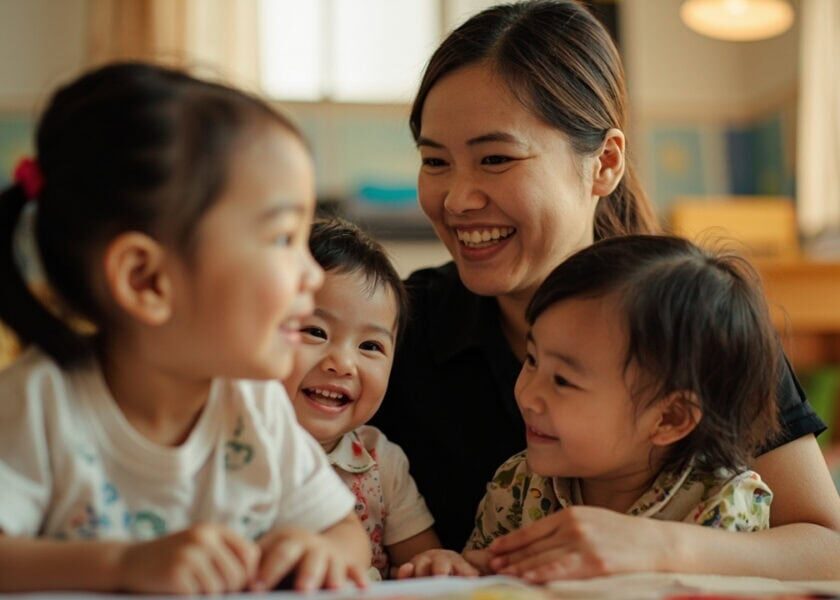
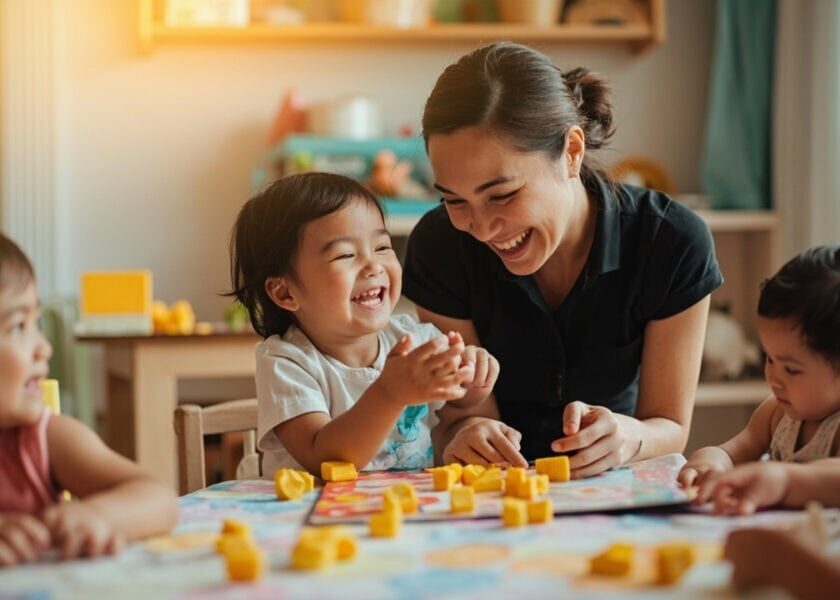
Here is what most parents never see during a centre tour or a home visit: the way a child gradually softens in a caregiver’s presence over weeks and months. The way a child who was once watchful begins to explore. The way laughter shifts from polite to genuine. The way a child runs to their caregiver in the morning with the same ease they once reserved only for their parents.
These are not accidents. They are evidence of a relationship forming. And they are the most meaningful measure of quality that exists.
When attunement happens naturally, it does so in the background of ordinary life — in the way a caregiver notices a child’s fatigue before a meltdown begins, in the way they adjust the pace of the morning when they sense a child’s need for stillness, in the way they sit close enough to offer comfort without crowding a child’s independence.
These are not observable on a checklist. They are felt by the child. And they are what make the difference between care that supervises and care that is truly present.
How Your Child Tells You What You Cannot See
So how do you, as a parent, learn to recognize this quality when you cannot witness it directly?
You learn to listen to what your child is telling you. Not just with words, because infants and young toddlers do not yet have words for what they experience. You learn to read their behavior, their ease, their willingness to go, their willingness to return.
Signs of Genuinely Attuned Care
When a child comes home from care that has been genuinely attuned, something is different. They are not simply calm. They are not simply fed and rested.
There is a quality of quiet confidence.
They have been in an environment where their needs were anticipated, where their emotions were met with understanding rather than impatience, where they were allowed to be fully themselves without performing for approval.
This confidence does not announce itself loudly. It shows up as:
- Ease — transitioning between home and care without distress
- Flexibility — adapting to new situations with resilience
- Genuine connection — running toward their caregiver with real warmth
- Curiosity — coming home ready to share discoveries
What This Means for Partnership
This is why we speak of childcare not as a service you purchase but as a partnership you enter. You are not outsourcing your role as a parent. You are extending it.
The caregiver becomes someone who works alongside you, who learns your child’s rhythms and preferences, who communicates with you honestly about what they observe, who adjusts their approach as your child grows and changes.
This is not a transaction. It is a living relationship that requires attention, communication, and mutual respect. And it is the kind of care that produces children who are not just safe and supervised, but genuinely known.
What Relationship-First Childcare Builds
The deeper outcome of relationship-first childcare is not the acquisition of skills, though skills come. It is not the completion of developmental milestones on schedule, though development follows naturally.
What relationship-first care builds is something more foundational: the child’s belief that they are worthy of attention, that their needs matter, that other people can be trusted to respond when they reach out.
The Invisible Foundation
This belief becomes the invisible foundation for every relationship, every challenge, every new environment the child will encounter for the rest of their lives.
When a child is in the care of someone who is truly attuned, they are learning something profound about the world. They are learning that people can be trusted, that attention is freely given, that their presence matters to someone beyond their parents.
This is not a small thing. This is the beginning of the child’s capacity for relationship, for empathy, for resilience, for the quiet confidence that will carry them through school, through friendships, through all the inevitable challenges of growing up.
The caregiver who gives your child this foundation is not just filling a role. They are participating in the most important work there is: shaping a human being’s first understanding of what it means to be loved and cared for in this world.
This is why we speak of the dignity of the childminder. This is why we invest in training, in support, in creating conditions where caregivers can do their best work. Because the relationship your child has with their caregiver matters. It is not a footnote to the real work of childcare. It is the work itself.
What This Looks Like for Singapore Families
Singapore parents carry particular pressures. The cost of living, the demands of dual-income households, the desire to give children every advantage, the guilt that comes when work pulls you away from the moments you wish you could hold onto.
These are real pressures. We do not dismiss them with easy reassurance.
What we offer instead is a different kind of peace: the peace that comes from knowing your child is in the care of someone who sees them as an individual, who responds to their unique temperament, who celebrates their small victories and holds them through their difficult moments.
Understanding Your Options
You have options in Singapore. Home-based care, centre-based care, different pathways with different structures, different ratios, different ways of staying connected to your child’s day.
What matters is not which structure you choose, but what happens within it. The quality of the relationship your child forms with their caregiver will always matter more than the shape of the building.
Our Approach at EduNanny Singapore
We have built our approach around the understanding that relationship is at the heart of quality care. We are part of the ECDA Childminder Pilot, which means we operate within a framework that recognizes home-based care as a legitimate, supported pathway for families who want something more personal than centre-based care can sometimes offer.
Our approach is designed around these principles:
- Small ratios for genuine attention — No more than three infants for every caregiver, so each relationship has the space and time it needs to deepen naturally
- Reliable care blocks — Monday to Friday care that gives families the stability they need for work and daily life
- Transparent partnership — Regular communication about your child’s day, because information closes the gap between what you know and what you can know
- Accessible quality — Pilot fee structures designed to be affordable, with support for using CDA funds and Baby Bonus where families qualify
Transparency as a Form of Trust
We believe transparency is a form of trust. When families choose this kind of care, they choose a partnership.
Where monitoring measures are deployed, they are deployed not for surveillance but for reassurance — for the confidence that comes from knowing there is nothing to hide. We believe parents deserve to feel secure in their choice, not because they have been sold a programme, but because they have been invited into a relationship.
Questions to Ask When Evaluating Childcare
You are right to look deeper than the surface. You are right to care about ratios and qualifications and communication practices.
But more than anything, you are right to ask:
- Will my child be known here?
- Will they be seen as themselves, not just as one of many?
- Will the person caring for them understand that they have a unique temperament, a unique set of needs, a unique way of experiencing the world?
If you are looking for childcare that answers yes to those questions, you are not asking for something unreasonable or luxurious. You are asking for exactly what your child deserves.
What to Look For in Practice
When visiting or evaluating any childcare arrangement, consider:
- How does the caregiver respond to a child’s cues? — Do they notice restlessness, fatigue, or discomfort before it becomes distress?
- What is the caregiver-to-child ratio? — Is there space for individual attention, especially for infants?
- How does the environment feel? — Not just whether it is clean and safe, but whether it feels warm and responsive
- How do the children move through the space? — Are they at ease? Do they show genuine rather than polite reactions?
- What does communication look like? — Will you receive regular, honest updates about your child’s day and development?
Walking This Path Together
At EduNanny Singapore, we are here to walk this path with you. Not as a service provider who manages your logistics, but as a partner who shares your investment in your child’s wellbeing.
We believe that every child deserves to be known. We believe that every parent deserves to trust the person caring for their child. And we believe that the daily, invisible moments of attunement are where this trust is built — not eventually, but right now.
One morning handover at a time. One gentle response at a time. One child who comes home a little more confident, a little more secure, a little more ready to explore the world because they know, in their bones, that the people who care for them will be there when they return.
If you are considering your childcare options in Singapore and want to explore what relationship-first care looks like in practice, we invite you to start a conversation with us. Every family’s journey is different, and we are here to answer your questions, address your concerns, and help you understand whether this approach is the right fit for your child and your family.
You have already shown that you care deeply about finding the right care. That care is exactly what we are here to provide.