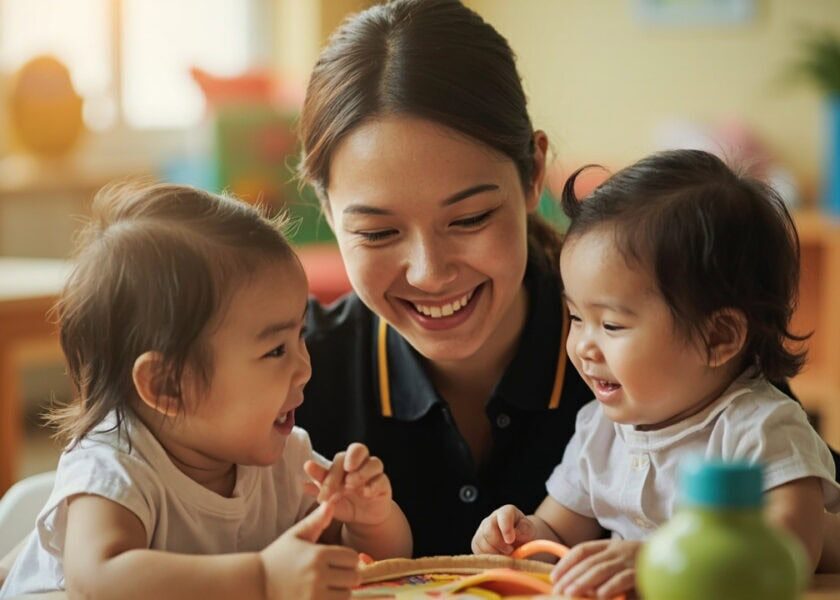
Trustworthy Childcare Guidance for Singapore Parents Tired of Guilt
The Question Singapore Parents Are Afraid to Ask Out Loud
There is a moment — you may remember it, or you may be living in it right now — when a parent sits down at their laptop or picks up their phone, and types something into a search bar with a kind of quiet desperation that no one will ever see.
What kind of childcare is best for my baby.
They do not post about it. They do not tell their friends. They sit alone with that question, and somewhere beneath the practical concern about ratios and curriculum and hours, there is another question they are really asking — a question they may not even fully admit to themselves:
Am I failing my child by needing to do this?
They type the question into the search bar because they need answers. But what they are really looking for is permission. Permission to choose what they already know, in some quiet corner of their heart, is right for their family.
Permission that has nothing to do with the quality of the childcare and everything to do with the quality of the permission-giver — which is themselves.
This article is for that parent. The one sitting in that moment. The one who deserves to be seen clearly, spoken to honestly, and given something far more valuable than information.
They deserve to be given their own power back.
Understanding the Guilt Singapore Parents Carry
It arrives quietly. It does not announce itself with a siren or a warning label. It comes in the small hours, when a parent is feeding their child or lying awake wondering if they are enough. It comes when the alarm goes off at six and the toddler is crying and the commute to the office is already looming — and the question surfaces, not as a question, but as a verdict:
You should be here. You should not need help. You should be able to do this alone.
And the silence that follows that verdict is where so many Singapore parents live. In the space between knowing that quality childcare benefits their child — the research is clear, the studies are everywhere — and feeling like they are somehow betraying something sacred by choosing it.
It Is Not Guilt. It Is Shame.
Guilt says: I have done something wrong. Shame says: I am something wrong.
The shame that many Singapore parents carry about needing childcare is not guilt about a specific action. It is a deeper, quieter story they have absorbed — from culture, from family, from the lingering idea that good mothers are present mothers, that good fathers are available fathers, that love is measured in hours.
That story is old. It does not fit the world we actually live in.
The parents who are brave enough to examine it — who sit with that discomfort and ask, not “what is wrong with me” but “what is actually true here” — those parents are the ones who change the narrative for everyone who comes after them.
The Belief That You Should Do This Alone Is Not Evidence-Based
Human beings are not designed to raise children in isolation. Across cultures and throughout history, children have been raised by networks of caregivers. The nuclear family raising children alone is the anomaly, not the norm.
This guilt is not rational. It is not logical. It is not evidence-based. It is a story you have been told, and that you have been telling yourself, about what it means to be a good parent.
And it is a story that does not survive contact with the real world.
What the Research Actually Shows
Decades of research on child development consistently points to a truth that is simultaneously obvious and profoundly underappreciated: children do not develop in isolation. They develop within relationships. Within systems. Within families.
When researchers look at what predicts a child’s emotional security, cognitive development, and long-term well-being, they consistently find that a primary caregiver who is regulated, present, and emotionally available matters enormously.
And when they look at what predicts a caregiver being regulated, present, and emotionally available — they find something that our childcare conversations almost never address:
The adult’s own well-being is not separate from the child’s development. It is input into it.
The Reframe That Changes Everything
A parent who is exhausted, depleted, running on empty, and barely holding themselves together is not bringing their best self to the relationship. They are there, physically. They may even be there more hours than parents in any previous generation. But presence is not measured in hours. It is measured in quality of attention. In the ability to be fully, emotionally available when it matters.
Here is the reframe worth sitting with — not as a platitude but as an evidence-based truth:
When a parent chooses to seek support, when they make the difficult, often guilt-laden decision to bring quality care into their child’s life, they are not stepping back from parenting. They are investing in their capacity to be present.
The parent who chooses intentionally is more present, not less present. And that is not a consolation prize. That is the point.
Multiple Attachments Are Healthy, Not Harmful
Research on attachment tells us that children form multiple significant attachments. What matters is not the number of caregivers, but the quality of those relationships.
A child who has a secure attachment to a primary caregiver — and who also experiences consistent, warm, responsive care from others — does not suffer from that additional care. They benefit from it.
No one will love your child the way you do. That is not the standard. The standard is whether your child is safe, nurtured, and responded to with warmth and consistency. Professional caregivers who are well-trained and genuinely engaged with children provide care that is different from parental love — but it is not lesser. It is complementary.
The Realities Singapore Parents Actually Face
Singapore is one of the most expensive cities in the world to raise a child. The cost of living is high. The expectations are high. The pace is relentless.
For dual-income families — which is the majority of families in this country — two salaries are not a luxury. They are the arithmetic of survival. Mortgage payments. Medical costs. Education savings. The quiet, relentless math of making it work.
And beneath that economic reality is a social one. Singapore has one of the world’s lowest birth rates, not because people do not want children, but because the equation of raising them feels impossible.
There is no extended family infrastructure that many other cultures take for granted. Grandparents are often still working. Siblings are across continents. The village that raised children in previous generations does not exist here — or exists only in fragile, exhausted fragments.
What This Does to Parents
They improvise. They stretch. They take on more than is sustainable. They tell themselves it is temporary. They begin each morning already depleted and end each evening already behind.
And then, when they finally acknowledge they need help, the guilt arrives like an old friend who was waiting at the door.
The real world is one where you need income to raise a child with dignity. The real world is one where human beings are not designed to raise children in isolation. The real world is one where some of the most devoted, attentive, emotionally intelligent parents are parents who chose to bring in support — because they understood that love is not about performing self-sacrifice until you break. It is about showing up, consistently, with your whole self.
That is only possible if your whole self is intact.
What Quality Childcare Actually Looks Like
Quality is a word that gets used so often it can lose its meaning. So let us be specific.
Trust Begins With Transparency
When you entrust your child to someone else’s care, you are making yourself vulnerable in a way that is difficult to articulate. You are handing over the thing you love most in the world, and you are asking — hoping — that it will be safe, nurtured, and loved.
That vulnerability is not weakness. It is the price of love.
Quality care acknowledges this. Look for:
- Transparent communication — where CCTV measures are deployed, families know. Where updates are shared, they are consistent. Parents deserve to feel connected to their child’s day, not because they should doubt the care, but because connection is part of what makes this work.
- Intentional ratios — for infants, a ratio of one caregiver to three children means your child is not one of ten or fifteen. Your child is seen. Known. Responded to. The early months and years are not the time for compromise on attention.
- Developmentally appropriate engagement — care that supports emotional regulation, secure attachment, and age-appropriate stimulation, not just supervision.
- Partnership with families — you are still the parent. You are always the parent. The caregiver’s role is to support that relationship, not to replace it.
Home-Based vs Centre-Based: Finding the Right Fit
There is no single answer that works for every family. Some children thrive in the familiarity of their own home environment, with a caregiver who becomes part of the household rhythm. Others benefit from the structure and socialization of a centre setting.
The right answer depends on your child, your family, your circumstances. What matters is that whichever pathway you choose, it is chosen with intention — and with the same standard of care and commitment.
A Practical Checklist for Choosing Infant Care in Singapore
- Observe the environment — Is it clean, safe, warm, and age-appropriate? Does it feel like a place where your child would thrive?
- Ask about caregiver ratios — For infants, lower ratios mean more individual attention. Know what you are signing up for.
- Inquire about communication — How will you receive updates about your child’s day? How are concerns addressed?
- Understand the approach — What is the philosophy around feeding, sleep, comfort, and development? Does it align with your values?
- Check for transparency — Are you comfortable with the communication protocols, observation practices, and reporting structures?
- Evaluate the support for you — Does the arrangement see you as a parent, or just as a logistics problem to solve?
EduNanny: Built Around the Whole Family
When we think about the families we serve, we think about the whole picture. Not just the child — though the child is always at the centre. But the parent too. The tired, loving, trying parent who is doing the best they can with an impossible set of demands.
This is why EduNanny exists. Not as a replacement for family, but as an extension of it. As a recognition that raising a child well requires more than love. It requires support. Structure. Trust. And a willingness to accept that asking for help is not a failure of devotion but an act of it.
Our Commitment
We are part of the ECDA Childminding Pilot, and we take that responsibility seriously. For us, this is not a regulatory designation. It is a commitment — to operating within a framework that prioritizes safety, quality, and the genuine development of the children in our care.
We offer both home-based and centre-based pathways, because families are not all the same. We keep our ratios intentional, because we believe the early months and years of a child’s life are not the time for compromise on attention.
Seeing the Parent, Not Just the Child
Most childcare conversations treat parents as a logistics problem. The parent needs to go back to work. The parent needs childcare. Here are the options. Here are the criteria.
That is not wrong. It is necessary information. But it is incomplete.
Because the parent sitting in that conversation is not just a logistics problem. They are a human being navigating one of the most profound, difficult, beautiful transitions of their life. They are grieving the baby who is growing up. They are anxious about returning to a workplace that may not understand what they have become. They are wondering if they will ever feel like themselves again, or if the person they were before children has been permanently overwritten.
They need more than logistics. They need to be seen.
That is what we try to offer at EduNanny. Not just a service — though the service matters — but a recognition that you are doing something hard, something important, something that deserves respect and support.
Choosing Without Apology
Here is a question worth sitting with:
What would change if you stopped apologizing?
Not for needing childcare — you will still need it, and that is fine. But for the guilt itself. For the feeling that you are less than, that you are failing, that you are somehow diminished as a parent because you cannot do everything alone.
What would happen if you sat with that feeling, let it be uncomfortable, and then asked it a different question?
Not “why do I feel guilty?” but “what am I actually afraid of?”
And then: “Is that fear true?”
Most of the time, the answer is no. The fear is a story. A remnant of an older narrative about what parents are supposed to be, what mothers are supposed to sacrifice, what fathers are supposed to provide. That story was never written with your life in mind. It was written for a world that no longer exists.
To the Parent Reading This
If you are in that moment I described at the beginning — typing a question into a search bar with quiet desperation, feeling the weight of needing help, wondering if that need makes you less — I want you to hear this:
You are not less. You are not failing. You are not inadequate.
You are a parent who is paying attention. Who is taking the question seriously. Who is not pretending that everything is fine when it is hard, or that you do not need support when you do.
That paying attention — that honesty — is not weakness. It is the foundation of good parenting. It is what will make you attuned to your child’s needs, present to their development, available to their joy and their struggle.
It is the same quality that led you to search for quality care in the first place.
The parents who choose intentionally — who research, who evaluate, who ask questions, who admit when they need help, who stop apologizing and start acting from a place of love and wisdom — those parents are not the parents who are doing less for their children.
They are the parents who are doing more.
Not more hours. Not more sacrifice. But more of the things that actually matter: attention, presence, emotional availability, a model of a human being who is whole and capable and knows how to ask for support.
That is what you are doing. That is who you are.
Choose for Both
The parents who understand this — who make the choice to seek support, to invest in quality care, to stop apologizing and start acting from a place of intentional love — those parents are not choosing between their child and their ambitions.
They are choosing for both.
They are choosing for their child’s development, because a well-rested, emotionally available parent is one of the greatest developmental gifts a child can receive.
And they are choosing for their own lives, because parents who are whole, who have space for their own ambitions, who do not disappear entirely into the role of caregiver — those parents model something invaluable for their children.
They model a human being who is complete, who has depth, who lives fully.
EduNanny exists because we believe that choice deserves support. Not because parents should be able to do it alone — no one should do it alone, and no one is meant to — but because the children of parents who are seen, supported, and understood will themselves grow up seeing, supporting, and understanding.
The arc of good care is not just developmental. It is generational.
So choose well. Choose intentionally. Choose without apology.
Know that when you do, you are not choosing between your child and your ambitions.
You are choosing for both.
And that is, in every sense that matters, what raising a child well looks like.
If you are ready to explore what intentional, quality childcare looks like for your family in Singapore, we invite you to start a conversation with us. We are here to see you — the whole you — and to support you in the choices only you can make.
Learn more about who we are or visit EduNanny to discover how we support families across Singapore.