Trust This Feeling When Choosing Childcare for Your Child
The Moment Before Everything Else: What Parents Actually Feel in a Childcare
There is a moment that happens, if you let it, before you have signed anything. Before the forms. Before the nursery tour. Before you have written down a single name or checked a single box.
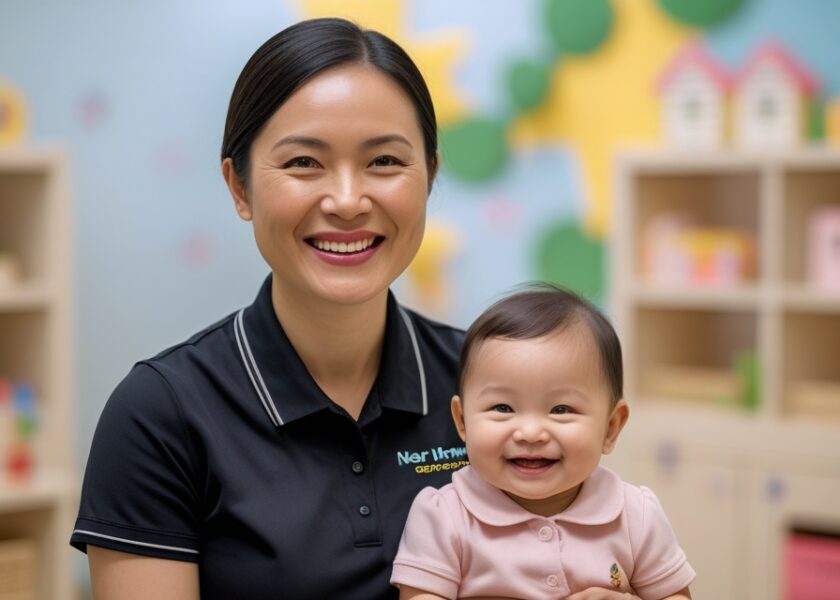
It happens the instant you stand in a room and a caregiver looks at your child — not at you, not at the door, not at the clipboard in her hands — but at your child. And something in you, something you could not have prepared for and would not have put on any list, either relaxes or tightens.
Most parents in Singapore have felt this. Very few have been told it is worth trusting.
Finding quality infant care in Singapore means more than comparing credentials and checking facilities. Research in attachment theory and early childhood development confirms what parents already sense: the relationship between caregiver and child matters at a foundational level. The key distinction is not whether a caregiver is qualified, but whether they will truly know your child. This article explores what to look for, how to trust your instincts, and why a home-based childminding approach like EduNanny Singapore is designed around this reality from the start.
Why Finding the Right Childcare Feels So Hard in Singapore
We live in a city that offers more information than almost any parent anywhere could use. Apps that compare. Directories that rank. Forums that debate the precise developmental merit of every sensory activity, every curriculum framework, every accreditation badge.
And yet, when you speak to mothers and fathers in Tampines and Toa Payoh, in Clementi and Compassvale, they do not describe feeling reassured by all this information. They describe feeling like something is missing from the conversation. Something they keep trying to name.
What they are trying to name is not a checklist item. It is a felt sense of whether this person, standing in this room, will know your child the way you do. Not perfectly. Not as a replacement. But close enough. Willingly. With care.
Whether your child will be met with recognition rather than routine. Whether the person who will spend eight hours a day with your infant will read the subtle shift in mood that means hunger is coming before the cry arrives. Whether they understand that the silent grip on a toy means something different than the one who wields it with a shriek.
Here is what is quietly difficult about finding childcare in Singapore: you are asked to make one of the most intimate decisions of your life using tools that were designed for a different kind of decision altogether.
The questions on enrollment forms are reasonable. They ask about feeding schedules and sleep routines, about allergies and developmental milestones. But they do not ask the question that lives underneath all of them: Will this person love my child?
Not in the way that sounds too much. In the way that means: will they notice? Will they pay the kind of attention that children deserve? Will they remember, six weeks from now, that your daughter does not like being approached from behind? That your son is most herself in the ten minutes before nap when she is quiet and watchful, when the world is too much and then suddenly, precisely, not?
These are not soft questions. They are, in fact, some of the most researched areas in early childhood development.
What the Research Actually Says About Early Attachment
Attachment theory, developmental psychology, the neuroscience of early relational experience — these fields have spent decades demonstrating what parents have always known in their bodies.
Children do not develop in isolation. They develop in relationship. The quality of those early relationships — the consistency, the attunement, the felt sense of being truly seen — shapes not just emotional wellbeing but cognitive architecture itself.
The first thousand days are not a slogan. They are a window in which the brain is building itself at a speed it will never again reach. And it builds itself in response to the quality of human connection it receives.
But here is what gets lost in the translation from research to reality: all of this lands on a parent who is also exhausted. Who is navigating work demands and financial pressures. Who is managing the particular Singapore reality of two-income households, of in-laws who help and cannot always help, of housing that was never designed with childcare in mind.
In the middle of all that, this parent is supposed to find someone to trust with the most precious thing in the world — and they are given a rubric to do it.
The rubric is not wrong. Credentials matter. Training matters. Safety protocols matter. But a caregiver who holds a perfect certificate and has never learned to read a child’s face — who can tell you the milestone but cannot tell you what this child needs right now — is not what most Singapore parents are actually looking for, even when they do not have the language to say so.
Watching Versus Reading: The Difference That Changes Everything
There is a difference, and you have felt it, between a caregiver who watches your child and a caregiver who reads your child.
Watching means tracking behavior. A watcher knows that your baby cried this morning.
Reading means understanding it. A reader knows that the cry was different from yesterday’s — a little more urgent, a little less about tiredness and more about something the baby could not yet name — and responds to that difference.
A watcher sees a toddler’s tantrum. A reader sees a child whose internal world is outpacing their ability to express it, and responds not to the tantrum but to the overwhelm behind it.
This distinction matters because the children know the difference. Long before they have language to tell you, they know.
There are cues that appear so quietly that most adults miss them entirely:
- The way a baby’s body softens when held by one person and stiffens when held by another
- The difference between a child who performs for a visitor — the bright, staged engagement — and the child who is simply present, unguarded, absorbed in play
- The child who runs to the door when a specific caregiver arrives and the child who hesitates
These are not dramatic signals. They are the subtle grammar of relational safety, and children speak it fluently long before we do.
Trusting What You Feel: Reading Each Other in the First Five Minutes
Somewhere between the nursery tour and the enrollment form, between the conversation about feeding schedules and the paperwork about CCTV access, something much deeper is happening. It is the same thing that happens in the first five minutes of any meaningful relationship.
You are reading each other.
The caregiver is reading you — your anxiety, your hopes, your unspoken need to be met with gentleness — and you are reading them. You are watching how they hold their posture when a child approaches. You are noticing whether their smile reaches their eyes. You are listening not to what they say about their qualifications but to how they talk about the children they have already cared for.
Whether they say “the children” or “my children.”
Whether the description of a difficult day sounds like a complaint or a confession.
Whether, when a toddler barrels into the room at full speed, the response is one of mild alarm or one of quiet, practiced joy.
And yet many parents in Singapore quietly doubt themselves afterward. They wonder if they were being too picky. Too sensitive. Too emotional. They worry that what they felt was not data, that it was only a feeling, and that good decisions are supposed to be made from data.
What you felt in that room was real. It was your nervous system assessing whether the environment your child is about to enter is safe, whether the person who will be present is trustworthy, whether the relational field your child will spend their days inside will nourish or deplete them.
You are not being too sensitive. You are being exquisitely tuned.
The question is not whether to trust that sense but whether you have been given permission to act on it.
What the Right Caregiver Does — and Why Home-Based Childminding Changes the Equation
The parents who end up feeling most at peace are not the ones who found the most qualified caregiver. They are the ones who found the caregiver who was genuinely interested in their child as a person.
Who asked not just about the schedule but about the temperament. Who did not simply receive the information you gave them but received it the way a person receives a gift — with attention, with care, with the understanding that what you are handing over is not a list of preferences but a small, luminous human being you made and love beyond reason.
The right caregiver does not diminish your role as a parent. The right caregiver honors it.
They do not create dependency in your child that replaces you. They create security in your child that frees you.
A caregiver who watches your child creates a bond that competes with yours. A caregiver who reads your child creates a bond that supports yours. And the parent feels this — in the small details, in the conversations at pickup, in the notes that are specific rather than generic, in the way the caregiver speaks about your child not as a student or a charge but as a person they are coming to know.
What EduNanny Singapore understood, at the very beginning, is that relational warmth cannot be an afterthought. It cannot be something you hope emerges after the contract is signed. It has to be part of the selection process itself. It has to be designed for.
EduNanny, a service under the BUTLER framework, is part of the ECDA Childminding Pilot. What the pilot represents is not simply a new option for childcare in Singapore — it is a different philosophy embedded in the structure of the service itself.
A philosophy that says: relational warmth is not a bonus feature. It is not something you find if you are lucky. It is something you select for, build toward, and protect.
The home-based model matters more than it might first appear. In a home-based setting, the ratios are different: up to one caregiver for every three infants. What that ratio actually means in practice is simple and profound — your child is not one of twelve. Your child is one of two or three.
The caregiver is not managing a room. They are knowing a small person. And that knowing is not accidental. It is the architecture of the care itself.
There are families in Singapore who have found exceptional center-based care, and there are families for whom center-based care is the right and needed choice. EduNanny’s approach does not argue against that. It offers a complementary pathway — one that sits closer to the texture of home, that allows care to be shaped around the rhythms of a single household, that gives the caregiver the space to truly attune because the numbers allow it.
On Cost and Accessibility
For families navigating the real economics of childcare in Singapore — the fees that stretch a household budget, the calculations that feel relentless — EduNanny’s pilot fee structure is designed to be accessible. CDA and Baby Bonus funds are usable. These are not small details. They are the things that allow a family to choose based on fit rather than necessity.
On Transparency and Trust
The other thing built into the EduNanny model, quietly but deliberately, is transparency. Where CCTV measures are deployed, families know. Where communication protocols are established, they are shared before enrollment, not discovered afterward. The instinct to overcommunicate is not paranoia — it is respect. It says to parents: we understand that handing over your child is an act of courage, and we are not going to make you do it without a clear line of sight.
On Credentials and Competency
EduNanny caregivers are trained and supported under the ECDA Childminding Pilot framework. But the selection process goes further than competency checks. The matching process is designed to assess relational alignment — not just whether a caregiver can perform the tasks of infant care, but whether they will notice your child the way you hope someone would.
How to Know When You’ve Found the Right Fit
If you are a parent in Singapore who has walked into a childcare and felt something click — or felt something not click, and doubted whether that feeling mattered — your nervous system is not your enemy. Your intuition is not a liability.
The same faculty that allows you to know your child’s cry from across a crowded room is the faculty that will tell you when you have found the right fit.
Here is what to look for, practically, as you visit and compare options:
- Notice the first look. When a caregiver sees your child for the first time, where do their eyes go? Do they look at your child as a person or as a task?
- Listen for specificity. A caregiver who reads children will speak about them with detail — not just “she’s lovely” but “she’s curious about how things work.” Listen for whether they notice temperament, not just behavior.
- Watch how they talk about difficult moments. Complaints reveal one thing. Reflections reveal another. “Some days are hard” can sound like a complaint. “Some days I have to slow down and figure out what’s really going on” reveals something deeper about how they think about children.
- Pay attention to how they receive information about your child. Do they take notes and move on, or do they lean in? Do they ask follow-up questions? Do they seem genuinely interested in the self you are describing, or only in the schedule?
- Trust the felt sense of being received. As a parent, you are handing over something irreplaceable. Notice whether the caregiver receives you — your concerns, your questions, your need to be heard — with the same attention they would give to your child.
A Place That Starts With Being Heard
What most parents in Singapore are looking for, when they are looking for childcare, is not a service. They are looking for a person.
What EduNanny has built, through the structure of its pilot and the values that animate it, is a system that understands this. It starts not with your child’s schedule but with your child’s self. Not with the transaction but with the conversation.
The conversation where you are heard before the contract is signed. Where your instincts are treated not as interference but as information. Where the question is not “does this caregiver meet our standards” but “does this caregiver meet your child.”
That question is not asked often enough. And when it is asked, and answered well, everything else aligns. The credentials are there. The ratios are right. The communication is clear. The environment is safe and warm and purposeful.
But underneath all of that — underneath the paperwork and the protocols and the carefully considered frameworks — the thing that makes it work, the thing that makes a parent sleep at night instead of lying awake listening for their phone to ring, is this single, ancient, unmeasurable thing:
The knowledge that your child is with someone who will know them.
Who will notice when they are tired before they are cranky. Who will celebrate the small triumph of stacking three blocks with the same genuine enthusiasm you would bring to it. Who will hold them when they fall and comfort them with the kind of presence that cannot be faked.
If you are ready to find a place that trusts your instincts, that selects for relational warmth rather than just competency, that holds connection as central rather than incidental — EduNanny Singapore is worth that conversation.
Not the enrollment conversation. The real one. The one where you talk about your child, and you are heard.
The one where the caregiver looks at your child — not at the clipboard, not at the door, not at you — but at your child. And something in you, something you did not expect and would not have put on any list, finally relaxes.
For families exploring thoughtful, development-oriented childcare in Singapore, learn more about EduNanny’s approach or begin a conversation about what your child needs.