The Village Starts Here: A Modern Singapore Approach to Intentional Family Care
Quick Summary: What Singapore Parents Need to Know
If you are short on time, here are the key ideas this article covers:
- The village that raised us is not the village we can recreate for our children—and that is not a failure. It is the reality of modern life.
- A thriving modern family needs three pillars: intergenerational wisdom, professional developmental care, and intentional parental presence.
- These pillars do not compete. When designed well, they strengthen each other.
- Quality home-based childminding under the ECDA Childminding Pilot offers Singapore families a thoughtful new option that fits the architecture of real life.
- Building your village intentionally is not a compromise. It is a strategy.
The Village We Lost—and the One We Are Building Instead
Here is what we rarely say out loud in Singapore, because saying it makes us feel vulnerable, even guilty: the village that raised us is not the village we can recreate for our children.
Not because we do not love them enough. Not because our parents did it better. But because the world has changed, and the architecture of family life has changed with it.
When our parents raised us, there was usually a grandmother home during the day. There was often a community of extended family within walking distance. The rhythms of work were different. The expectations were different. The infrastructure of support was built into daily life.
Today, we are building something new—working with smaller families, longer commutes, higher expectations on all sides, and a childcare landscape that offers more options than ever but somehow feels more fragmented:
- Centre-based care with structured programmes
- Home-based care with smaller ratios
- Grandparent care that comes with love and also with limits
- Helper care that manages a household and sometimes infant care
All of it overlapping, sometimes harmoniously, sometimes not.
And here is the thing we need to acknowledge before we can move forward: there is no shame in any of this. There is no wrong choice between family care and professional care. There is only the question of whether we are building intentionally—whether we are creating something that works for our whole family, or simply surviving each week and hoping it will somehow come together.
The parents who raise thriving children in Singapore are not the ones who found the perfect solution. They are the ones who stopped trying to choose between tradition and quality, between family and professional care, between what they were given and what their children actually need.
They are the ones who started building their village on purpose.
The Three Pillars of a Modern Singapore Village
A village, in the way I am thinking about it, is not a single caregiver. It is not a single solution. It is an ecosystem—carefully designed—where every person in your child’s life has a role that fits their capacity, their relationship, and their purpose.
Pillar One: Intergenerational Wisdom
This is the knowledge that only comes from having lived, from having raised children, from understanding that fevers come and go, that certain stubbornness is actually determination, that the thing your toddler is refusing to eat today is the thing they will ask for tomorrow.
This wisdom lives in your parents, in your in-laws, in the older generation who love your child with a depth that only grandparents can. They are the ones who remember that this too shall pass, who bring continuity and roots and the irreplaceable gift of being known across generations.
Pillar Two: Professional Developmental Care
This is intentional, trained, evidence-informed care that helps your child learn to communicate, to solve problems, to play cooperatively, to manage transitions, to develop the cognitive and emotional foundation they need for everything that comes after.
This is not a replacement for family love. It is a complement to it. It is the care that asks: what should a one-year-old be learning right now, and how do we create an environment where they learn it naturally?
Pillar Three: Parental Presence
This is the irreducible, irreplaceable role of you. Not just being physically present, but being emotionally available, being the secure base from which your child explores, being the person who knows them most deeply and loves them most fiercely.
Your presence is not diminished by professional care. Your presence is enabled by it. When your child’s developmental needs are being met by trusted, quality care, you get to come home and truly be with them—instead of being exhausted and distracted by the weight of trying to do everything alone.
Why These Pillars Strengthen Each Other
Here is the insight that changes everything: these three pillars do not compete. They do not divide your child’s love or loyalty. When designed well, they strengthen each other.
- Grandparents get to grandparent without burning out—showing up with unconditional love, sharing stories, passing down traditions, being the grandparent instead of the exhausted backup childcare
- Parents get to work with peace and come home present, emotionally available, not running on empty
- Children get consistency, warmth, and the rich developmental environment they deserve—multiple caring adults who communicate with each other, who respect each other’s roles, who are all invested in their wellbeing
When a grandparent knows that professional care is handled with excellence on certain days, they are free to do what they do best. When a parent knows their child is being held, stimulated, cared for by someone trained to notice developmental milestones and respond with warmth, they can breathe. When a child has multiple caring adults around them, they do not become confused or divided. They become secure.
They learn that love is not a limited resource. They learn that different people can have different relationships with them, and all of those relationships can be real and valuable. They learn, through the adults around them, how to build community.
What Quality Childminding Looks Like in Singapore
I know what some of you are thinking. This sounds wonderful in theory. But how does it actually work in a Singapore flat, with both parents working, with grandparents who have their own lives, with schedules that barely fit everything in?
Real life in Singapore is not a philosophy. It is a calendar.
For many families, the puzzle looks something like this: Monday to Friday, the working hours need to be covered. Your parents might be able to help on certain days, but they may also have their own health needs, their own social lives, their own desire to not be on call every single day of their retirement. Your domestic helper is often a lifeline, but she is also managing a home, and the reality of infant care—especially in those critical early years—requires a level of focus and training that household management simply does not demand.
Centre-based care is wonderful, but for infants especially, the group setting is not always the right fit for every family’s rhythm or every child’s temperament. There is also the logistical reality: transporting a six-month-old to a centre by 7:30am, navigating waiting lists, managing illness policies, coordinating pickup times that may not align with your workday.
The ECDA Childminding Pilot: A Thoughtful Option for Singapore Families
In response to the very real childcare challenges Singapore families face, the Early Childhood Development Agency (ECDA) introduced the Childminding Pilot to expand quality childcare options. This initiative supports home-based childminding arrangements with trained, professional caregivers—offering families an alternative to centre-based care that may better suit their circumstances.
Under this framework, trained childminders provide care in your home or in carefully selected home-based settings. The ratios are intentionally small—typically up to one caregiver for three infants in the early years—which means your child receives the focused attention and responsive care that builds secure attachment and supports healthy development.
The fee structures under the pilot are designed to be accessible, and many families find that their Child Development Account and Baby Bonus contributions can be utilized. This means quality infant care does not have to be a luxury reserved only for families with significant financial flexibility.
EduNanny: The Strategic Anchor for Your Village
EduNanny, operating under the ECDA Childminding Pilot, offers home-based childminding with trained, professional caregivers designed to complement—not replace—the other pillars of your village.
What does that look like in practice?
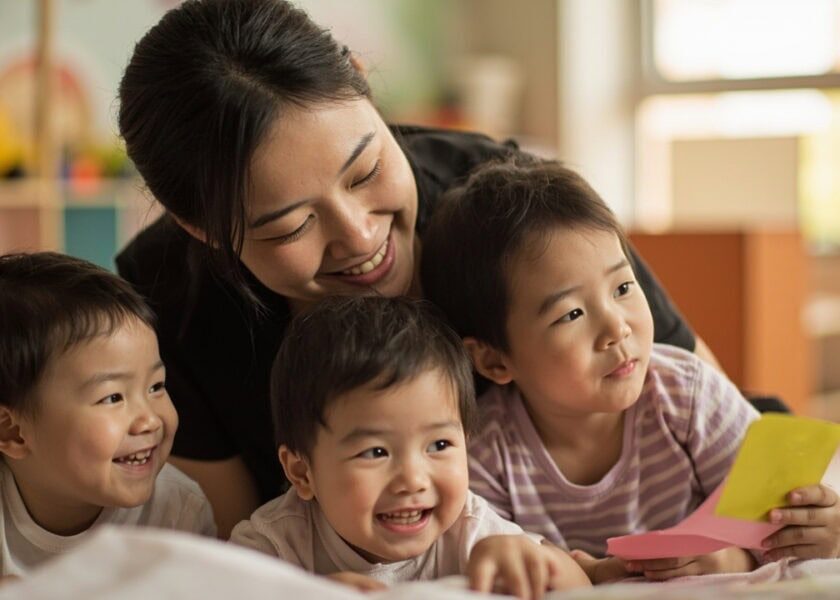
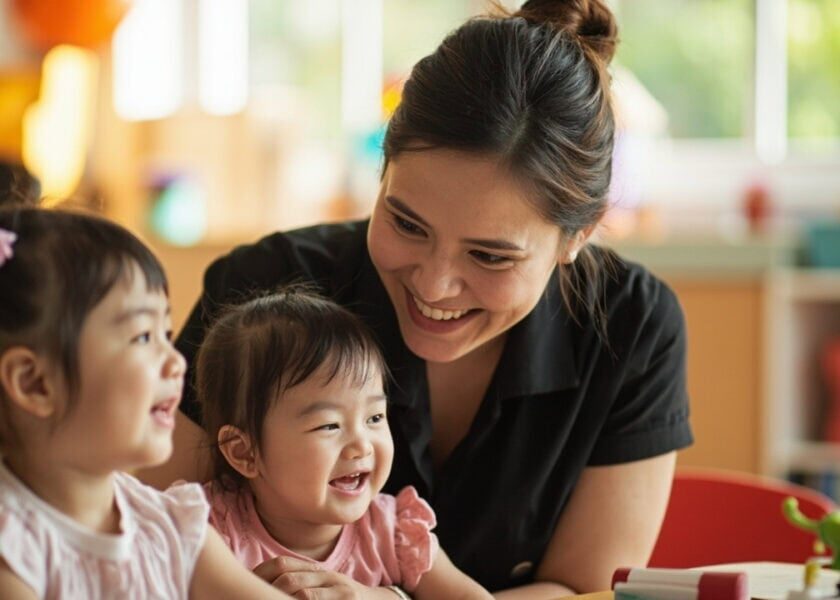
- Your child is cared for in your home by a trained childminder who brings intentional, developmentally appropriate care to their daily life
- Small ratios mean focused attention and responsive care during the critical early years
- Care blocks run Monday to Friday, giving working parents reliable support during working hours
- Transparent communication keeps you connected to your child’s day
- The framework is designed to work alongside grandparent care and centre-based options
But I think the most important thing EduNanny offers is not a service. It is a shift in how we think about childcare altogether.
For too long, we have been asking the wrong question. We have been asking: who will watch my child? Or even: who will replace me?
What EduNanny invites us to ask instead is: how do we build a system around our child that draws on the best of every person in their life?
EduNanny is not asking you to give up anything. It is inviting you to design better. To stop choosing between family and quality, between tradition and innovation, between your needs and your child’s needs. To start building a village that does both.
Addressing What Singapore Parents Actually Worry About
The Quiet Tension in Families Around Childcare Decisions
There is sometimes an unspoken hierarchy of care that goes something like this: grandmother’s care is best, everything else is a compromise. Or the opposite: professional care is modern and superior, grandparent care is outdated and well-meaning but not good enough.
Both of these framings are harmful. Both of them create guilt. Both of them miss the truth.
The truth is that your parents raised you with love and skill, and they also made choices that you have chosen not to repeat, and that is okay. The truth is that professional care is not a cold, institutional experience, and it is also not magic. The truth is that your child needs a variety of relationships, experiences, and care contexts to develop into a complete person.
What EduNanny offers is not a verdict on who should care for your child. It is a framework for integrating all of the care your child receives into something coherent and healthy.
The Weight of Trust
You are handing your infant to someone else. Your heart is involved in a way that is primal, protective, and completely understandable. The idea of regular updates, of communication protocols, of visibility into your child’s day, is not micromanagement. It is reasonable. It is what every caring parent should expect and demand.
When you choose a childminder through EduNanny, you are choosing someone who has been trained, vetted, and supported by a system that understands the weight of what you are entrusting to them. You are choosing a relationship that will evolve over time, that will include conversations about your child’s milestones and challenges, that will treat you as a partner rather than a client.
Childcare is not a product. It is a relationship. And relationships require trust, communication, and mutual respect.
The Ache of the Early Years
Those first thousand days of your child’s life are not just a phrase. During this time, your child’s brain is forming rapidly, and the attachment patterns established in infancy become the template for relationships to come. The language exposure, the sensory experiences, the quality of responsiveness they receive in these early years shapes their development in ways we continue to understand better through research.
This is not to create more guilt. It is to create more clarity.
The care you provide in these early years—whether directly or through those you trust—is not just about keeping your child safe and warm. It is about building the foundation of their future. When you choose quality infant care, whether through centre-based or home-based pathways, whether that involves your parents or a professional childminder or both, you are making an investment in your child’s future. You are saying: I take this seriously. I am not just passing time until they are old enough for school. I am building something that will last.
How to Build Your Village with Intention
The question is not whether you are doing it perfectly. You are not. No one is. The question is whether you have a framework that allows you to build with intention, to adjust when something is not working, to give yourself and your family members grace when things are hard.
Here is practical guidance for Singapore families ready to start building:
Step 1: Have the Honest Conversation
Start by talking to your parents about what they can realistically give, and what they need in return. Grandparents often want to help but also need boundaries, rest, and their own lives. Naming this openly—not as a rejection but as a healthy boundary—is a gift to everyone.
Step 2: Map Your Actual Week
Look at your calendar realistically. Where are the gaps? Where is the stress highest? Where are you rushing or burning out? This is where intentional childcare support can make the biggest difference.
Step 3: Explore Options That Actually Fit
Not every childcare solution fits every family. Centre-based, home-based, grandparent care, helper care—each has strengths and limitations. The question is not which is theoretically best, but which works for your specific family rhythm, your child’s temperament, and your values.
Step 4: Trust That Imperfect and Collaborative Is Better Than Perfect and Alone
Your family’s village will be unique, will be messy, will require constant adjustment—and it will be exactly what your child needs because it was built specifically for them.
Your Child Will Know the Difference
Here is what I want you to hold onto as you make these decisions.
Your child will grow up knowing the love of their grandparents, the skill of professional caregivers, and the presence of parents who are rested, present, and not running on empty. They will grow up seeing adults collaborate. They will grow up understanding that love is abundant, that asking for help is strength, that family is not a small unit fighting alone but a network of people who show up for each other.
This is not just childcare. This is the foundation of everything.
There is a loneliness in modern parenting that we do not talk about enough. The pressure to be perfect, to know everything, to never make a wrong choice, to raise a child who is happy and successful and secure while also somehow maintaining your own identity, your marriage, your career, your sanity. The weight of that is real, and it is heavy, and it is carried largely in silence.
You do not have to carry it alone.
The village that your child needs is not just for them. It is for you. It is for your marriage. It is for your parents. It is for everyone who loves this child and wants to be part of their life in a way that is sustainable, joyful, and meaningful.
Building your village is not a sign that you cannot do it all. Building your village is wisdom. It is the understanding that no one parent, no one caregiver, no one generation has everything a child needs. It is the mature recognition that raising a child truly does take a village, and that the modern parent’s job is not to recreate the village of the past, but to architect a new one that fits the world we actually live in.
Stop looking for the one right answer. Stop trying to do it all yourself. Stop carrying the weight of generations on your shoulders alone.
Start by acknowledging that what you are doing is hard. That it was always going to be hard. That there is no shame in needing support. That asking for help is one of the most loving things you can do for your child and for yourself.
Start by designing your village with intention. By talking to your parents about what they can realistically give. By exploring the options that actually fit your life, your values, and your child’s needs. By trusting that imperfect, collaborative, lovingly messy is infinitely better than perfect and alone.
And if you are ready to explore what a professional, trained, intentionally developmental approach to infant care can look like in your home, then EduNanny is here for that conversation. Not to replace what your family offers. Not to diminish the role of grandparents or parents. But to be the anchor that makes everything else work more smoothly, more joyfully, more sustainably.
The village your child deserves is not a fantasy. It is not something that only other families have. It is available to you, if you are willing to build it intentionally, if you are willing to ask for help, if you are willing to trust that asking for support is not failure but wisdom.
You are not failing. You are building.
Your child is lucky to have someone like you—someone who cares enough to ask the hard questions, to look for real solutions, to refuse to settle for a village that does not serve their whole family well.
The village starts here. It starts with you. It starts now.
If you are a parent in Singapore exploring quality infant care options and would like to learn more about how EduNanny can become part of your family’s village, we invite you to start a conversation with us.
You can also learn more about who we are and how we work under the ECDA Childminding Pilot.