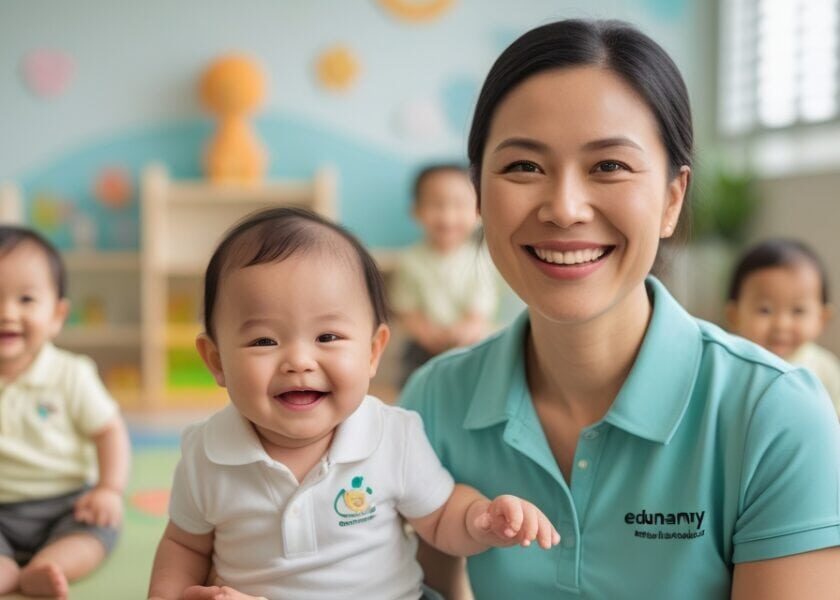
The Tiny Movements Building Your Child’s Brain Right Now
The Question Every Parent Needs to Ask
What is your child actually doing right now, at this very moment, while someone else is watching?
Not just where they are. Not just whether they are safe. I mean really: what are their little hands touching, what sounds are filling their ears, what textures are they crawling toward, what are they trying to pick up and put down and throw and build and take apart?
Most parents, when they first hear this question, pause. Because the truth is that we love our children deeply, but we often have no idea what their hours look like when they are not with us. We trust. We hope. We drop them off in the morning with a kiss and a prayer that the day will be good for them. And then we spend the rest of the day wondering.
This wondering is not a sign of anxious parenting. It is a sign that you understand something profound: that the early years matter. That what happens in those hours, when you are not there to see it, is building the person your child will become.
Tonight, I want to invite you into that wondering. I want to show you something remarkable about what happens in the hours of quality childcare. I want to give you a lens, a vocabulary, a way of seeing your child’s world that will change how you think about every single decision you make about who cares for them and how.
What Sensory-Motor Development Actually Means
Let me take you somewhere. Close your eyes if you need to.
Your child wakes up in the morning. She is six months old, or fourteen months old, or two years old. The age does not matter as much as you think. She wakes up, and her body tells her things. The cool air on her skin. The texture of the sheet beneath her. The smell of the room. The light coming through the window. Her body is a receiver, and from the moment she opens her eyes, she is taking in the world through her senses.
This is not passive. This is not waiting. Her brain is firing. Millions of connections are forming. She rolls over, and her brain learns what gravity feels like. She reaches for a toy, and her brain learns distance and coordination and the satisfaction of intention meeting action. She drops something on the floor and watches it fall, again and again, because her brain is trying to understand the physics of the universe, and she is doing it the only way a human being can: through her body.
This is sensory-motor development. And it is, I will argue to you, the foundation of everything your child will ever learn.
Beyond Letters and Numbers
When we talk about children being ready for school, we often think about letters and numbers. We think about whether they can sit still, whether they can follow instructions, whether they can share. But here is what decades of research tells us: all of those capacities, the abilities that make learning possible, grow from the same root. They grow from the sensory-motor foundations laid in the first years of life.
A child who has had rich sensory experience, who has crawled and climbed and poured and squeezed and squished and climbed again, has built something profound in her brain. She has built the neural architecture for attention. For working memory. For the ability to regulate her emotions when things get hard. For the coordination between her eyes and her hands that will one day allow her to hold a pencil and write her name.
The child who has been held, who has felt different textures against her skin, who has heard the full range of human speech and music and laughter, has built the neurological pathways for language. Not just the ability to produce sounds, but the deep capacity to understand meaning, to listen with attention, to process the complexity of human communication.
Why the First Thousand Days Matter
This is not metaphor. This is neuroscience. When your child reaches for an object, when she explores a new surface with her fingers, when she proprioceptively maps the space around her body through movement, she is not just playing. She is building her brain.
This building happens fastest and most profoundly in the earliest years. From birth to three, the brain forms over one million new neural connections every second. The brain is not waiting to be taught. It is hungry, it is active, it is building itself based on everything your child experiences. The question is not whether this building will happen. The question is what it will be built from.
This is why the environment your child spends her waking hours in matters so profoundly. Not as a nice-to-have, not as an add-on to safety, but as the raw material of her brain.
What a Quality Sensory-Motor Environment Actually Looks Like
So what does that environment actually look like? This is where I want to give you something practical. Something you can look for. Something you can observe.
The Space Itself: Designed for Movement
In a truly developmental childcare environment, your child is not sitting still. She is moving. She is reaching. She is climbing and sliding and dancing and crawling through spaces designed for her body to learn.
Gross motor development, the big movements, are not a separate activity from learning. They are learning. When a toddler climbs a small structure, she is not just exercising. She is calibrating her balance, learning the relationship between her body and space, building the proprioceptive awareness that will later help her sit in a chair at school without fidgeting. When she runs, she is not just burning energy. She is developing the coordination and cardiovascular capacity that support sustained attention.
Watch a room where sensory-motor development is prioritized, and you will see children in motion. Not chaotic motion, but purposeful, guided motion. The environment has been designed to invite movement. There are spaces to climb, surfaces to balance on, materials to carry, objects to manipulate.
The Small Movements Matter Too
And then there are the small movements. The fine motor development. The way a child’s fingers learn to work.
Watch a child at a sensory table, working with water, with sand, with dried rice or beans. She is pouring from one container to another. She is scooping. She is squeezing a dropper. She is using a spoon to transfer objects from one bowl to another.
To an untrained eye, this looks like play. And it is play. But it is also the most precise workout for the small muscles of the hand, the same muscles that will one day allow her to hold a crayon, to cut with scissors, to eventually write. The arch of her hand is developing. The separation of her fingers is happening. The bilateral coordination, using both hands together for a single purpose, is being strengthened.
Why Open-Ended Materials Matter
This is why open-ended materials matter. Quality childcare environments are not filled with plastic toys that do everything and require nothing from the child. They are filled with objects that invite investigation.
- Textured balls
- Fabric squares of different weights
- Wooden blocks that can be stacked and knocked down and sorted
- Shells and stones and pinecones and leaves
- Objects that have weight and temperature and smell and feel
A basket of pinecones and leaves is richer than a battery-operated toy that sings a song. The question is whether the materials invite the child to use her body and her mind together.
The Caregiver: Where Development Actually Happens
And then there is the adult.
I want to talk about the role of the caregiver, because this is where sensory-motor development either flourishes or flattens.
Co-Regulation, Not Just Supervision
In a quality environment, the caregiver is not just supervising. She is co-regulating. She is responding. She is narrating. She is joining.
Watch a skilled caregiver with a baby. The baby reaches for a toy, and the caregiver hands it to her, saying, “You want the red ball. Here it is.” The baby explores it, and the caregiver says, “It feels smooth, doesn’t it? Can you feel how smooth it is?” The baby drops the ball, and the caregiver hands it back, saying, “You dropped it. Now you want it again.”
This is not small talk. This is scaffolding. This is the caregiver building language on top of sensation. Every time she names what the baby is experiencing, she is creating a neural pathway between the sensory input and the word. The baby feels the smoothness, hears the word “smooth,” and begins to build the architecture that will one day allow her to understand “smooth” in a book, in a conversation, on a worksheet.
Following the Child’s Lead
With older toddlers, watch the caregiver join the play. She does not direct. She follows. If the child is building a tower, the caregiver might hand her a block, or model a technique, or simply be present as a witness. She asks open-ended questions:
- “What do you think will happen?”
- “How can we make it taller?”
- “What else could we use?”
This responsive interaction is the secret ingredient. It is what transforms a room full of materials into a true developmental environment. The brain does not grow strongest in isolation. It grows strongest in relationship. In connection. When a caregiver is attuned, responsive, warm, and engaged, the child’s stress hormones remain low, and her brain is free to explore, to experiment, to build.
When Meltdowns Are Not Just Meltdowns
Here is something that surprises many parents: the child who has frequent meltdowns, who seems unable to calm down, who falls apart over small frustrations, may not simply be “emotional” or “difficult.” She may be a child whose sensory system is overwhelmed. She may be a child who has not yet developed the capacity to regulate the sensory input coming at her from all directions.
Every child processes sensory information differently:
- Hyposensitive children need more input to feel regulated. They seek out movement, they crash into things, they love spinning and swinging.
- Hypersensitive children become overwhelmed easily. They are distressed by loud noises, by tags in their clothing, by certain textures.
- Most children are somewhere on a spectrum, and the spectrum changes from day to day, from moment to moment.
In a quality childcare environment, caregivers understand this. They observe. They notice when a child is starting to dysregulate. They offer movement breaks. They create calm corners with soft lighting and weighted materials. They modulate the sensory environment, sometimes reducing stimulation, sometimes increasing it, based on what individual children need.
They teach children, gradually and patiently, to notice their own bodies. To recognize when they are starting to feel overwhelmed. To develop strategies for self-regulation that they can carry with them for life.
The child who learns these skills in early childhood, who has a caregiver who helps her understand her own inner world, becomes the child who can sit in a classroom. Who can manage frustration. Who can recover from setbacks. Who has the executive function foundation that predicts academic success more reliably than early literacy or numeracy skills.
Why Ratios Matter
This is why ratios matter. You cannot scaffold development you cannot see. You cannot respond to a child you do not have time to observe. Quality care is not just about safety and kindness, though both matter. It is about the cognitive richness of every single interaction.
Six Things Every Parent Can Look For
I promised you observable indicators. I promised you tools for recognizing quality when you see it. Here is what I want you to look for, the next time you visit a childcare environment, whether it is a center or a home-based setting.
1. Look at the Children’s Faces
Are they engaged? Are they interested in what they are doing? Are they moving with purpose? Or are they wandering, listless, staring at walls, sitting passively?
The emotional engagement of the children is your first indicator. Children who are truly learning and developing are typically absorbed in their activities.
2. Look at the Caregiver’s Hands
Are the caregiver’s hands busy? Are they engaged with the children, playing alongside them, offering materials, responding to their actions? Or are the caregiver’s hands folded, or holding a phone, or doing something else while the children play unattended?
Remember what I said about scaffolding. It happens through interaction. It happens through hands.
3. Look at the Environment
Is it rich? Is it varied? Are there natural materials, open-ended objects, textures and colors and surfaces that invite exploration? Or is it dominated by plastic toys, by screens, by materials that do not require imagination to use?
Quality sensory-motor environments are not necessarily expensive. The question is whether the materials invite the child to use her body and her mind together.
4. Listen
What sounds fill the room? Are there meaningful conversations, songs, narrations? Or silence, or television noise, or chaos?
Language development is deeply tied to sensory experience. Children need to hear language that connects to what they are doing and experiencing. They need rich, responsive, back-and-forth interaction. A quiet room is not necessarily a good room. A noisy room is not necessarily a bad room. What matters is the quality of the communication happening within the noise.
5. Observe the Routines
Are children moving throughout the day, or are they sitting for long periods? Are there transitions that feel rushed and stressful, or are they paced in ways that help children regulate?
Movement should be woven throughout the day, not relegated to a single physical education period.
6. Notice How Difficult Moments Are Handled
Do children seem regulated, or dysregulated? Do caregivers respond with patience and warmth, or with impatience and control?
When you see a child having a hard time, watch what happens. That is when you see the true quality of care.
These are not guarantees. Every child is different, and every family has different values. But these indicators will serve you well. They are grounded in what developmental science tells us about how children learn and grow.
Why Singapore Parents Have a Real Choice Here
Now I want to speak to something closer to home. I want to speak to you, specifically, as Singapore parents navigating the childcare landscape.
You are living in a city that is ambitious and demanding. You are balancing careers, expectations, financial pressures, and the relentless comparison machine of modern parenting. You want the best for your children. You want them to thrive. And you are making decisions about their care under conditions of real uncertainty.
I see you. I understand the weight of those decisions.
And I want to tell you that the decision you make about childcare is not just a logistical decision. It is not just about who will keep your child safe while you work. It is a decision about what raw material will build your child’s brain. It is a decision about the kinds of experiences that will form the foundation for everything that comes after.
This does not mean you should feel guilty if you work. Human beings are remarkably resilient. Children can and do thrive in a wide range of circumstances.
But resilience is not the same as optimization. And the question you are asking tonight, the question that brought you here, is whether there is a way to do this better. Whether there is a choice that gives your child more.
There is.
How EduNanny Singapore Approaches Sensory-Motor Development
EduNanny Singapore was built on a simple conviction: that every child deserves to have her early years filled with the rich sensory-motor experiences that build strong brains and capable bodies. That parents deserve to understand what is happening in those hours, to feel confident that their children are not just supervised but truly nurtured and developed.
We are proud to be part of the ECDA Childminding Pilot, an initiative that recognizes the importance of home-based and community-based pathways in Singapore’s childcare landscape. We believe that children thrive in environments that feel like home, that offer small ratios, that provide personalized attention.
Our caregivers maintain ratios of up to one to three for infants, because we know that the depth of attention matters as much as the presence of supervision. Our care runs Monday through Friday, in structured blocks designed to support your family’s rhythm. CDA and Baby Bonus funds can be used, because we believe that developmental childcare should not be a privilege reserved for the wealthy.
We operate across Singapore, and we are committed to transparency. Where deployed, we use communication measures, including CCTV, to give you visibility into your child’s day. We send updates, we share observations, we invite your questions. We do not want you to wonder. We want you to know.
But what we are most proud of is the philosophy that drives everything we do. We believe that the childminder is not a stopgap. She is not a placeholder until school begins. She is a developmental professional whose work, in these earliest years, shapes the trajectory of a human life. We honor that role. We train for it. We support it. We recognize that the person who holds your child in her arms for eight hours a day is doing something meaningful.
Supporting You on the Parenting Journey
We have developed Thomas, our AI-powered chatbot, designed to support parents and childminders alike. Thomas is not a replacement for human care. He is a bridge. He answers your questions at any hour, about developmental milestones, about sensory needs, about what to expect at different ages. He helps childminders access resources and guidance, so they can be even more confident in the work they do.
Because we believe that knowledge empowers. We believe that when you understand what your child is experiencing, when you have language for the remarkable processes happening in those early years, you make better decisions. You feel more confident. You partner more effectively with the caregivers in your child’s life.
Thomas is part of our commitment to being more than a service. We want to be a resource. A guide. A trusted presence in your parenting journey.
Your Child Deserves a Strong Foundation
Let me close by coming back to where we started. With the question.
What is your child actually doing, right now, while someone else is watching?
I have given you a lens tonight. I have shown you that what your child is doing is not passive. It is not waiting. It is the most important work a human being can do: building a brain through sensation and movement. Learning through her body. Growing the architecture that will support attention, language, literacy, emotional regulation, and the capacity to learn anything the future demands.
This is what quality childcare gives your child. Not just safety. Not just supervision. A sensory-motor foundation. A rich environment of movement and touch and sound and discovery, guided by warm, responsive, skilled caregivers who understand the profound significance of these early years.
When you choose childcare, you are not just choosing a safe space. You are choosing an environment that will shape your child’s brain. You are choosing the raw material from which her future self will be built.
That is a powerful thing. It is a weight, yes. But it is also a gift. Because it means that what you do matters. It means that the choices you make have meaning. It means that in a world that often feels chaotic and uncertain, there is something you can do, right now, that will give your child the best possible start.
Our Invitation to You
EduNanny Singapore is here because we believe that every child deserves this start. We are here because we have seen what is possible when children are given the sensory-rich, developmentally attuned care they need. We are here because we believe that Singapore’s children deserve the best, and because we know that the best is not about flash or prestige. It is about depth. It is about attention. It is about the thousand small moments of connection and exploration that, together, build a life.
The hours at childcare are not lost hours. They are foundational hours. They are the hours that matter most.
Choose them wisely. Choose them with knowledge. And trust that the work your child is doing, even when you cannot see it, is the most important work of her life.
Curious about how EduNanny Singapore supports your child’s sensory-motor development? Reach out for a conversation about your family’s needs. We are here to listen, answer your questions, and help you feel confident in the choices you make for your child.