The Social Skills Your Child Is Quietly Building at Childcare
The Morning Goodbye No One Talks About
There is a moment, probably familiar to you, when you drop your child at childcare in the morning. You kiss their forehead. You tell them you will be back soon. You walk away.
Behind you, your child enters a world you cannot follow.
Most parents understand intellectually that their child is in good hands. You have done the research. You have asked the questions. You have trusted the process. But there is another understanding—one that operates beneath logic, in the realm of the heart—that never quite settles.
It asks: what happens in there? Not in terms of safety, which you have been assured of. But in terms of everything else.
What happens when your child plays alongside another child and does not know how to share? What happens when the block tower falls and someone laughs, or cries? What happens in the long hours between morning drop-off and evening pickup, when your child is learning to be a person among people?
This is the quiet anxiety I want to name today. Not to resolve it, because I do not believe it can ever be fully resolved. But to give it language. Because what happens in those unseen hours is one of the most significant forms of learning your child will ever do.
What Your Child Is Learning (That You Cannot See)
If you have ever stood at the observation window of a childcare centre, you will know the strange geometry of that moment. You see a slice of room, a corner of play, your child absorbed in something you cannot quite identify.
That window is a metaphor for something deeper—the experience of raising a child who is daily entering a social world you cannot fully access. But in that world, something extraordinary is happening.
Children learn to be human together. Not through lectures or instruction, but through the raw material of proximity—through being near other small people who want things too, who feel things too, who are learning the same lessons at the same time.
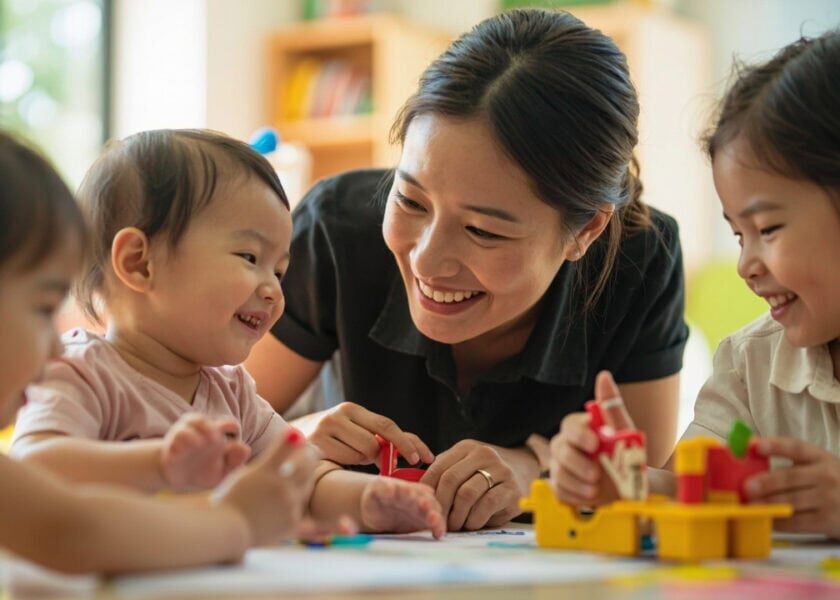
When two children reach for the same toy and neither has the words yet for negotiation, something begins. A look passes between them. A reaching, a pulling back, a sudden storm of feeling. And in that moment, two children are learning what it means to be a self among selves.
Developmental psychologists call this social competence, and it is one of the most important things your child will build in the early years. It does not show up on assessments. But it becomes the foundation for every relationship your child will ever have—friendships in primary school, collaboration in the workplace, intimacy in adult life.
The child who learns to navigate frustration with another child at age two is building the architecture for emotional regulation that will serve them at twenty-two and forty-two.
The Friend Curriculum in Action
Let me describe what this looks like, because it is more intentional than it appears. In quality childcare settings, cooperation, conflict, friendship, and emotional navigation happen constantly—and trained caregivers are paying attention.
When two three-year-olds want to use the same tricycle, they are discovering that another person has wants that differ from their own, and that this difference can be negotiated. When a caregiver notices this moment and gently names what is happening, offering language and scaffolding, the child receives something invaluable: a bridge between impulse and response.
The caregiver does not force sharing. Instead, they help the children find words, offer simple explanations of why sharing matters, and give them the experience of trying again. Over time, this accumulates. Children begin to hold the idea of the other person in their minds even when that person is not present. They develop what researchers call theory of mind—the understanding that others have thoughts, feelings, and desires different from their own.
This is not a small achievement. It is the beginning of empathy.
The Skills That Quietly Build
By the time a child has spent a year in a quality childcare environment, they have practiced dozens of social skills that adults take for granted:
- They have learned to wait
- They have learned to take turns
- They have learned to notice when another child is upset and respond, however imperfectly
- They have learned that words can resolve what fists cannot
- They have learned the particular pleasure of a shared project—a block tower built together, a song learned together, a game whose rules they invented together
These are not trivial experiences. They are the raw material of social identity.
Learning to Hold Big Feelings in a Group
There is another dimension worth naming: emotional regulation in groups. This is one of the most demanding skills a young child can develop.
In a family setting, a child may have the luxury of a caregiver’s undivided attention when big feelings arrive. In a childcare setting, a child must learn to manage frustration, excitement, and disappointment while others are also managing their own emotions.
This is harder. It requires a different kind of resilience—the ability to hold one’s own experience while remaining part of a group. When a caregiver creates a calm, predictable environment where big feelings are not punished but guided, children learn that emotions are manageable and that they can remain safe even when they feel unsafe inside.
This is foundational for the self-regulation they will need in school, in relationships, and in life.
The Hidden Work of Quality Caregivers
This learning does not happen by accident in high-quality settings. Caregivers are not passive observers. They are architects of social opportunity.
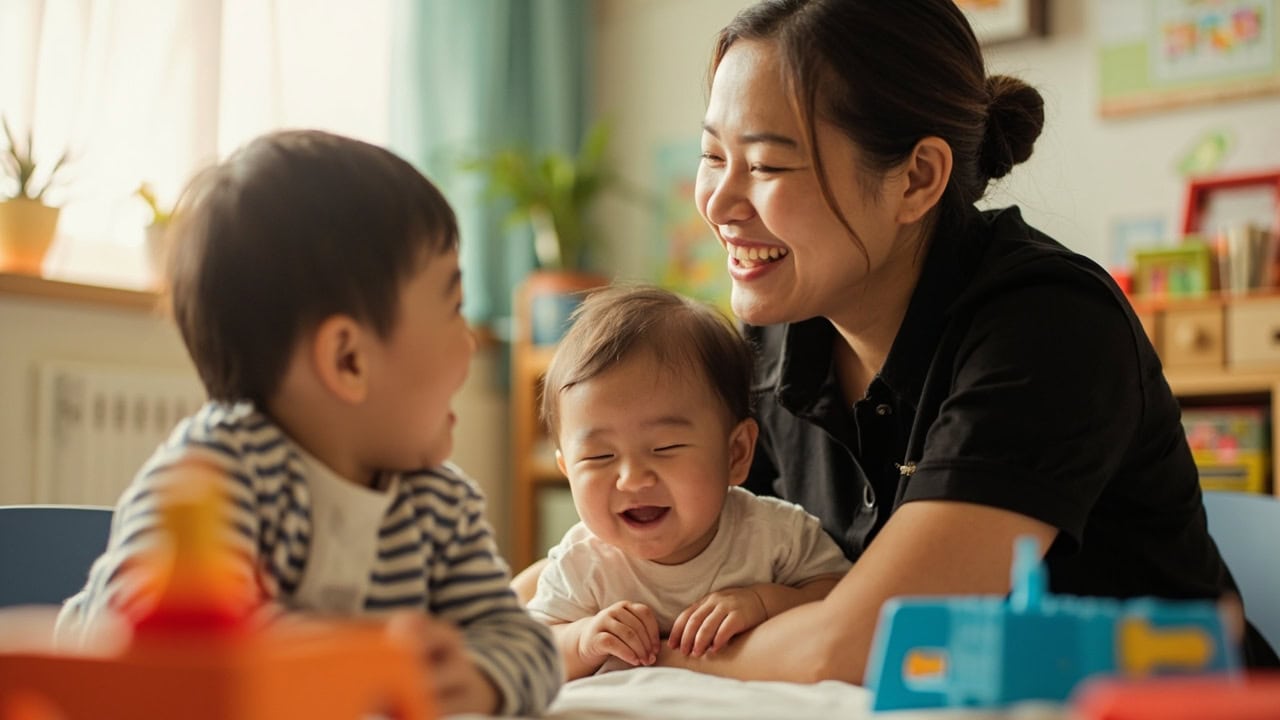
They notice which children are withdrawn and gently invite them in. They step in when conflicts exceed a child’s current capacity to resolve them, offering just enough support to move the child forward without taking over. They model cooperation, language, and calm. They narrate social situations for children who have not yet developed the vocabulary to name what they are experiencing.
They create the conditions for children to practice being together, again and again, with increasing skill.
This is the hidden social curriculum of quality childcare. It is hidden not because it is secret, but because it is happening beneath the surface of what parents typically see—beneath the daily reports of meals and naps and milestones, beneath the photographs of smiling children at play.
It is happening in the spaces between activities, in the negotiations over toys, in the friendships that form slowly and the conflicts that teach more than any lesson could.
When you pick up your child at the end of the day and ask what they did, the answer may be vague: We played. We coloured. We went outside. These answers can feel unsatisfying, but I want to suggest they are more meaningful than they appear. When a child says they played, they may mean they practiced cooperation. When they say they coloured, they may mean they learned to sit near another child in a shared activity, to negotiate space and materials, to feel the quiet pleasure of parallel work.
These are not small things. They are the building blocks of everything your child will become.
Why Social Readiness Matters as Much as Academic Readiness
The child who enters primary school with strong social-emotional skills has something precious. They know how to make friends. They can read a room, navigate group dynamics, manage disappointment, and recover from conflict.
They have what researchers sometimes call social readiness—a readiness that is as important as academic readiness, though it is far less discussed.
A child who can cooperate with a teacher, collaborate with peers, and manage the social complexity of a classroom is a child who can learn. Social competence is not separate from academic success. It enables it.
Your Role Does Not End at Pickup
What your child learns at childcare comes home with them. The child who is learning to share at school brings that learning home. The child who is practicing emotional regulation in a group setting carries that capacity into family life. The child who is building friendships is building the social confidence that will help them navigate every new environment.
Your role in this does not end at pickup. In some ways, it begins there.
When you feel uncertain about whether your child is learning what they need to learn, when you lie awake wondering if they are being meaningfully supported in the invisible but crucial work of becoming socially capable—know that this wondering is not a sign of failure. It is a sign that you care deeply about your child’s development in every dimension.
When your child struggles with sharing at home, or when a playdate goes sideways, or when your toddler has a meltdown over something that seems impossibly small—you are not failing as a parent. You are in the middle of the same work that is happening at childcare. You are helping your child build the same social competencies, one moment at a time.
Simple Ways to Reinforce Social Learning at Home
- Ask about friends—when you notice your child mentions a name again and again, ask a question about that friend. You are telling your child that their social world matters.
- Help them process conflict—when your child describes a dispute with another child, offer language and perspective. You are extending the work that began in childcare.
- Celebrate small victories—a successful playdate, a kind word to a sibling, a moment of sharing. You are reinforcing that this learning matters.
- Name what you see—when your child shares a toy with their sibling, pause and name it: “That was kind. You remembered how it feels to want something, and you let your brother have a turn.” Children need to hear their social choices named and valued.
What to Look For When Choosing Infant Care in Singapore
If you are researching childcare options, here are the questions that will help you understand whether your child will be meaningfully supported in their social development:
- How do caregivers respond when children conflict over toys? Look for settings where adults help children find words and solutions rather than simply enforcing rules.
- What is the ratio of caregivers to children? Small group sizes allow for genuine attention to each child’s emerging social world.
- Do caregivers narrate what they observe? When adults name emotions and social situations aloud, they are building vocabulary that children will eventually use themselves.
- How does the environment support both independence and connection? Quality settings balance opportunities for child-initiated play with guided social experiences.
- How will you know what your child is learning socially? Transparent communication ensures you are not left guessing about the social dimension of your child’s day.
EduNanny Singapore: Walking Alongside You
EduNanny Singapore was built with this understanding at its centre. As an ECDA Childminding Pilot partner, EduNanny is committed to providing care that attends to the whole child—not just physical needs, but social and emotional development as well.
Whether through home-based care or community-based pathways, EduNanny creates environments where children learn to be together, to navigate relationships, and to build the social competencies that will serve them for life.
This commitment shows up in tangible ways:
- Transparent communication between caregivers and families ensures that parents are not left guessing about their child’s social experiences.
- Small group sizes in infant care, with ratios that allow for genuine attention to each child’s emerging social world, mean that caregivers can notice and respond to the moments that matter.
- Caregivers trained to observe, document, and scaffold social-emotional growth, partnering with parents in supporting each child’s development.
- Monday to Friday care blocks with accessible fee structures designed to make quality care a reality for families across Singapore.
- CDA and Baby Bonus schemes accepted, removing barriers between families and the care their children deserve.
These are not just features. They are expressions of a belief: that every child in Singapore deserves the opportunity to build the social competencies that will shape their future, and that no family should have to choose between quality care and financial feasibility.
Your Child Is Learning to Be Human
The next time you drop your child in the morning and feel that familiar pull of love and worry and uncertainty, I invite you to hold this thought:
Your child is learning to be human among humans. They are practicing the oldest and most important skills—how to connect, how to cooperate, how to navigate difference, how to be known and to know others.
This learning will stay with them long after the details of any single day have faded. It will shape who they become, how they love, how they work, how they contribute to the world.
The social world your child enters at childcare is not separate from the world you are building at home. It is an extension of it. The values you model—the way you treat others, the way you handle conflict, the way you name and manage emotions—all of this travels with your child. And what your child learns at childcare travels home too.
You are not passive in this. You are essential. And so are we.
When you drop your child at the door of an EduNanny partner childcare or home-based setting, you are not simply handing over care. You are entrusting your child to a community that understands what is at stake. You are trusting that someone will attend to the whole child, including the social self that is being quietly, persistently built every single day.
That trust is not small. And we do not take it lightly.
Every child deserves to learn the art of being together—and every family deserves to feel confident about who is teaching them.