The Social-Emotional Curriculum Your Child Learns at Childcare
The Vocabulary Gap: Why Singapore Parents Feel Uncertain
Here is what we do not talk about enough in Singapore. We talk about numeracy readiness. We talk about language exposure. We share articles about brain development and synaptic pruning and the wonders of the first thousand days. We feel very informed.
And yet, when your child comes home tired and clingy, or defiant and irritable, you have no framework for understanding what happened. You default to worry. You wonder if the childcare is too stimulating, not stimulating enough, too structured, too loose. You wonder if you made the right choice.
What is missing is this: you have not been given the vocabulary for social-emotional learning. Without that vocabulary, without that framework, you are left measuring childcare by the only metrics you have access to:
- Did they eat?
- Did they sleep?
- Did they learn a new word?
- Did they seem happy?
Those things matter. But they do not tell the whole story.
What the Social-Emotional Curriculum Actually Looks Like
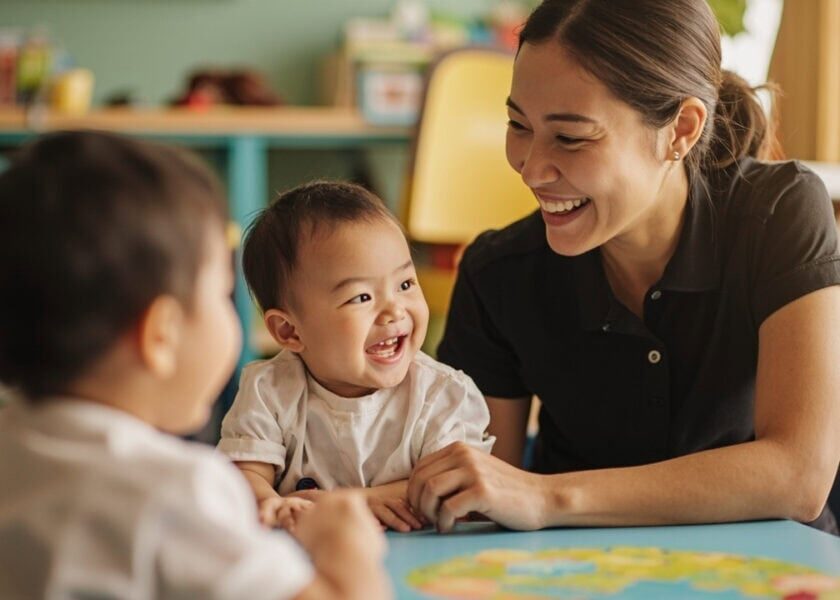
Let us paint a picture. It is four-thirty in the afternoon. You walk into your child’s childcare environment. Your daughter is sitting with a caregiver near the water table. She is not playing with the water. She is watching another child who is struggling to fill a bottle without spilling. Your daughter leans over, says something you cannot hear, and gently adjusts the other child’s grip. The caregiver notices, nods, and says something quietly. Your daughter returns to her own activity, satisfied.
What just happened? Most parents would see a nice moment between children. A caring gesture. Pleasant and forgettable.
But that moment was not accidental. It was not a random act of childhood kindness. That moment was the result of a curriculum that has been running all day, quietly, in the background of every song, every transition, every shared meal, every gentle correction, every moment of waiting.
Your daughter learned, over weeks and months in this environment, that she is part of a group. She learned that others have needs. She learned that her actions affect people around her. She learned that a caregiver notices and names these moments, that the adult in the room holds space for small acts of empathy and does not let them pass unnoticed. She learned that she has something to offer.
This is what we mean when we say quality childcare runs a social-emotional curriculum. It is not a lesson plan on a wall. It is not a circle time activity that checks a box. It is a living, breathing system of relational learning that shapes who your child is becoming in ways that no worksheet can measure and no parent conference can fully capture.
Why This Curriculum Determines Everything
This curriculum is not optional. It is not a bonus layer that a good childcare adds on top of supervision. It is the thing that determines whether your child thrives or merely survives their early years.
Research across decades and cultures has shown us what parents somehow still doubt: a child’s social-emotional readiness predicts their academic trajectory more reliably than any pre-reading or pre-math intervention. Children who can regulate their emotions, who can navigate conflict without escalating, who can enter a room full of strangers and find their footing, who can wait, who can share, who can ask for help, who can tolerate disappointment—these children do not just feel better. They learn better.
The opposite is also true. Children who do not develop these capacities early often spend their entire schooling years fighting a battle they did not know was social before it became academic. A child who cannot sit with discomfort cannot sit with a difficult maths problem. A child who cannot read the room cannot read the text.
We have been asking Singapore children to perform academically while leaving their emotional foundations to chance, and then wondering why anxiety and burnout are rising among our young people.
This is why understanding the social-emotional curriculum matters. Not as a philosophical nice-to-have. As a practical, urgent necessity.
Signs Your Child’s Childcare Is Running This Curriculum
So how do you know if your child is in an environment where this curriculum is running? Here are signs you can learn to look for—not a checklist, but a framework for observation.
After Pickup: Watch Your Child’s Social Footing
When you pick up your child, notice how they are with other children in the room. A child who has been in a quality social-emotional environment will often have what we call a “home base”—a caregiver they have a genuine relationship with, not just familiarity.
Watch how they move between that caregiver and the other children. Watch how the caregiver responds when your child approaches. Is the interaction warm but not anxious? Does the caregiver include your child in the ongoing social fabric of the room, or does your child feel like an outsider returning to claim a parent? The difference is subtle but profound.
Notice How Your Child Responds to Small Frustrations
Not the big tantrums—those happen everywhere and mean nothing diagnostic. Notice the small ones. The dropped spoon. The closed door. The moment another child takes a toy.
A child who has been in a relational environment will show something remarkable: a brief flash of frustration, followed by a recovery. Not because they were told to calm down. Because they have internalised, through hundreds of small experiences, that difficult moments pass. That adults help. That they have options.
This is emotional regulation in its earliest, most tender form.
Notice How Your Child Talks About Other Children
Not in glowing terms—young children are rarely consistently positive about peers. But notice if they mention others. If they have language for the social world.
If they say things like “my friend” or “the baby in the blue shirt” or “he was sad because”—children who are embedded in a social-emotional curriculum develop a rich inner social language. They begin to narrate their world in relational terms. This is a sign of deep learning.
Notice the Caregiver Most of All
This is perhaps the most important sign of all. A caregiver who is running a social-emotional curriculum is not merely supervising. She is narrating. She is naming emotions out loud, consistently, for every child to hear:
- “I see you worked hard on that puzzle and it fell apart. That feels disappointing.”
- “Jun Wei is feeling sad right now. Let’s give him space.”
- “Mei Ling, I noticed you helped Chen Wei with his shoe. That was kind.”
This narration is not soft or sentimental. It is precise. It is deliberate. It is the most powerful teaching tool in early childhood, and most parents have never been taught to recognise it.
When you see a caregiver who narrates, who pauses before correcting, who makes explicit what is happening inside each child’s emotional experience, you are looking at someone who understands that the real work of early childhood is not the colouring-in or the alphabet songs. The real work is building the internal architecture that will allow a human being to function in a complex social world.
Managing Behaviour Versus Growing Emotional Capability
Managing behaviour means keeping children safe, fed, and occupied. It means getting through the day without incidents. It means photo updates that show smiling faces without context.
Growing emotional capability means giving children the tools to understand themselves and others. It means navigating the inevitable friction of human relationships. It means emerging from each day not just physically intact but socially a little more sophisticated than before.
Most childcare environments operate in survival mode—managing ratios, managing schedules, managing parents’ expectations for photo updates and activity logs. They are not running a social-emotional curriculum because that requires something expensive and rare: caregivers who are trained, supported, and given the time and space to be relational rather than merely transactional.
What EduNanny Does Differently
EduNanny by BUTLER operates within the ECDA Childminding Pilot, and this matters more than it might seem. The pilot exists because Singapore recognises that the early childhood system must evolve—that the model of mass childcare delivery has not always served the developmental needs of our youngest children, and that a more relational, individualised approach is not just preferable but necessary.
EduNanny chose to build something that fits within the pilot’s structure and philosophy. Our model is intentional. It is not a centre scaled up or a home care scaled down. It is a thoughtfully designed environment where:
- The ratio of caregivers to children allows for genuine relationship
- Training prepares our people not just to care but to nurture
- Every element of the day—from the morning greeting to the transition between activities to the quiet end-of-day wind-down—is understood as an opportunity for social-emotional growth
Our infant ratio of up to one to three is not a compliance number. It is the architecture of intimacy. It is what makes it possible for a caregiver to know each child deeply enough to notice when something is off before the parents do. It is what makes it possible to run the curriculum described in this article.
In a centre with a one-to-eight ratio, a caregiver can keep children safe. In a centre with a one-to-three ratio, a caregiver can shape a human being.
We share what we see because you deserve transparency. We use communication tools and, where deployed, CCTV measures—not because we have something to hide but because we have something to show.
We want you to see the curriculum running. We want you to pick up your child and know, with confidence, that today your daughter practised saying no when she needed to. That today your son learned that sharing feels strange at first and then feels good. That today, in a hundred tiny ways, your child grew.
Addressing the Guilt You Carry—and Your Irreplaceable Role
Because you carry it, and it is heavy, and no one has told you that you can put it down.
The guilt of the working Singapore parent is a particular species of suffering. You are not neglecting your child. You are not abandoning them to indifferent strangers. You are making one of the most profound acts of love and trust a parent can make: you are entrusting your child’s social and emotional development to people who are trained, qualified, and devoted to this work.
You are not choosing between your career and your child. You are choosing an environment that will teach your child things you, frankly, cannot teach them alone. Things that require peers. Things that require a skilled adult who is not their parent. Things that require a small society.
Your child is not missing you during those hours in a way that damages them. They are learning to be a person in the world. And that world, when it is a good one, is not a lesser substitute for your presence. It is a necessary complement to it.
Here is what EduNanny understands: we are not a service you purchase. We are an environment we co-create with you. We give you the framework you have been missing. We give you the vocabulary. We give you a window into your child’s social-emotional growth so that when you pick them up, you do not just see a tired, grumpy, adorable stranger. You see a person in process. You see the skills emerging. You see the curriculum working.
And you feel, perhaps for the first time since you became a parent, that you understand what is happening in those hours you cannot see.
That understanding is transformative. It transforms guilt into confidence. It transforms anxiety into pride. It transforms the question “what is my child becoming when I am not there?” into an answer you can trust.
You are irreplaceable. You are the home base. You are the source of unconditional love and primary attachment that no caregiver, however excellent, can replicate.
What EduNanny and centres like it offer is not a replacement for you. It is an extension of the work you have already started. Every time you read your child a book and name the character’s feelings, you are running a social-emotional curriculum. Every time you validate their frustration instead of dismissing it, you are running a social-emotional curriculum. Every time you model how to apologise, how to wait, how to be wrong, how to forgive—you are running the same curriculum we run all day, and it is the most important education any human being receives.
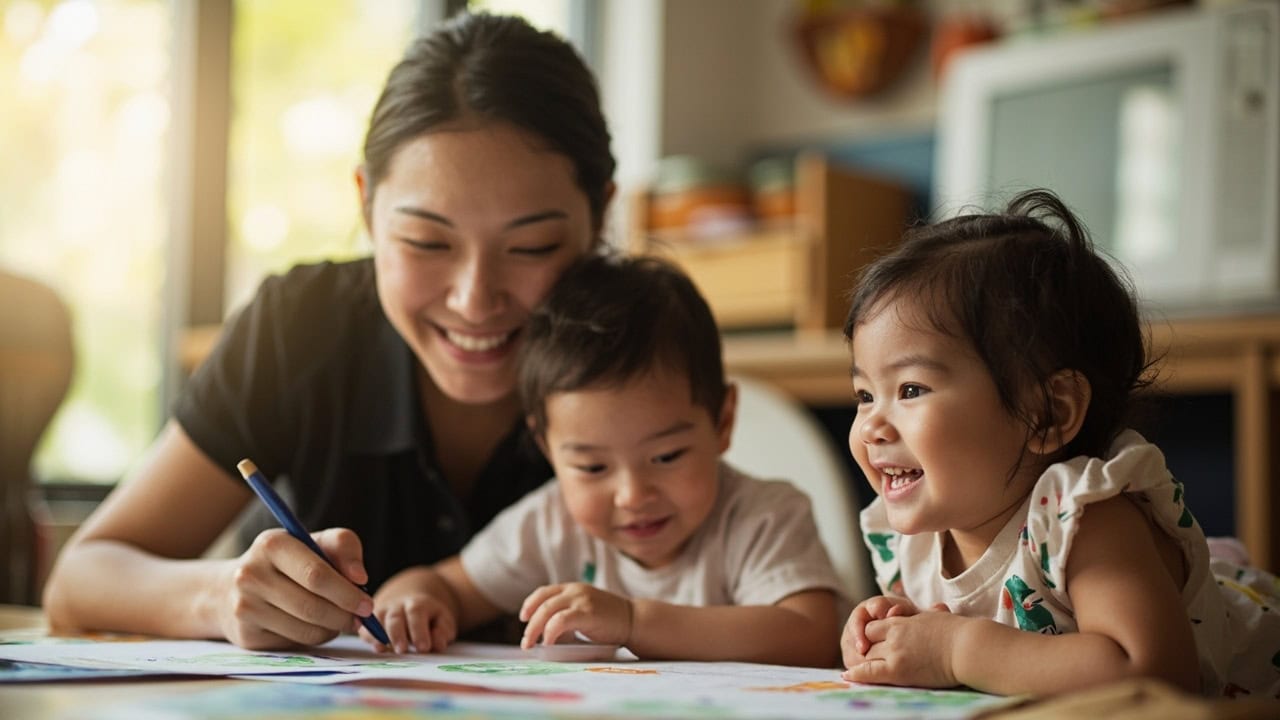
What we do at EduNanny is amplify that work. We give your child additional hours of relational richness. We give them peers to practice with, conflicts to navigate, empathy to develop, social scripts to internalise. We give them a caregiver who knows them, who celebrates their small victories, who holds them when they are overwhelmed, who talks to them like thinking, feeling human beings from the moment they arrive.
Practical Guidance: What to Look for When Choosing Infant Care in Singapore
Whether or not EduNanny is the right fit for your family, here is what we believe every Singapore parent deserves to know when evaluating childcare options:
- Ask about caregiver ratios. Smaller ratios enable deeper relationship. Ask what the actual ratio is, not just what is legally permitted.
- Observe how caregivers speak to children. Do they narrate emotions? Do they name what they see happening inside the child’s experience? This is the signature of a social-emotional curriculum.
- Notice the environment’s emotional temperature. Is it warm but calm? Do children seem to feel safe expressing frustration, or is the expectation that they will be “good”?
- Ask how conflicts are handled. Not “what happens when there is a fight,” but “how do caregivers support children when they disagree or feel upset.”
- Ask about transitions. How does the day move between activities? Transitions are where the social-emotional curriculum shows up most visibly.
- Trust your observation after pickup. Does your child seem regulated? Do they mention peers? Do they have a visible connection with a caregiver?
The Question Worth Asking: Begin With Observation
Perhaps you are still deciding between options. Perhaps you are doubting the choice you have already made. Perhaps you are preparing to return to work after your maternity leave and feeling the weight of that transition in a way that makes every childcare tour feel like a verdict on your worth as a mother.
Here is what we want you to know: you are not alone in this uncertainty. The fact that you are reading this article—that you are asking deeper questions about what your child needs—already tells us something important. You care. You are paying attention. You are doing the work of a thoughtful parent.
And here is the question we leave you with, one that replaces the anxious one you have been carrying:
Not “What is my child doing when I am not there?”
But “I am learning to watch. I am beginning to see.”
Today, after pickup, try something. Before you ask “What did you do today?”—which rarely yields useful answers from a two-year-old—try instead:
- “Who did you play with today?”
- “What made you happy?”
- “Was anyone feeling sad? What happened?”
- “What did Miss [caregiver’s name] say today?”
Listen not for facts but for relational language. For the names of peers. For the small social scripts your child is beginning to carry. These are the signs that the curriculum is working—that your child is becoming a person who understands the social world they live in.
EduNanny by BUTLER is built on the belief that every infant deserves to be known deeply. Every toddler deserves to be guided through the hard work of learning to be human. Every Singapore parent deserves to feel that their child’s social and emotional development is in hands that understand its profound importance.
We are not just a childcare choice. We are a partner in your child’s becoming. We are the environment where the curriculum runs. And we are here, every day, doing the quiet, essential, often invisible work of raising children who will grow into adults capable of connection, resilience, and empathy.
If this article resonated with you, we would welcome the opportunity to continue the conversation. Whether you are exploring options for the first time or seeking something more intentional for your family, learn more about EduNanny’s approach and what we believe every child deserves.