The Silence Between Us: Why Singapore Parents Are Building a New Village
The Silence Singapore Parents Know Too Well
There is a particular kind of silence that Singapore parents know well. It is the silence of a Wednesday afternoon when the house is too quiet, when the play mat is scattered with abandoned toys, when the morning’s energy has long since dissolved and the evening is still hours away.
It is the silence that used to be filled—by grandparents who lived down the road, by cousins who came after school, by neighbours whose doors were always open.
That silence is not a failure. It is simply the sound of a world that has changed faster than our instincts ever could.
We were all raised in villages. Not in the romantic, uncomplicated sense that the word sometimes implies, but in the real, complicated, sometimes exhausting sense. Our villages were imperfect. They were loud. They were full of opinions about how we should be raised, when we should eat, whether we needed another blanket.
But they were constant. They were there, day after day, in the ordinary rhythms of our childhoods.
And so when we became parents ourselves, something deep inside us expected the same village to materialize—to appear the way it always had, like air, like gravity, like something that simply exists.
It does not exist anymore. Not in the way it once did.
This is the quiet tension that sits beneath so much of modern Singapore parenting. We carry within us a blueprint for raising children that our parents and grandparents never had to construct because it was simply there—embedded in the architecture of daily life.
And now, as parents ourselves, we are being asked to build that village from scratch. Not because we failed to inherit one, but because the world changed, and we are living in the beautiful, complicated, fully modern gap between the village we remember and the village we are now making.
The Guilt That Has No Name
Every parent in Singapore knows the moment I am about to describe. It arrives differently for each of us, but its shape is familiar. It is the moment you realize that the help you expected to arrive is not arriving.
Your parents are still working, or they live across the island, or the weekly commitment they offered in the early weeks of pregnancy has quietly softened into occasional weekends. Your partner is doing everything possible, but everything possible is also not enough—not because either of you is failing, but because young children need more than two adults can sustainably provide.
And in that moment, something inside many parents shifts into guilt. It is a particular kind of guilt, specific to our cultural context.
It whispers: I am supposed to have a village. Why do I feel so alone in this?
It whispers: My parents raised four children. Why can I barely raise one?
It whispers: If I need help, what does that mean about me?
This guilt is not rational. It is not helpful. But it is real, and it deserves to be named before we can move past it.
Here is what I want you to hear: the guilt you feel about needing support is the echo of a village you never actually had to ask for. In the generation that raised us, village support was so woven into daily life that accepting it was not a decision—it was simply the water they swam in.
Our parents did not feel guilty about relying on grandparents because there was no alternative to feel guilty about. The village did not need to be chosen because it was already there.
But we are the first generation of parents in Singapore who must actively construct what previous generations simply inherited. We are building it without the template, without the automatic trust that comes from knowing someone your whole life, without the cultural permission to simply accept that children belong to a community, not just to their parents.
The guilt, then, is not evidence that something is wrong with you. It is evidence that something has changed in the world. And the sooner we can name that clearly, the sooner we can redirect the energy that guilt consumes toward something far more generative: the intentional design of the village your child actually needs.
Understanding “It Takes a Village” Differently
There is a phrase that sometimes surfaces in conversations about Singapore childcare, and I want to take it seriously: it takes a village. We have all heard it. We have perhaps used it ourselves, often as a way of acknowledging that childcare is hard and we need support.
But I want to suggest that we have been using this phrase too casually. When we say it takes a village, we are not merely saying that childcare is difficult and parents need help. We are saying something more profound: that children are not meant to be raised by one or two adults in isolation.
They are meant to be surrounded by a network of consistent, attuned, emotionally present relationships—relationships that, together, form the village that shapes who they become.
Here is the insight that I believe is quietly transforming how thoughtful Singapore parents approach childcare: that village does not have to look like it did in our childhoods. It does not have to be built entirely from blood relatives. It does not have to be free, or convenient, or exactly what we imagined.
It has to be present, and consistent, and safe, and warm. It has to give children the signal—day after day, across seasons and growth spurts and tantrums and victories—that they are held by more than just their parents. That the world is populated by adults who know them, who care about them, who show up.
This is what children read when they assess their village. Not the family tree. Not the cultural credentials. Not whether the caregiver shares your surname or your language or your parenting philosophy perfectly.
What children read is whether the village is there, reliably, with warmth, with attention, with consistency.
They read the village signal.
And when we can hear that insight clearly, something remarkable happens. The childcare decision stops being about guilt and starts being about architecture. You are not outsourcing the village. You are building one.
The Three Pillars of Your Modern Singapore Village
In the modern Singapore family village, there are three pillars. They are not equal in every family—that is not the point—but they are all real, and they all matter.
Pillar One: Family
For some Singapore families, this pillar is robust. Grandparents who are retired, nearby, and willing to participate daily. Aunts and uncles who are actively involved. Cousins who are close in age and available for sibling-adjacent care.
For other families, this pillar is thinner—not absent, but less present than they would wish, perhaps available for weekends but not weekdays, perhaps helpful with pickups but not with the long hours of infant care that working parents require.
The family pillar matters enormously, and wherever it exists, it deserves to be honoured and included. But for many Singapore families navigating the realities of dual-income households, ageing grandparents who deserve their own rest, and extended family scattered across the island or overseas, this pillar alone cannot carry the full weight of what young children need.
Pillar Two: Community
This is the friendships and relationships that parents cultivate—playgroups, parent networks, neighbours who become trusted faces in your child’s life. Community is real and it is valuable.
But I want to name something honestly: community alone is not enough. Community is voluntary. Community relationships can drift. Community caregivers may relocate, change their minds, face their own life transitions.
What children need from their village is not just warmth and love, which community can provide, but also continuity—the knowledge that the adults in their world will be there tomorrow and the day after and the month after.
Community is essential, but community without consistency is an incomplete pillar.
Pillar Three: Professional Care
And this is where I want to slow down, because this pillar has been misunderstood.
In too many narratives, professional childcare is positioned as the fallback. The thing you turn to when family fails, when community is unavailable, when your village cannot assemble. This framing is not just inaccurate—it is harmful.
It positions professional caregivers as lesser members of the village, as substitutes rather than pillars, as evidence of parental inadequacy rather than parental wisdom.
The truth is exactly the opposite. When you choose professional childcare thoughtfully, you are not settling for a lesser village. You are completing one.
You are adding a pillar that brings something the other pillars often cannot: trained expertise in early childhood development, consistent presence across working hours, professional accountability, and a structure designed specifically around the needs of young children.
A trained, experienced, emotionally attuned childcare professional is not a substitute for grandmother. She is a different kind of pillar, one that brings different strengths to the village architecture—and those strengths are irreplaceable.
| Pillar | What It Brings | What It Cannot Provide Alone |
|---|---|---|
| Family | History, culture, genetic connection, love that began before birth | Consistent daytime availability for working parents |
| Community | Friendship, social connection, diverse perspectives | Continuity and reliability over time |
| Professional Care | Training, consistency, developmental expertise, structured care | The family’s irreplaceable emotional bond |
What Makes a Childcare Arrangement a True Village Pillar
Not all professional care is equal, and the difference matters enormously. When you are evaluating whether a childcare arrangement can become part of your village, there are three qualities you are ultimately looking for. They are not complicated, but they are non-negotiable if the arrangement is going to serve your child the way a village pillar should.
The First Quality: Consistency
Children, especially in the early years, do not generalise well. A different face every few weeks is not a village. It is a series of introductions.
What children need—what their developing brains require for healthy attachment—is the same face, the same voice, the same hands, the same rhythm of care, day after day after day.
This is not a luxury. It is a developmental necessity.
When you evaluate childcare, ask not just about the qualifications of the caregiver but about the turnover rate, the scheduling structure, the likelihood that your child will have the same primary caregiver six months from now. Ask how the arrangement handles sick days, public holidays, and caregiver transitions.
Consistency is the foundation everything else builds on.
The Second Quality: Warmth
Warmth is harder to define than consistency, but you know it when you see it. It is the way a caregiver holds a child—not just physically, but with attention, with presence, with genuine delight in the child’s emerging personality.
It is the way she narrates the day, the way she speaks to the child as a full person rather than a task to be managed. It is the care in her voice when she greets your child in the morning, the unhurried quality of her attention even when she is tired.
Warmth cannot be trained into someone who does not have it. But it can be recognised—and it can be trusted when you find it. When you observe a caregiver interacting with your child, watch not for perfection but for presence. Watch for whether she is truly with the child in that moment.
The Third Quality: Training
This is the pillar that professional care uniquely contributes. Early childhood is not intuitive. The developing brain, the emerging attachment system, the subtle milestones of motor and language and social development—these require knowledge that most parents do not have and cannot be expected to have.
A trained caregiver brings expertise to your village that grandparents and friends typically cannot, however much they love your child. She understands developmental norms. She knows how to respond to separation anxiety in a way that builds rather than breaks trust. She can recognise when a child’s behaviour is a normal developmental phase versus when it warrants attention.
Training does not replace warmth—but combined with warmth, it creates something extraordinary: a caregiver who both loves your child and knows how to nurture her.
The Village Signal Your Child Is Reading
Consistency, warmth, training. These are the village signals your child is reading. When you find a childcare arrangement that delivers all three, you have found something valuable. You have found a pillar.
If you are already in an arrangement and wondering whether it is serving your child well, here is a reframe worth holding: you are not discovering whether you chose correctly. You are discovering who your child is becoming.
Every childcare arrangement reveals something about your child—her social nature, her need for stimulation or for calm, her way of relating to adults who are not her parents. This information is not a verdict on your choice. It is data. It is the ongoing process of understanding your child well enough to know what kind of village she specifically needs.
If the arrangement is not serving her well, you are not a failure for having chosen it. You are a parent who has learned something important, and you are now in a position to adjust.
That is what intentional village-building looks like in practice. It is not a single choice made perfectly. It is a living architecture that you continue to refine.
And simply by taking the question seriously—by reading this article, by paying attention to the signals your child is giving you—you are already engaging in that intentional building. That matters.
EduNanny: Built for This Moment in Singapore Family Life
EduNanny exists because of a very specific problem that Singapore parents face: finding professional care that actually functions as a village pillar rather than a transactional service.
We were built with an understanding of what Singapore families actually need. We know that families across this island face different situations—different work schedules, different family structures, different financial realities. We know that what a parent in Jurong needs may not look exactly like what a parent in Tiong Bahru needs.
And we know that the childcare landscape in Singapore is complex, with home-based pathways and centre-based options, with subsidies and structures and regulations that can feel overwhelming to navigate.
Our Place in the Village
I want to say something about the word “nanny” because I think it carries weight that sometimes distracts from what EduNanny is actually offering.
In some contexts, “nanny” suggests an outsider—someone hired to do the work of childcare so that parents can step back. We understand that association, and we want to gently push against it.
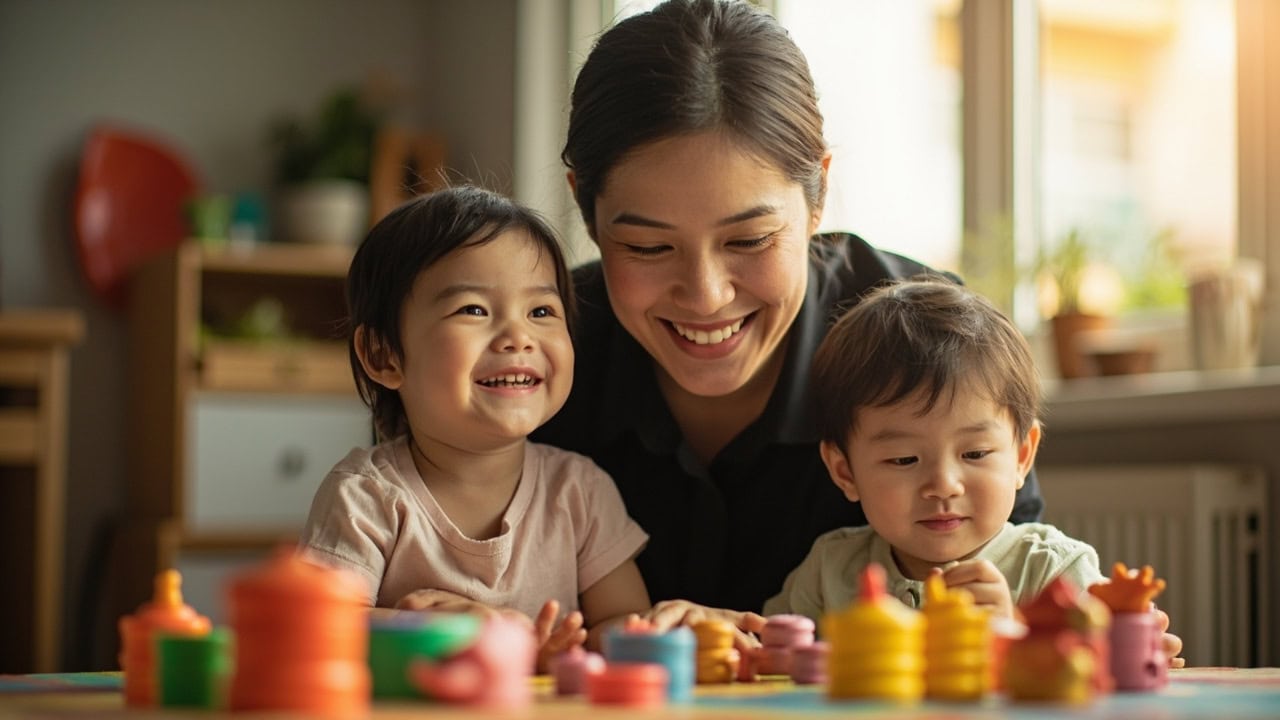
The caregivers in the EduNanny network are not outsiders to your village. When we place a caregiver in your family, she becomes part of your village architecture. She is not replacing you as a parent—she is standing alongside you, as a pillar that carries weight you cannot carry alone.
This is not charity. This is not convenience. This is intentional community-building at its most practical. When your EduNanny caregiver shows up consistently, day after day, learning your child’s rhythms and preferences and fears and joys, she is doing exactly what a village member does. She is becoming someone your child trusts.
What We Offer as a Pillar
EduNanny is part of the ECDA Childminding Pilot, which means our approach is grounded in regulatory standards designed specifically to support quality home-based infant and childminding in Singapore.
We work within a framework that prioritises small ratios—one caregiver for up to three infants in our home-based care arrangements—because we know that the closeness of attention matters profoundly in the early years.
We offer care blocks Monday through Friday, designed around the realities of working family life, and we do so at fee structures that are accessible within the pilot framework. We know that families want to use their CDA and Baby Bonus for quality care, and we have built our arrangements to be compatible with these Singapore government supports.
We believe that quality village care should not be available only to families who can pay premium rates. Every child in Singapore deserves a village, and every parent in Singapore deserves support in building one.
How We Prepare Our Caregivers
We train our caregivers not just in the technical aspects of infant care but in the deeper work: how to read a child’s cues, how to respond to separation anxiety in a way that honours the parent-child bond rather than undermining it, how to be present without replacing, how to be professional without being cold.
We know that our caregivers are entering families at some of the most vulnerable moments of those families’ lives—the new parents still reeling from birth, the exhausted parents navigating the return to work, the families still grieving the village they thought they would have.
We train our caregivers to understand that context, to bring not just competence but compassion. And we build in accountability structures—open communication, transparency about how care is delivered, and oversight—that give parents the confidence to truly lean on the pillar we provide.
Building Your Village: What Changes and What Comes Next
And here is what we have learned from the families we serve: when this works—when you find the right caregiver, when the pillar is solid, when your child runs to greet her in the morning without hesitation—something shifts in the whole family.
The parents breathe. They find moments of restoration they desperately needed. They return to their children more present, more patient, more whole. The village is working. The architecture is holding.
This is what village consistency creates: not just better-rested parents, though that matters. It creates children who are more confident, more secure, more capable of exploring the world because they know the world has reliable adults in it.
It creates families that are more cohesive, not less, because family roles are no longer strained to breaking by the weight of unsustainable childcare demands.
The ripple effect of a solid village pillar reaches every corner of family life.
Questions Worth Asking as You Search
- Ask about consistency: What is the caregiver turnover rate? Will my child have the same primary caregiver in six months? How are gaps in coverage handled?
- Observe for warmth: When you visit, watch how the caregiver interacts with children. Is she present with them? Does she speak to them as people? Does she seem to genuinely enjoy this work?
- Verify training: What qualifications does the caregiver hold? What ongoing training does she receive? How does she handle developmental milestones and concerns?
- Consider ratios: How many children is each caregiver responsible for? In infant care especially, smaller ratios mean more individual attention.
- Check alignment with subsidies: Can the arrangement work with CDA or Baby Bonus funds? Are there subsidy schemes you qualify for?
- Trust your read: After visiting, ask yourself: does this feel like a place my child could belong? Does this feel like someone my child could trust? The village signal works for parents too.
If you are a parent in Singapore who has been navigating the childcare search alone—if you have been carrying the weight of that search in isolation, wondering if you are asking too much, wondering if your need for support is a weakness rather than a wisdom—I want you to hear this:
You are not navigating this alone. You are part of a generation of parents who are quietly, patiently, intelligently rebuilding something precious. You are part of a generation that is choosing intention over accident, architecture over accident, village over isolation.
You do not have to build the village your parents had. That village was specific to its time, its geography, its family structures. The village you are building is specific to this time, to this family, to this child.
And it is, in many ways, a more thoughtful village than the one you inherited—because you are building it on purpose.
The question is no longer: Do I have the village I need?
The question is: Am I building the village my child deserves?
Building that village means including all three pillars. It means honouring your family’s role, yes, but not pretending that family alone is sufficient when it is not. It means appreciating your community, yes, but not expecting community to provide the consistency that children require.
And it means choosing professional care not as a last resort, but as a deliberate, intelligent pillar in your village architecture.
Stop choosing childcare in isolation. Stop treating it as a logistical problem to solve on your own. Start designing your village with intention. Start asking what your child specifically needs, and what pillars you need to construct to meet those needs.
EduNanny is here to help you build that village. Not to replace you as a parent. Not to diminish the role of your family. Not to suggest that you cannot do this alone.
But to stand alongside you as the trained, consistent, warm pillar that your village needs and that your child deserves.
The village is not gone. It is being rebuilt, right now, by parents like you.
And the childcare you choose is not a compromise of that village. It is the completion of it.
Know that when you build the village with the same intentionality and care that you bring to everything else you do as a parent, you are not just solving a childcare problem. You are giving your child a gift that will echo through her entire life: the knowledge that she is held by more than just her parents. That the world is safe, and warm, and populated by adults who show up.
That is the village your child needs.
That is the village you are building.
And we are honoured to be part of it.
Ready to explore what a village pillar could look like for your family?
Connect with EduNanny to learn more about home-based infant and childminding options available through the ECDA Childminding Pilot. Learn about our approach and what we stand for.