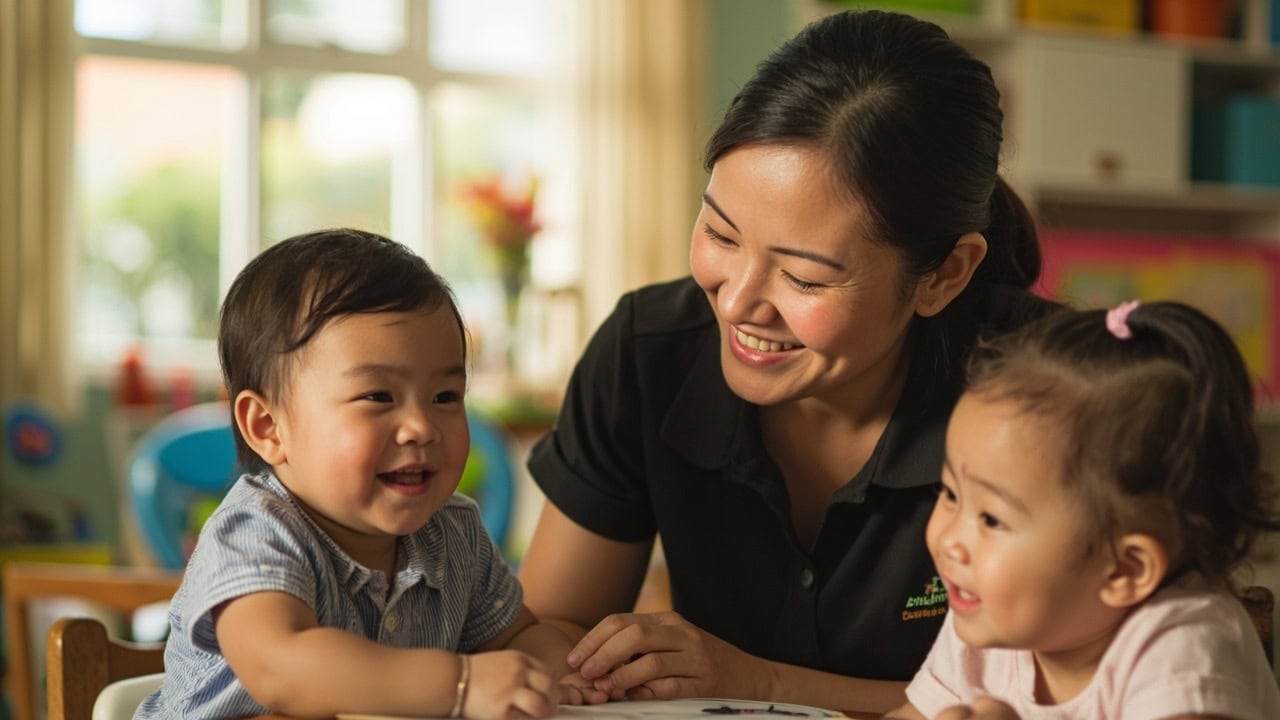
The Signs Your Child Is Thriving in Quality Childcare
The Signs That Tell You the Care Is Working
Before we go deeper, here are the key developmental signs that indicate your child’s care environment is actively supporting their growth:
- Language that communicates—not just words, but phrases, questions, and attempts to share meaning
- Social orientation toward peers—gaze and attention turning toward other children, not just adults
- Emotional resilience—calming in reasonable time, tolerating small disappointments without collapse
- Cognitive curiosity—persistent “why” questions, experimentation, simple storytelling
- Physical confidence—increasing self-care skills, coordination, and pride in physical capability
If you are noticing these things at home, pay attention. That is your child’s care environment doing its work.
When Development Becomes Legible
Because here is what I have learned, watching children grow in environments of genuine intentional care: that question you are asking—is this working?—is not a sign of doubt. It is a sign of attention. You are already watching. You are already noticing. What you need is not reassurance alone. What you need is a framework for reading the evidence that is already in front of you.
When development is genuinely supported—supported by consistent relationships, responsive interaction, intentional design—children do not simply grow older. They become legible. Their inner world starts to show itself in their outer world. And parents who are paying attention start to see things they did not expect to see, or did not know how to name.
Language: The Bridge Between Inner Experience and Shared Communication
Language is often the first signal parents notice, and for good reason. Language is not just vocabulary. It is the child making sense of the world and trying to share that sense with others. When a child who has been in quality care for several months begins using phrases and ideas—not just words and labels—you are watching something specific happen.
You are watching a child who has had someone talking with them, not just at them. Responding to their babble as if it carried meaning. Naming what they notice. Repeating their words back with genuine interest. Building, word by word, a bridge between their inner experience and shared communication.
In Singapore, where many families navigate code-switching between English, Mandarin, and dialect in complex ways, language development in quality care shows up in specific ways:
- Children begin to narrate. They say things like “water all gone” after watching water pour out of a cup.
- They begin to ask questions—why, what, where—which is a different cognitive act than receiving information.
- They start to follow two-step instructions, which sounds simple but represents a significant leap in comprehension.
- They use language to manage social situations: “My turn soon?” “No thank you.” “Help please.”
These are not just cute phrases. They are evidence of a child who is learning that language is a tool for connection.
Social Confidence: The Child Who Turns Toward Others
Now let me move to something that is harder to measure but equally real: social confidence. This is the child who, six months ago, clung to you at drop-off and now walks into the childcare space with something like anticipation. The child who, when another child takes their toy, looks for a solution—perhaps offering a trade, perhaps seeking the caregiver’s support in a way that is assertive rather than desperate. The child who has started to notice other children as people worth watching, people whose actions matter.
In a quality care environment, children learn that other people have intentions, preferences, and feelings. This sounds like a small thing. It is not. This is the foundation of empathy. This is the beginning of understanding that the world contains others who matter.
There is a particular sign parents often notice without knowing what it means: peer orientation. When a child’s gaze begins to turn toward other children as much as toward adults, when their emotional state begins to be influenced by the behavior of other children, you are seeing something significant. This is not just socialization. This is a child who has developed enough security to look outward.
Emotional Regulation: Learning That Big Feelings Are Survivable
Let me speak now about something that matters enormously but is often overlooked: emotional regulation. This is where many parents feel the most anxiety, because emotional dysregulation is exhausting for everyone—child and parent alike. And yet emotional regulation is one of the clearest signs that a care environment is doing what it should.
When a child is in a responsive, consistent care environment, they begin to internalize something. They begin to learn that big feelings are survivable. That someone will stay with them when they are upset. That the world does not end when they are angry or frightened or overwhelmed.
This sounds like philosophy, but it is actually neuroscience. The developing brain learns to regulate emotion partly through being regulated—by the calm presence of a caregiver who does not panic, who names the feeling, who stays close. Over time, the child begins to carry that calm inside.
What does this look like at home?
- A child who can be soothed in reasonable time rather than spiraling indefinitely
- A child who can tolerate small disappointments without total collapse
- A child who, after a difficult moment, can return to play, to connection, to the ordinary business of being a child
These are signs of a child who is developing the capacity to manage their own inner world. And that capacity is built in relationship, in the day-to-day texture of care that is attentive, consistent, and present.
Cognitive Flexibility: The Signs of a Growing Mind
Let me move to cognitive flexibility, because this is where the richest evidence often lives. A child in a quality care environment is not just being kept safe. They are being challenged. Presented with problems to solve, materials to explore, ideas to test. And over time, you begin to see the results at home.
A child who asks “why” persistently—not as a delaying tactic, but with genuine interest—is a child whose cognitive curiosity has been activated. A child who experiments with cause and effect, who notices changes in their environment, who begins to understand that objects have properties and behaviors, is a child whose mind is actively growing.
In practical terms, here is what this might look like:
- Your child is playing with a shape-sorter and suddenly gets it right—not through random trial and error, but through a moment of real understanding.
- They notice a reflection in the window and become absorbed in the question of who is there.
- They begin to sort things by category without being asked, putting all the red toys together, all the round things together.
- They tell simple stories that reveal an understanding of sequence: “First we went to park. Then we ate ice cream. Then Mama carried me.”
These are windows into a mind that is building structure, making meaning, developing the cognitive architecture that will serve them for years to come.
Physical Confidence: The Foundation of Agency
And finally—though this should not be last in importance, because it is so often underrated—I want to speak about physical coordination and self-care. These are the domains that get the least attention in conversations about quality childcare, and that is a mistake. Because physical development is not separate from cognitive and emotional development. It is connected.
A child who is developing physical confidence is also developing a sense of agency, of capability, of their own competence in the world.
When you see your child beginning to manage more of their own body—feeding themselves with increasing skill, beginning to dress themselves, climbing with growing coordination, showing pride in their physical capabilities—you are seeing something that quality care environments actively support. In a setting with the right ratios—small enough that a caregiver can be attentive, large enough that children have peers to move with and alongside—children are given the freedom to test their physical selves in safe conditions. They fall and get up. They climb and discover. They practice and improve. And they bring that confidence home.
Understanding What Quality Childminding Actually Looks Like
Normal development does happen. Children are resilient, and they grow. But actively supported development has a quality that is different. It is more visible. It is more calibrated. It follows certain patterns that you can learn to recognize.
When you see language emerging not just as words but as communication, when you see social behavior that includes genuine engagement rather than just proximity, when you see emotional resilience that shows up across settings—these are signs that your child’s development is not just occurring but accelerating, deepening, being actively shaped by the environment you chose.
That distinction matters. And once you can see it, you cannot unsee it.
The Role of Consistent Relationships
Children develop in relationship. They do not develop in isolation, in crowds, in environments where attention is divided. They develop when someone knows them. When someone notices them. When the same person is there, day after day, building the kind of consistent relationship that allows a child to feel secure enough to explore, to grow, to become.
This is why small ratios matter. This is why consistency matters. The caregiver who knows your child’s temperament, who recognizes their signals, who has seen them through difficult days and joyful days—this person is not just a supervisor. They are a developmental partner.
The Role of Intentional Design
Quality care is not accidental. It is designed. The space, the schedule, the interactions, the balance between structure and freedom—all of it is thoughtfully arranged to support development at every stage.
Children in such environments are not just passing time. They are being presented with challenges appropriate to their development, supported in working through frustration, given language for their experiences, and surrounded by peers who are themselves growing and learning.
The Bridge Between Care and Home
One of the clearest signs of quality care is when parents can trace a line between what happens at childcare and what appears at home. When your child comes home using a word you have never said. When they reference an experience from their day with detail and enthusiasm. When they demonstrate a skill or a confidence that clearly came from practice somewhere else.
That connection is powerful. It confirms what you are observing. It gives you the language to understand it. It deepens your confidence in the choice you have made. And it means that home and care are working together, not in isolation, but as parts of a coherent developmental ecosystem.
Why This Matters for Singapore Parents
We live in a society that is intensely focused on outcomes. We plan carefully. We invest heavily. We want to know that what we are doing is producing results.
And when it comes to our children, that desire is not about pressure or performance. It is about love. It is about wanting to give our children what they need to thrive. It is about the fundamental parental question: Am I doing right by this person I love more than I knew it was possible to love anyone?
Singapore parents face real pressures. The cost of living, the demands of work, the complexity of raising children in a society that moves fast and expects much. Many families need two incomes. Many families are navigating the logistics of childcare as a practical necessity.
And in that reality, parents deserve to know—with clarity, not just hope—that the care environment they have chosen is actually serving their child’s development. Not just keeping them safe. Not just feeding them. But actively, intentionally building the person they are becoming.
That is why understanding these signs matters. Not as a test your child must pass, but as evidence you can read. A language you can use. A way of understanding that the investment you are making—in time, in resources, in trust—is producing real results in the person you love most.
How EduNanny by BUTLER Approaches This Work
At EduNanny by BUTLER, we are part of the ECDA Childminding Pilot, and we take that responsibility seriously. Our model is built around the truth that children develop in relationship—which is why everything we do is designed to make those relationships possible.
We maintain ratios that make genuine attention possible. Our caregivers are trained, supported, and treated as the professionals they are. We build our model around both home-based care and community-based pathways—because families are different, needs are different, and the right fit matters.
Our Monday to Friday care blocks are designed around the realities of working families. Our fee structures within the pilot are built to be affordable and accessible. And we make it possible for families to use their CDA and Baby Bonus support, because every layer of practical accessibility matters when parents are making these decisions.
We also believe in transparency as a form of trust. When families know what is happening in the care environment—when they receive regular communication, when they have visibility into their child’s day—they can connect what happens at childcare with what they see at home.
When parents can see the environment that is shaping their child’s development, they are better equipped to read the signs at home. They can say, yes, I see now why my child came home using that word, asking that question, showing that behavior. The pieces fit together. The picture makes sense.
This is what we want for every family in our care: not just a childcare solution, but a developmental partnership. Not just supervision, but the kind of intentional environment that makes growth visible.
Questions to Ask When Choosing Infant Care in Singapore
If you are evaluating childcare options, here are the questions worth asking—and the answers that matter:
- What are the caregiver-to-child ratios? Smaller ratios mean more individual attention, more responsive interaction, more opportunities for relationship-building that supports development.
- Who will be caring for my child day to day? Consistency matters. Ask about caregiver stability, turnover, and how relationships are built and maintained.
- How do you communicate with parents? Regular, meaningful communication helps you connect what happens at care with what you see at home.
- What does a typical day look like? Intentional environments have structure and purpose. Ask about how the day is designed to support development across domains.
- How do you support emotional regulation? This is one of the clearest signs of quality. Look for caregivers who name feelings, stay calm, and help children work through difficult moments.
- Can I observe? If possible, spend time in the environment. Watch how children and caregivers interact. Notice whether children seem engaged, secure, curious.
The Signs Are Already There
Here is what I want you to take with you today. The signs are already there. In your child’s language, in their social confidence, in their emotional resilience, in their curiosity, in their growing capability. You are already seeing them.
You may not have had the framework to know what they meant. You may not have been sure whether they were the result of your child’s care environment or just the passage of time. But now you know. These signs are legible. They tell a story. And the story is this: your child is developing in the way that children develop when they are in the right environment.
The question is not whether it is working. The evidence is already in front of you. The question is whether you can see it clearly enough to trust what it means.
You are already watching your child grow. Now you know how to read what you are seeing. And when you see it clearly, you can trust it. You can trust the care you chose. You can trust the signs. You can trust that what you are doing for your child is working.
Because it is. And now you have the language to know exactly why.
If you would like to explore whether EduNanny by BUTLER is the right fit for your family, we welcome the conversation. Not every environment is right for every child, and we believe the best decisions come from clear information and honest dialogue. We are here to answer your questions, share what we observe, and help you understand what we see when we watch your child grow.
The difference is real. The signs are legible. And the care you choose can make all the difference.
Learn more about who we are or get in touch to begin a conversation about your family’s needs.