The Sibling Effect: How Brothers and Sisters Thrive Together in Near-Home Care
The Sibling Effect: What Happens When Children Grow Up Together in Near-Home Care
If you are a parent in Singapore researching infant care options for more than one child, you already know this feeling. The quiet, persistent worry that sits beneath the practical logistics of drop-off times and CDA fund usage: Can one caregiver really give both my children what they need?
It is not a small question. It is the right question to ask. And it deserves more than a reassuring slogan — it deserves a careful, honest look at what developmental science actually tells us about siblings in the first years of life, and what that means for how you should think about near-home care in Singapore.
- Children who grow up with siblings develop certain social capacities earlier — including emotional awareness and cooperative play
- A mixed-age care environment gives infants access to a “living curriculum” they cannot get from adults alone
- Small-ratio near-home care is uniquely positioned to support sibling interaction because caregivers can notice and nurture specific moments of connection
- The fear of divided attention is understandable, but near-home models are designed around the rhythms of multiple children
- Consistency of caregiver and environment reduces stress for both children and supports attachment
Let Us Be Honest About the Anxiety
When Singapore parents consider near-home care for more than one child, a specific and entirely reasonable fear surfaces. It is not about safety — most parents have resolved that question before they begin their search in earnest. The fear is subtler.
It is the fear of divided attention. It is the quiet worry that a caregiver, however devoted, will have to make an invisible and impossible choice: How do you attune to a newborn who needs feeding every three hours and a toddler who needs structured play and emotional coaching and a bathroom break and more?
How do you give each child what they need when their needs are so beautifully, irreducibly different?
This is not a small fear. It is the fear that the arrangement you chose because it felt more personal will, under the weight of real life, become impersonal after all.
You deserve honesty here, not just reassurance. So let us start with what the research actually shows — and then look at how a well-designed near-home model addresses these concerns head-on.
What Developmental Science Tells Us About Siblings in the First Years
Here is what researchers have observed consistently enough that it demands our attention.
Children who grow up with siblings in the home develop certain capacities earlier than only children in comparable care settings. Not dramatically earlier — we are not talking about prodigies. We are talking about something quieter and, arguably, more important. We are talking about social awareness: the ability to read another person’s emotional state, the impulse toward cooperative play, and the understanding that another person has intentions, preferences, and a perspective that is different from your own.
The psychologist Susan Silverman has described what she calls the “sibling as first peer” — the idea that a brother or sister, even a very young one, provides a kind of social learning environment that no adult can replicate. An adult caregiver responds to a child with the patience and attunement of an adult. A sibling responds with siblingness — unpredictable, sometimes rough, sometimes generous, always genuine.
And that authenticity, that absence of performance, is precisely what helps an infant learn about real human interaction.
Parallel Play: More Than It Seems
There is also the phenomenon researchers call parallel play — a stage of development most commonly associated with toddlers, where children play side by side with similar materials, each engaged in their own activity but acutely aware of the other.
You see this in any room where two young children are present. The blocks. The dolls. The same mat. Each child doing their own thing, but occasionally glancing, occasionally mirroring, occasionally — and this is the part that makes every parent hold their breath — offering something to the other.
Parallel play sounds simple. It is not. It is one of the foundational acts of early social cognition. And it happens more naturally, more frequently, and more productively in a small, consistent, home-based environment than in a larger setting where transitions, ratios, and group schedules can interrupt the delicate timing of a two-year-old’s desire to connect.
What the Younger Child Gains
Here is what we sometimes miss when we talk about mixed-age care environments. We talk about the older child benefiting from the responsibility of proximity to a younger one — and that is real, and it matters. But we talk less about what the younger child gains from being alongside an older sibling from the very beginning of their cognitive life.
A five-month-old infant placed in the company of an active toddler receives something that a child in a homogeneous infant-only setting does not. She receives a living curriculum. She watches language emerge. She observes physical problem-solving. She witnesses emotional reactions — frustration, delight, surprise — played out in real time by someone close to her in size, in energy, in the fundamental inexperience of being alive.
She is, in the most literal sense, surrounded by a model of what it means to be a person in the world.
This is not a replacement for individual caregiver attunement. It is not a substitute for the focused eye contact, the responsive feeding, the quiet singing, the slow smile of a trained childminder giving a single infant her complete attention.
It is something additional and complementary — a layer of developmental richness that near-home care is uniquely positioned to provide because of its size, its consistency, and its fundamentally familial structure.
How Near-Home Care Accommodates Two Children Simultaneously
So what does that actually look like in practice? How does a near-home care model handle the real, everyday challenge of tending to two children with different needs at the same time?
EduNanny Singapore operates within the ECDA Childminding Pilot framework, which means the model is grounded in regulatory standards for safety, training, and caregiver competency. Singapore’s approach to infant care has matured significantly, and parents who choose near-home care through this pathway are choosing a model that is both supported by and accountable to that framework.
But beyond the regulatory grounding, here is what makes near-home care structurally different.
Small Ratios Mean Real Attunement
In practice, a near-home caregiver is not managing eight or ten infants at once. She is tending to a handful of children in a familiar space — one that does not require a morning transition, a commute, or a classroom arrival ritual that begins each day with a logistical demand rather than a human one.
The children who come to near-home care arrive in the same space they will spend the day in. They recognise the mat, the window, the sound of the fan. That familiarity is not cosmetic. It is neurological.
A child’s stress response is measurably lower in environments they recognise, and for infants whose nervous systems are still being calibrated, that difference has developmental consequences.
Consistency Across the Sibling Relationship
For families with multiple children in the same setting, this consistency extends to the caregiver relationship. The same trusted person tends to both children. The toddler does not have to re-regulate from a different face each morning. The infant does not have to restart the attachment process every week.
There is continuity, and within that continuity, there is room for the caregiver to hold both children’s individual rhythms — the baby’s feed-sleep-wake cycle and the toddler’s exploration-skill-building-social-drama cycle — within the same morning, the same room, the same unbroken thread of care.
Guided Sibling Interaction
Here is something that institutional childcare models structurally struggle with: the ability to orchestrate guided sibling interaction.
In a classroom with twenty toddlers, a teacher cannot slow down and facilitate the precise moment when one child offers a block to another. That moment is too fast, too crowded, too interrupted.
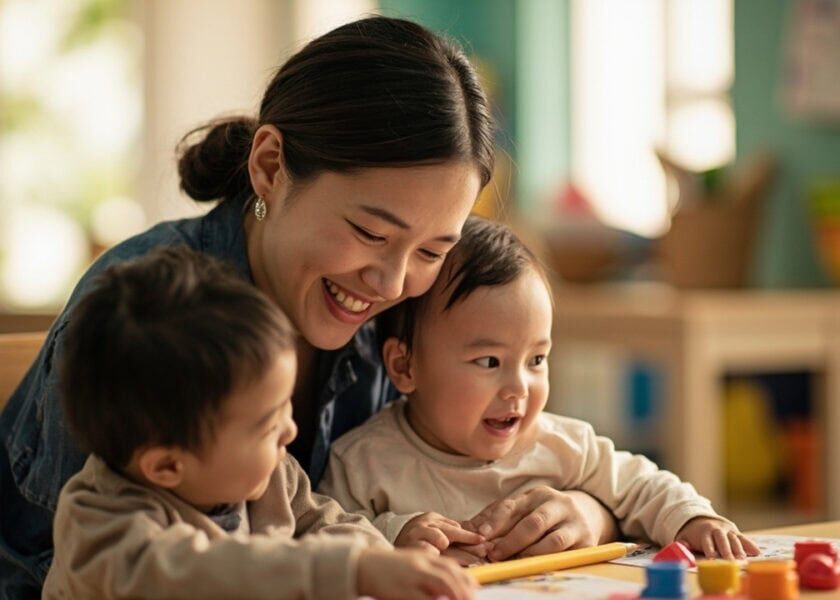
In a near-home setting of three or fewer infants, the caregiver can notice it. She can be there. She can sit beside them and narrate — “You gave her the red one, she liked that” — giving language to an act of social generosity that the children can then internalise.
That act of narration, that quiet verbal scaffolding around a moment of sibling connection, is one of the most powerful tools in early social-emotional development. And it only happens when the environment is small enough for a caregiver to see it happen.
Addressing Your Real Concerns
If you are still uncertain, you are not alone. Here are the questions Singapore parents ask most often when considering near-home care for multiple children.
“Will my infant get enough individual attention?”
A trained near-home caregiver is attuned to the rhythms of both children. During your infant’s most alert windows, the caregiver provides focused, responsive interaction — feeding, tummy time, language-rich conversation.
When your toddler needs engagement, there are periods of structured play that do not require the infant to be the centre of attention. The key is not dividing attention equally, but matching care to each child’s needs at the right moments.
“What if the toddler disturbs the baby’s naps?”
Near-home caregivers are trained to read and manage the sleep environment. In a small, consistent setting, they learn quickly which conditions support the baby’s rest — and they learn to prepare the toddler for quiet periods, turning nap time into an opportunity for the older child to develop patience and understanding of others’ needs.
“How do I know what happens during the day?”
EduNanny maintains transparency in its communication with families — regular updates, clear channels, and in deployments where it is in place, technology that supports rather than replaces the human connection.
The camera in the corner is not a substitute for a conversation at the end of the day. But it is a bridge. And for parents managing work, commutes, and the daily cognitive load of modern Singapore parenting, that bridge matters.
“Is this really better than a larger centre?”
Different families have different needs, and we are not here to dismiss the strengths of other models. What we can say is this: for families who want their children to grow up together, who value the sibling bond as part of their children’s developmental foundation, and who want a caregiver who knows both children and the relationship between them — near-home care offers something that larger settings find structurally difficult to replicate.
That is not a universal claim. It is a specific one, for a specific kind of family.
Questions to Ask When Choosing Near-Home Care
- What is the caregiver-to-child ratio? For infants and toddlers together, you want to feel confident that individual attention is possible.
- How does the caregiver handle different sleep schedules? Ask specifically about how they manage the toddler’s active periods alongside the infant’s rest needs.
- What is the daily routine? A well-structured but flexible rhythm suggests a caregiver who plans for multiple children’s needs.
- How does communication work? You should feel informed about both children’s days, not just when something goes wrong.
- Is the caregiver trained in early childhood development? Credentials matter, but so does the ability to narrate, scaffold, and respond.
- How does the caregiver describe sibling interaction? Listen for someone who sees siblings as an opportunity, not a complication.
The Trust That Builds Over Time
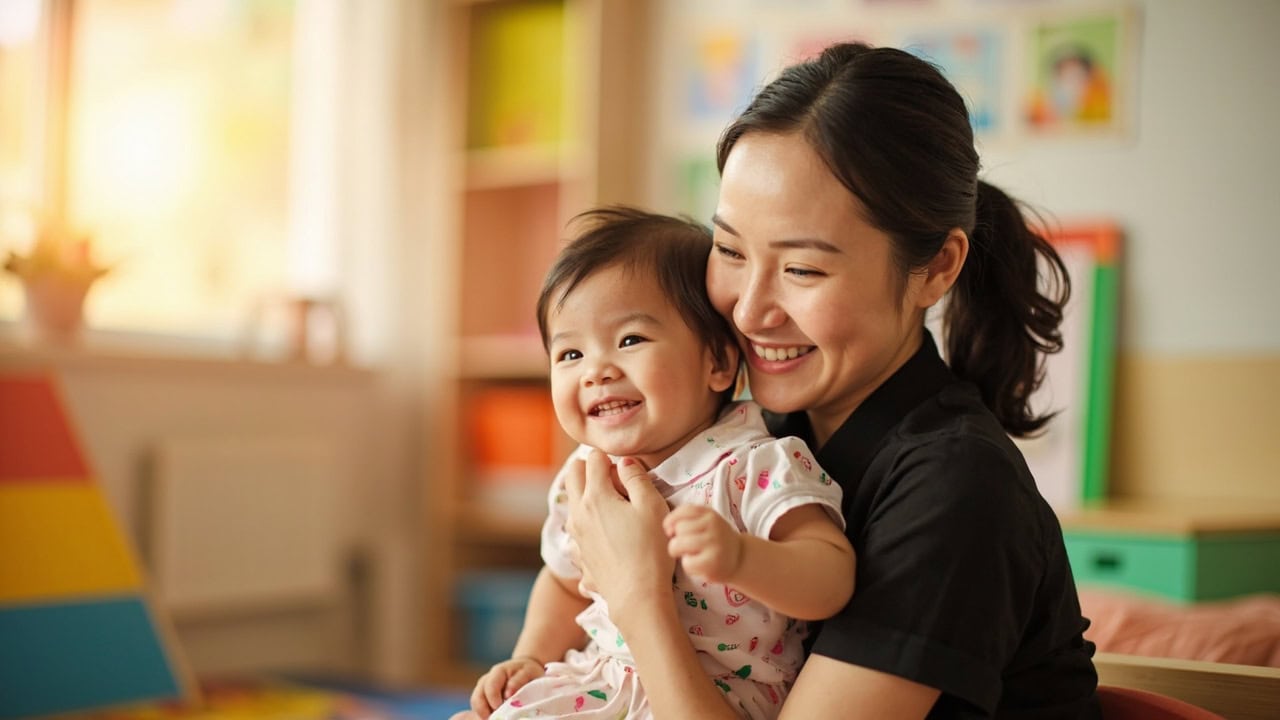
Trust is not a box to check. Trust is the quiet, daily accumulation of evidence that your child is in a place where they are known.
Where the caregiver notices the shift in mood before the tears come. Where the room smells familiar. Where a child who falls and scrapes their knee can be soothed not just by comfort but by context — by being in the same space where they have always been soothed, with the same person who has always done the soothing.
Near-home care builds that context deliberately. Small ratios mean the caregiver knows each child’s face, their rhythm, their preferred song, the way they hold a spoon when they are tired versus when they are curious.
For families with multiple children in the same setting, this knowledge extends across the sibling relationship itself. The caregiver learns that this toddler is more likely to share when he is well-rested. That this infant is most alert and socially engaged in the mid-morning window that overlaps with her brother’s free play.
That the two of them, in this specific order, in this specific space, make each other more than they are apart.
A Beginning That Lasts
We do not fully understand, as a society, how profoundly the early years shape the people we become. We know enough to be worried about it. We know enough to make it a subject of national policy, of subsidy structures, of regulatory pilots.
But knowing something intellectually and feeling it in your chest are different things — and as parents, we live in the gap between those two ways of knowing.
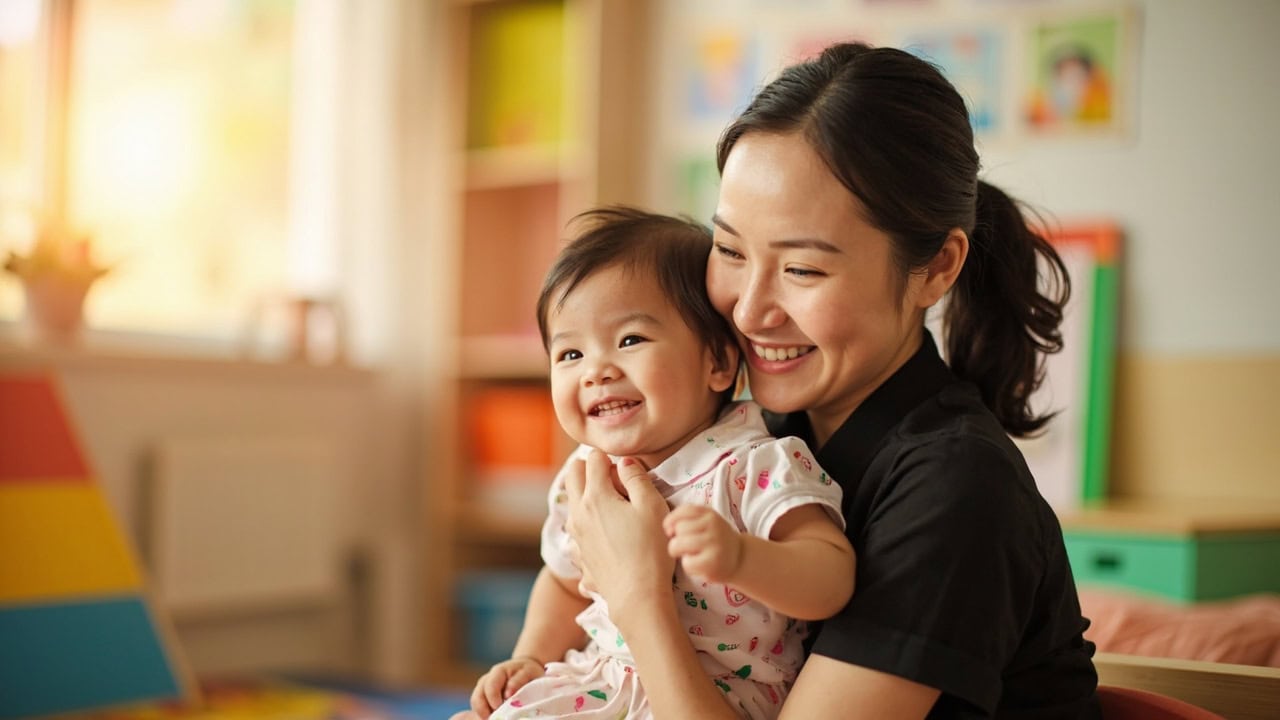
What I have tried to share with you here is not a sales pitch. It is an observation. A well-supported, research-informed, deeply considered observation that siblings who grow up together in a near-home care environment have access to a form of developmental richness that other settings, for all their strengths, cannot easily replicate.
Not because the people in those settings care less. But because siblings are not a logistical complication to be managed alongside the other children. They are, in the most profound sense, each other’s first teachers, first playmates, and first witnesses to what it means to be loved by the same person in the same place.
And when that place is small, and familiar, and held by a trained, trusted caregiver who knows not just your children but the relationship between your children — something extraordinary begins to take root.
It is the scaffolding of a bond that will carry them through their entire lives.
Ready to Explore Near-Home Care for Your Family?
If you are a parent in Singapore weighing your options for infant and toddler care — especially if you are considering how to manage two children in the same setting — we invite you to have a conversation with us.
EduNanny Singapore operates within the ECDA Childminding Pilot framework, offering near-home care that is small by design, consistent by structure, and built around the reality that siblings are not a complication to be managed. They are a gift to be nurtured.
We cannot promise that every day will be perfect. No care arrangement can. But we can promise that in a near-home setting, your children will not be two names on a register. They will be two people — known, tended, and growing up together.
Reach out to learn whether EduNanny’s near-home childminding services are available in your area. We are here to answer your questions, address your concerns, and help you find the right fit for your family.