The Second Secure Base: Why Quality Childcare Matters
The Science of Attachment: What Every Parent Needs to Understand
Let us begin with the science that has quietly transformed our understanding of how children form the most important emotional foundation of their lives.
The word attachment has become so common in parenting discourse that it risks losing its precise meaning. We speak of attachment parenting, attachment styles, attached children—and somewhere in the overuse, the deep psychological architecture beneath the concept gets obscured.
Attachment, in the developmental sense that matters most here, refers to a specific biological system that every infant is born primed to activate. From the earliest weeks of life, children are not passive recipients of care. They are active participants in building something extraordinary: an internal working model of what relationships feel like, how people respond when you reach out, whether the world is a reliable place where needs are met and comfort is available.
This internal working model becomes the lens through which your child will eventually navigate every significant relationship in their life. It is the foundation upon which confidence, emotional resilience, and the capacity for intimacy are built. It is, without exaggeration, one of the most consequential developments of early childhood.
The Insight That Changes Everything
Now here is what many parents have not been told, or have not heard with sufficient clarity to let it change their thinking: this internal working model does not form from a single relationship alone.
John Bowlby, the psychologist who first articulated attachment theory, and Mary Ainsworth, whose meticulous observations gave attachment science its empirical foundation, both understood that children develop the richest, most robust internal working models when they encounter consistent emotional reliability across multiple environments.
When a child experiences warm, responsive, predictable care not only at home but in other settings—with caregivers who respond to distress with comfort, who celebrate discovery with shared joy, who maintain the same emotional consistency that parents provide—the child does not become confused or conflicted. The child becomes more secure.
The child learns that the world, broadly speaking, is reliable. That adults can be trusted. That exploring new territory is possible because there is always a safe base to return to.
This is the insight that transforms our understanding of professional childcare from a necessary compromise into something far more significant: an opportunity.
The Safe Base: Your Child’s Launching Pad for Growth
The safe base concept is central to attachment science, and it deserves to be understood with precision because it is frequently misinterpreted.
A safe base is not merely a place where a child is kept safe from harm. It is a psychological launching pad. When a child feels truly secure in a caregiver’s presence—not just physically safe, but emotionally certain that this person will respond consistently, that their needs matter, that they are seen and valued—they are freed to explore. They venture further, test their abilities more boldly, take on challenges that would seem impossible if the emotional anchor were uncertain.
A securely attached child can walk into a new room, encounter unfamiliar toys, meet new people, because deep beneath the surface, the internal working model whispers: I am held. I am known. I can come back.
Consider what this looks like in practice. When your eighteen-month-old climbs the small ladder at a quality childcare environment, looks back to check for your presence, and finds instead a responsive caregiver who meets their glance with an encouraging nod or a steady, reassuring presence—that child is building something. That child is learning that exploration is safe, that adults beyond the immediate family can be sources of confidence rather than uncertainty, that the world contains more than one reliable base from which to venture out and return.
Addressing the Fear: Will Professional Care Dilute Our Bond?
There is a quiet fear that lives beneath the surface of every working parent’s decision to place their child in someone else’s care. It does not arrive all at once. It builds in the small hours, in the moment before the nursery door closes, in the question that cannot quite be voiced because it sounds almost irrational even to the parent who holds it: what if my child forgets me? What if the distance I create by leaving creates something that cannot be undone?
You are not alone in this fear. It is among the most universal and most misunderstood anxieties in parenting.
The anxiety many parents feel about professional childcare often stems from a deeper concern: what if my child forms a stronger attachment to the caregiver than to me? What if the bond we have worked so hard to build is somehow diluted or overwritten by the hours spent in someone else’s care?
This fear, while understandable, misunderstands the nature of attachment. Attachment is not a finite resource that gets distributed among caregivers, growing thinner the more hands it passes through.
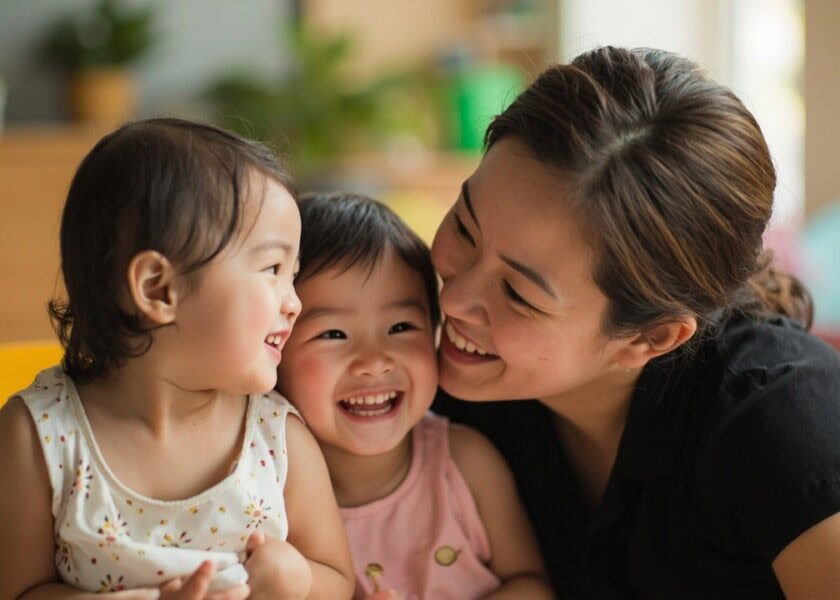
Secure attachment is built through consistency, through the repeated experience of being met with reliability. When your child experiences your presence as consistently warm and responsive, that bond deepens and strengthens. When your child also experiences the presence of a professional caregiver who is consistently warm, responsive, and predictable, that child is not dividing their attachment like a pie. That child is building a more complex, more resilient internal working model that recognizes: there are reliable adults in my world. The adults who care for me respond when I need them. I am held.
The Hidden Cost of Unchecked Anxiety
There is something important to acknowledge here, and that is the legitimacy of the anxiety itself. The fear that professional care will harm your child is not irrational. It is rooted in genuine understanding of how consequential early emotional development is. Parents who feel this fear most acutely are not being overly anxious or overly protective for no reason. They are responding to the real significance of the developmental window they are in.
What they may not yet understand is that the anxiety itself, when it becomes controlling, when it leads to overinvolvement, when it communicates to the child that the world outside the parent is uncertain or dangerous—that anxiety carries its own developmental cost.
Children are exquisitely attuned to the emotional states of their caregivers. When a parent approaches every separation with visible distress, hovers at the classroom door, or cannot allow the child to experience any frustration or momentary uncertainty without rushing to intervene, the child learns something unintended: that the world is not safe to explore from, that uncertainty is to be feared, that independence is dangerous.
Anxious parenting, even when it comes from a place of deep love and devotion, can inadvertently create the very insecurity it seeks to prevent.
This is perhaps the most counterintuitive truth in the attachment conversation: the parents who agonize most about maintaining secure attachment sometimes inadvertently undermine it by refusing to allow the child the experiences that actually build confidence. Exploration requires the possibility of temporary uncertainty. Growth requires the experience of managing small challenges. Confidence requires the evidence that one can cope, that the world can be navigated, that other capable adults exist who can be trusted.
What Quality Childcare Actually Looks Like
So how do you recognize when a childcare environment is truly supporting your child’s attachment security? The signs are more observable than most parents have been led to believe. You will not find them in lesson plans or curriculum documents. You will find them in the small moments that reveal emotional climate.
Response to Distress
Notice how the caregiver responds when a child is distressed. Is there immediate, warm attention—an embrace, a calm voice, a genuine meeting of eyes—or dismissal, frustration, or the kind of distracted multitasking that communicates the child’s needs are an interruption?
The quality of response to distress is perhaps the single most reliable indicator of whether a caregiver is functioning as an attachment-consistent figure. Attachment security is built one responsive moment at a time.
Emotional Tone During Play
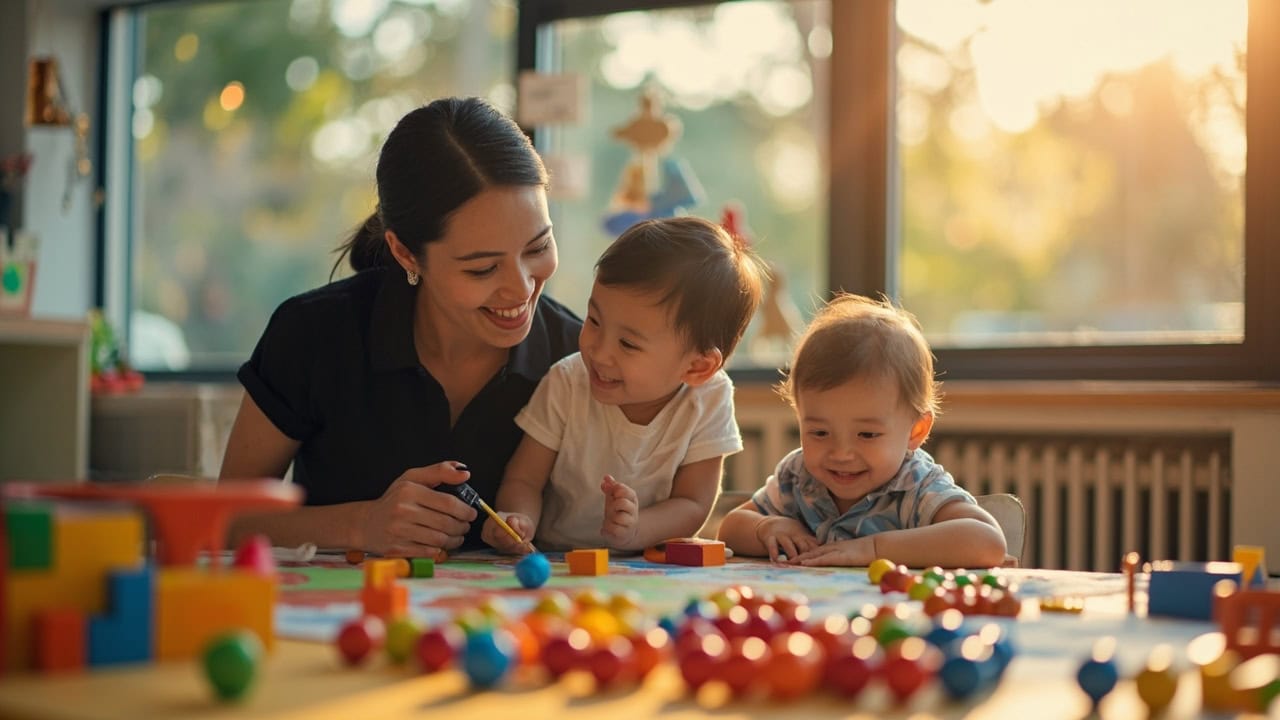
Notice the emotional tone of the environment when children are engaged in free play. Is there a sense of ease, of genuine warmth, of adults who are present rather than merely supervising? Do the children appear calm and curious, or is there an undercurrent of anxiety, of children who seem watchful, who need to check repeatedly on the caregiver’s whereabouts or emotional state?
A child who feels secure in a childcare environment will not need constant vigilance. The child will be able to immerse themselves in play because the internal working model says: I am held here. I can lose myself in this activity because I trust this base will remain stable.
How Transitions Are Handled
Notice how transitions are handled. When children arrive and when they prepare to leave, does the caregiver take time for genuine connection, for a warm greeting, for a proper goodbye? These moments are not trivial. They are the hinge points where children consolidate their understanding of what it means to separate and reunite.
When arrivals and departures are handled with emotional consistency—warm, present, predictable—the child builds confidence in the reliability of the relationship. When they are handled with rush or distraction, the child may begin to sense an unpredictability that sows the seeds of insecurity.
The Physical Environment
Notice the physical environment itself. Not its cleanliness or its colorful decoration, but its emotional architecture. Is the space arranged in ways that allow children to see and be seen by their caregiver? Is there a cozy corner where a child can retreat when overwhelmed, but still remain in the presence of the familiar adult? Are there soft elements—natural materials, gentle lighting, comfortable furnishings—that communicate this is a place designed for emotional wellbeing, not just activity management?
These environmental choices reflect a philosophy. They reveal whether the people who created this space understand that emotional regulation happens through the body, through the senses, through small comforts that say without words: this is a safe place.
Evaluating Childcare: Quick Reference
| What to Observe | Signs of Attachment-Supportive Care | Warning Signs |
|---|---|---|
| Response to distress | Immediate, warm, calming attention | Delay, irritation, distraction |
| Free play atmosphere | Children immersed, calm curiosity | Watchful, anxious, needing reassurance |
| Transitions | Genuine greetings, proper goodbyes | Rushed, distracted, perfunctory |
| Physical space | Child-height sightlines, cozy retreats | Isolated from caregiver, sterile |
| Caregiver presence | Attentive, emotionally engaged | Multitasking, distracted, reactive |
How EduNanny Singapore Was Built Around Attachment Science
EduNanny Singapore was designed to provide exactly this kind of care—a childcare approach built from its foundation with attachment science in mind. It emerged from a recognition that Singapore parents deserve more than convenient scheduling and colourful facilities. They deserve care that understands what children actually need to thrive, and that works in genuine partnership with the emotional foundation parents build at home.
A Government-Recognised Framework
EduNanny operates within the ECDA Childminding Pilot, which means it is part of a structured, government-recognized framework designed to bring quality, accessible childcare to families across Singapore. This is not a programme that appeared overnight or one that lacks the oversight and standards parents should expect. It is a pilot developed with careful attention to the realities of Singapore family life and the developmental science that should underpin any serious approach to infant and early child care.
Pathways That Serve Different Family Needs
Within this framework, EduNanny offers pathways that recognise every family’s circumstances are different. Some families prefer the familiarity and individualized attention of home-based care, where a caregiver comes to your space, where your child’s routine and environment remain largely undisturbed. Others find that a community or centre-based environment suits their child and family dynamic in different ways.
EduNanny has designed its approach to serve both pathways with the same quality standards, the same attention to attachment principles, the same commitment to the emotional climate that supports healthy development.
Small Ratios That Enable Genuine Attunement
One of the practical elements that sets quality infant care apart is its commitment to small caregiver-to-child ratios. When caring for children under the age of two, this ratio is one of the most consequential structural decisions that can be made.
EduNanny maintains ratios of up to one to three infants, which means each child receives the attention, the responsiveness, the emotional attunement that attachment security requires. This is not a luxury feature. It is a structural prerequisite for the kind of care that actually supports emotional development.
When an infant cries, the response must be swift, warm, and consistent. When an infant explores, the caregiver must be available to witness, to encourage, to hold the emotional space that allows discovery to feel safe. These things are not possible when a single caregiver is responsible for too many children.
Consistency, Communication, and Parent Support
Monday to Friday care blocks provide the predictability that attachment security requires. When care schedules are consistent, when the child knows what to expect, when the rhythm of arrivals and departures follows a reliable pattern, the internal working model is strengthened. There are no surprises, no anxious wondering about when Mama or Papa will return, no uncertainty about whether today is a day with the familiar caregiver or a day of disruption.
EduNanny’s approach to transparency and communication is designed to bridge the distance between home and childcare, not widen it. When parents can see what their child’s day looked like, when they receive genuine updates that go beyond perfunctory checklists, the separation feels less like a chasm and more like a passage—one that can be crossed back and forth with trust.
Where deployed, CCTV measures offer an additional layer of reassurance for parents whose anxiety about the unknown is a real and legitimate burden. These are tools of trust, designed to give parents the confidence to step back, to trust the process, to allow their child the growth-promoting experience of exploration in a setting where the emotional base is secure.
For those moments when parents need guidance—when they have questions about development, about behaviour, about the best way to support their child’s emotional growth between home and childcare—EduNanny offers the Thomas AI Chatbot. This is a resource designed to give parents the support of knowledge, to answer the questions that arise in the middle of the night, to provide evidence-based guidance that helps parents understand what they are observing and how to respond.
Your Next Step Toward a Secure Foundation
What EduNanny offers, ultimately, is not just childcare. It is an answer to the question that lies at the heart of every working parent’s decision about professional care: can this be good for my child? Can someone else hold my child in the way my child needs to be held, and can this strengthen rather than undermine what I am building at home?
The answer, grounded in decades of developmental science and embodied in the daily practices of quality professional care, is yes. It can. It does.
When the environment is right, when the caregivers understand attachment, when the structure supports responsiveness and consistency, when the ratios allow genuine attunement—when all of these elements come together, professional childcare becomes not a compromise but an extension of the secure base your child needs.
The children who benefit from attachment-supportive childcare develop something that cannot be measured in test scores or developmental milestones, though it certainly supports both. They develop an unshakeable foundation of confidence. They learn that they are worthy of responsive care, that the world contains reliable adults, that they can venture forth and return.
This foundation does not belong only to the hours spent at home with you, though those hours are irreplaceable and precious. It expands to include the spaces where your child feels safe beyond your immediate presence. It grows richer with every experience of consistent, warm, responsive care.
You built this foundation. You have been building it every day since your child was born, through the countless moments of responsiveness, of comfort, of presence. And now, with EduNanny, you have a partner who understands that this work must not only continue but expand—into the hours of professional care, into the environment where your child encounters capable adults beyond the family, into the relational space where attachment security grows stronger with every consistent, warm, responsive experience.
This is not about replacing what you do. It is about extending it. It is about trusting that the bond you have built is strong enough to hold even when you are not physically present. It is about trusting that your child is learning the most important lesson of all: that the world is a reliable place, that there are many safe bases from which to explore, and that love is not diminished by distance but can, in the right circumstances, grow more robust, more resilient, more expansive.
The quiet fear you carry is valid. It comes from love, from the deep desire to give your child everything they need to thrive. But it does not have to be a fear that limits your choices. It can be a fear that guides you toward the right choices, toward the environments where your child’s attachment security will be honoured, supported, and strengthened.
When you find a place where your child feels safe, where your child waves goodbye with confidence, where your child runs to greet a familiar caregiver with evident joy, where the transition from your arms to another trusted adult feels like a continuation rather than a rupture—that is not a sign that your child needs you less. It is a sign that your child is developing exactly as they should. It is a sign that the secure base is working. It is a sign that your child is building the foundation they need to explore, to grow, and eventually to flourish.
EduNanny Singapore is here to be that second secure base. To hold your child with the warmth, the responsiveness, the consistency, the love that reinforces everything you are building at home. To walk alongside you in this most important work of raising children who feel held, who feel safe, who feel confident enough to reach into the world knowing they can always come home.
If you are a parent in Singapore exploring infant care or childminding options, we would be glad to hear from you. Learn more about EduNanny’s approach and how our framework aligns with what developmental science tells us about raising secure, confident children.
#secureattachment #childmindingSingapore #infantcareSingapore #EduNannySG #attachmentparenting