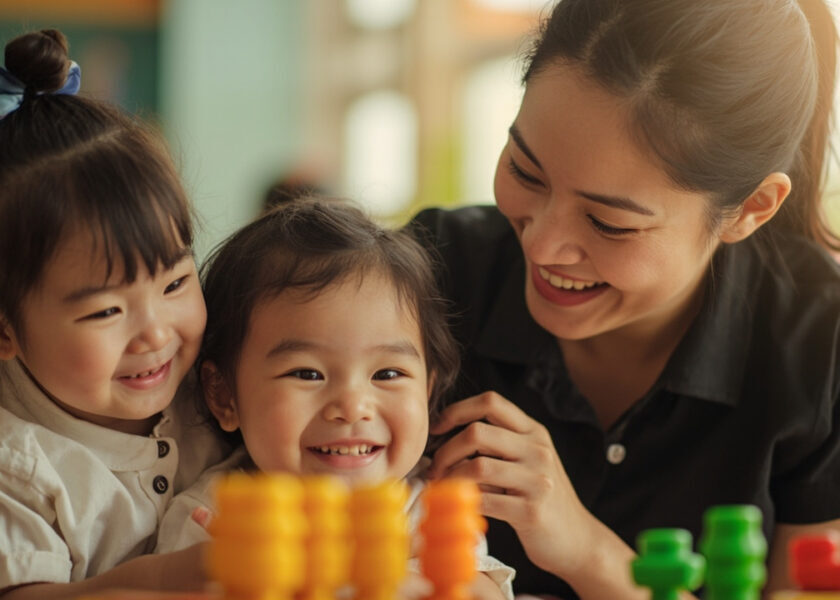
The Science of Attunement That Transforms Your Child’s World
The Inner World Your Child Carries Through the Day
Let me take you inside the experience of a young child in care, because this is where the real story lives — and it is a story that is almost never told.
When a young child arrives at a childcare setting, they are not simply occupying space. They are navigating a psychological landscape of extraordinary complexity. Even before they walk through the door, the journey begins. The car ride or the walk, the approach to the building, the moment when the familiar face of a parent begins to recede — all of this is internalized.
Young children do not experience separation the way adults do, as a logistical inconvenience or a manageable practical arrangement. For a child of two or three, separation from a primary caregiver is a small earthquake. Not because the care they are entering is inadequate, but because the very nature of young children’s attachment systems means that when the person who makes them feel safe is not in sight, the child’s entire psychological orientation shifts toward finding that safety again.
This is not weakness. This is neurobiology.
The attachment system is one of the most powerful motivational systems in the human mind, and in the early years it is exquisitely sensitive. When a child enters a childcare environment, their first and most urgent internal question is not about the activities or the toys or the other children. Their first question is:
Is there someone here who will respond to me when I need them? Is this a place where I am safe?
Depending on how that question is answered — not in words, because words are not available, but in the quality of presence, in the speed and warmth of a caregiver’s response, in the way the child’s distress is met rather than dismissed — a child’s entire inner experience of the day begins to take shape.
What Children Are Actually Building
Here is what is so rarely understood and almost never communicated to parents: this inner experience is not passive. The child is not simply receiving care. The child is constructing something.
Every day, in every interaction, in every moment of being met or not met, being seen or overlooked, being comforted or left to self-soothe, the child is building an internal model of what the world is like. This is what developmental psychologists mean when they talk about inner architecture — not metaphor, but literal structure.
The neural pathways that will govern how your child processes emotion, how they relate to other people, how they approach challenge or novelty, how they feel about themselves as worthy of attention and care — these are being laid down in the early years with a density and a permanence that later development simply cannot match.
This is why the difference between a childcare environment that manages children and one that understands them is not a matter of degree. It is a difference in kind.
The Science of Attunement: What Actually Happens Inside Your Child
Consider what actually happens in a child’s nervous system when they are in a setting with a caregiver who is attuned.
Attunement is one of those words that has become familiar in parenting discourse, and yet its full meaning is rarely grasped. Attunement is not simply being nice to a child. It is a specific quality of presence in which the caregiver is reading the child’s internal state — not just their behavior, but the feeling underneath the behavior — and responding in a way that communicates: I see you. I understand what you are feeling. And I am here with you in this.
When a caregiver achieves this, something remarkable happens in the child’s nervous system. The child’s stress response — which activates the moment a parent leaves, which sends cortisol flooding through the body, which makes the chest tight and the breath shallow — begins to regulate. The caregiver’s regulated presence becomes, neurologically, an external regulator of the child’s internal state.
The child does not yet have the capacity to self-regulate. That capacity is built in relationship, not in isolation. And so what the caregiver provides is not just physical care but neurobiological scaffolding. They do for the child’s emotional system what a scaffold does for a building under construction: they hold it steady until the structure can hold itself.
What Happens Without Attunement
Now consider what happens when that attunement is absent. When a child is in a setting where there are too many children for any one caregiver to truly attune to, where the pace is driven by schedules and routines that leave no space for the child who is struggling, where the caregiver’s attention is necessarily divided — the child’s stress response does not regulate. It stays activated.
Day after day, week after week, the child’s nervous system learns that the world is a place where their distress goes unmet.
This is not about bad intentions. This is about the mathematics of attention:
- A caregiver responsible for one child can attune to that child.
- A caregiver responsible for three children can still attune, with effort and intention.
- A caregiver responsible for six or eight children cannot attune to each one in the way that their developing nervous systems require.
The difference that smaller ratios make is not a marketing specification. It is a neurological reality. It is the difference between a child’s stress response regulating and not regulating. Between a child building a secure inner base and a child building an inner world that is, at its foundation, uncertain.
How Quality Care Feels at Every Stage of Development
What quality care looks like from the inside changes as your child grows. Here is what the inner experience actually feels like for an infant, a toddler, and a preschooler in attuned care.
For the Infant: The World Is the Caregiver
An infant cannot yet separate their experience of the caregiver from their experience of the world. The caregiver is the world, in a sense.
When the infant is held warmly, fed responsively, responded to when they cry — they do not think, “I am being well cared for.” They feel, at a pre-verbal, somatic level: the world is good. I am safe here. I can rest.
They are building the most fundamental sense of trust that a human being can have — not trust in a specific person, but a generalized sense that existence is benevolent and that their needs will be met. This is the bedrock upon which all later development rests.
For the Toddler: Freedom and Safety in Balance
Toddlers are beginning to assert agency in the world. They are walking, reaching, saying no, testing limits. They are also still deeply attached and still dependent on attuned care for emotional regulation.
What quality care looks like for a toddler, from the inside, is a balance between freedom and safety. It is a space where the child can explore — picking up objects, investigating textures, climbing, running — and know that there is a responsive presence nearby.
When the child falls and looks up, there is someone who makes eye contact, who offers a hand, who names what happened and helps them regulate the small shock. This is what developmental psychologists call a secure base — not a helicopter presence that hovers and prevents all falls, but a reliable presence that is there when the child needs it.
A toddler who has this begins to feel: I can go out into the world because there is a home base I can return to. I am not alone. I am held.
For the Preschooler: A Self Taking Shape
For a preschooler, the inner world is more verbal, more social, more complex. Preschoolers in quality care are building something remarkable: an internal sense of self that is separate from their caregivers but still connected to them.
They are learning to navigate peer relationships, to manage frustration, to delay gratification, to express emotions in words rather than actions. And they are doing all of this while still needing — more than they would ever admit — the secure base of attuned adult presence.
What quality care provides for the preschooler is not just activities and socialization, though those matter. What it provides is a space where the child’s emerging self is witnessed and reflected back. Where their drawings are noticed. Where their stories are listened to. Where their efforts are valued not for their outcome but for the trying.
This is how a child builds self-esteem — not through praise that is disconnected from reality, but through the felt experience of being known by another person and finding oneself reflected as competent, as worthy of attention, as someone whose inner life matters.
What You Cannot See at Pickup — and Why It Matters Most
None of this — none of it — is visible at pickup. You cannot see the inner architecture your child’s caregiver has been constructing all day. You cannot see the neural pathways that have been reinforced, the emotional regulation capacity that has been built, the sense of security that is taking root.
You may see a child who is cheerful, or a child who is tired, or a child who is clingy — and you will try to read these behaviors as signs of whether the day was good. But the truth is that the most important things that happened in your child’s inner world are invisible.
They are felt by the child, but not easily narrated. They are expressed in ways that are subtle:
- A slightly easier transition to sleep at night
- A slightly greater willingness to try something new
- A slightly quicker recovery from a small frustration
These are the signatures of a child who is building a healthy inner world. And they are the signatures that parents often do not consciously notice until someone names them.
How This Transformation Unfolds Over Time
Here is what this looks like over weeks and months, because this is where the long-term impact becomes visible:
| Timeframe | What You May Notice |
|---|---|
| Week 1 | Uncertainty. The environment is new, the caregiver is not yet familiar, routines are not yet learned. The child’s attachment system is activated. |
| Month 1 | Something begins to shift. The caregiver has become familiar. Routines feel predictable. The child begins to trust that drop-off is not permanent. Stress response regulates more quickly after the morning transition. |
| Month 3 | Remarkable changes may emerge. The child who was uncertain at drop-off begins to walk in with something like confidence. They may wave goodbye with ease. They may look back once and then turn to activities with curiosity rather than anxiety. |
| Month 6 | The transformation may be unmistakable. The child explores new situations. Manages transitions with greater ease. Sleeps better, eats better, plays more independently, relates to peers with growing sophistication. This is the inner architecture doing its work. |
Ask yourself what changed. You may not immediately connect it to the quality of care. But developmental science tells us that this is exactly what happens when a child’s inner world has been consistently held by attuned, responsive caregivers.
The EduNanny Difference: Structure, Attunement, and Trust
EduNanny exists not as a convenience, but as a response to a real and largely unarticulated need in Singapore: the need for childcare that reaches beyond supervision into genuine attunement. Childcare that does not merely keep children occupied and safe, but that actively constructs the inner architecture of security, curiosity, and self-trust that will carry them through their entire lives.
EduNanny’s participation in the ECDA Childminding Pilot represents a recognition — at the level of policy and practice — that home-based and community-based care with small ratios is not an inferior alternative to centre-based care. It is a different model with different developmental outcomes.
For Singapore parents, this is significant. It means that there is now a pathway — structured, supported, recognized — for a form of care that was previously invisible in the formal childcare landscape but that developmental science has always known is optimal for the early years.
What the Pilot Framework Provides
- Reliability — Monday through Friday care blocks mean consistent coverage, not patchwork arrangements that fragment a child’s sense of routine.
- Affordability — fee structures designed to make quality care accessible to families across different circumstances.
- Singapore family support integration — CDA and Baby Bonus funds are usable, so existing family support mechanisms can be brought to bear.
- Recognition — care that is structured, supported, and integrated into Singapore’s childcare landscape, not an informal arrangement at the margins.
What Separates EduNanny From Other Models
What separates EduNanny from other models of care is the explicit intention to know the child. Not just to manage their day, not just to keep them safe and fed and stimulated, but to know them. To know their rhythms, their preferences, their fears, their joys. To hold a mental model of each child as a unique person with a unique inner world, and to let that knowledge guide every interaction.
This is not a philosophical aspiration. It is a practice. It shows up in:
- The ratios that allow caregivers to hold this knowledge
- The training that prepares caregivers to attune
- The communication structures that keep parents informed about what is happening in their child’s inner world — not just photographs of activities, but meaningful information about how their child engaged, what seemed to bring them joy, how they handled a moment of difficulty
- The setting design — home-based pathways where the environment feels domestic and warm, community pathways where small groups allow for genuine relationship, centre-based pathways where ratio and structure are designed with the child’s inner experience in mind
In settings where CCTV measures are deployed, parents have an additional layer of confidence. These are not about surveillance. They are about trust — the trust that comes from knowing that the invisible work of attunement has an accountability structure around it.
Questions Parents Actually Ask — Answered
Many parents experience a specific kind of guilt — not the guilt of being a bad parent, but the guilt of not being present. They drop their children off in the morning and go to work, and part of them wonders whether their child is okay, truly okay, in their absence.
They compensate for this by seeking out childcare that is safe, that is stimulating, that has good reviews and qualified staff. These are reasonable criteria. But they are surface criteria.
What EduNanny offers is a deeper answer to that parental anxiety — the answer that says: your child is not just being supervised. Your child is being known. The hours they spend in our care are not just hours of occupation. They are hours of construction. Your child’s inner world is being built, and we are building it with intention, with attunement, with the kind of attention that you yourself would provide if you could be there.
“How will I know if my child is really okay?”
You will know by what you come to notice over time — not dramatic changes, but subtle ones. An easier transition in the morning. A child who waves goodbye with something like ease. A child who seems genuinely glad to see their caregiver, not just resigned to your leaving. These are the signatures of a child whose inner world is being held.
“What if my child cries at drop-off?”
Crying at drop-off is not a sign of bad care. It is a sign that your child has an attachment system — and that attachment system is healthy and functioning. What matters is what happens after you leave. In quality care, your child’s stress response will begin to regulate. They will be comforted. They will be held. Within weeks, the crying at drop-off typically decreases as your child builds trust in the caregiver and confidence in the routine.
“Is home-based care really as good as centre-based care?”
The ECDA Childminding Pilot exists because the answer to this question depends entirely on ratios and attunement, not on the label of the care setting. A centre-based setting with ratios of 1:8 is not automatically better than a home-based setting with ratios of 1:3. What developmental science tells us is that the quality of attention matters most — and that quality is only possible when ratios allow for genuine attunement.
If You Are Researching Infant Care Options
Here is what the evidence suggests matters most when choosing care for your infant:
- Ratios — Ask explicitly how many children each caregiver is responsible for. The lower the ratio, the more space there is for attunement.
- Responsiveness — Ask how caregivers respond to a crying infant. Listen for language that suggests the caregiver reads the child’s internal state, not just the behavior.
- Communication — Ask what updates parents receive. Look for meaningful information about your child’s experience, not just photographs of activities.
- Training — Ask about the caregiver’s preparation in child development, not just childcare certification. Understanding attachment and attunement is different from knowing how to run a safe environment.
- Your own observation — Spend time in the environment if possible. Notice how the caregivers speak to children. Notice whether they are present with the child in front of them or distracted. Notice whether the children appear easeful, not just occupied.
These are the questions that get at what is actually important. They are not always the questions that childcare marketing answers — but they are the questions that developmental science has been answering for decades.
The Choice That Echoes
Imagine for a moment that you could see your child’s inner experience as clearly as you see their face. Imagine that you could see the neural pathways being laid down, the emotional associations being formed, the sense of security or insecurity being built, moment by moment, in the hours that you are not there.
What would you want to see?
You would want to see your child feeling safe. Feeling known. Feeling held. Not just physically — though that matters — but psychologically. In the deepest part of their being, feeling that the world is a place where their needs will be met, where their feelings matter, where they are not alone.
This is what EduNanny is committed to building. Not just a service, but a space — in home-based settings and community settings and centre-based settings across Singapore — where that inner world is taken seriously. Where the child is not just a small person to be managed, but a whole inner life to be known and tended.
Where the mathematics of attention allow for genuine attunement. Where communication keeps parents connected to the invisible work of care. Where the pilot framework ensures that this quality is structured, supported, and accessible.
You are not just choosing childcare when you choose EduNanny. You are choosing a partner in the construction of your child’s inner world.
And that is a choice that will echo — quietly, invisibly, but powerfully — through every year that follows. Through their confidence in new situations. Through their capacity to regulate their emotions. Through their ability to form healthy relationships. Through the foundation of security that allows them to go out into the world and come back again, knowing that they are held.
Your child is having an experience, not just a day. And that experience matters.
That is what EduNanny is here to provide. And that is the difference that you will come to recognize — in your child’s ease, in their curiosity, in the quiet confidence with which they move through the world — long after the pickup moment has passed and the day continues inside them, shaping everything that comes after.
At EduNanny, we believe that every child deserves to be known. Learn more about our approach to thoughtful, development-oriented childcare or reach out to speak with our team about finding the right fit for your family.